All 40 questions from the Joint Admissions and Matriculation Board (JAMB) Chemistry 2017 Objective paper, with the correct answer and a full explanation for each. Free, no signup needed.
An organic compound commonly used as a disinfectant is
A. tolueneB. glycolC. styreneD. phenolCorrect Explanation Phenol is commonly used as a disinfectant; toluene is used for making explosives and styrene for making rubber.
Which of the following is the least soluble in water?
A. Al(OH)3Correct B. Ca(OH)2C. NaOHD. KOHExplanation NaOH and KOH are very soluble alkalis, Ca(OH)2 is slightly soluble, while Al(OH)3 is essentially insoluble in water.
The factor that lowers the activation energy of a chemical reaction is
A. pressureB. temperatureC. catalystCorrect D. concentrationExplanation A (positive) catalyst increases reaction rate by lowering the activation energy required.
Tin is unaffected by air at ordinary temperature due to its
A. low melting pointB. weak electropositive characterCorrect C. high boiling pointD. white lustrous appearanceExplanation Tin's chemical inactivity (weak electropositive character), reflected by its position in the electrochemical series, explains its resistance to reacting with air.
Incomplete oxidation of an alkanol (ethanol) yields
A. CH3COOHB. CH3COCH3C. CH3CH2OCH2CH3D. CH3CHOCorrect Explanation Incomplete oxidation of ethanol (C2H5OH) gives ethanal (CH3CHO); complete oxidation gives the alkanoic acid, ethanoic acid.
The oxidation number of iodine in potassium iodate, KIO3, is
A. +7B. +3C. +5Correct D. +6Explanation K is +1, O is -2 (x3=-6). For neutral compound: 1 + I - 6 = 0, so I = +5.
The acid anhydride that will produce a weak acid in water is
A. SO3B. NO2C. SO2D. CO2Correct Explanation CO2 dissolves in water to give carbonic acid (H2CO3), which is a weak acid.
If Y = 1s²2s²2p⁴ and X = 1s²2s²2p⁶3s², the chemical formula of the likely compound formed between X and Y is
A. X2YB. XY2C. XYCorrect D. X2Y3Explanation Y needs 2 electrons to complete its octet (combining power 2); X loses 2 electrons to attain octet (combining power 2). Equal combining powers of 2 give the simplest formula XY.
The constituents of air necessary in the rusting process are
A. O2 and H2OCorrect B. Ar and CO2C. CO2 and H2OD. O2 and CO2Explanation Oxygen and moisture (water) are both required for iron to rust: 4Fe + 3O2 + 2xH2O → 2Fe2O3.xH2O.
The pollutant that may induce the condensation of water vapour in the atmosphere is
A. dustB. sootCorrect C. oxides of nitrogenD. chlorofluorocarbonsExplanation Soot particles act as condensation nuclei, inducing the condensation of atmospheric water vapour.
10cm³ of hydrogen was sparked with 10cm³ of oxygen at s.t.p. Calculate the volume of the unreacted gas.
A. 15cm³B. 20cm³C. 5cm³Correct D. 10cm³Explanation 2H2 + O2 → 2H2O. 10cm³ H2 reacts completely with 5cm³ O2, leaving 10-5 = 5cm³ of unreacted oxygen.
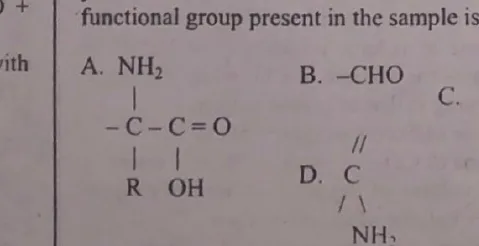
When a few drops of concentrated trioxonitrate(V) acid are added to an unknown sample and warmed, an intense yellow colouration is observed. The likely functional group present in the sample is shown in the diagram (structures for options A-D).
A. the carboxylic acid group (-C-C=O with R and OH)Correct B. -CHO (aldehyde group)C. C=O (ketone group)D. an amide group (-C(=O)NH2)Explanation This is the xanthoproteic test for protein. The functional groups present in protein are the amino group (-NH2) and the carboxyl group (-COOH), matching structure A.
5g of potassium trioxonitrate(V) saturates 20g of water at 25°C. Calculate its solubility in grammes per 100g of water.
A. 50.0gB. 25.0gC. 5.5gD. 12.5gCorrect Explanation Solubility = (2.5/20) x 100 = 12.5g per 100g of water.
Calculate the mass of copper deposited when a current of 0.5 ampere is passed through a solution of copper(II) chloride for 45 minutes in an electrolytic cell (Cu=64, F=96500Cmol⁻¹).
A. 0.300gB. 0.250gC. 0.224gD. 0.448gCorrect Explanation Q=It=(0.5x2700)=1350C. Cu²⁺+2e⁻→Cu, so 1 mole Cu (64g) requires 2F=193,000C. Mass deposited = (64/193000)x1350 ≈ 0.448g.
Ca(OH)2(aq) + 2NH4Cl(aq) → CaCl2 + 2H2O(l) + X. In the reaction above, X is
A. NO2B. NH3Correct C. N2OD. N2Explanation When a base and an ammonium salt are heated together, ammonia gas (NH3) is produced.
Temporary hard water is formed when rain water containing dissolved carbon (IV) oxide flows over deposits of
A. CaCO3Correct B. Na2CO3C. Na2SO4D. CaSO4Explanation Rainwater containing dissolved CO2 reacts with CaCO3 (or MgCO3) rock deposits to form soluble calcium bicarbonate, causing temporary hardness.
The salt formed from a weak acid and a strong base hydrolyzes in water to form
A. a saturated solutionB. an acidic solutionC. a buffer solutionD. an alkaline solutionCorrect Explanation A salt formed from a strong base and a weak acid hydrolyses to give an alkaline solution, e.g. Na2CO3, CH3COONa.
The process that occurs when two equivalent forms of a compound are in equilibrium is known as
A. isotopyB. resonanceC. isomerismCorrect D. reformingExplanation Isomerism describes two equivalent (interconvertible) structural forms of a compound existing in equilibrium.
Calculate the amount in moles of a gas which occupies 10.5dm³ at 6atm and 30°C (R=0.082 atm dm³K⁻¹mol⁻¹).
A. 2.536molCorrect B. 1.623molC. 4.736molD. 0.394molExplanation n = PV/RT = (6x10.5)/(0.082x303) ≈ 2.536mol.
¹⁹₉F + X → ²²₁₁Na + ¹₀n. In the equation above, X represents
A. a proton (¹₁P)B. an electron (⁻⁰₋₁e)C. a neutron (¹₀n)D. an alpha particle (⁴₂He)Correct Explanation Balancing mass and atomic numbers shows X must be an alpha particle (⁴₂He).
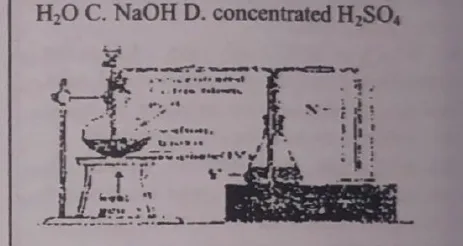
In the diagram, Y is
A. fused CaOB. H2OC. NaOHD. concentrated H2SO4Correct Explanation Concentrated H2SO4 acts as the drying agent for SO2 gas in the set-up shown.
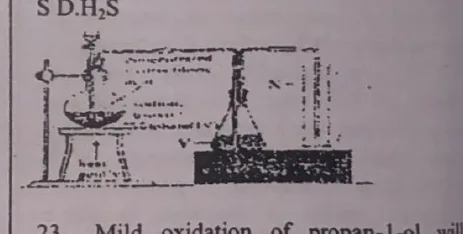
In the diagram, X is
A. SO3B. SO2Correct C. SD. H2SExplanation In the reaction Na2SO3 + 2HCl → 2NaCl + H2O + SO2, gas X evolved is sulphur (IV) oxide, SO2.
Mild oxidation of propan-1-ol will yield
A. propanoneB. propanalCorrect C. propanoic acidD. propaneExplanation Mild (incomplete) oxidation of propan-1-ol (CH3CH2CH2OH) yields the aldehyde propanal (CH3CH2CHO).
Ethene is prepared industrially by
A. reformingB. polymerizationC. distillationD. crackingCorrect Explanation Ethene is industrially prepared by cracking heavy hydrocarbons, e.g. pentadecane can be cracked to give ethene among other hydrocarbons.
Butter is an example of an emulsion in which
A. solid is dispersed in a liquid mediumB. gas is dispersed in a solid mediumC. liquid is dispersed in a solid mediumCorrect D. liquid is dispersed in a gas mediumExplanation Butter is an emulsion of liquid (milk/water) dispersed in a solid (fat) medium.
In the laboratory preparation of trioxonitrate(V) acid, the nitrogen (IV) oxide formed as a by-product is removed by
A. further heatingB. adding concentrated H2SO4C. cooling the acid solution with cold waterD. bubbling air through the acid solutionCorrect Explanation The yellowish NO2 impurity dissolved in the freshly prepared acid is removed by bubbling air through the acid solution.
Sodium hydroxide can be used
A. in the purification of bauxiteCorrect B. as a deoxidant in steel castingC. in the extraction of sulphurD. in the oxidation of ironExplanation Sodium hydroxide is used to purify bauxite (Al2O3.2H2O), the ore from which aluminium is extracted.
The constituent common to duralumin and alnico is
A. CoB. MnC. AlCorrect D. MgExplanation Duralumin = Al+Mn+Cu+Mg; Alnico = Al+Ni+Co+Fe. Aluminium (Al) is common to both alloys.
A mixture of sugar and sulphur can be separated by dissolution in water followed by
A. filtration and evaporationCorrect B. decantation and filtrationC. centrifugation and evaporationD. decantation and evaporationExplanation Water dissolves the sugar; the insoluble sulphur residue is removed by filtration, and the sugar recovered from the filtrate by evaporation.
The ideal gas laws and equations are true for all gases at
A. low pressures and low temperaturesB. low temperatures and high pressuresC. high temperatures and low pressuresD. low pressure and high temperatureCorrect Explanation Real gases behave most ideally at high temperature and low pressure, where intermolecular forces and molecular volume become negligible.
Due to the high reactivity of sodium, it is usually stored under
A. waterB. mercuryC. paraffin oilCorrect D. phenolExplanation Sodium is stored under paraffin oil to prevent it from reacting with moisture and oxygen in the air.
What is the IUPAC nomenclature of the structure CH3CH2-C(CH3)=CH2?
A. 3-methylbut-3-eneB. 2-methylbut-1-eneCorrect C. 2-ethylprop-1-eneD. 2-methylbut-2-eneExplanation The parent chain is but-1-ene, with a methyl group attached at the second carbon, giving 2-methylbut-1-ene.
Calculate the amount in moles of silver deposited when 9650C of electricity is passed through a solution of silver salt (1F=96500Cmol⁻¹).
A. 0.03B. 10.80C. 10.00D. 0.10Correct Explanation Ag⁺(aq)+e⁻→Ag(s); 1 mole Ag requires 1F (96500C). Moles deposited = 9650/96500 = 0.10 mol.
The enzyme used in the hydrolysis of starch to dextrin and maltose is
A. amylaseB. diastaseCorrect C. invertaseD. zymaseExplanation Diastase hydrolyses starch to dextrin and maltose: 2(C6H10O5)n + nH2O → nC12H22O11.
In which of the following reactions will an increase in pressure shift the equilibrium position to the left?
A. H2(g) + I2(g) ⇌ 2HI(g)B. 2SO2(g) + O2(g) ⇌ 2SO3(g)C. N2O4(g) ⇌ 2NO2(g)Correct D. 3H2(g) + N2(g) ⇌ 2NH3(g)Explanation For N2O4⇌2NO2, the backward (leftward) reaction reduces the number of gas moles/volume, so an increase in pressure favours the backward reaction, shifting equilibrium to the left.
Phosphorus-32 decays as a β-emitter to produce
A. ³²₁₆SB. ²⁴₁₁AlC. ³²₁₆S (with a beta particle emitted)Correct D. ³⁵₁₇ClExplanation ³²₁₅P → ³²₁₆S + ⁰₋₁e: beta decay converts a neutron to a proton, increasing the atomic number by 1 while mass number stays the same, giving sulphur-32.
In the laboratory preparation of ethyl ethanoate, the water present in the mixture is removed using a solution of
A. anhydrous calcium chlorideCorrect B. concentrated NaCO2 (sodium carbonate solution)C. dilute NaOHD. concentrated H2SO4Explanation Water present as an impurity in the ethyl ethanoate preparation is removed using anhydrous calcium chloride.
The reaction of halogens with alkanes in the presence of sunlight is an example of
A. oxidation reactionB. addition reactionC. hydrogenation reactionD. substitution reactionCorrect Explanation Halogens react with alkanes via a substitution reaction, catalysed by sunlight, replacing hydrogen atoms with halogen atoms.
X(g) + 3Y(g) ⇌ 2Z(g), ΔH = +Ve. If the reaction above takes place at room temperature, the ΔG will be
A. negativeB. zeroC. positiveD. indeterminate without further dataCorrect Explanation ΔG = ΔH - TΔS depends on both the enthalpy change and the entropy term, so its sign cannot be determined from ΔH alone.
The ability of an atom in a molecule to attract shared electrons to itself is
A. electron affinityB. ionic radiusC. ionization energyD. electronegativityCorrect Explanation Electronegativity is defined as the ability of an atom to attract shared electrons (a bonding pair) towards itself.
Sign up free to unlock …and/or go further with premium services and No Ads .