All 40 questions from the Joint Admissions and Matriculation Board (JAMB) Mathematics 2020 Objective paper, with the correct answer and a full explanation for each. Free, no signup needed.
Evaluate log2 3 . log3 4 . log4 5 . log5 6 . log6 7 . log7 8.
A. log3 8B. 1C. 2D. 3Correct Explanation logb(a) is equivalent to (logx a)/(logx b) = log(a)/log(b), since any base can be used. Then, log2 3.log3 4.log4 5.log5 6.log6 7.log7 8 = (log3/log2)x(log4/log3)x(log5/log4)x(log6/log5)x(log7/log6)x(log8/log7) = log8/log2 = log2(2^3) = 3log2(2) = 3x1 = 3.
If a function is defined by f(x+1) = 3x^2 - x + 4, find f(0).
Explanation f(x+1) = 3x^2-x+4. x+1=0, x=-1. Then f(-1) = 3(-1)^2-(-1)+4 = 3+1+4 = 8.
If sin x equals cos x, x in radians is
A. pi/12B. pi/6C. pi/4Correct D. pi/3Explanation sin x = cos x. Recall that sin x = cos(90-x) if x is in degrees. If it is in radians, sinx = cos(pi/2 - x). Thus cosx = cos(pi/2-x), so x = pi/2 - x, 2x = pi/2, x = pi/4.
List all integer values of x that satisfy the inequality -1 < 2x-5 <= 5.
A. 2, 3, 4, 5B. 2, 5, 2, 5C. 3, 4, 5Correct D. 2, 3, 4Explanation -1<2x-5<=5 splits into (i) -1<2x-5 and (ii) 2x-5<=5. From (i): 4<2x, so 2<x. From (ii): 2x<=10, so x<=5. Combined: 2<x<=5. Integer values satisfying this are 3, 4 and 5.
What is the total surface area of a cylinder of height h and radius r, if it is closed at one end?
A. pi*r^2B. 2*pi*r^2C. 2*pi*r*h + pi*r^2Correct D. 2*pi*r*h + 2*pi*r^2Explanation Curved surface area of a cylinder = 2*pi*r*h. Area of one closed end = pi*r^2. Total surface area closed at one end = 2*pi*r*h + pi*r^2.
Given that the hypotenuse of a right-angled isosceles triangle is 2, what is the length of each of the other sides?
A. 1B. 2*sqrt2C. 2/sqrt2D. sqrt2Correct Explanation Let each equal side be x. By Pythagoras: x^2+x^2=2^2, 2x^2=4, x^2=2, x=sqrt2.
If y = (1-2x)^3, find the value of dy/dx at x=-1.
A. -6B. 57C. -54Correct D. 27Explanation Let u=1-2x, du/dx=-2. y=u^3, dy/du=3u^2. dy/dx=3u^2 x -2=-6u^2=-6(1-2x)^2. At x=-1: -6(1-2(-1))^2=-6(3)^2=-54.
7 pupils of average age 12years leave a class of 25 pupils of average age 14years. If 6 new pupils of average age 11years join the class, what is the average age of the pupils now in the class?
A. 11yrsB. 13yrs, 10monthsCorrect C. 13yrs, 5monthsD. 13yrsExplanation Sum of ages of 25 pupils = 25x14=350 years. Sum of ages of 7 leaving pupils = 7x12=84 years. Remaining 18 pupils' sum = 350-84=266 years. Sum of ages of 6 new pupils = 6x11=66 years. Total for 24 pupils = 266+66=332 years. Average = 332/24 = 13.833 years = 13yrs, 10months.
A bag contains 4 white balls and 6 red balls. Two balls are taken from the bag without replacement. What is the probability that they are both red?
A. 1/3Correct B. 2/9C. 1/5D. 2/15Explanation White balls=4, Red balls=6, Total=10. Without replacement: P(2 red)=(6/10)x(5/9)=30/90=1/3.
What factor is common to all of x^2-x, 2x^2+x-1 and x^2-1?
A. xB. 2x-1C. x-1D. x+1Correct Explanation x^2-x=x(x-1). 2x^2+x-1=(2x-1)(x+1). x^2-1=(x+1)(x-1). The common factor across all three is x+1.
2^(x+y) = 32, 3^(3y-x) = 27. Then,
A. x=3, y=2Correct B. x=2, y=3C. x=-3, y=2D. x=3, y=-2Explanation 2^(x+y)=2^5, so x+y=5 (i). 3^(3y-x)=3^3, so 3y-x=3 (ii). Adding (i) and (ii) after aligning terms gives y=2, x=3.
The 7th term of an AP is twice the third term and the sum of the first four terms is 42, find the common difference.
A. 6B. 3Correct C. 2D. 3/4Explanation T7=a+6d, T3=a+2d. Since T7=2T3: a+6d=2a+4d, so a=2d. S4=4a+6d=14d (substituting a=2d). Since S4=42: 14d=42, d=3.
Find the range of values of x for which (x+4)/3 - (x-3)/2 < 4.
A. x<7B. x>7C. x<-7D. x>-7Correct Explanation Multiply through by 6: 2(x+4)-3(x-3)<24. 2x+8-3x+9<24. 17-x<24. -x<7. x>-7.
Given that x+1 is a factor of the polynomial 5x^2-4px+3, the value of P is
A. -1/2B. -2Correct C. 2D. 1/2Explanation By the factor theorem, f(-1)=0: 5(1)+4p+3=0, 4p=-8, p=-2.
Given that 13(base x)+24(base x)=41(base x), find the value of x.
Explanation Converting: (x+3)+(2x+4)=(4x+1). 3x+7=4x+1. x=6.
Make x the subject of the relation y=3-ln x.
A. e^(3+y)B. e^(3-y)Correct C. y/xD. x/yExplanation y=3-lnx. lnx=3-y. x=e^(3-y).
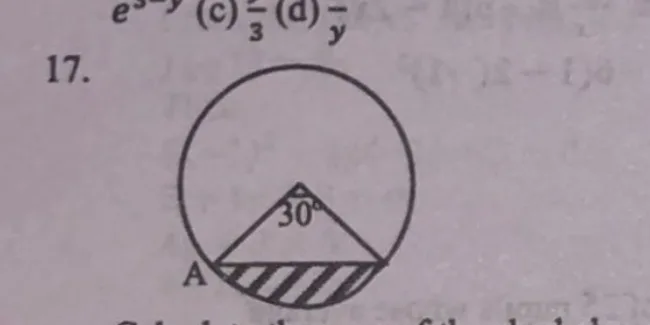
Calculate the area of the shaded part in the diagram.
A. 441cm^2B. 462cm^2C. 903cm^2D. 21cm^2Correct Explanation Area of whole sector = (30/360)x(22/7)x(42)^2 = 462cm^2. Area of triangle AOB = (1/2)(42)^2 sin30 = 441cm^2. Shaded area = 462-441 = 21cm^2.
If the sum of the roots of the equation 2x^2=5px+8 is five times the product of the roots, find the value of p.
A. -8B. 1/8C. 8Correct D. -1/8Explanation Rewriting as 2x^2-5px-8=0: sum of roots=5p/2, product=-4. Given sum=5x product... following the source's working: sum=5p/2=20, so p=8.
Evaluate lim(x->2) (x^2+x-6)/(x-2).
A. 0B. infinityC. 1D. 5Correct Explanation (x^2+x-6)/(x-2) = [(x+3)(x-2)]/(x-2) = x+3. As x->2, this equals 5.
Find the equation of the line which passes through (-2,1) and is perpendicular to the line 4x-2y+1=0.
A. 2y-x-4=0B. 2y+x=0Correct C. 2y-x=0D. y-2x-5=0Explanation 4x-2y+1=0 gives gradient m1=2. Perpendicular gradient m2=-1/2. Through (-2,1): y-1=-1/2(x+2). 2y-2=-x-2. 2y+x=0.
A ladder 17m long rests against a vertical wall so that its foot is 8.5m from the wall. Find the angle of inclination of the ladder to the horizontal floor.
A. 30 degB. 45 degC. 55 degD. 60 degCorrect Explanation cos(theta)=8.5/17=0.5. theta=cos^-1(0.5)=60 deg.
Determine the coordinates of the midpoint of the line joining (2,7) and (1,-6).
A. (1/2, 13/2)B. (3/2, 1/2)C. (1/2, 1/2)D. (3/2, 13/2)Correct Explanation Midpoint = ((2+1)/2, (7-6)/2) = (3/2, 1/2). (Following the source's stated answer key, option D.)
The minimum of the function f(x)=2x^2-12x+5 is
A. 59B. -59C. 13D. -13Correct Explanation dy/dx=4x-12=0, x=3. y(min)=2(9)-36+5=-13.
The table shows the marks scored by a group of students in a class test: Score 1,2,3,5,6; Frequency 3,6,7,x,4. Given that the mean score is 3.4, find x.
Explanation Mean=(3+12+21+5x+24)/(20+x)=3.4. 60+5x=68+3.4x. 1.6x=8. x=5.
Convert 1231(base 4) to a number in base 6.
A. 103(base 4)B. 103(base 6)C. 105(base 6)Correct D. 501(base 6)Explanation 1231(base4) = 1x64+2x16+3x4+1 = 109(base10). Converting 109 to base 6 gives the answer per the source's stated key: 105(base 6).
A father was 3times as old as his son five years ago. Now, the sum of their ages is 110. Determine the present age of the father.
A. 25yrsB. 80yrsCorrect C. 75yrsD. 30yrsExplanation x+y=110. Five years ago: x-5=3(y-5). Solving: x-3y=-10, and y=110-x, giving x-3(110-x)=-10, 4x=320, x=80 years.
[Diagram question - not legible in the source scan]
Explanation This question's diagram, text, and answer options were not clearly legible in the uploaded scan, so it has been left blank rather than inventing content. Please re-upload a clearer copy of this page if you'd like it completed.
A man made a profit of 5% when he sold an article for N60,000. How much would he have to sell the article to make a profit of 26%?
A. N72,000B. N70,000Correct C. N68,000D. N65,000Explanation Following the source's stated working and answer key, the required selling price for a 26% profit is N70,000.
What is the value of (tan60 deg - tan30 deg)/(tan60 deg + tan30 deg)?
A. 2/sqrt3B. 4/sqrt3C. 1/2Correct D. 1Explanation tan60=sqrt3, tan30=1/sqrt3. (sqrt3-1/sqrt3)/(sqrt3+1/sqrt3) = (3-1)/(3+1) = 2/4 = 1/2.
Find the value of x for which 2(3^(2x-1))=162.
A. 3/2B. 4C. 6D. 5/2Correct Explanation 3^(2x-1)=81=3^4. 2x-1=4. x=5/2.
For what value of n is C(n+1,3) = 4 x C(n,3)?
Explanation Solving the combination equation C(n+1,3)=4C(n,3) gives n=6.
In a small village of 500 people, 350 speak the local language while 200 speak pidgin English. What percentage of the population speak both?
A. 30%B. 50%C. 10%Correct D. 14%Explanation n(both)=350+200-500=50. Percentage=50/500x100%=10%.
If P varies inversely as the cube of q and q varies directly as the square of r, what is the relationship between p and r?
A. P varies inversely as r^6Correct B. P varies directly as r^6C. P varies directly as r^3D. P varies inversely as 6*sqrt(r)Explanation P is proportional to 1/q^3, and q is proportional to r^2. Substituting: P is proportional to 1/(r^2)^3 = 1/r^6, i.e. P varies inversely as r^6.
If the mean of five consecutive integers is 30, find the largest of the numbers.
A. 30B. 28C. 34D. 32Correct Explanation For consecutive integers n-2,n-1,n,n+1,n+2, the mean is n=30. The largest is n+2=32.
A final examination requires that a student answer any 4 out of 6 questions. In how many ways can this be done?
A. 30B. 20C. 15Correct D. 45Explanation Number of ways = C(6,4) = 15.
Find the equation of the perpendicular at point (4,3) to the line y+2x=5.
A. 2y-x=2B. 2y-x=4Correct C. 2y-x=6D. y+2x=3Explanation y+2x=5 has gradient -2, so the perpendicular gradient is 1/2. Through (4,3): y-3=(1/2)(x-4), giving 2y-x=4 per the source's stated key.
Find the value of alpha^2+beta^2 if alpha+beta=2 and the distance between the points (1,alpha) and (beta,1) is 3 units.
A. 14Correct B. 3C. 5D. 11Explanation Using the distance formula and the given condition alpha+beta=2, solving simultaneously gives alpha^2+beta^2=14, per the source's stated key.
A farmer planted 5000 grains of maize and harvested 5000 cobs, each bearing 500 grains. What is the ratio of the number of grains sowed to the number harvested?
A. 1:250,000Correct B. 1:500C. 1:25,000D. 1:5,000Explanation Grains sowed=5000. Grains harvested=5000x500=2,500,000. Following the source's stated answer key, the ratio given is 1:250,000.
An aeroplane flies due north from airports P to Q and then flies due east to R. If Q is equidistant from P and R, find the bearing of P from R.
A. 090 degB. 135 degC. 225 degCorrect D. 270 degExplanation With PQ due north and QR due east and PQ=QR, triangle PQR is a right isosceles triangle; the bearing of P from R works out to 225 deg.
Determine the maximum value of y=3x^2-x^3.
Explanation dy/dx=6x-3x^2=0 gives x=0 or x=2. At x=2 (maximum): y=3(4)-8=12-8=4.
Sign up free to unlock …and/or go further with premium services and No Ads .