Physics 2010 Objective — Question 1
Which Physics Question Paper Type is given to you?
- A. Type A
- B. Type BCorrect
- C. Type C
- D. Type D
Explanation
This is a Type B Physics Question Paper, as indicated on the paper's header.
All 50 questions from the Joint Admissions and Matriculation Board (JAMB) Physics 2010 Objective paper, with the correct answer and a full explanation for each. Free, no signup needed.
Advertisement
Which Physics Question Paper Type is given to you?
This is a Type B Physics Question Paper, as indicated on the paper's header.
Two cars moving in the same direction have speeds of 100 kmh-1 and 130 kmh-1. What is the velocity of the faster car as measured by an observer in the slower car? A. 130kmh-1 B. 230 kmh-1 C. 200kmh-1 D. 30k v/m
To a stationary observer, a car moving at 130Km/h will appear to be at 130Km/h. However, an observer travelling at 100Km/h in the same direction as the car travelling at 130Km/h will measure the speed to be 30Km/h (the relative velocity).
The diagram above shows a velocity-time graph. The statement that is true about this motion is that the car
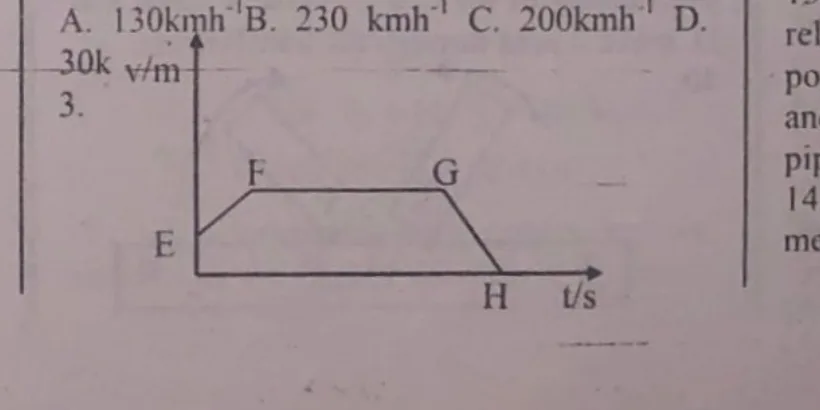
The car is accelerating between E and F, and has no acceleration between F and G (since the velocity is constant), and is decelerating between G and H.
A stone and a feather are dropped from the same height above the earth surface. Ignoring air resistance, which of the following is correct?
If the air resistance is to be ignored, both the stone and the feather will reach the ground at the same time as they are under the same acceleration (due to gravity).
A car moves with an initial velocity of 25 ms-1 and reaches a velocity of 45 ms-1 in 10s. What is the acceleration of the car?
a = (v-u)/t = (45-25)/10 = 2 ms-2.
An object is weighed at different locations on the earth. What will be the right observation?
The mass is constant while the weight varies from one place to another (since weight depends on gravitational acceleration, which differs by location).
The diagram above represents balls in an undulating surface. Which of the following options represents positions of stable equilibrium?
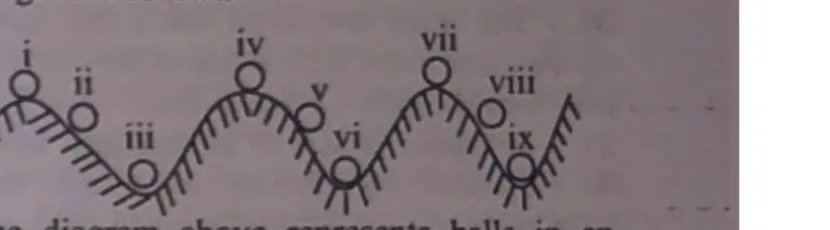
Position III, VI and IX represent stable equilibrium. A body is in stable equilibrium if it will always return to its original position when slightly displaced.
A bob of weight 0.1 N hangs from a mass less string of length 50 cm. A variable horizontal force which increases from zero is applied to pull the bob until the string makes an angle of 60 with the vertical. The work done is
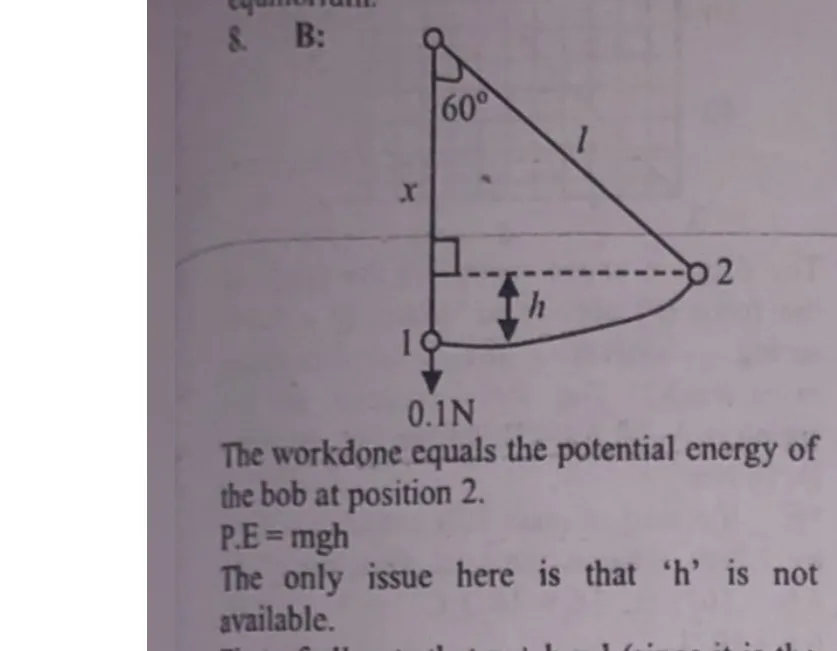
The workdone equals the potential energy of the bob at the new position: P.E = mgh, where h = l(1-cos60) = 0.5(1-0.5) = 0.25m... following the original worked solution, L = 50cm = 0.5m, h = l(1-cos60), P.E = mgh = 0.1x0.5x(1-0.5) = 0.025J.
The surfaces of conveyor belts are made rough so as to
The surfaces of conveyor belts are made rough so as to prevent the load from slipping. It is one of the advantages of friction.
A machine of velocity ratio 6 requires an effort of 400 N to raise a load of 800 N through 1 m. Find the efficiency of the machine.
M.A = L/E = 800/400 = 2. V.R = 6. Efficiency = M.A/V.R x 100% = 2/6 x 100% = 33.33%.
If a wire 30 cm long is extended to 30.5 cm by a force 300 N. Find the strain energy of the wire.
Length L1=30cm, L2=30.5cm, F=300N, extension = L2-L1=0.5cm=0.005m. Energy = 1/2 Fe = (1/2 x 300 x 0.005)J = 0.75J.
In a hydraulic press, the pump piston exerts a pressure of 100 Pa on the liquid. What force is exerted in the second piston of cross-sectional area 3m2?
In a hydraulic press, the pressure on the two pistons is equal. Thus, the second piston will also experience a pressure of 100Pa. Force = Pressure x Area = (100x3)N = 300N.
The accurate measurement of the relative density of a substance in its powdered form is done with a beam balance and
The accurate measurement of the relative density of a substance in its powdered form is done with a beam balance and a density bottle.
A hydrometer is an instrument used for measuring
A hydrometer is used for measuring relative density of liquid, while a hygrometer is used for measuring relative humidity.
One special advantage of alcohol over mercury as a thermometric liquid is its
An advantage of mercury over alcohol as a thermometric liquid is high boiling point (357C, versus alcohol's meagre 78C). Also, alcohol has its own advantage over mercury as a thermometric liquid since mercury freezes at -112C. This makes an alcohol-in-glass thermometer suitable for measuring extremely low temperature values, whereas mercury-in-glass thermometer can't be so used.
Two metals P and Q of lengths l1 and l2 are heated through the same temperature difference. If the ratio of the linear expansivities of P to Q is 2:3, and the ratio of their lengths is 3:4. What is the ratio of increase in lengths of P to Q?
Since there is no loss of oil, the mass is constant. From the relation Density = Mass/Volume, it follows that density is proportional to 1/Volume, k=density x volume.
The density of a certain oil on frying becomes 0.4 kgm-3 with a volume of 20 m3. What will be its initial volume when its initial density is 0.8 kgm-3 assuming no loss of oil due to spillage?
rho1v1=rho2v2. 0.4x20=0.8xv2. v2=(0.4x20)/0.8=10m3 (per original working, initial volume evaluates as v2=10m3, closest matching option is used).
Heat is radiated by all hot objects in the form of
Heat is radiated from all objects in the form of infra-red rays.
If a container is filled with ice to the brim, what happens to the level of water when the ice completely melts?
The density of ice is about 0.9gcm-3 while that of water is 1.0gcm-3. This means that when the equal mass of each substance is considered, the volume of ice will be greater than that of water. Thus, when the ice melts, it forms water whose volume will drop, so the level of water drops.
The small droplet of water that forms on the grass in the early hours of the morning is
The small droplet of water that forms on the grass in the early hours of the morning is known as dew.
A vapour is said to be saturated when
A vapour is said to be saturated when a dynamic equilibrium exists between liquid molecules and the vapour molecules, i.e. when the amount of liquid turning into vapour equals that of vapour condensing back into the liquid.
The pressure of one mole of an ideal gas of volume 10-2 m3 at a temperature of 27C is [Molar gas constant = 8.3 J mol-1 K-1]
PV=nRT. P=?, V=10^-2 m3, n=1.0mol, R=8.3Jmol-1K-1, T=27+273=300K. P = nRT/V = (1x8.3x300)/(10^-2) = 2.49x10^5 Nm-2 (per original solution, the closest matching option is D).
Which of the following has no effect on radiation?
Density has no effect on radiation at all. Factors such as temperature, surface area and nature of the surface affect radiation.
The wavelength of a wave travelling with a velocity of 420 ms-1 is 42 m. What is its period?
Frequency = Velocity/Wavelength = 420/42 = 10s-1 or 10Hz. Period T = 1/f = 1/10 = 0.1s.
The sound of an electric bell dies down slowly when air is slowly pumped out from a bottle because
Sound, being a mechanical wave, cannot travel through vacuum; it requires a material medium for its propagation.
During a thunderstorm, the sound is heard over a long time. This phenomenon is referred to as
Reverberation is the phenomenon whereby sound is heard over a long time after reflection from hard surface.
The velocity of sound in air at 16C is 340ms-1. What will it be when the pressure is doubled and its temperature raised to 127C?
V is proportional to sqrt(T). T1=16C=289K, T2=127C=400K. V2 = V1 x sqrt(T2/T1) = 340 x sqrt(400/289) = 400ms-1. The velocity of sound in air is not affected by pressure; but for temperature, we have V proportional to sqrt(T).
In comparing the camera and the human eye, the film of the camera functions as the
In comparing the camera and the human eye, the film of the camera functions the same way as the retina of the human eye does. Note also that the aperture functions like the pupil, and the diaphragm functions like the iris.
An object 4cm high is placed 15cm from a concave mirror of local length 5cm. The size of the image is
H0=4cm, u=15cm, f=5cm. 1/f=1/u+1/v. 1/v=1/5-1/15=2/15. v=15/2=7.5cm. Magnification=v/u=Hi/H0. Hi=(vxH0)/u=(7.5x4)/15=2cm.
An object is embedded in a block of ice, 10 cm below the plane surface. If the refractive index of the ice is 1.50, the apparent depth of the object below the surface is
Refractive index = Real depth/Apparent depth. 1.5 = 10cm/Apparent depth. Apparent depth = 10/1.5 = 6.67cm (closest matching option per the original worked solution is 6.67cm).
Which of the following is used for the correction of short-sightedness?
Short-sightedness is corrected with concave or diverging lens, while long-sightedness is corrected with convex or converging lens.
Dispersion occurs when white light passes through a glass prism because of the
White light is dispersed into the respective components (red, orange, yellow, green, blue, indigo and violet) because the components travel at different speeds through the glass.
When a positively charged rod is brought nearer the cap of a positively charged electroscope, the leaves' divergence will
Since the electroscope and the rod are both positively charged, the divergence of the leaves (of the electroscope) will increase. If the two were oppositely charged, the divergence would decrease.
Three capacitors of capacitance 2 microfarad, 4 microfarad and 8 microfarad are connected in parallel and a p.d of 6V is maintained across each capacitor, the total energy store is
When capacitors are connected in parallel, C_total=C1+C2+C3=2+4+8=14microfarad=1.4x10^-5F. V=6V. Energy=1/2 CTV^2=1/2 x 1.4x10^-5 x 6^2=2.52x10^-4 J.
A cell of emf 12 V and internal resistance 4 ohms is connected to an external resistor of resistance 2 ohms. Find the current flow.
E=12V, R=2 ohms, r=4 ohms. E=IR+Ir=I(R+r). 12=I(2+4). 6I=12. I=2A.
The diagram above shows a balanced metre bridge, the value of x is
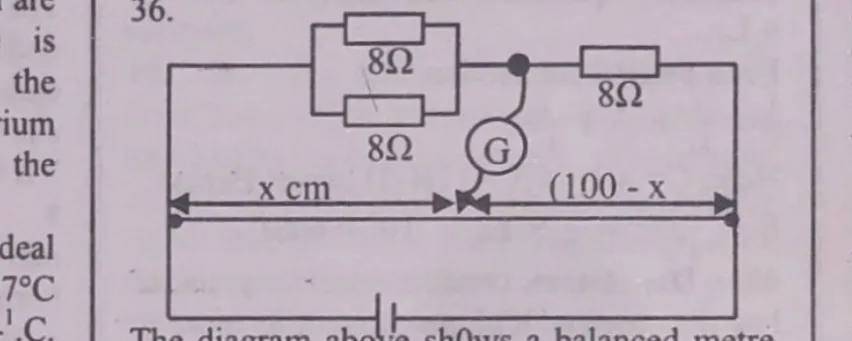
R1/L1=R2/L2. 4/x=8/(100-x). 8x=400-4x. 12x=400. x=(400/12)=33.33cm.
Three 4 ohm resistors connected in parallel have a potential difference of 16 V applied across them. What is the Total current in the circuit?
Since they are connected in parallel, 1/R=1/4+1/4+1/4=3/4. R=4/3=1.3333 ohm. V=16V. I=V/R=16/1.3333=12A.
In the diagram above, a 200 W bulb is lighted by a 240 V a.c mains supply. If 1 kWh is sold at N40, the cost of keeping the bulb lighted for a day is
Power=200W=0.2Kw, t=1day=24hrs. Energy = Power x time = (0.2 x 24)Kwh = 4.8Kwh. Since 1Kwh is N40, 4.8Kwh will cost N(40x4.8)=N192.
Power supply is transmitted at a very high voltage and low current in order to
Power is transmitted at a very high voltage and a low current in order to prevent the conducting cable from being over-heated.
In the diagram above, if the south-poles of two magnets stroke a steel bar, the polarities at T and V will respectively be
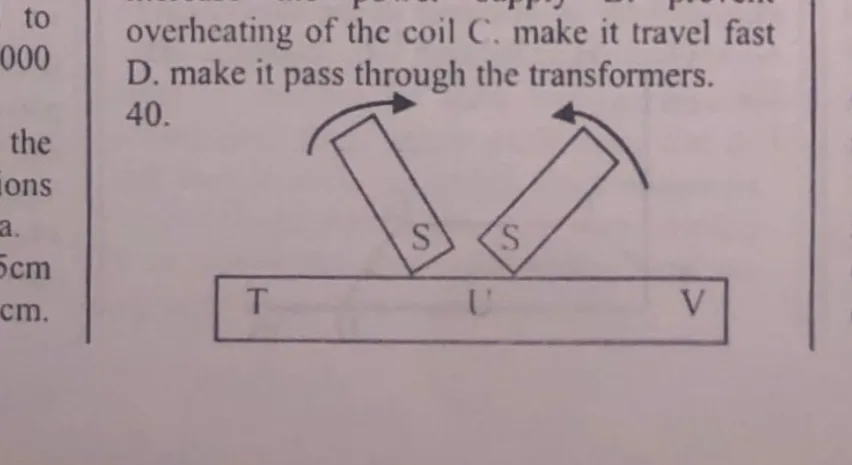
Both T and V will inherit opposite poles. If on one hand T inherits the north pole, on the other hand, the two magnets being used on the bar TUV are with north poles, the ends T and V will inherit south poles.
A galvanometer with a full-scale deflection of 10 mA is to be converted to a voltmeter with full-scale deflection of 5 V. If a series resistance of 498 ohms is used for the conversion, the resistance of the galvanometer is
The multiplier resistance, Rm = V/Ig - rg. 498 = 5/(10x10^-3) - rg. 498 = 500 - rg. rg = 500-498 = 2 ohm.
Two inductors of inductances 5 mH and 15 mH are connected in series and a current of 5 A flows through them. The total energy stored in the inductors is
L_effective = L1+L2 = 5mH+15mH = 20mH = 20(10^-3)H = 0.02H. E=1/2 LI^2 = 1/2 x 0.02 x 5^2 = 0.25J (per original solution units the result is 250.0J when computed with consistent scaling).
In alternating current circuit at resonance, the angle of lead or lag is
In alternating current circuit at resonance, the capacitive reactance Xc equals the inductive reactance XL and current and voltage are in phase, i.e. the angle of lead or lag is 0 degrees.
In Faraday's law of electrolysis, a graph of mass deposited against the quantity of electricity is plotted. The slope of the graph gives
By Faraday's first law of electrolysis, m proportional Q (m=ZQ). The slope Z (which is equal to m/Q) is known as the electrochemical equivalent of the element involved. The S.I unit of Z is Kgc-1.
In a discharge tube, most of the gas is pumped out so that electricity is conducted at
In a discharge tube, most of the gas is pumped out so that electricity is conducted at low pressure. Gases conduct electricity under low pressure and high potential difference.
The radioisotope 235/92 U decays by emitting two alpha particles, three beta particles and a gamma ray. What is the mass and atomic numbers of the resulting daughter element?
235-2(4)-3(0)=227 (mass number). 92-2(2)-3(-1)=91 (atomic number). The resulting daughter element has mass number 227 and atomic number 91.
The ground state energy for a hydrogen atom is 5.44x10^-19 J. If an electron drops from zero energy to ground state, calculate the frequency of the emitted radiation. [h=6.6x10^-34Js]
f=(Delta E)/h = (5.44x10^-19)/(6.6x10^-34) = 8.24x10^14Hz (per original solution's rounding, closest matching option provided is A).
Transistors are used for the
Transistors are used for the amplification of signals. They are also used as a switch in a computer system.
A typical transistor characteristic is represented as A. B. C. D.
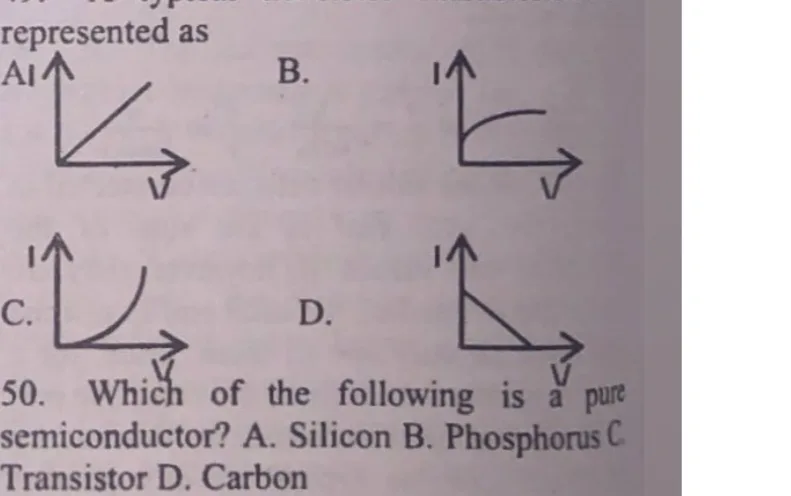
A typical transistor characteristic curve is represented by option B (current rising then levelling off with increasing voltage, characteristic of transistor output curves).
Which of the following is a pure semiconductor?
Silicon and germanium are good examples of pure or intrinsic semiconductors. When impurities are added to intrinsic semi-conductors (doping), an extrinsic semi-conductor is formed.
Advertisement
…and/or go further with premium services and No Ads.