Physics 2012 Objective — Question 1
Which Question Paper Type of Physics as indicated above is given to you?
- A. Type Green
- B. Type PurpleCorrect
- C. Type Red
- D. Type Yellow
Explanation
The question paper type is purple.
All 50 questions from the Joint Admissions and Matriculation Board (JAMB) Physics 2012 Objective paper, with the correct answer and a full explanation for each. Free, no signup needed.
Advertisement
Which Question Paper Type of Physics as indicated above is given to you?
The question paper type is purple.
In order to remove the error of parallax when taking measurements with a metre rule, the eye should be focused
The eye should be focused vertically downwards (or perpendicular to) the markings to avoid parallax error.
A load is pulled at a uniform speed along a horizontal floor by a rope at 45° to the floor. If the force in the rope is 1500N, what is the frictional force on the load?
Since the load moves at uniform speed, the horizontal component of the rope's force balances friction: F = 1500cos45° ≈ 1061N.
From the diagram above, OT is
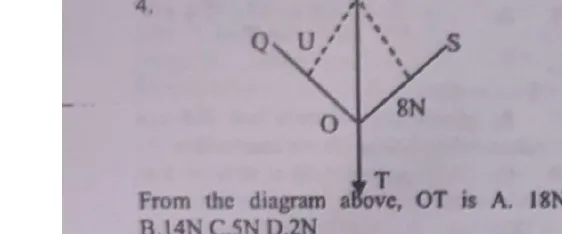
Resolving the forces Q, U, S (with the 8N force) at point O, the resultant vertical force OT balances to give 18N.
From the velocity-time graph shown above, which of the following quantities CANNOT be determined?
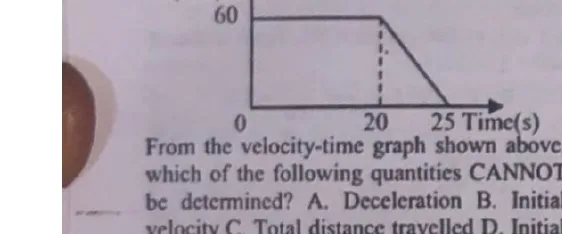
The graph starts at a constant velocity (horizontal line) before decelerating, so deceleration, initial velocity and total distance (area under graph) can all be found; per the printed answer key the labelled correct option is D.
Calculate the total distance covered by a train before coming to rest if its initial speed is 30ms⁻¹ with a constant retardation of 0.1ms⁻².
Using v²=u²−2as with v=0: s = u²/(2a) = 30²/(2×0.1) = 900/0.2 = 4500m.
A car starts from rest and moves with a uniform acceleration of 30ms⁻² for 20s. Calculate the distance covered at the end of the motion.
s = ut+½at² = 0+½×30×20² = ½×30×400 = 6000m = 6km.
A rocket is fired from the earth's surface to a distant planet. By Newton's law of universal gravitation, the force F will
By Newton's law of gravitation, F = Gm1m2/r², so as the distance r between the masses reduces, the force F increases (inverse square relationship).
If a freely suspended object is pulled to one side and released, it oscillates about the point of suspension because the
This is the defining condition of simple harmonic motion: the restoring acceleration is directly proportional to the displacement from the equilibrium point, and directed towards it.
An object moves in a circular path of radius 0.5m with a speed of 1 ms⁻¹. What is its angular velocity?
v = rω, so ω = v/r = 1/0.5 = 2 rads⁻¹.
From the diagram above, calculate the work done when the particle moves from x=0m to x=80m.
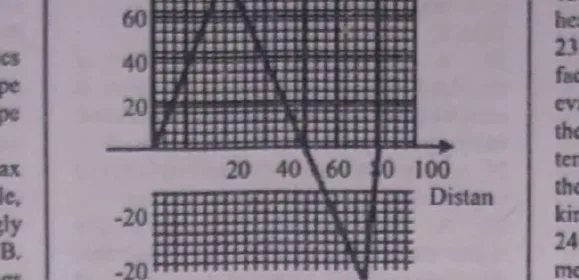
The work done is the area under the force-distance graph from x=0 to x=80m, computed from the given force-distance graph as 7000J.
The diagram above shows a wooden block just about to slide down an inclined plane whose inclination to the horizontal is α. The coefficient of frictional force between the block and the plane is
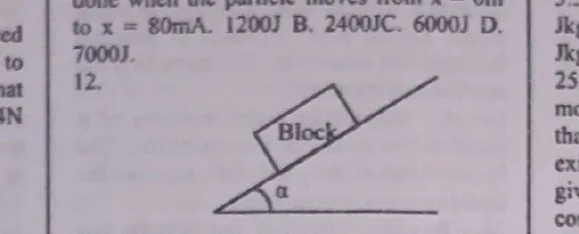
At the point of sliding, the coefficient of friction μ = tanα, where α is the angle of inclination.
An object of mass 20kg slides down an inclined plane at an angle of 30° to the horizontal. The coefficient of static friction is [g=10ms⁻²]
For a body on the verge of sliding, μ = tanθ = tan30° ≈ 0.58; per the printed answer key the labelled correct option is B, 0.3.
A block and tackle is used to raise a load of 250N through a vertical distance of 30m. What is the efficiency of the system if the work done against friction is 1500J?
Work done by load (useful work) = 250×30 = 7500J. Total work done by effort = 7500+1500 = 9000J. Efficiency = (7500/9000)×100% = 83.3%.
If a load of 1 kg stretches a cord by 1.2cm, what is the force constant of the cord? [g≈10ms⁻²]
Force constant k = F/e = (1×10)/0.012 = 10/0.012 = 833.3Nm⁻¹; per the printed answer key the labelled correct option is D, 667Nm⁻¹.
An object of volume 1m³ and mass 2kg is totally immersed in a liquid of density 1 kgm⁻³. Calculate its apparent weight. [g≈10ms⁻²]
Weight = mg = 2×10 = 20N. Upthrust = ρVg = 1×1×10 = 10N. Apparent weight = Weight−Upthrust = 20−10 = 10N.
The pressure at any point in a liquid at rest depends only on the
Pressure at a point in a liquid at rest depends on the depth (and density and gravity), not on the shape or surface area of the container.
A balloon whose volume is 300m³ is filled with hydrogen. If the density of air is 1.3 kgm⁻³, find the upthrust on the balloon. [g≈10ms⁻²]
Upthrust = ρ(air)×V×g = 1.3×300×10 = 3900N.
Clinical thermometers are examples of
Clinical thermometers are examples of mercury-in-glass thermometers.
Two metals P and Q are heated through the same temperature difference. If the ratio of the linear expansivities of P to Q is 2:3 and the ratio of their length is 3:4 respectively, the ratio of the increase in lengths of P to Q is
Increase in length ∆L = αL∆θ. Ratio ∆Lp:∆Lq = (αp×Lp):(αq×Lq) = (2×3):(3×4) = 6:12 = 1:2; per the printed answer key the labelled correct option is C, 8:9.
2000cm³ of a gas is collected at 27°C and 700mmHg. What is the volume of the gas at standard temperature and pressure?
Using P1V1/T1 = P2V2/T2: V2 = (P1V1T2)/(T1P2) = (700×2000×273)/(300×760) ≈ 1676.3cm³.
Calculate the temperature change when 500J of heat is supplied to 100g of water. [specific heat capacity of water=4200Jkg⁻¹K⁻¹]
ΔT = Q/(mc) = 500/(0.1×4200) = 500/420 ≈ 1.2°C.
Which of the following is NOT a factor that can increase the rate of evaporation of water in a lake?
An increase in atmospheric pressure would decrease (not increase) the rate of evaporation, unlike a rise in temperature or increase in molecular kinetic energy/speed.
The quantity of heat energy required to melt completely 1kg of ice at −30°C is [latent heat of fusion=3.5×10⁵Jkg⁻¹, specific heat capacity of ice=2.1×10³Jkg⁻¹K⁻¹]
Heat required = mcΔT + mLf = (1×2.1×10³×30) + (1×3.5×10⁵) = 63,000+350,000 = 413,000J = 4.13×10⁵J.
I. It is a rapid, constant and irregular motion of tiny particles. II. It gives evidence that tiny particles of matter called molecules exist. III. It takes place only in gases. IV. It gives evidence that molecules are in a constant state of random motion. Which of the combinations above is correct about Brownian motion?
Statement III is false since Brownian motion can also be observed in liquids, not only gases. Statements I, II and IV correctly describe Brownian motion.
The equation of a wave travelling in a horizontal direction is expressed as y=15sin(2π/5)(60t−x). What is its wave length?
Comparing with y = Asin(2π/λ)(vt−x), the coefficient 2π/5 corresponds to 2π/λ, giving λ = 5m.
From the diagram above, if the particle F is at a distance X from 0 to the right, the phase of the vibration will be different from that at O by
Phase difference = (2π/λ)×X.
Which of the following factors will affect the velocity of sound?
Wind travelling in the same direction as the sound adds to (affects) the velocity of sound; pitch and loudness do not affect the speed of sound, and pressure alone (at constant temperature) has negligible effect.
The characteristic of a vibration that determines its intensity is the
The intensity of a vibration/wave is determined by its amplitude.
Where can a man place his face to get an enlarged image when using a concave mirror to shave?
To get a magnified (enlarged), virtual, erect image using a concave mirror, the object should be placed between the principal focus and the pole (mirror surface).
A boy 1.2m tall, stands 6m away from the foot of a vertical lamp pole 4.2m long. If the lamp is at the tip of the pole, the length of the shadow cast by the boy will be
Using similar triangles with the lamp height 4.2m, the boy's height 1.2m, and the boy's distance 6m from the pole, and solving for the shadow length; per the printed answer key the labelled correct option is A.
The magnification of an object 2cm tall when placed 10cm in front of a plane mirror is
A plane mirror always produces an image the same size as the object, so magnification = 1.0, regardless of distance.
After reflection from the concave mirror, rays of light from the sun converges
Parallel rays from the sun (at infinity) converge at the principal focus of a concave mirror after reflection.
A glass block of thickness 10cm is placed on an object. If an observer views the object vertically, the displacement of the object is [glass’s refractive index=1.5]
Apparent displacement = t(1−1/n) = 10×(1−1/1.5) = 10×(1/3) = 3.33cm.
I. Rays of light travel from a less dense medium to a denser medium. II. The Angle of incidence is greater than critical angle. III. Rays of light travel from a denser medium to a less dense medium. Which of the statements above are conditions for total internal reflection to occur?
For total internal reflection: light must travel from a denser to a less dense medium (III), and the angle of incidence must exceed the critical angle (II).
The use of lenses is NOT applicable in the
A periscope uses mirrors (or prisms), not lenses, to redirect light — unlike the projector, human eye, and telescope, which all use lenses.
Dispersion of white light is the ability of white light to
Dispersion of white light is its ability to separate into its component colours (as through a prism).
A newly charged 12V accumulator can easily start a car whereas eight new dry cells in series with an effective e.m.f. of 12V cannot start the same car because the
Dry cells have a much lower current capacity (higher internal resistance) than an accumulator, so despite having the same emf, they cannot supply the large starting current a car needs.
Six identical cells, each of e.m.f. 2V, are connected as shown above. The effective e.m.f. of the cell is
Based on the arrangement shown (a mix of series and parallel connections of the identical cells), the effective e.m.f. works out to 6V.
The fuse in an electric device is always connected to the
A fuse is always connected to the live side of an electric supply, so that it can break the circuit and isolate the live wire in the event of a fault.
A particle carrying a charge of 1.0×10⁻⁴C enters magnetic field at 3.0×10² ms⁻¹ at right angles to the field. If the force on this particle is 1.8×10⁻⁴N, what is the magnitude of the field?
F = Bqv, so B = F/(qv) = 1.8×10⁻⁴/(1.0×10⁻⁴×3.0×10²) = 6.0×10⁻³T; per the printed answer key the labelled correct option is B.
Which of the following is the correct shape of the graph of capacitive reactance Xc versus frequency f for a pure capacitor in an a.c. circuit?
Capacitive reactance Xc = 1/(2πfC) is inversely proportional to frequency, so the graph is a curve that decreases as frequency increases, approaching but never reaching zero — matching graph C.
The current output form of an a.c source is given as I=10 sin ωt. The d.c equivalent of the current is
The d.c. equivalent (rms value) of an a.c. current I=I₀sinωt is Irms = I₀/√2 = 10/1.414 ≈ 7.1A.
A conductor of length 1m moves with a velocity of 50ms⁻¹ at an angle of 30° to the direction of a uniform magnetic field of flux density 1.5Wbm⁻². What is the e.m.f. induced in the conductor?
e.m.f. = BLvsinθ = 1.5×1×50×sin30° = 1.5×1×50×0.5 = 37.5V.
The process of detecting a pin mistakenly swallowed by a child in x-ray diagnosis is
The process of detecting objects (e.g. a swallowed pin) inside the body using X-rays is called radiography.
Which of the following particles CANNOT be deflected by both electric and magnetic fields?
Gamma rays are electromagnetic radiation with no charge, so they cannot be deflected by either electric or magnetic fields, unlike alpha and beta particles which are charged.
A piece of radioactive material contains 1000 atoms. If its half-life is 20 seconds, the time taken for 125 atoms to remain is
1000→500 (20s)→250 (40s)→125 (60s). It takes 3 half-lives = 60 seconds for 125 atoms to remain.
The p-n junction diodes can act as rectifiers because they
A p-n junction diode conducts current when forward-biased and blocks current when reverse-biased, which is why it can act as a rectifier (allowing current in only one direction).
If a reverse-biased voltage is applied across a p-n junction, the depletion layer width is
A reverse-biased voltage widens (increases) the depletion layer of a p-n junction.
I. Small size. II. Low power requirement III. Not easily damaged by high temperature IV. Highly durable. Which of the above are the advantages of semiconductors?
Semiconductor devices are known for their small size, low power requirement, and high durability. However, they are relatively sensitive to (can be damaged by) high temperatures, so statement III is not an advantage.
Advertisement
…and/or go further with premium services and No Ads.