All 9 questions from the West African Examinations Council (WAEC) Accounting 2019 Theory paper, with the correct answer and a full explanation for each. Free, no signup needed.
Explain the following items and outline how they are treated in the final accounts: (a) Increase in provision for doubtful debts; (b) Decrease in provision for doubtful debts; (c) Provision for discount on debtors; (d) Provision for discount on creditors; (e) Provision for depreciation.
Model answer
(a) Increase in provision for doubtful debt: An increase in the provision for doubtful debt means that the doubtful debts of the current year has increased compared with the previous year. Thus, this is an emphasis to the business. The accounting treatment in the final account goods thus: Dr Profit and loss account with the increase; Cr Debtors account with the increase.
(b) Decrease in provision for doubtful debt: A decrease in provision for doubtful debt means that the doubtful debts of the current year has decreased compared with doubtful debt of the previous year. This is an income to the business e.g. in 2017, the doubtful debt was estimated at N300 but in 2018 it was estimated that the premiums N300 doubted has reluctant to N250. This is an income to the business. Thus, the accounting treatment is: Dr Debtors account with the decrease; Cr Profit and loss account with the decrease.
(c) Provision for discount on debtors: This is the allowance based on some percentage allowed debtors as deduction from their total debts. It could be caused or used to influence quick payment or quantity purchase. The provision is a relief to the debtors and an expense to the business, thus the accounting treatment is: Dr Profit and loss account; Cr Debtors account.
(d) Provision for discount on creditors: This is the allowance based on some percentage allowed by creditors to the organization. It could be to facilitate quick payment. It is an income to the organization, thus the accounting treatment is: Dr Creditors account; Cr Profit and loss account.
(e) Provision for depreciation: This can be defined as an allowance made for replacement of fixed asset as a result of wear and tear. It is an expense to the organisation, thus the accounting treatment in the final account is: Dr Profit and loss account; Cr Asset account.
2(a) What are closing entries? (b) Distinguish between a branch and a department. (c) State four reasons for the preparation of branch accounts.
Model answer
(a) Closing entries: These are balancing entries in the journal accounts which are transferred to the income and expenditure account or the balance sheet.
(b) A branch is a division of an organization which is located in another location apart from its headquarters or other branches while a department is a section of a single organization divided into units operating under a single roof. Example of a branch is a bank while example of a department is a departmental stores or finance department in an organization.
(c) Reasons for the preparation of a branch account: i. To determine branch profit and for loss. ii. To reconcile branch and head office account. iii. To prevent fraud at the branch. iv. To know branch performances.
3(a) State three effects of drawings on the business of a sole proprietor. (b) Explain how the following items are treated in the balance sheet: (i) accrued expenses; (ii) prepaid expenses; (iii) accrued income.
Model answer
(a) Effects of drawings on the business of a sole proprietor: i. It reduces the capital of the proprietor in the business if the drawing is in form of money. ii. It could reduce profit of the drawing if in form of goods. iii. It leads to reduction in asset of comparing if it's in form of cash and flow stock.
(b)(i) Accrued expenses: It is added to current liabilities in the balance sheet.
(ii) Prepaid expenses: It is added to current asset in the balance sheet.
(iii) Accrued income: It is added to current asset in the balance sheet.
4(a) Outline three reasons for which a cheque would be dishonoured. (b) Explain the following terms: (i) petty cash floats; (ii) contra entries; (iii) imprest system. (c) State three advantages of keeping petty cash book using imprest system.
Model answer
(a) Reasons for dishonouring cheques: i. Irregularity in signature of drawer. ii. Disagreement in amount written in word and the one written in figure. iii. Suspicion of alteration in the displaced (altered) cheque.
(b)(i) Petty cash float: This can be defined as maximum amount given to the petty cashier to run the petty cashbook. Expenses incurred are reimbursed regularly for the cashier to keep the maximum amount intact.
(ii) Contra entries: These are referred to entries posted in both debit and credit side of a single account or two similar account (such as total debtors account and total creditors account) to offset the effect of the transaction.
(iii) Imprest system: This can be defined as a system of petty cashbook in which a certain amount is given to the petty cashiers to run some minute expenses in order not to overlook the main cash books. The amount spent is reimbursed regularly to keep the maximum amount intact.
(c) Advantages of keeping petty cashbook using imprest system: i. It reduces burden or too much entry in the main cash book. ii. It monitors the small daily but recurring expenses in the organisation. iii. It minimizes fraud.
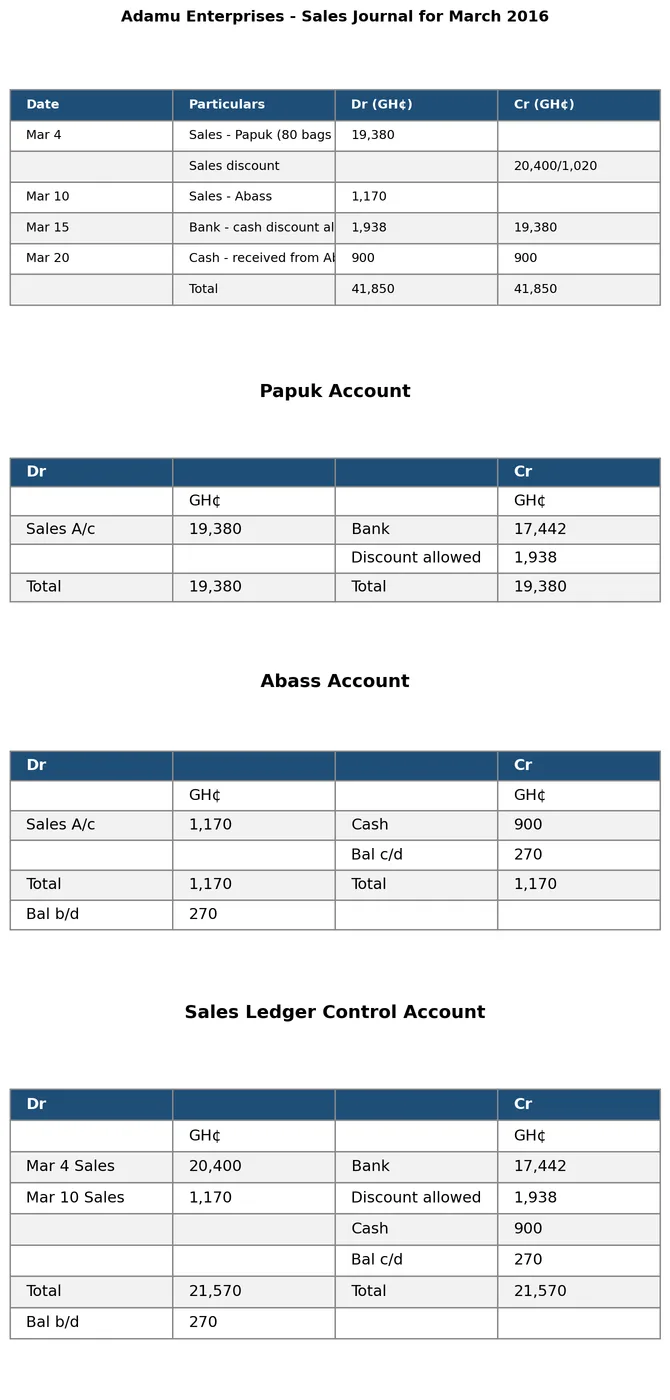
The following transactions were extracted from the books of Adamu, a sole trader for the month of March 2016. March 4: Sold 80 bags of maize on credit to Papuk at GH¢255 per bag subject to a trade discount of 5%. March 10: Sold goods on credit to Abass for GHc1,170. March 15: Received a cheque from Papuk for the amount due less a discount of 10%. March 20: Received cash of GH¢900 from Abass. You are required to prepare the: (a) Sales Journal; (b) Customers' Accounts in the Sales Ledger; (c) Sales Ledger Control Account.
Model answer
See the Sales Journal, Papuk Account, Abass Account, and Sales Ledger Control Account tables in the Diagram column. Sales to Papuk (80 bags x GH¢255 = GH¢20,400, less 5% trade discount of GH¢1,020) = GH¢19,380. Papuk pays via cheque less a 10% cash discount (GH¢1,938), settling the account in full. Abass's account records the GH¢1,170 credit sale, a GH¢900 cash payment received, leaving a balance of GH¢270 owing. The Sales Ledger Control Account totals GH¢21,570 on the debit side (from total sales of GH¢20,400 and GH¢1,170) and is balanced by the cheque received (GH¢17,442), discount allowed (GH¢1,938), cash received (GH¢900), and the closing balance owed (GH¢270).
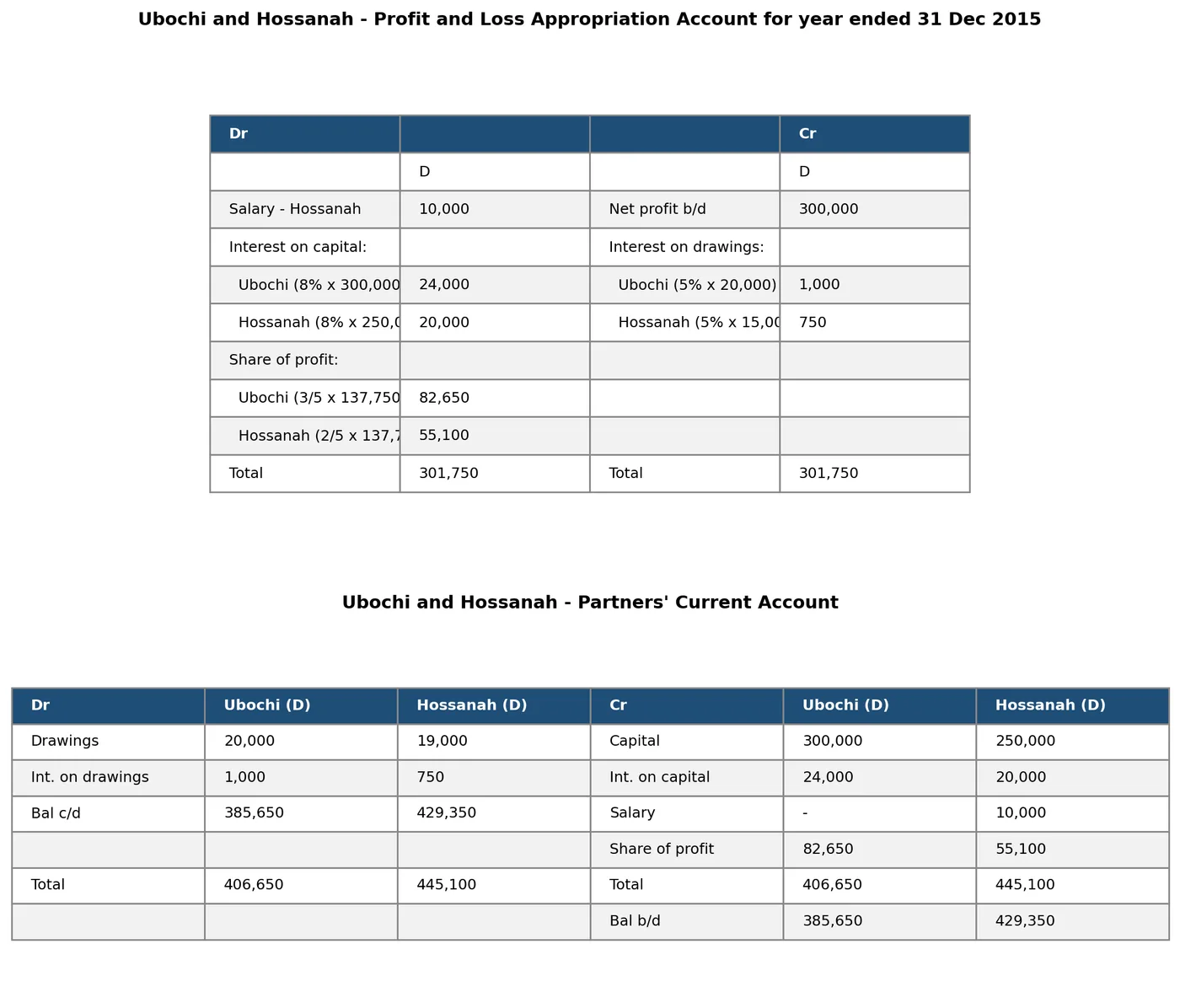
Ubochi and Hassanah started a partnership business on 1st January, 2015. They contributed D300,000 and D250,000 respectively as capital. Their partnership deed stated that: (i) Interest of 8% should be paid on capital per annum, (ii) Hassanah would be paid D10,000 monthly as salary; (iii) interest on drawings is 5%; (iv) the profits are to be shared in the ratio 3:2 respectively. At the end of the year, the profit made was D300,000. During the period, Ubochi and Hassanah made drawings of D20,000 and D15,000 respectively. You are required to prepare: (a) Profit and Loss Appropriation Account for the year ended 31st December, 2015; (b) Partners' Current Accounts.
Model answer
See the Profit and Loss Appropriation Account and Partners' Current Account tables in the Diagram column. Note: Hassanah's monthly salary of D10,000 gives an annual salary of D120,000 (D10,000 x 12); interest on capital is Ubochi D24,000 (8% x D300,000) and Hassanah D20,000 (8% x D250,000). After deducting salary and interest on capital from the net profit of D300,000, the remaining profit of D137,750 is shared 3:2 between Ubochi (D82,650) and Hassanah (D55,100). The Partners' Current Accounts show closing balances of D385,650 for Ubochi and D429,350 for Hassanah, after accounting for drawings and interest on drawings.
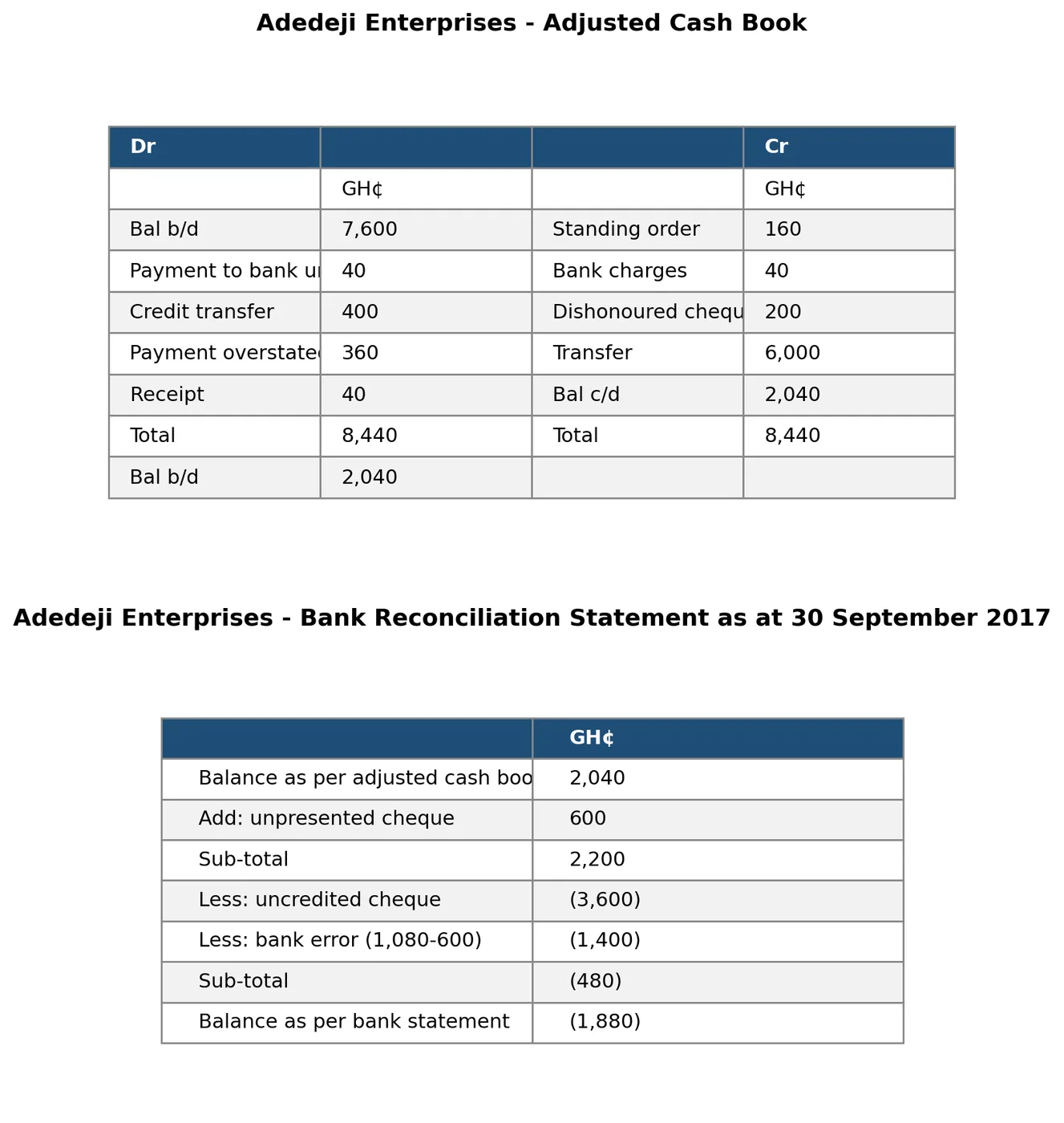
On 30th September, 2017, Adedeji's cash book showed a debit balance of GH¢7,600. However, his bank statement showed an overdraft balance of GH¢1,880. On investigation, the following details were discovered: (i) A standing order of GH¢160 had not been entered in the cash book; (ii) Bank charges of GH¢40 did not appear in the cash book; (iii) Cash paid into the bank for GH¢400 had been entered in the cash book as GH¢360; (iv) A cheque of GH¢200 received from a customer was dishonoured; (v) The bank received a credit transfer of GH¢400 from a customer; (vi) A cheque of GH¢1,360 paid to Dexteri Ltd had been entered in the cash book as GH¢1,720; (vii) A receipt of GH¢40 shown on the bank statement had not been entered in the cash book; (viii) A cheque drawn amounting to GH¢160 paid is still with the supplier; (ix) Receipts of GH¢3,600 paid into the bank on 30th September, 2017 did not appear on the bank statement until October 2017; (x) A cheque of GH¢1,080 paid into the bank had been wrongly credited by bank as GH¢600; (xi) A transfer of GH¢6,000 to bank had not been recorded in the cash book. You are required to prepare: (a) Adjusted Cash Book; (b) Bank Reconciliation Statement as at 30th September, 2017.
Model answer
See the Adjusted Cash Book and Bank Reconciliation Statement tables in the Diagram column. The cash book is adjusted for items not yet recorded by Adedeji: the standing order (GH¢160), bank charges (GH¢40), the dishonoured cheque (GH¢200), the transfer to bank (GH¢6,000), the understated payment correction (GH¢40), the credit transfer received (GH¢400), and the overstated payment correction (GH¢360), and the unrecorded receipt (GH¢40), giving an adjusted cash book balance of GH¢2,040. The Bank Reconciliation Statement then reconciles this adjusted balance to the bank statement balance by accounting for the unpresented cheque (GH¢600), the uncredited cheque (GH¢3,600), and the bank's crediting error (GH¢1,080-600=GH¢480 difference), arriving at the balance as per the bank statement.
The following trial balance was extracted from the books of Dushimar Ventures on 31st December, 2015 (in Le): Fixed Assets 72,200; Stock 13,800; Debtors 6,300; Creditors 2,456; Bank overdrafts 528; Provision for depreciation 10,200; Sales 102,320; Capital 106,440; Purchases 72,308; Drawings 29,960; Sundry expenses 26,616; Provision for doubtful debts 360; Suspense Account 1,120. The following errors were discovered: (i) The total sales day book for December 2015 had been overstated by Le480; (ii) In January 2015, new office furniture was purchased for Le14,400, this was debited to Purchases Account; (iii) A cheque payment of Le864 to a supplier was entered in the book as Le1,044; (iv) A credit note of Le148 sent to a customer for returns was overlooked; (v) Payment of sundry expenses of Le640 had been omitted from the trial balance. You are required to prepare: (a) Journal entries to correct the errors; (b) Suspense Account.
Model answer
See the Journal Entries and Suspense Account tables in the Diagram column. The Suspense Account opens with a balance brought down of Le1,120 (the difference on the original trial balance), which is fully cleared by correcting the overstated sales figure (Le480) and the omitted sundry expenses (Le640), bringing the account to balance.
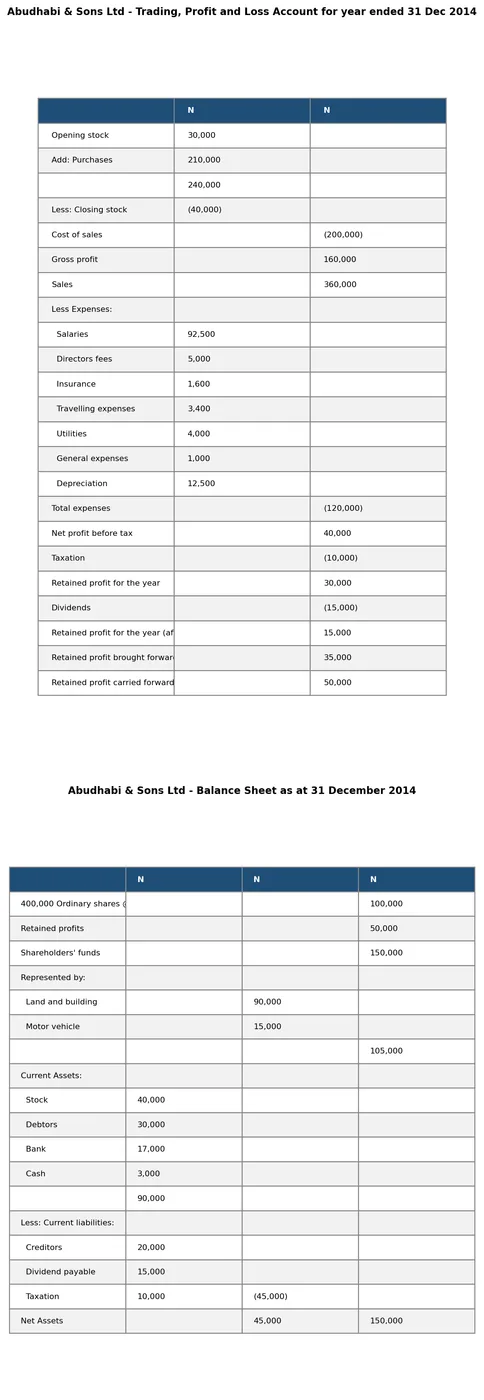
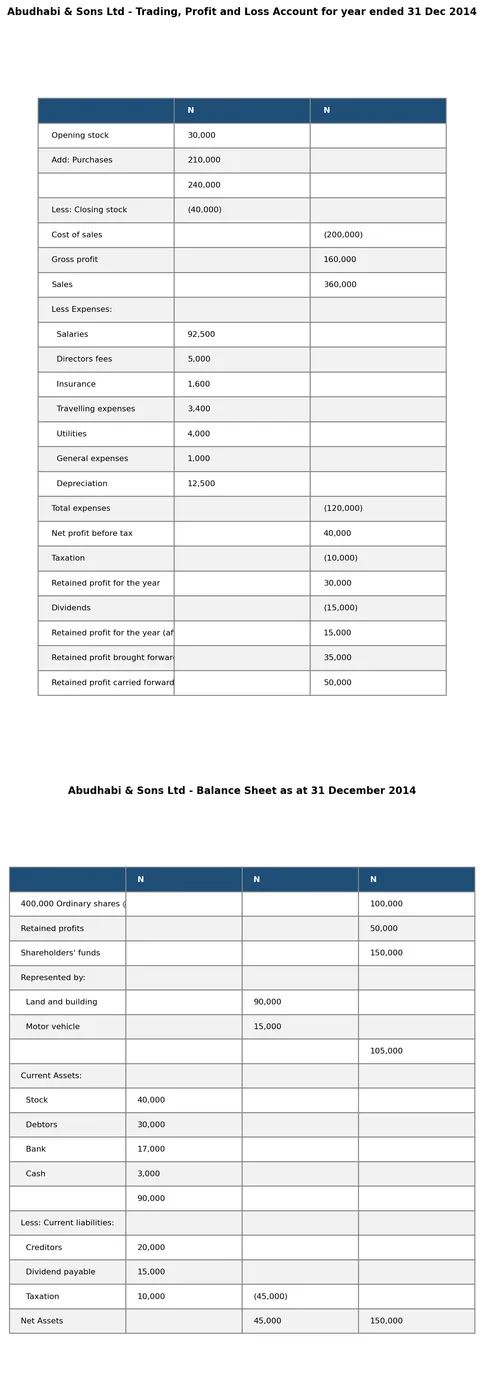
The following information was extracted from the books of Abudhabi & Sons Ltd: Stock (opening) N30,000; Purchases N210,000; Stock (closing) N40,000; Sales N360,000; Salaries N92,500; Directors fees N5,000; Insurance N1,600; Travelling expenses N3,400; Utilities N4,000; General expenses N1,000; Depreciation N12,500; Taxation N10,000; Dividends N15,000; Retained profit brought forward N35,000. All sales and purchases were on credit. Balance sheet items: 400,000 Ordinary shares @ N0.25 each; Land and building N90,000; Motor vehicle N15,000; Stock N40,000; Debtors N30,000; Bank N17,000; Cash N3,000; Creditors N20,000; Dividend payable N15,000; Taxation N10,000. (a) Prepare the Trading, Profit and Loss Account for the year ended 31st December, 2014, and the Balance Sheet as at that date. You are required to calculate: (i) Stock turnover ratio; (ii) Gross profit margin; (iii) Net profit margin; (iv) Current ratio; (v) Acid test ratio.
Model answer
See the Trading, Profit and Loss Account and Balance Sheet tables in the Diagram column, showing a Gross profit of N160,000, Net profit before tax of N40,000, and Shareholders' funds of N150,000.
(i) Stock turnover ratio = Cost of goods sold / Average stock = N200,000 / N35,000 = 5.71 times, approximately 6 times (Average stock = (N30,000+N40,000)/2 = N35,000).
(ii) Gross profit margin = (Gross profit/Sales) x 100 = (N160,000/N360,000) x 100 = 44.4%.
(iii) Net profit margin = (Net profit/Sales) x 100 = (N40,000/N360,000) x 100 = 11.1%.
(iv) Current ratio = Current assets/Current liabilities x 100 = (N90,000/N45,000) x 100 = 2:1.
(v) Acid test ratio = (Current assets - Stock)/Current liabilities x 100 = (N90,000-N40,000)/N45,000 x 100 = 1.11:1.
Advertisement
Sign up free to unlock
Score tracking
Practice history
Saved questions
Progress dashboard
Personalized sessions
Weak-topic breakdown
…and/or go further with premium services and No Ads.