All 50 questions from the West African Examinations Council (WAEC) Biology 2023 Objective paper, with the correct answer and a full explanation for each. Free, no signup needed.
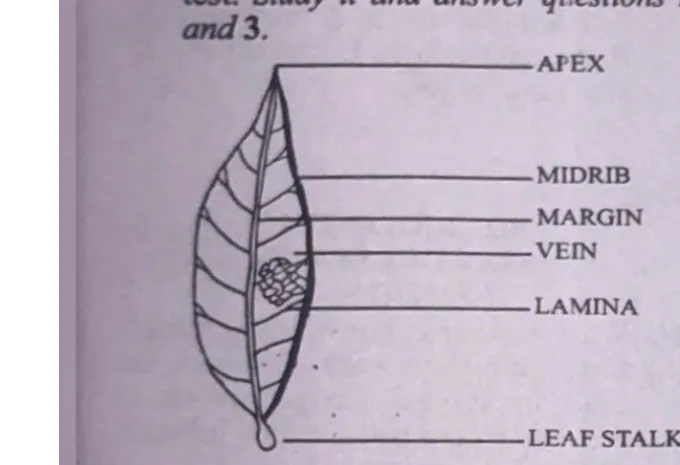
The diagram below is an illustration of a mango leaf drawn by a student in a Biology test. The student failed the test. Study it and answer questions 2 and 3.
The likely reason why the student failed the test was that the
A. labels were wrong and the guidelines were not touching the structuresCorrect
B. net venation shown were few, rough, not properly drawn and wrongly placed
C. leaf was too tapered at the apex, the leaf stalk was too short and the shape of the leaf venation was wrong
D. leaf venation should have been parallel and the mid-rib should be thicker
Explanation
The guidelines were not touching the structures; the student labelled the vein as 'lamina' and the lamina as 'vein'; the student labelled the midrib as 'margin' — these labelling errors are why the student failed.
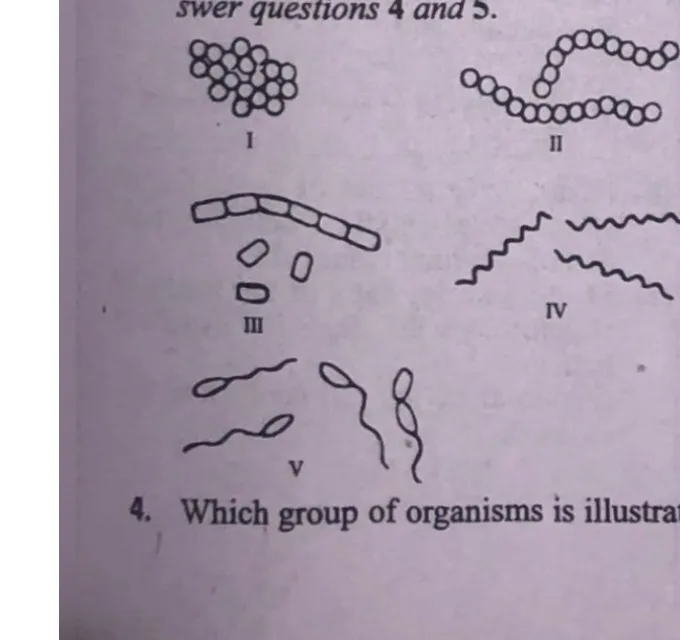
The diagrams below are illustrations of forms in which a particular group of organisms exist. Study them and answer questions 4 and 5.
Which group of organisms is illustrated?
In which of the illustrated forms does the organism that causes cholera exist?
A. II
B. III
C. IV
D. VCorrect
Explanation
The organism that causes cholera is a vibrio bacterium (Vibrio cholerae). Diagram 'V' represents vibrio bacteria — a vibrio bacterium uses a single polar flagellum to travel, which is evident in diagram 'V'.
Study the list of organisms below and use them to answer questions 6 and 7.
I - Hydra II - Owl III - Snake IV - Snail
6. Arrangement of the organisms in order of increasing complexity is
A. I - II - III - IV
B. II - III - I - IV
C. I - IV - III - IICorrect
D. IV - III - II - I
Explanation
Since hydra and snail are invertebrates, they are less complex than snake and owl. Also, molluscans (e.g. snail) are more advanced than coelenterates (e.g. hydra). For vertebrates, the evolutionary trend is Pisces→Amphibians→Reptiles→Aves→Mammals; owl (a bird) is more advanced than snake (a reptile). Thus, in order of increasing complexity: I→IV→III→II.
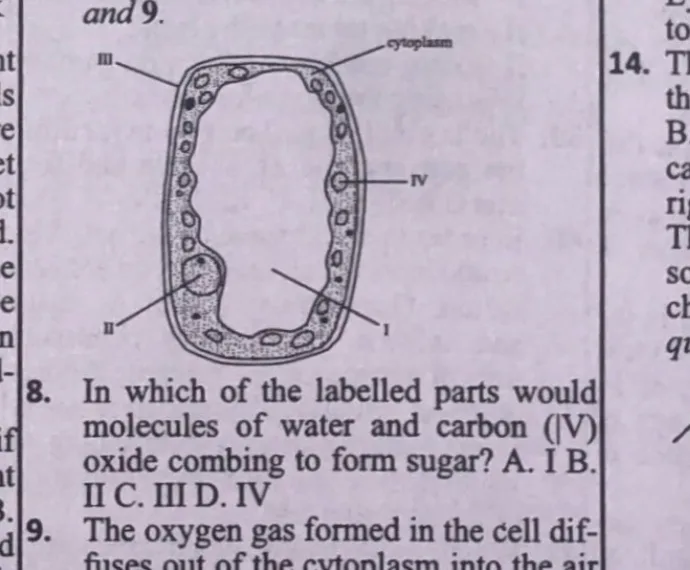
The diagram below is an illustration of a cell in which photosynthesis takes place. Study it and answer questions 8 and 9.
In which of the labelled parts would molecules of water and carbon (IV) oxide combine to form sugar?
A. I
B. II
C. III
D. IVCorrect
Explanation
Combination of water and carbon (IV) oxide to form sugar (photosynthesis) occurs in the chloroplast, labelled IV.
The oxygen gas formed in the cell diffuses out of the cytoplasm into the air spaces through the part labelled
A. I
B. II
C. IIICorrect
D. IV
Explanation
The cell membrane regulates the movement/transport of materials into and out of the cell, so oxygen diffuses out through the part labelled III (the cell membrane).
An example of a process that involves osmosis is the
A. movement of digested food from ileum into blood capillaries
B. translocation of starch from leaves to all parts of a plant
C. reabsorption of food nutrients from the kidney into blood capillaries
D. movement of water from root hairs into cortical cellCorrect
Explanation
Water enters the plant through the root hairs. This decreases the concentration inside the root hair cells (when compared with the cortex). As a result, water from the root hair cells moves to the cortex by osmosis.
Growth in animals differs from that in plants because growth in
A. animals is intercalary
B. animals is apical
C. plants is from within
D. plants is indefiniteCorrect
Explanation
Growth is apical and intercalary in plants but only apical in animals; growth ceases after maturity in animals whereas in plants, growth continues indefinitely.
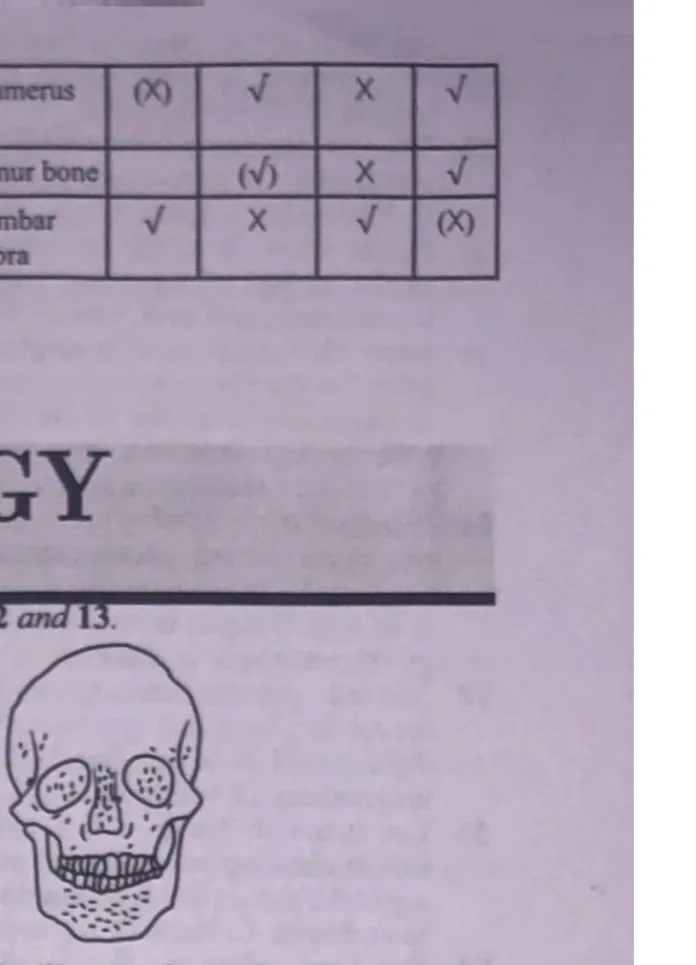
The diagram below is an illustration of a structure in the skeletal system of humans. Study it and answer questions 12 and 13.
The illustrated structure is a part of the
A. cervical vertebrae
B. axial skeletonCorrect
C. axis vertebrae
D. appendicular skeleton
Explanation
The structure given represents the skull. The skull is part of the axial skeleton, which comprises the skull, the vertebral column, the sternum and the ribs (while the appendicular skeleton comprises the limbs and the limb girdles — pelvic and pectoral).
An individual was involved in a car accident and the illustrated structure was badly injured. Which of the following structures would most likely be affected?
A. Lumbar, eye and teeth
B. Ear, brain and hinge joint
C. Eye, cerebellum and carCorrect
D. Clavicle, tongue and pelvis
Explanation
Eyes and ear are structures on the skull, so they are also likely to be affected in the case of a head injury. The cerebellum is part of the brain; thus, it is likely to be affected if the head/skull suffers a serious injury.
The tricuspid valve is located between the right auricle and the right ventricle. (The bicuspid valve is located between the left auricle and the left ventricle.)
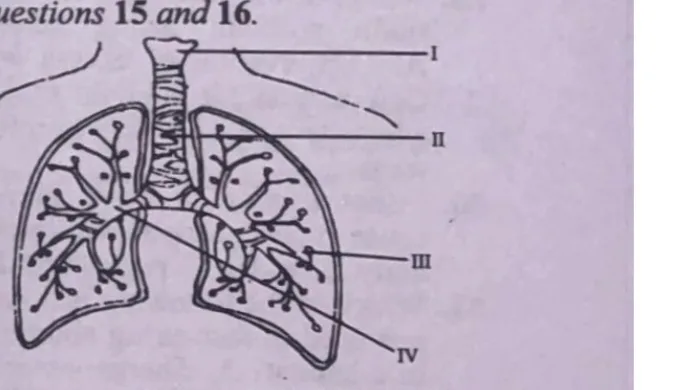
The diagram below is an illustration of some structures used for gaseous exchange in humans. Study it and answer questions 15 and 16.
The parts labelled I, II, III and IV respectively are
A. larynx, bronchus, bronchiole and trachea
B. bronchus, bronchiole, trachea and larynx
C. bronchiole, trachea, bronchus and larynx
D. larynx, trachea, bronchus and bronchioleCorrect
Explanation
The whole set-up indicates the structure of a lung: I=Larynx, II=Trachea, III=Bronchiole, IV=Bronchus.
Which of the following hormones is wrongly paired with its secretory organ?
A. Insulin and pancreas
B. Oestrogen and ovary
C. Oxytocin and hypothalamus
D. Adrenalin and kidneyCorrect
Explanation
The adrenal glands are located at the top of the kidneys, and adrenalin is secreted by adrenal glands, not by the kidneys directly — making this pairing wrong.
A. part of the ovary where the ovules originate and remain till maturity
B. formation of a single carpel joined at the two edges of an ovule
C. arrangement of ovules in the ovary of a flowerCorrect
D. ovules borne on a central column of tissues in an ovary
Explanation
In fruits, placentation refers to the arrangement of ovules in the ovary of a flower. Placentation may be axile, marginal, parietal, free-central, superficial or basal.
Stunted growth and small yellow leaves in plants are symptoms of the deficiencies of
A. sulphur
B. iron
C. magnesium
D. nitrogenCorrect
Explanation
Slow growth and uniform yellowing of older leaves are the first symptoms of nitrogen deficiency. Nitrogen-deficient plants produce smaller than normal fruits, leaves and shoots, and they also develop later than normal.
The structure that its action could result in choking when talking and eating at the same time is
A. epiglottisCorrect
B. oesophagus
C. liver
D. stomach
Explanation
When a person swallows, the epiglottis folds backward to cover the entrance of the larynx so that food and liquid do not enter the windpipe and lungs. Talking and eating at the same time may cause choking.
Organisms that feed on dead, decaying tissues of other organisms are known as
A. parasites
B. autotrophs
C. heterotrophs
D. saprophytesCorrect
Explanation
Saprophytes are the organisms that live and feed on dead and decaying organisms. Saprophytes are usually bacteria and fungi (such as molds, mushroom, yeast, penicillium and mucor).
The grasshopper has mandibulate mouth-parts that are adapted for biting and chewing. Other insects that have chewing mouth-parts include crickets, beetles and cockroaches.
Which of the following factors is the main problem facing xerophytes?
A. Conservation of excess waterCorrect
B. Competition for sunlight
C. Lack of adequate watch
D. Poor formation of roots
Explanation
Plants which grow in areas with limited supply of water are known as xerophytes. Thus, their main problem is lack of adequate water — meaning conservation of excess water is a key adaptive need.
Fishes survive in water mainly because they possess
A. streamlined body
B. scales
C. paired fins
D. gillsCorrect
Explanation
Gills are organs that allow fish to breathe underwater. They are made up of feathery structures called gill filaments, providing a large surface area for exchange of gases.
Which of the following instruments is not used in measuring abiotic factors in a habitat?
A. Thermometer
B. MicroscopeCorrect
C. Hygrometer
D. Wind vane
Explanation
Thermometer→Temperature, Hygrometer→Relative humidity, Wind vane→Wind direction. A microscope is used to view small organisms/cells, not to measure an abiotic factor.
Which of the following soil types have a high capillarity?
A. Sand and clay
B. Silt and clayCorrect
C. Silt and sand and Loam
D. Sand and clay
Explanation
Clay has very tiny particles with very small pore spaces (micropores). Capillarity is much greater in micropores than in macropores. Note as well that capillarity is higher in silt than in sand.
The capturing and digestion of insects by a pitcher plant is a special form of nutrition that is
A. chemosynthetic
B. saprophytic
C. heterotrophicCorrect
D. autotrophic
Explanation
Even though pitcher plants (and other carnivorous plants) can photosynthesize, they still have to trap insects and other small animals to obtain nitrogen. Thus, they exhibit both autotrophy and heterotrophy. Since we are concerned about their capturing and digestion of insects, this demonstrates heterotrophic nutrition.
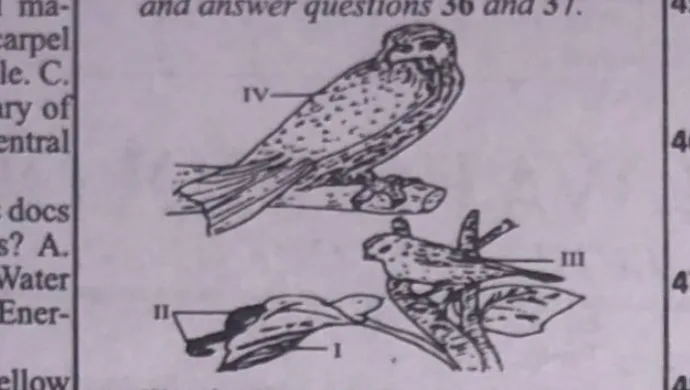
The diagrams below are illustrations of organisms in a habitat. Study them and answer questions 36 and 37.
The feeding relationship between the organisms labelled III and IV in the diagrams is
A. mutualism
B. parasitism
C. predationCorrect
D. saprophytism
Explanation
From the appearance of the beak and the claws of IV (the larger bird), it can be easily guessed that it is a predator; thus the feeding relationship between III (prey) and IV is predation.
Use the information below to answer questions 39 and 40.
I - making shoes from crocodile skin II - making tables with plastic III - using elephant tusk for decoration IV - using firewood for cooking
39. The act that should be encouraged for the conservation of wildlife and forests is
A. I
B. IICorrect
C. III
D. IV
Explanation
If tables are made with plastic instead of wood, it clearly enhances the conservation of the forest.
In order to avoid some of the acts that would have negative effects on conservation, Government should A. enact and enforce laws towards conservation of resources. B. promote felling of trees without planting new ones. C. encourage indiscriminate killing of wildlife. D. encourage over-utilization of forest resources.
A. enact and enforce laws towards conservation of resourcesCorrect
B. promote felling of trees without planting new ones
C. encourage indiscriminate killing of wildlife
D. encourage over-utilization of forest resources
Explanation
The government should educate people on the need for conservation, and laws should be enacted and enforced towards the conservation of natural resources.
A Rhesus negative woman may experience stillbirth of the second child that is Rhesus positive because
A. the woman is susceptible to diseases during pregnancy
B. the blood of the foetus might clump, as they have a poor circulatory systemCorrect
C. the foetus is deprived of nourishment
D. (option D not clearly legible in the source scan)
Explanation
Rh-antibodies are not harmful until the second or later pregnancy. If the baby is Rh-negative just like the mother, there is no issue. However, if the baby (foetus) is Rh-positive, the mother's Rh-antibodies will recognize the Rh-proteins on the surface of the baby's blood cells as foreign, causing them to attack those cells (agglutination/clumping) — a risk that grows from the second Rh-positive pregnancy onward.
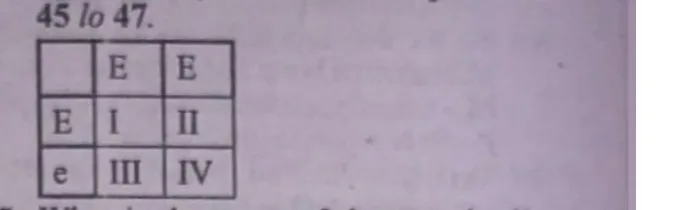
The illustration below is a genetic diagram. Study it and answer questions 45 to 47.
What is the name of the genetic diagram?
A. A genetic cross
B. B Punnett squareCorrect
C. C Inheritance diagram
D. D Genetic square
Explanation
It is known as Punnett square. The Punnett square is a square diagram that is used to predict the genotypes of a particular cross or breeding experiment.
What is the probability that a pregnancy would result in a male child?
A. ¾
B. ½Correct
C. ¼
D. 4
Explanation
Since a child/baby is either male or female, the probability that a pregnancy would result in a male child is ½. Similarly, the probability that it would result in a female child is also ½.
Vestigial structures are those structures that have no known function. Examples of vestigial structures in humans are the tailbone, appendix and wisdom teeth.