All 21 questions from the West African Examinations Council (WAEC) Biology 2025 Theory paper, with the correct answer and a full explanation for each. Free, no signup needed.
Excretion is the biological process by which living organisms eliminate metabolic waste products and toxic substances that result from cellular activities. These wastes may include carbon dioxide, urea, excess salts, water and other by-products.
1(c) Complete the table below for: Paramecium, Planaria, Leaf of plant, Earthworm - showing Excretory structure, Mechanism involved, and Adaptation of the structure for excretion.
Model answer
Paramecium: Excretory structure - Contractile vacuole; Mechanism - Osmoregulation and internal water balance; Adaptation - Regulates internal water balance and expels excess water.
Planaria: Excretory structure - Flame cells; Mechanism - Ciliary movement and diffusion; Adaptation - Extensive branching increases surface area for excretion.
Leaf of plant: Excretory structure - Stomata; Mechanism - Transpiration; Adaptation - Stomata open to allow water vapour to escape.
Earthworm: Excretory structure - Nephridium; Mechanism - Filtration and diffusion; Adaptation - Tubular structures in segments efficiently remove nitrogenous waste.
2(a) State two differences between photosynthetic mode of nutrition and chemosynthetic mode of nutrition.
Model answer
Photosynthetic nutrition: Requires sunlight; Uses chlorophyll; Occurs in plants; Produces oxygen.
Chemosynthetic nutrition: Does not require sunlight; Uses chemical energy from inorganic substances; Occurs in some bacteria; Does not produce oxygen.
(Any two contrasting points.)
2(b)(i) What are saprophytes? (ii) Give two examples of saprophytic organisms. (iii) Explain briefly the mode of feeding in saprophytes. (iv) State three ways by which saprophytes are of economic importance.
Model answer
(i) Saprophytes are organisms that feed on dead and decaying organic matter, using extracellular digestion.
(ii) Examples: Rhizopus, mucor, penicillium, some bacteria (any two).
(iii) Mode of feeding: Saprophytes release digestive enzymes onto the substrate to break down complex organic substances into simpler compounds, which they then absorb.
(iv) Economic importance: Decomposition - breakdown of dead organisms, aiding nutrient recycling; Soil fertility - enhances soil quality through humus formation; Bioremediation - degrade pollutants and clean up the environment.
2(c) State three characteristic features of carnivorous plants.
Model answer
- Possession of specialized structures to capture insects (e.g. traps, sticky hairs)
- Ability to secrete digestive enzymes
- Absorption of nutrients from digested prey
- Often grow in nitrogen-poor soils (any three)
2(d) State the feeding habit of: (i) butterfly; (ii) mosquito larva; (iii) mucor; (iv) housefly.
Model answer
(i) Butterfly: Siphoning
(ii) Mosquito larva: Filter feeding (feeds on microscopic organisms in water)
(iii) Mucor: Saprophytic (extracellular digestion of dead matter)
(iv) Housefly: Sponging (releases saliva to liquefy food and suck it up)
3(a) Explain briefly how carbon (IV) oxide and oxygen are balanced in nature.
Model answer
The balance of carbon dioxide and oxygen in nature is maintained through various biological processes: Photosynthesis - plants absorb CO2 and release O2; Respiration - animals and plants take in O2 and release CO2; Decomposition - decomposers release CO2 during the breakdown of organic matter.
3(b) List five factors that affect the distribution of plants in their habitats.
Model answer
- Light intensity and duration
- Soil type and nutrients
- Water availability
- Temperature
- Wind
- pH of soil
- Biotic interactions (e.g. competition, grazing) (any five)
3(c)(i) What is overcrowding in an ecosystem? (ii) List five effects of overcrowding in an ecosystem.
Model answer
(i) Overcrowding in an ecosystem refers to a situation where the population density of organisms exceeds the carrying capacity of the habitat.
(ii) Effects: Increased competition for resources; Spread of diseases; Increased mortality rate; Aggressive behaviour and stress; Migration or emigration of species; Environmental degradation (any five).
3(d)(i) Distinguish between density-dependent and density-independent factors in an ecosystem. (ii) Give two examples of density-dependent factors. (iii) Explain briefly how density-dependent and density-independent factors affect the dynamic equilibrium in an ecosystem.
Model answer
(i) Density-dependent factors vary with population size, while density-independent factors affect populations regardless of their size.
(ii) Examples of density-dependent factors: disease, competition, predation and parasitism (any two).
(iii) Density-dependent factors help maintain dynamic equilibrium by regulating population size based on how crowded the population becomes; as a population grows, competition for food and space intensifies, leading to higher death rates or lower birth rates. Density-independent factors can cause sudden and unpredictable changes in population size regardless of density - events like floods or wildfires may drastically reduce a population. Together, both types of factors influence population balance, resource availability and species interaction.
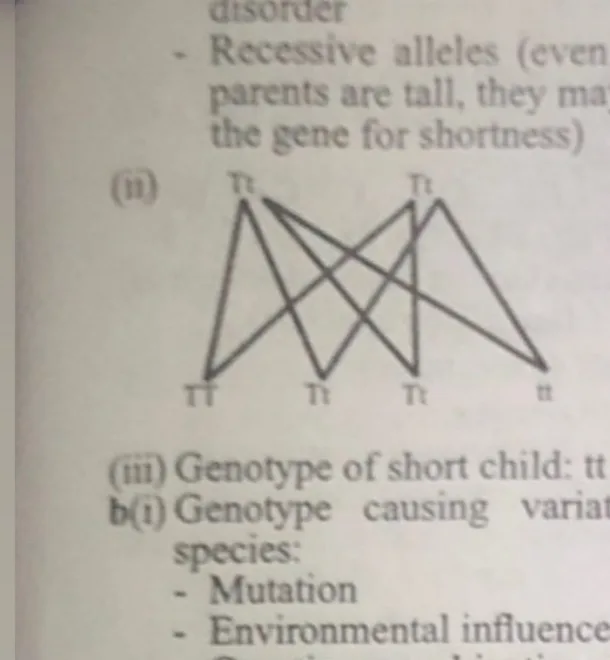
4. A tall man and a tall woman have a child that is short. (a)(i) State two factors that could be responsible for the height of their child. (ii) With the aid of a genetic diagram, give the genotypes of the offspring if the allele for tallness is T. (iii) Give the genotype of the child that is short.
Model answer
(i) Factors responsible for short height in a child of two tall parents: Poor nutrition or environmental factors; Hormonal imbalances or growth disorder; Recessive alleles (even though the parents are tall, they may both carry the gene for shortness).
(ii) Genetic diagram: Parents Tt x Tt -> Offspring genotypes: TT, Tt, Tt, tt (see genetic cross diagram).
(iii) Genotype of the short child: tt
4(b)(i) Define the term genotype. (ii) List two factors that could cause variation in a character within the same species.
Model answer
(i) Genotype is the genetic constitution (the set of alleles) an organism possesses for a particular trait.
(ii) Factors causing variation within species: Mutation; Environmental influences; Genetic recombination during meiosis (any two).
4(c)(i) Define the term allele. (ii) State two differences between genotype and phenotype.
Model answer
(i) An allele is an alternative form of a gene found at a specific locus on a chromosome. For example, T and t are alleles for height.
(ii) Differences: Genotype includes alleles inherited from parents while phenotype includes the physical (observable) traits; Genotype is not visible while phenotype is visible/measurable; Genotype is influenced by heredity only while phenotype is influenced by both genotype and environment (any two).
5(a) State five effects of high temperature on organisms in their habitats.
Model answer
- Increased rate of water loss through evaporation
- Heat stress leading to death
- Altered reproductive cycles
- Increased transpiration
- Denaturation of enzymes
- Disruption of metabolic processes (any five)
5(b) Mention five effects of bush burning on the ecosystem.
Model answer
- Destruction of habitats and biodiversity
- Reduced soil fertility
- Death of beneficial microorganisms
- Disruption of nutrient cycles
- Loss of vegetation cover leading to erosion (any five)
5(c) State four roles of the World Health Organization (WHO) in the control of pandemic diseases.
Model answer
- Surveillance and monitoring of outbreaks
- Coordinating international response
- Distribution of vaccines and medical supplies
- Public education and information dissemination
- Development of policies and health protocols
- Mobilization of emergency funding (any four)
5(d)(i) Explain briefly countershading as an adaptive feature of Tilapia in freshwater habitats. (ii) Explain briefly seasonal migration in birds.
Model answer
(i) Countershading in Tilapia: a camouflage adaptation where the dorsal side (top) of the fish is darker and the ventral side (bottom) is lighter. This helps the fish blend into the aquatic environment (darker from above, lighter from below), making it less visible to predators.
(ii) Seasonal migration in birds: the regular, often long-distance movement of birds between breeding and non-breeding areas in response to seasonal changes. It allows them to exploit different habitats for food and nesting while avoiding harsh climatic conditions.
5(f) A patient with blood group O requires blood transfusion. (i) Name two blood groups that the patient should not be transfused with. (ii) State two likely effects that the transfusion of any of the blood groups named in 5(f)(i) would have on the patient.
Model answer
(i) The blood groups not to be transfused into a patient with blood group O are: A, B and AB (any two). NB: Even though O can donate to all groups, it can only receive from a fellow O.
(ii) Likely effects of transfusing incompatible blood: Agglutination (clumping) of red blood cells; Severe allergic reactions; Death in extreme cases (any two).
Advertisement
Sign up free to unlock
Score tracking
Practice history
Saved questions
Progress dashboard
Personalized sessions
Weak-topic breakdown
…and/or go further with premium services and No Ads.