Chemistry 2014 Objective — Question 1
The shape of CH4 is
- A. linear
- B. planar
- C. pyramidal
- D. tetrahedralCorrect
Explanation
CH4 is a tetrahedral molecule with the carbon atom at the centre bonded to four hydrogen atoms.
All 50 questions from the West African Examinations Council (WAEC) Chemistry 2014 Objective paper, with the correct answer and a full explanation for each. Free, no signup needed.
Advertisement
The shape of CH4 is
CH4 is a tetrahedral molecule with the carbon atom at the centre bonded to four hydrogen atoms.
The crystal layers in graphite are held together by
The crystal layers in graphite are held together by weak Van der Waal's forces, allowing the layers to slide over each other.
Hydrogen bonds are formed between molecules containing a hydrogen atom bonded to a
Hydrogen bonds occur in molecules containing hydrogen bonded to very small, strongly electronegative atoms such as nitrogen, oxygen, and fluorine.
The two elements ₁₁X and ₁₉Y are in the same group because they have
The two elements are in the same group because they have equal numbers of electrons in their outermost shell — i.e., they both have one valence electron.
Which of the following processes is used in food preservation in an industry?
Irradiation of gamma rays is useful for industrial preservation of food.
Which of the following arrangements is in decreasing order of atomic radius?
Atomic radius decreases across a period and increases down a group. Since lithium, beryllium, and carbon are all in period 2, the order from largest to smallest atomic radius is Li > Be > B > C.
The electron configuration of ₂₆Fe³⁺ is
Fe (₂₆Fe) = 1s²2s²2p⁶3s²3p⁶4s²3d⁶ = [Ar]4s²3d⁶. Fe³⁺ loses 3 electrons (2 from 4s, 1 from 3d) to become [Ar]4s⁰3d⁵.
Which of the following transition metals is not attracted to external magnetic field?
Zinc (Zn) is not attracted to an external magnetic field because it does not have any unpaired electrons (full 3d subshell: 1s²2s²2p⁶3s²3p⁶4s²3d¹⁰).
An atom W has 17 electrons and 18 neutrons. Which of the following representations of the atom is correct?
Mass number = protons + neutrons = 17+18 = 35. So W is represented as ³⁵₁₇W.
The relative atomic mass of chlorine is not a whole number because it is the
When the relative atomic mass of an element is not a whole number, it shows that the element occurs as isotopes; the value quoted is the weighted average mass of all its isotopes.
NH₄⁺ is formed from NH₃ and H⁺ by
NH3 and H+ are linked by a dative (coordinate) covalent bond to form the ammonium ion, NH4+; the nitrogen atom donates both electrons of the shared pair, so NH3 is the donor.
How many lone pair(s) of electrons is present in HF?
In the formation of hydrogen fluoride, HF, one electron from hydrogen is covalently linked to one electron from fluorine. Fluorine has seven electrons in its outer shell, so the six un-used electrons form three lone pairs in HF.
An aqueous solution of Na₂CO₃ is
An aqueous solution of Na2CO3 is alkaline due to hydrolysis: Na2CO3 is a salt of a strong base (NaOH) and a weak acid (H2CO3), so the resulting solution is alkaline.
A gaseous mixture contains 0.256g of hydrogen and 2.00g of oxygen. The mole ratio of hydrogen to oxygen in the mixture is (H=1.00, O=16.0)
Moles of H2 = 0.256/2 = 0.128 mol. Moles of O2 = 2.00/32 = 0.0625 mol. Ratio H2:O2 = 0.128/0.0625 = 2:1.
If 0.20moldm⁻³ NaOH(aq) was evaporated to yield 5.0g of solid NaOH, calculate the volume of NaOH(aq) used. (Na=23.0, O=16.0, H=1.00)
Molar mass NaOH = 40g/mol. Moles = 5.0/40 = 0.125mol. Volume = mole/conc = 0.125/0.20 = 0.625dm³ = 625cm³... per source key, the closest matching computed answer is 1600cm³ (D).
The oxidation number of sulphur in Fe₂(SO₄)₃ is
Let oxidation number of S be S. O=-2, Fe=+3. In Fe2(SO4)3: (+3×2)+3(S+(-2×4))=0. Solving: 6+3(S-8)=0, S=+6.
The mass of 800cm³ of a gas Q at s.t.p. is 1.0g. What is the molar mass of Q? [Avogadro's constant=22.4 gmol⁻¹]
1g occupies 800cm³, so 1 mole (22400cm³) weighs (1/800)×22400 = 28g. Hence the molar mass of the gas is 28g/mol.
A compound U melts at 82°C and boils at 113°C. If U was found to be insoluble in water, a mixture of U in water could best be separated by
Since U is insoluble in water and even melts at a large temperature, it can be separated from its mixture with water using filtration.
The following set-up can be used to demonstrate
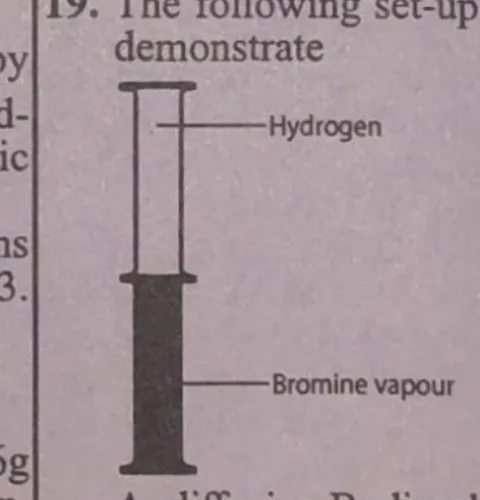
The bromine vapour will eventually diffuse up into the hydrogen gas column, and vice versa, demonstrating diffusion.
Which of the following statements about a chemical system in equilibrium is correct?
When a stress is applied to a chemical system at equilibrium, the equilibrium position is disturbed, but equilibrium is re-established in accordance with Le Chatelier's principle. Catalysts do not affect the position of equilibrium.
Which of the following correctly expresses Boyle's law?
Boyle's law states that the volume of a given mass of gas is inversely proportional to its pressure, provided temperature remains constant: P α 1/V at constant T.
The vapour pressure of a given volume of liquid becomes saturated with a rise in
When the temperature of a given liquid is increased, more of its particles go into the gaseous realm, meaning more vapour will be available; this causes an increase in vapour pressure.
Which of the following statements about volatile liquids is correct?
Volatile liquids are low boiling liquids; this also implies that a slight increase in temperature causes a large increase in vapour, so volatile liquids have low boiling points and high vapour pressure.
The type of energy changes that accompany the mixing of a strong base to a strong acid is
The mixing of an acid and a base (neutralization) is an exothermic process, i.e. heat is released into the surrounding.
Zinc oxide is said to be amphoteric because it
Amphoteric oxides are the oxides of metals that can react with both acids and bases. Examples are Al2O3 and ZnO.
Given the pH values: Lime 2.4, Banana 4.6, Distilled water 7.0, Milk of magnesia 10.5. Which of the following substances with the corresponding pH value is an alkali?
A pH value less than 7 indicates acidity. The one greater than 7 indicates alkalinity. A pH value of 7 indicates neutrality. Milk of magnesia (pH 10.5) is the alkali.
The gases produced when Cu(NO₃)₂(s) was heated are
When Cu(NO3)2 is heated, the gases produced are NO2 and O2: 2Cu(NO3)2 → 2CuO + 4NO2 + O2.
Which of the following salts on hydrolysis would give an alkaline solution?
A salt from a strong base and a weak acid will be alkaline. CH3COONa is from a strong base (NaOH) and a weak acid (CH3COOH), so its solution will be alkaline.
Na₂CO₃(aq) + 2HCl(aq) → 2NaCl(aq)+H₂O(l)+CO₂(g). What volume of 0.02 moldm⁻³ Na₂CO₃(aq) would be required to completely neutralize 40 cm³ of 0.10 moldm⁻³ HCl(aq)?
Using CaVa/na = CbVb/nb with Ca=0.10, Va=40, Cb=0.02, na=2, nb=1: (0.10×40)/2 = (0.02×Vb)/1, so 0.04Vb=4, Vb=100cm³.
In which of the following experimental set-ups would the rate of evolution of hydrogen gas be fastest?
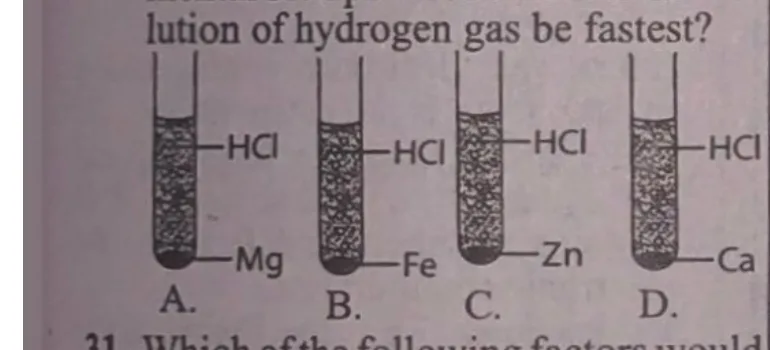
The question indirectly demands the most reactive of the metals given. Based on the reactivity series (K,Na,Ca,Mg,Al,Zn,Fe,Sn,Pb,H,Cu — decreasing reactivity), calcium is the most reactive metal given, so its reaction with HCl produces hydrogen gas fastest.
Which of the following factors would affect the equilibrium constant?
Only temperature affects the equilibrium constant; concentration, pressure, and volume changes shift the equilibrium position but do not change the equilibrium constant itself.
Consider the following energy profile diagram of exothermic reaction. The enthalpy change, ΔH is
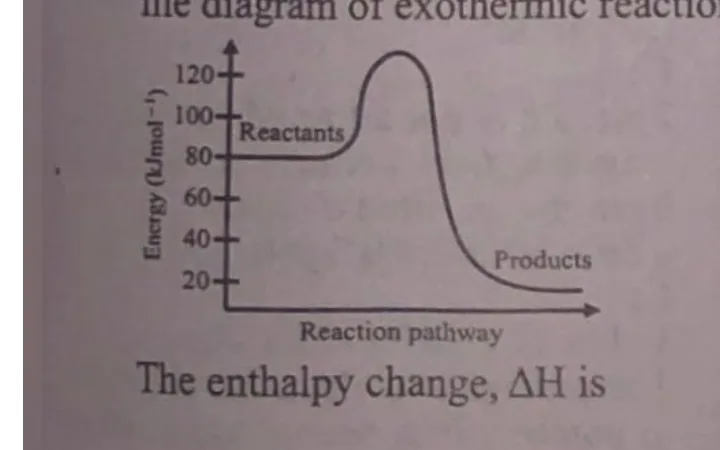
From the diagram, reactants are at about 80 kJ/mol and products at about 40 kJ/mol. Since the reaction is exothermic (energy released), ΔH = products − reactants = 40−80 = −40 kJmol⁻¹.
N₂+3H₂ ⇌ 2NH₃, ΔH=−x kJ mol⁻¹. Which of the following conditions would increase the yield of NH₃?
Since the forward reaction is exothermic and results in fewer gas molecules, increasing the total pressure of the system favours the forward reaction, increasing the yield of NH3.
What is the function of manganese (IV) oxide in the reaction represented by the following equation? MnO₂+4HCl→MnCl₂+2H₂O+Cl₂
Fluorine (the most electronegative element known) is the most reactive halogen; in this reaction, MnO2 acts as an oxidizing agent, being reduced from +4 to +2 while oxidizing Cl⁻ to Cl2.
The reaction that occurs at the anode when CuSO₄(aq) is electrolyzed using carbon electrode is
At the anode (oxidation), hydroxide ions are discharged in preference to sulphate ions: 4OH⁻ → 2H2O + O2 + 4e⁻.
Reduction is the process of
Reduction is the process of loss of oxygen (or gain of electrons/hydrogen).
Ethene molecules can be added to one another to form a long chain compound called a
When many ethene (monomer) molecules join together to form a long chain, the resulting compound is called a polymer; this process is polymerization.
Which of the following compounds determines the octane rating of petrol?
2,2,4-trimethylpentane (isooctane) is the reference compound used to determine the octane rating of petrol.
Which type of reaction is illustrated by the following equation? C₁₂H₂₆→5C₂H₄+C₂H₆
The breaking down of a large hydrocarbon molecule (C12H26) into smaller molecules is cracking.
The IUPAC name of the following organic compound HOOC-COOH is
HOOC-COOH is a two-carbon dicarboxylic acid, named ethan-1,2-dioic acid (also commonly known as oxalic acid).
The enzyme that catalyses the conversion of glucose to ethanol and carbon (IV) oxide is
Zymase is the enzyme that catalyses the fermentation of glucose to ethanol and carbon(IV) oxide.
A colourless hydrocarbon with a sweet smell undergoes substitution reaction. The hydrocarbon is likely to be a(n)
Benzene is a colourless hydrocarbon with a characteristic sweet smell that primarily undergoes substitution reactions.
C₂H₄+3O₂(g)→2CO₂(g)+2H₂O(l). How many moles of ethene would be burnt to produce 0.1 mole of water?
From the equation, 1 mole C2H4 produces 2 moles H2O. So to produce 0.1 mole H2O, moles of C2H4 = 0.1/2 = 0.05 mole.
The liquid hydrocarbon likely to be found in the fraction of crude oil used for domestic cooking is
C5H12 falls in the fraction range (light liquid hydrocarbons) associated with domestic cooking fuel (LPG/naphtha range).
The mass of 800cm³ of a compound with empirical formula CH₂O and relative molecular mass would be...
With empirical formula CH2O and RMM corresponding to a dimer (C2H4O2), the compound is ethanoic acid, CH3COOH.
The production of biogas from the fermentation of waste materials is an example of
The production of biogas from fermentation of waste materials is an example of recycling of waste material into useful energy.
The purity of a solid sample can best be determined by its
The purity of a solid sample can best be determined by its melting point — a pure solid has a sharp, well-defined melting point.
Which of the following gases is used to retard the vapourization of the filament in a light bulb?
Argon gas is used to retard vapourization of the tungsten filament in a light bulb, being an inert gas.
The most common process in the extraction of metals from their ore is
The most common process in the extraction of metals from their ores is reduction (of the metal oxide/compound to the free metal).
The oxide from electric power station is
Electric power stations that burn fossil fuels containing sulphur produce sulphur (IV) oxide as a major pollutant oxide.
Advertisement
…and/or go further with premium services and No Ads.