All 28 questions from the West African Examinations Council (WAEC) Chemistry 2019 Theory paper, with the correct answer and a full explanation for each. Free, no signup needed.
1(a) State the conditions necessary for the cracking of long-chain hydrocarbons to produce more gasoline. [2 marks]
Model answer
There are two types of cracking:
• Thermal cracking: large hydrocarbons are broken into smaller ones using a high temperature of about 450–750°C and a pressure of about 70 atmospheres.
• Catalytic cracking: the hydrocarbon is brought into contact with a catalyst (commonly a zeolite) at about 500°C and a moderately low pressure.
1(c)(i) Explain briefly why calcium oxide cannot be used to dry hydrogen chloride gas.
(ii) State one drying agent for hydrogen chloride gas. [3 marks]
Model answer
(i) Calcium oxide is alkaline (basic) while hydrogen chloride gas is acidic, so the two would react together instead of the CaO simply drying the gas. (A drying agent must not react chemically with the gas it is drying.)
(ii) Concentrated tetraoxosulphate(VI) acid (concentrated H2SO4) is normally used to dry hydrogen chloride gas.
1(d) Concentrated trioxonitrate(V) acid was added to a solution of iron(II) tetraoxosulphate(VI) and the mixture heated. The mixture turned from pale green to yellow with the evolution of a brown gas. Explain briefly these observations. [3 marks]
Model answer
The yellow colour obtained results from the oxidation of iron(II) ions (pale green, Fe²⁺) to iron(III) ions (yellow, Fe³⁺) by the concentrated HNO3.
The brown gas evolved is nitrogen(IV) oxide (NO2), formed from the nitrogen(II) oxide produced in the reaction, upon exposure to air: 2NO + O2 → 2NO2.
1(e)(i) Write the equation for the reaction between zinc oxide and I. dilute tetraoxosulphate(VI) acid, II. Sodium hydroxide solution.
(ii) State which property of zinc oxide is shown by the reactions in 1(e)(i). [5 marks]
Model answer
(i) I. ZnO + H2SO4 → ZnSO4 + H2O
II. ZnO + 2NaOH + H2O → Na2Zn(OH)4
(ii) These equations demonstrate the amphoteric nature of ZnO — a substance is amphoteric if it can react with both an acid and a base.
1(f) Two isotopes of chlorine are 35/17Cl and 37/17Cl.
State one: (i) similarity; (ii) difference between the isotopes. [2 marks]
Model answer
(i) Similarity: Both 35Cl and 37Cl have the same number of protons (17), i.e. the same atomic number.
(ii) Difference: 35Cl contains 18 neutrons, while 37Cl contains 20 neutrons (they have different mass numbers/number of neutrons).
1(g) State the two products formed when chlorine water is exposed to sunlight. [2 marks]
Model answer
When chlorine water is exposed to sunlight, it decomposes to give hydrochloric acid (HCl) and oxygen (O2):
Cl2 + H2O → HCl + HOCl, then HOCl →(sunlight)→ HCl + ½O2.
The two products are HCl and O2.
1(h) Consider the reaction represented by the following equation:
H2S + SO2 →(H+)→ S + H2O.
State the: (i) species that is undergoing oxidation; (ii) Oxidizing agent [4 marks]
Model answer
(i) H2S undergoes oxidation — the oxidation number of sulphur increases from –2 in H2S to 0 in elemental sulphur, S.
(ii) SO2 is the oxidizing agent — it undergoes reduction (its sulphur is reduced), and a species that is itself reduced acts as the oxidizing agent.
The carbon-12 scale is the scale on which the relative atomic masses of different atoms are expressed. On this scale, the relative atomic mass of an element is defined as the number of times one atom of the element is heavier than one-twelfth (1/12) the mass of one atom of carbon-12.
1(j) State two properties of a chemical system in equilibrium. [2 marks]
Model answer
(i) A chemical equilibrium is dynamic in nature — both the forward and reverse reactions continue to occur, but at equal rates.
(ii) The concentrations of all chemical species present in the system remain constant as long as the reaction conditions (temperature, pressure, etc.) are unchanged.
2(a) A hydrocarbon having the formula C10H22 was cracked to produce C6H14 and another hydrocarbon P.
(i) Give the molecular formula of P.
(ii) Draw the structure of two isomers of P.
(iii) Give a reason why P could be polymerized. [4 marks]
Model answer
(i) C10H22 → C6H14 + P. By balancing atoms, the molecular formula of P is C4H8 (but-1-ene or but-2-ene, an alkene).
(ii) Two isomers of P (C4H8):
• But-1-ene: CH2=CH–CH2–CH3
• But-2-ene: CH3–CH=CH–CH3
(iii) P can be polymerized because it is unsaturated — it contains a C=C double bond which can open up to link with other identical monomer units to form a polymer.
2(b) State the guiding principles which are used to explain the way electrons of the atoms of the elements are arranged in atomic orbitals. [4 marks]
Model answer
• Aufbau principle: electrons fill orbitals starting from the lowest energy level before occupying higher-energy orbitals.
• Pauli exclusion principle: no two electrons in an atom can have the same set of all four quantum numbers (i.e. an orbital can hold a maximum of 2 electrons with opposite spins).
• Hund's rule of maximum multiplicity: when filling degenerate orbitals (of the same energy), electrons occupy each orbital singly before any orbital receives a second electron (pairing).
2(c) Consider each of the following substances: NaH, H2, H2S, NH4Cl.
(i) Describe the nature of the intermolecular forces holding the units or molecules together in the condensed (liquid or solid) state.
(ii) Explain briefly what happens when a sample of each of the substances is added to water.
(iii) Write the chemical equations of any reactions occurring or of any equilibria established. [14 marks]
Model answer
(i) Intra-molecular forces (e.g. covalent/ionic bonds) hold atoms together within a molecule/compound, and are generally much stronger than inter-molecular forces, which hold separate molecules together in a liquid or solid and determine bulk properties such as melting and boiling points; they are electrostatic in nature. NaH is ionic (held by strong electrostatic ionic bonds); H2 and H2S are held together in the condensed state by weak van der Waals forces (H2S also has some dipole-dipole attraction); NH4Cl is ionic, held by strong electrostatic forces between NH4+ and Cl– ions.
(ii) • NaH: reacts vigorously with water; an alkaline solution (NaOH) is formed and hydrogen gas is liberated.
• H2: no reaction occurs when hydrogen gas is passed into water.
• H2S: dissolves to give a weakly acidic solution which turns blue litmus red.
• NH4Cl: dissolves appreciably in water; the container feels cold to the touch (the dissolution is endothermic).
(iii) NaH + H2O → NaOH + H2
NH4Cl + H2O ⇌ H3O+ + NH3 + Cl– (or NH4Cl + H2O → NH4OH + HCl)
3(a)(i) In the Solvay process, explain briefly with equations the functions of the following substances: (i) Limestone; (ii) ammonia. [7 marks]
Model answer
• Limestone (CaCO3): its function is to decompose on heating to produce calcium oxide (used to regenerate ammonia from NH4Cl) and carbon(IV) oxide (used in forming the sodium hydrogentrioxocarbonate(IV)):
CaCO3 →(Δ)→ CaO + CO2
• Ammonia (NH3): it combines with water and carbon(IV) oxide to form ammonium hydrogentrioxocarbonate(IV), which then reacts with brine to precipitate sodium hydrogentrioxocarbonate(IV):
NH3 + H2O + CO2 → NH4HCO3
3(b)(ii) Explain briefly why a tightly corked glass bottle filled to the brim with fresh palm-wine shatters on standing for some time. [5 marks]
Model answer
As the glucose inside the palm-wine ferments, carbon(IV) oxide gas is continuously released. Since the bottle is tightly corked and filled to the brim, the gas cannot escape, so it exerts increasing pressure inside the bottle. As fermentation progresses, the pressure eventually becomes too great for the glass to withstand, and the bottle shatters.
3(c) Consider the following metals: Na, Fe, K and Cu.
(i) Arrange the metals in order of increasing reactivity.
(ii) Which of the metals will react with cold water?
(iii) Which of the metals could form coloured salts? [3 marks]
Model answer
(i) Increasing reactivity: Cu < Fe < Na < K
(ii) Only sodium (Na) and potassium (K) react with cold water.
(iii) Copper (Cu) will form coloured salts, since it is a transition element.
3(d)(i) What is a redox reaction?
(ii) Identify which of the following reactions are redox:
I. 2Na+Cl2→2NaCl
II. AgCl+2NH3→[Ag(NH3)2]Cl
III. C2H2+H2→C2H4
IV. 2FeCl3+2KI→2FeCl2+2KCl+I2
(iii) Give a reason for each of the answers in 3(d)(ii).
(iv) Write balanced equations for any two of the redox reactions identified in 3(d)(ii). [10 marks]
Model answer
(i) A redox reaction is one in which a chemical species undergoes reduction while another species simultaneously undergoes oxidation (i.e. electron transfer occurs between reactants).
(ii)/(iii):
I. 2Na+Cl2→2NaCl — REDOX (Na is oxidized: 2Na→2Na⁺+2e–; Cl2 is reduced: Cl2+2e–→2Cl–)
II. AgCl+2NH3→[Ag(NH3)2]Cl — NOT redox (it is a complex-formation/ligand-substitution reaction; oxidation states of all atoms remain unchanged throughout)
III. C2H2+H2→C2H4 — REDOX (an addition/hydrogenation reaction in which C2H2 is reduced by the addition of hydrogen while H2 is oxidized)
IV. 2FeCl3+2KI→2FeCl2+2KCl+I2 — REDOX (Fe is reduced from +3 to +2: 2Fe3++2e–→2Fe2+; I is oxidized from –1 to 0: 2I–→I2+2e–)
(iv) Cl2+2e–→2Cl– (reduction) and 2Na→2Na⁺+2e– (oxidation); or 2Fe3++2e–→2Fe2+ (reduction) and 2I–→I2+2e– (oxidation).
4(a) [FOR CANDIDATES IN NIGERIA AND THE GAMBIA] The following reaction scheme is an illustration of the contact process. Study the scheme and answer the questions that follow.
(i) Name X and Y.
(ii) Write balanced chemical equations for each of the processes I, II, III and IV.
(iii) Name the catalyst used in process II.
(iv) Using Le Chatelier's principle, explain briefly why increasing the temperature would not favour the reaction in II.
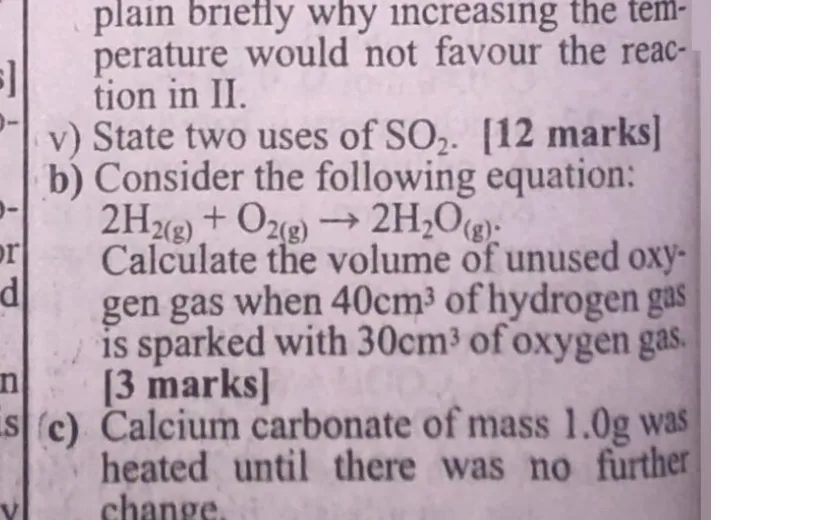
(v) State two uses of SO2. [12 marks]
Model answer
(i) X is oxygen while Y is sulphur.
(ii) I. S(s)+O2(g)→SO2(g)
II. 2SO2(g)+O2(g)⇌2SO3(g)
III. SO3(g)+H2SO4(aq)→H2S2O7(l) (oleum)
IV. H2S2O7(l)+H2O(l)→2H2SO4(aq)
(iii) The catalyst used in process II is vanadium(V) oxide, V2O5.
(iv) The forward reaction (II) is exothermic, so by Le Chatelier's principle, increasing the temperature would only favour the backward (endothermic) reaction, reducing the yield of SO3.
(v) SO2 is used in the manufacture of H2SO4, and for bleaching wood pulp/wool/silk (also used for destroying bacteria and fungi/as a preservative).
4(b) Consider the following equation: 2H2(g)+O2(g)→2H2O(g). Calculate the volume of unused oxygen gas when 40cm³ of hydrogen gas is sparked with 30cm³ of oxygen gas. [3 marks]
Model answer
Mole ratio of H2:O2 in the equation is 2:1, so 40 cm³ of H2 requires only 20 cm³ of O2 to react completely.
Volume of unused (excess) oxygen = 30 − 20 = 10 cm³.
4(c) Calcium carbonate of mass 1.0g was heated until there was no further change.
(i) Write an equation for the reaction which took place.
(ii) Calculate the mass of the residue.
(iii) Calculate the volume of the gas evolved at s.t.p.
(iv) What would be the volume of the gas measured at 15°C and 760mmHg? [C=12.0, O=16.0, volume of a gas at s.t.p.=22.4dm³] [10 marks]
Model answer
(i) CaCO3(s) →(Δ)→ CaO(s) + CO2(g)
(ii) Moles of CaCO3 = 1.0/100 = 0.01 mol. Since mole ratio CaCO3:CaO = 1:1, moles of CaO (residue) = 0.01 mol. Molar mass CaO = 56 g/mol, so mass of residue = 0.01×56 = 0.56 g.
(iii) Since mole ratio CaCO3:CO2 = 1:1, moles of CO2 = 0.01 mol. Volume at s.t.p. = moles × 22.4 dm³ = 0.01×22.4 = 0.224 dm³.
(iv) Using Charles'/combined gas law with P constant: V1/T1 = V2/T2, where V1=0.224 dm³, T1=273K, T2=(15+273)=288K.
V2 = V1×T2/T1 = 0.224×288/273 = 0.236 dm³.
5(a)(i) Draw and label a diagram to illustrate the preparation and collection of dry chlorine gas in the laboratory.
(ii) State two uses of chlorine. [9 marks]
Model answer
(i) Dry chlorine gas is prepared in the laboratory by heating concentrated hydrochloric acid with manganese(IV) oxide (MnO2) in a flask; the gas produced is passed through concentrated H2SO4 (to dry it) and collected by downward delivery (chlorine is denser than air), as shown in the labelled diagram.
(ii) Chlorine is used for water purification/disinfection, and for the manufacture of important organic solvents such as tetrachloromethane and trichloromethane (it is also used in bleaching powder manufacture and aerosol propellants).
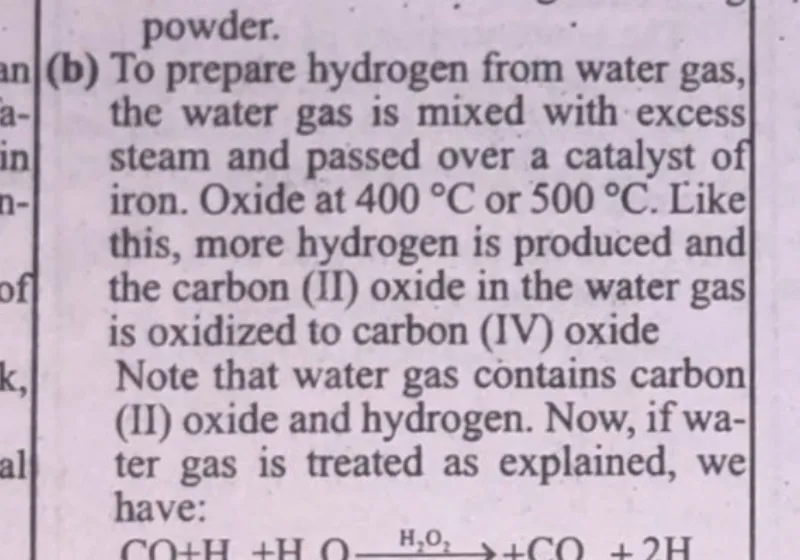
5(b) Describe the preparation of hydrogen from water gas. [8 marks]
Model answer
To prepare hydrogen from water gas, the water gas (a mixture of CO and H2) is mixed with excess steam and passed over an iron oxide catalyst at 400–500°C. This produces more hydrogen while the carbon(II) oxide in the water gas is oxidized to carbon(IV) oxide:
CO + H2 + H2O →(catalyst)→ CO2 + 2H2
The carbon(IV) oxide formed is removed by dissolving it in water under pressure (about 30 atmospheres); any unreacted CO is absorbed in an ammoniacal solution of copper(I) methanoate, leaving pure hydrogen gas.
5(c)(i) Name the chief ore of aluminium.
(ii) Why is the ore purified?
(iii) Name the electrode used in the electrolysis of bauxite to produce aluminium.
(iv) Give one reason why cryolite, NaAlF6, is added to the electrolyte.
Model answer
(i) The chief ore of aluminium is bauxite.
(ii) The ore is purified because it contains impurities such as iron(III) oxide and trioxosilicates, which must be removed before electrolysis.
(iii) In the electrolysis of purified bauxite, the anode is made of graphite (carbon) while the cathode is iron.
(iv) Cryolite is added because it lowers the melting point of bauxite (alumina), reducing the energy cost of electrolysis; it also serves as a solvent for the alumina.
Practical Q1(a) A is a solution containing 15.8 gdm⁻³ of Na2S2O3. B was obtained by dissolving 9.0g of an impure sample of I2 in aqueous KI and the solution made up to 1 dm³.
(i) Put A into the burette and titrate it against 20.0 cm³ or 25.0 cm³ portions of B, using starch solution as indicator. Repeat the titration to obtain concordant titre values.
Equation: I2+2S2O3²⁻→2I⁻+S4O6²⁻.
(b) From your results, calculate: (i) concentration of A in moldm⁻³; (ii) concentration of I2 in B in moldm⁻³; (iii) percentage by mass of I2 in the sample.
(c) Give a reason why the starch indicator was not added at the beginning of the titration. [23 marks]
Model answer
Sample titration results: Rough=21.20, I=17.60, II=18.40, III=16.50 (final readings); average volume of A used (from concordant titres I–III) = (16.60+16.40+16.50)/3 = 16.50 cm³.
(b)(i) Molar mass Na2S2O3 = (23×2)+(32×2)+(16×3)=158 g/mol. Concentration in gdm⁻³ of Na2S2O3 = 15.8 gdm⁻³, so Concentration in moldm⁻³ = 15.8/158 = 0.1 moldm⁻³.
(ii) Using CaVa/Na = CbVb/Nb with Ca=0.1 moldm⁻³, Va=16.50 cm³, Na=2 (S2O3²⁻), Vb=25 cm³, Nb=1 (I2):
Cb = (Ca×Va×Nb)/(Vb×Na) = (0.1×16.50×1)/(25×2) = 0.033 moldm⁻³.
(iii) Molar mass I2 = 254. Concentration of I2 in gdm⁻³ = 0.033×254 = 8.38 gdm⁻³ (mass of I2 in the sample). Given mass of impure I2 sample = 9.0 gdm⁻³.
Percentage by mass of I2 = (8.38/9.0)×100 = 93.1%.
(c) The starch indicator is added only near the end-point because if added at the beginning, the iodine is strongly adsorbed onto the starch, making it difficult to desorb, which reduces the accuracy/sharpness of the final colour-change reading.
Practical Q2 C is a mixture of two inorganic compounds. Carry out the following exercises on C: record your observations and identify any gas(es) evolved. State the conclusions you draw from the results of each test.
(a) Test 10cm³ of distilled water with sample C, shake, filter; test the residue and filtrate with a further sample.
(b)(i) To about 2cm³ of the filtrate add a few drops of AgNO3, followed by dilute HNO3. (ii) Add excess NH3 solution to the resulting mixture.
(c)(i) Put the residue in a test tube, add about 2cm³ of dilute HCl and shake. (ii) Add NH3 solution in drops and then in excess.
Model answer
(a) Part of the 10cm³ of distilled water sample dissolves the soluble part of C, leaving an insoluble residue; on shaking thoroughly and filtering, a colourless filtrate is obtained and an insoluble residue is retained — C is a mixture of a soluble and an insoluble part.
(b)(i) A white precipitate is formed with the filtrate and AgNO3, which is insoluble in dilute HNO3 — this indicates the presence of chloride (Cl⁻) ions.
(ii) On adding excess NH3, the white precipitate dissolves in excess NH3(aq), consistent with AgCl formation and its dissolution to form a soluble complex.
(c)(i) The residue partly dissolves in dilute HCl, giving a colourless (and odourless) gas with rapid effervescence, which turns lime water milky (identified as CO2, i.e. carbonate/CO3²⁻ present) — indicating the residue contains a carbonate.
(ii) A blue gelatinous precipitate is formed with NH3 in drops, which dissolves in excess NH3(aq) to form a deep blue solution — indicating the presence of Cu²⁺ ions.
Practical Q3(a)(i) State what would be observed when BaCl2 solution is added to a portion of a saturated Na2CO3 followed by dilute HCl in excess.
(ii) A gas Q decolorized acidified KMnO4 solution. Suggest what Q could be. [4 marks]
(b) Name one substance used in the laboratory for drying each of the following substances: (i) ammonia gas; (ii) carbon(IV) oxide [2 marks]
(c) Give a reason why a given mass of sodium hydroxide pellets cannot be used to prepare a standard solution. [2 marks]
Model answer
(a)(i) A white precipitate (BaCO3) is formed with BaCl2; on adding excess dilute HCl, the white precipitate dissolves with the evolution of a colourless, odourless gas that turns lime water milky (CO2), i.e. Ba2++CO3²⁻→BaCO3, then BaCO3+2HCl→BaCl2+H2O+CO2.
(ii) Q is likely sulphur(IV) oxide, SO2 (a reducing gas that decolorizes acidified KMnO4 by reducing it).
(b)(i) Concentrated tetraoxosulphate(VI) acid is normally used to dry hydrogen chloride gas; ammonia gas itself is dried using calcium oxide (quicklime), since it is basic and would react with acidic drying agents.
(ii) Carbon(IV) oxide is dried using concentrated H2SO4.
(c) Sodium hydroxide pellets are deliquescent — they absorb moisture from the atmosphere, so their mass keeps changing/varying, meaning an accurate, fixed concentration (a true standard solution) cannot be obtained from them.
Advertisement
Sign up free to unlock
Score tracking
Practice history
Saved questions
Progress dashboard
Personalized sessions
Weak-topic breakdown
…and/or go further with premium services and No Ads.