All 31 questions from the West African Examinations Council (WAEC) Chemistry 2021 Theory paper, with the correct answer and a full explanation for each. Free, no signup needed.
1(a). Distinguish between molecular formula and structural formula.
Model answer
Molecular formula gives the total number of atoms of each element present in one molecule of a compound, while structural formula shows the graphical arrangement/representation of the atoms and bonds in the compound.
1(c). State the two conditions necessary for the establishment of a chemical equilibrium.
Model answer
(i) The rates of the forward and backward reactions must be equal. (ii) The system must be closed, i.e. there must be no loss of mass or exchange of matter between the system and its environment. (Other acceptable conditions: ΔG must be zero; the system must be dynamic.)
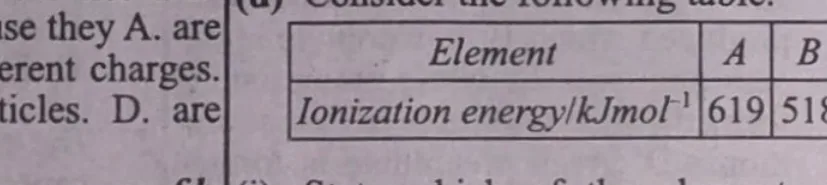
1(d). Consider the following table: Element A, B, C with Ionization energy (kJmol⁻¹) 619, 518, 594 respectively. (i) State which of the elements is the strongest reducing agent. (ii) Give a reason for the answer stated in (i).
Model answer
(i) Element B is the strongest reducing agent.
(ii) It has the lowest ionization energy (518 kJmol⁻¹), so it loses its outermost electron most easily, making it the strongest reducing agent.
Graham's law states that the rate of diffusion of a gas (at constant temperature and pressure) is inversely proportional to the square root of its density (or molar mass).
Atomic radius is half the distance between the nuclei of two close (bonded/touching) atoms in a molecule — a measure of the size of an atom, from the centre of the nucleus to the boundary of the surrounding electron shells.
1(i). Explain briefly why ethanol has a higher boiling point than propane even though they both have comparable molar masses.
Model answer
Ethanol molecules form strong intermolecular hydrogen bonds (via the O-H group), which are stronger than the weak Van der Waals forces present between propane molecules, so more energy is needed to separate ethanol molecules, giving it a higher boiling point.
1(j). State three significance of the pH value in everyday life.
Model answer
Any three of: determining pH of soil for agriculture; digestion of food; role in survival of animals/existence of living things; pH changes as a cause of tooth decay; treatment of water for public supply; treatment of industrial effluent/liquid waste; determining pH of body fluids (urine/blood) in medicine.
2(a)(i). State two characteristics of homologous series.
Model answer
Any two of: members can be represented by a general formula; each member differs from the next by a fixed number of atoms (a CH2 group, 14 amu); members show a gradual change in physical properties (density, solubility, etc.); members have similar chemical properties/the same functional group; members can be prepared by similar chemical methods.
2(a)(ii). Explain briefly why there are differences in the reaction of ethene and ethane.
Model answer
Ethane is a saturated hydrocarbon (single C-C bond) and mainly undergoes substitution reactions, while ethene is unsaturated (contains a C=C double bond) and therefore mainly undergoes addition reactions.
2(b). When crystals of sodium chloride are warmed with concentrated tetraoxosulphate (VI) acid, a gas was produced. (i) Name the gas. (ii) State two physical properties of the gas. (iii) Write a balanced chemical equation for the reaction.
Model answer
(i) Hydrogen chloride gas.
(ii) Any two: colourless; has a choking/irritating smell; very soluble in water; fumes in moist air.
(iii) 2NaCl(s) + H2SO4(aq) → Na2SO4(aq) + 2HCl(g).
2(c). What are hydrocarbons? (i) State two natural sources of hydrocarbons. (ii) A hydrocarbon contains 83% carbon and 17% hydrogen by mass. Calculate its empirical formula. [H=1.0, C=12.0]
Model answer
Hydrocarbons are compounds containing only carbon and hydrogen.
(i) Any two: coal; petroleum/crude oil; natural gas.
(ii) Moles: C = 83/12 = 6.92, H = 17/1 = 17.0. Dividing by the smaller (6.92): C = 1, H ≈ 2.46 ≈ 2.5. Multiplying through by 2: C = 2, H = 5. Empirical formula = C2H5.
2(d). Draw and label a diagram of a cell that could be used to electroplate a copper ornament with silver.
Model answer
The cell consists of a silver rod as the anode and the copper ornament as the cathode, both dipped in a solution of AgNO3 (silver trioxonitrate(V)) electrolyte, connected to a DC power source with the anode at positive terminal and cathode (copper ornament) at negative terminal. Silver dissolves at the anode and deposits onto the copper ornament at the cathode.
3(a). (i) What are acid-base indicators? (ii) Name a suitable indicator for titrating a weak acid against a strong base. (iii) Give a reason for your answer in (ii).
Model answer
(i) Acid-base indicators are dyes that change colour depending on the acidity/alkalinity (pH) of the solution.
(ii) Phenolphthalein.
(iii) The reaction between a weak acid and a strong base has a slightly alkaline end-point, so an indicator that changes colour in the alkaline range (phenolphthalein) is required.
3(b). Give a reason for each of the following laboratory practices: (i) the first jar of hydrogen gas collected during its preparation is discarded; (ii) the conical flask is not rinsed with the solution to be put in it during titration.
Model answer
(i) The first jar contains air, an impurity, mixed in with the gas.
(ii) Rinsing the flask with the solution would leave extra solute behind, causing an unintended increase in the amount/concentration of that solution eventually placed in the flask, giving an inaccurate titre.
3(c). 25.0cm³ of hydrochloric acid was completely neutralized by 24.0cm³ of 0.150 mol dm⁻³ aqueous KOH using a suitable indicator. (i) Write a balanced chemical equation for the reaction. (ii) Calculate the concentration of the acid.
Model answer
(i) KOH + HCl → KCl + H2O.
(ii) Moles of KOH = 0.150 × 24/1000 = 0.0036 mol. Since the mole ratio acid:base = 1:1, moles of HCl = 0.0036 mol. Concentration of HCl = 0.0036 / (25/1000) = 0.144 mol dm⁻³.
3(b-ii). A burning magnesium ribbon was placed in a gas jar containing carbon (IV) oxide. (I) Write an equation for the reaction. (II) Explain briefly why the magnesium ribbon continues to burn in carbon (IV) oxide despite the gas not supporting combustion generally. (ii) Calculate the percentage by mass of nitrogen in magnesium trioxonitrate (V). [N=14.0, O=16.0, Mg=24.0]
Model answer
(I) 2Mg(s) + CO2(g) → 2MgO(s) + C(s).
(II) The heat of reaction (enthalpy) released is high enough to decompose the CO2, releasing oxygen which then reacts further with the magnesium.
(ii) Mg(NO3)2: molar mass = 24 + 2(14+3×16) = 24+124 = 148 g/mol. Mass of N = 28. %N = (28/148)×100 = 18.9%.
3(c-ii). Consider the organic compound CH3CH2CH=CHCOOH. (i) State two chemical reactions that could be used to identify the compound. (ii) What would be observed in each of the reactions stated in (i)?
Model answer
(i) Reaction with bromine water/CCl4-bromine; reaction with acidified potassium dichromate(VI) (K2Cr2O7/H+); reaction with acidified/aqueous NaHCO3 or Na2CO3.
(ii) The compound decolourises bromine water/CCl4-bromine (unsaturation test); it changes acidified K2Cr2O7 from orange to green, and changes H+/KMnO4 from purple to colourless (oxidation of the double bond); it produces effervescence (gas evolution) with NaHCO3(aq), confirming the carboxylic acid (-COOH) group.
3(d). Describe briefly how soap could be manufactured using pellets of sodium hydroxide and vegetable oil.
Model answer
Step 1: Add enough water to dissolve the pellets of NaOH.
Step 2: Add the NaOH solution to the vegetable oil, then stir the mixture and boil.
Step 3: Cool the resulting mixture to precipitate out the soap/salt.
Step 4: Filter off the soap and remove the soap crust.
4(a). (i) What is the structure of: I. graphite; II. diamond? (ii) Explain briefly why diamond is hard and a non-conductor of electricity while graphite is soft and an electrical conductor.
Model answer
(i) I. Graphite has a hexagonal (layered sheet) structure. II. Diamond has a tetrahedral (giant covalent, 3-D network) structure.
(ii) In diamond, each carbon is covalently bonded to four others in a rigid interlocking 3-D network, giving it hardness; all four valence electrons are localised in covalent bonds so there are no free/mobile electrons, making it a non-conductor. In graphite, each carbon is bonded to only three others, forming flat sheets held together by weak Van der Waals forces that can slide over each other (making it soft); one valence electron per atom is delocalised and free to move, allowing graphite to conduct electricity.
4(b). (i) State what is achieved at each of the following stages in the purification of town water supply: (I) aeration; (II) screening; (III) sedimentation. (ii) Name two substances responsible for hardness in water. (iii) State two methods for the removal of hardness in water. (v) Give one disadvantage of hard water.
Model answer
(i) I. Aeration removes odour/unpleasant taste and kills some bacteria (adds oxygen). II. Screening removes large debris/floating matter. III. Sedimentation removes suspended solid particles that settle out.
(ii) Any two of: calcium/magnesium hydrogen trioxocarbonate(IV); magnesium chloride; magnesium or calcium tetraoxosulphate(VI); iron(II) hydrogen trioxocarbonate(IV) or tetraoxosulphate(VI); calcium chloride.
(iii) Any two of: addition of washing soda (Na2CO3); addition of a calculated amount of slaked lime Ca(OH)2; use of ion-exchange resin/permutit/zeolite; boiling/distillation.
(v) Any one of: furring of kettles/pipes causing blockages and wasted energy; wastes soap by forming scum; unsuitable for laundry, dyeing, textile or paper industries.
4(c). Describe briefly the extraction of tin from its ore.
Model answer
The ore is concentrated by crushing and washing with water, then roasted in air to remove impurities. The concentrated ore is mixed with charcoal/carbon (coke) and heated (smelted) to reduce the tin(IV) oxide to molten tin: SnO2(s) + 2C(s) → Sn(l) + 2CO(g). The impure tin obtained is then refined to obtain pure tin.
5(a). With the aid of an equation, explain briefly why aluminium metal is not affected by air.
Model answer
Aluminium reacts with oxygen in the air to form a thin, non-porous, insoluble protective layer of aluminium oxide on its surface: 4Al(s) + 3O2(g) → 2Al2O3(s). This oxide film adheres tightly and protects the metal underneath from further attack/corrosion by air or moisture.
5(a-ii). In the extraction of aluminium from bauxite, state the: (I) substance used for purifying the ore; (II) composition of the mixture electrolysed.
Model answer
(I) Aqueous sodium hydroxide/caustic soda solution (NaOH(aq)) is used to purify the bauxite ore.
(II) The mixture electrolysed is molten alumina (Al2O3) dissolved in molten cryolite (Na3AlF6).
5(c). List three uses of sodium trioxocarbonate (IV).
Model answer
Any three of: glass production; water treatment/softening of hard water; production of soaps and detergents; paper production; production/preparation of NaHCO3; preparation of baking powder; as a standard alkali in acid-base titration; used in the textile industry.
Practical 1. D is a solution containing ethanedioic acid. E is a solution of sodium hydroxide. (a) Put D into the burette and titrate against portions of E using phenolphthalein as indicator. Repeat to obtain concordant titre values. Tabulate the results and calculate the average volume of acid used. (b) From your results and the information provided, calculate the: (i) concentration of D; (ii) value of x in D=(COOH)2·xH2O; (iii) volume of solution D that would neutralize a solution containing sodium hydroxide.
Model answer
This is a titration practical. (a) Average titre = (sum of concordant burette readings)/number of readings, e.g. an average volume of acid used ≈ 24.6 cm³ (sample data). (b) Using the balanced equation H2C2O4 + 2NaOH → Na2C2O4 + 2H2O and the relation CaVa/CbVb = na/nb, the concentration of D is calculated from the known concentration and volume of E used, e.g. Ca = (Cb×Vb×na)/(Vb×nb). (ii) The value of x is found by comparing the calculated molar mass of the hydrated acid to the theoretical formula mass of (COOH)2·xH2O. (iii) The volume of D needed to neutralize a given amount of NaOH is found using the mole ratio from the balanced equation.
Practical 2. K is a solution of an inorganic salt. L is a solution of a trioxonitrate(V) salt. Carry out the following exercises on K and L, record your observations, identify any gas(es) evolved, and state the conclusions from the results of each test: (i) to a portion of K, add reagent in drops and then in excess; (ii) to another portion of K, add another reagent in drops and then in excess; (iii) to a portion of L, add reagent in drops, boil the mixture and allow to cool. (c)(i) State two reagents that could be used to identify the anion present in L. (ii) State what would be observed on addition of dilute HCl acid as stated in (c)(i).
Model answer
This is a qualitative analysis (salt/ion identification) practical. Typical results: adding NaOH(aq) in drops then excess to K may give a white precipitate that is insoluble in excess NaOH (suggesting Pb2+ or Al3+ is present) or soluble in excess (suggesting Zn2+ or Al3+); adding NH3(aq) in drops then excess may give a precipitate that dissolves or persists depending on the cation present. For L (a trioxonitrate(V) salt), the brown ring test is used: add freshly prepared iron(II) tetraoxosulphate(VI) solution, then carefully add concentrated H2SO4 down the side of the test tube — a brown ring at the interface confirms the presence of the trioxonitrate(V), NO3⁻, ion. (c) Reagents to confirm the anion in L: freshly prepared FeSO4 and concentrated H2SO4 (brown ring test), or copper turnings and concentrated H2SO4 (warmed, giving brown NO2 fumes). Adding dilute HCl would produce effervescence if a carbonate is present, or no obvious reaction if the anion is trioxonitrate(V).
Advertisement
Sign up free to unlock
Score tracking
Practice history
Saved questions
Progress dashboard
Personalized sessions
Weak-topic breakdown
…and/or go further with premium services and No Ads.