All 50 questions from the West African Examinations Council (WAEC) Chemistry 2023 Objective paper, with the correct answer and a full explanation for each. Free, no signup needed.
Which of the following laws or theory cannot be explained by the application of the kinetic theory of gases?
A. Dalton's atomic theoryCorrect
B. Charles' law
C. Gay-Lussac's law
D. Boyle's law
Explanation
As they are gas laws, Charles' law, Gay-Lussac's law and Boyle's law can be explained by the kinetic theory of gases. Dalton's atomic theory is not a gas law.
Methane is the main component of natural gas. It makes up 70–90% of natural gas. The other significant components are ethane, propane and butane; nitrogen, carbon dioxide, helium and trace amounts of hydrogen sulphide and odorants can also be present.
In thermal cracking, high temperatures (usually 450–750°C) and pressures (up to about 70 atmospheres) are used to break large hydrocarbons into smaller ones — this is a decomposition process.
A. addition of hydrogen to unsaturated vegetable oils
B. the cracking of hydrocarbonsCorrect
C. polymerization reactions
D. the combustion of alkanes
Explanation
Alkenes can be obtained from the cracking of hydrocarbons. (Combustion of alkanes produces CO2 and H2O; addition of hydrogen to vegetable oils produces margarine, using a nickel catalyst at about 200°C.)
Petrochemistry is a branch of applied chemistry that focuses on how crude oil and natural gas are transformed into raw materials and other useful products.
A. An alkane with 49 carbon atoms contains 100 hydrogen atomsCorrect
B. Addition reactions occur between alkanes and chlorine
C. Butane has a lower boiling point than pentane
D. Pentane has five isomers
Explanation
Since the general formula of alkanes is CnH2n+2, an alkane with 49 carbon atoms will contain (2×49)+2 = 100 hydrogen atoms. The reaction between alkanes and chlorine is a substitution reaction, not addition. Butane is heavier than propane so has a higher boiling point than propane (not relevant to this comparison — butane's boiling point is in fact higher than propane's, and lower than pentane's, so option C is false). Pentane has three isomers, not five.
If 100 cm3 of a saturated solution of sodium tetraoxosulphate (VI) at 30°C contains 10.5 g of the salt, what would be its solubility at this temperature? [Na2SO4 = 142]
A. 0.57 mol dm⁻³
B. 0.60 mol dm⁻³
C. 0.74 mol dm⁻³Correct
D. 2.15 mol dm⁻³
Explanation
Mole = 10.5 g ÷ 142 g/mol = 0.0739 mol. Since 0.0739 mol saturates 100 cm3 at 30°C, 1000 cm3 (1 dm3) at the same temperature contains (0.0739/100)×1000 = 0.739 mol. Solubility ≈ 0.74 mol dm⁻³.
The salt solution formed from a reaction between ethanoic acid and sodium hydroxide solution would be
A. acidic
B. basicCorrect
C. neutral
D. amphoteric
Explanation
A salt solution formed from a reaction between a weak acid (such as ethanoic acid) and a strong base (such as sodium hydroxide) will be alkaline/basic. (If the reaction were between a strong acid and a weak base, the resulting salt solution would be acidic.)
Which of the following reactions represents the hydrolysis of an alkanoate?
A. CH3COOH + C2H5OH ⇌ CH3COOC2H5 + H2O
B. CH3COOC2H5 + H2O ⇌ CH3COO⁻ + C2H5OH
C. CH3COOCH2CH3 + H2O ⇌ CH3COOH + CH3CH2OHCorrect
D. CH3COOH + OH⁻ ⇌ CH3COO⁻ + H2O
Explanation
The hydrolysis of an alkanoate (ester) yields the constituent alkanoic acid and alkanol: RCOOR' + H2O ⇌ RCOOH + R'OH. For example, hydrolysis of ethyl ethanoate: CH3COOCH2CH3 + H2O ⇌ CH3COOH + CH3CH2OH.
Why are H2SO4 and CaCl2 not suitable for drying ammonia gas? They
A. are poisonous
B. are corrosive
C. react with the gasCorrect
D. pollute the gas
Explanation
H2SO4 and CaCl2 are not suitable for drying ammonia because they react with the gas. As a rule, an alkaline gas should not be dried with an acidic substance, and an acidic gas should not be dried with an alkaline substance.
How many unpaired electrons are present in ₂₆Fe³⁺?
A. 2
B. 3
C. 4
D. 5Correct
Explanation
₂₆Fe = 1s² 2s² 2p⁶ 3s² 3p⁶ 4s² 3d⁶. The two 4s electrons and one 3d electron are removed to form Fe³⁺: 1s² 2s² 2p⁶ 3s² 3p⁶ 3d⁵. The five 3d electrons are all unpaired, so Fe³⁺ has five unpaired electrons.
Going down group II in the periodic table normally
A. shielding effect increasesCorrect
B. melting point increases
C. ionization energy increases
D. electronegativity increases
Explanation
Going down group II: shielding effect increases; melting point decreases; ionization energy decreases; electronegativity decreases. Only 'shielding effect increases' (option A) is a correct trend among those listed — the other three options describe the opposite of the actual trend.
Which of the following elements has its valence electrons in the s-orbital?
A. SodiumCorrect
B. Carbon
C. Phosphorus
D. Aluminium
Explanation
₁₁Na = 1s² 2s² 2p⁶ 3s¹; ₆C = 1s² 2s² 2p²; ₁₅P = 1s² 2s² 2p⁶ 3s² 3p³; ₁₃Al = 1s² 2s² 2p⁶ 3s² 3p¹. Sodium has its valence electron in the s-orbital, while the others have valence electrons in both s and p orbitals.
The periodic property that is used to determine whether a covalent molecule is polar or not is
A. atomic radius
B. electron affinity
C. electronegativityCorrect
D. ionization energy
Explanation
Electronegativity is used to investigate the nature of a bond: if the difference between the electronegativities of the bonded atoms is less than 0.5, the bond is non-polar covalent; from 0.5 to 1.7, it is polar covalent; greater than 1.7, it is ionic.
Isoelectronic species have the same number of electrons. For example, Ne, Na⁺, Mg²⁺, Al³⁺, F⁻, O²⁻ and N³⁻ each contain 10 electrons and are therefore isoelectronic.
The pair of compounds that belongs to the same homologous series is
A. C3H8 and C3H6
B. C4H10 and C5H10
C. C2H4 and C4H10
D. C2H6 and C4H10Correct
Explanation
C3H8 (propane, an alkane) and C3H6 (propene, an alkene) do not belong to the same series; same for C4H10 (butane, alkane) and C5H10 (pentene, alkene); and for C2H4 (ethene, alkene) and C4H10 (butane, alkane). C2H6 (ethane) and C4H10 (butane) both belong to the alkane family, so they are in the same homologous series.
Which of the following gases has the lowest rate of diffusion? [H=1.0, C=12.0, N=14.0, O=16.0]
A. Nitrogen
B. Ammonia
C. OxygenCorrect
D. Methane
Explanation
N2 = 14×2 = 28; NH3 = 14+(1×3) = 17; O2 = 16×2 = 32; CH4 = 12+(1×4) = 16. The heavier a gas, the lower its rate of diffusion. Oxygen is the heaviest here, so it has the lowest diffusion rate.
For a gas to be less dense than air, its RMM should be less than 28.8 (approx. average molar mass of air). CO2 = 44, N2 = 28, Cl2 = 71, O2 = 32. Only nitrogen is less dense than air here.
Which of the following equimolar solutions has the highest conductivity?
A. H2CO3(aq)
B. H2SO4(aq)Correct
C. NaOH(aq)
D. CH3COONa(aq)
Explanation
H2SO4 is a strong acid that fully dissociates, giving it the highest conductivity. H2CO3 has the lowest conductivity since it is a weak acid that only dissociates slightly.
What takes place at the cathode during electrolysis?
A. Anions lose electrons
B. Anions are oxidized
C. Cations are dischargedCorrect
D. Cations lose electrons
Explanation
At the cathode, reduction occurs — cations gain electron(s) and are discharged. (At the anode, oxidation occurs — anions lose electron(s) and are discharged.)
The formation of a bond between hydrogen and a highly electronegative atom results in
A. polarityCorrect
B. dipole
C. metallic bond
D. electrovalent bond
Explanation
Between hydrogen and a very small, highly electronegative atom (nitrogen, oxygen or fluorine), a hydrogen bond is formed — hydrogen bonding results from bond polarity.
The molecule that has a non-polar covalent bond is
A. H2O
B. HCl
C. NH3
D. Cl2Correct
Explanation
Since the electronegativity difference between the two identical chlorine atoms in Cl2 is zero, the bond is non-polar. The same applies to F2, Br2, I2, N2, O2 and H2.
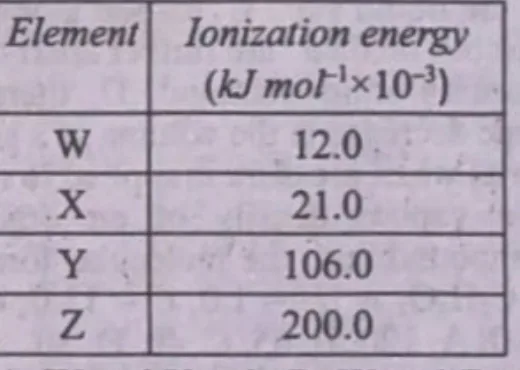
Use the following information to answer this question.
Which of the elements in the table below would react more readily with chlorine?
A. W and X onlyCorrect
B. W and Z only
C. X and Z only
D. Y and Z only
Explanation
Chlorine (being electronegative) reacts readily with elements that lose electrons easily. A higher ionization energy means it is harder to lose an electron. Since W and X have the lowest ionization energies in the table, they lose electrons most easily and so react most readily with chlorine.
Consider the following reaction equation: 2SO3(g) → 2SO2(g) + O2(g); ΔH = +198 kJ mol⁻¹. Which of the following statements about the reaction is correct?
A. The reaction is exothermic
B. The reaction container would feel warm
C. 198 kJ of energy is given off
D. 198 kJ of energy is absorbedCorrect
Explanation
Since ΔH is positive, the reaction is endothermic, not exothermic — heat is absorbed, not released. An endothermic reaction container would feel colder, not warmer.
A compound that could be dried by using conc. tetraoxosulphate (VI) acid and not by calcium oxide is likely to be
A. a salt
B. a base
C. an alkane
D. an acid anhydrideCorrect
Explanation
It is likely to be an acid anhydride (an acidic gas). An acidic gas should not be dried with an alkaline/basic drying agent (like calcium oxide) since they would react — but it can be dried with an acidic drying agent such as concentrated H2SO4. (See the reasoning for Q17.)
Dilute trioxonitrate (V) acid does not produce hydrogen when it reacts with metals because
A. it is a strong oxidizing agentCorrect
B. it reacts with the product
C. there is no visible reaction
D. it is highly corrosive
Explanation
HNO3 does not liberate hydrogen gas when it reacts with metals (unlike other acids) because it is a strong oxidizing agent — any hydrogen formed is immediately oxidized to water.
Which of the statements about gases is not correct?
A. The total kinetic energy of the gas is not affected by collision
B. Molecules of the gas are in constant motion
C. Gases have low densities compared to solids and liquids of equal mass
D. Gases are highly soluble in water at high temperaturesCorrect
Explanation
Unlike most solids, the solubility of most gases in water decreases as temperature increases (and vice versa) — so option D is the incorrect statement.
Arrange the following compounds in decreasing order of their boiling points: NH3, HF, SiH4, CH4
A. NH3, CH4, SiH4, HF
B. CH4, SiH4, NH3, HF
C. HF, NH3, SiH4, CH4Correct
D. CH4, SiH4, HF, NH3
Explanation
NH3 and HF have higher boiling points than SiH4 and CH4 because NH3 and HF exhibit hydrogen bonding. HF has the strongest hydrogen bonding of common substances, so its boiling point is higher than NH3's. SiH4 has a higher boiling point than CH4 because it is heavier. Decreasing order: HF > NH3 > SiH4 > CH4.
A. energy is released when liquids change to solids
B. particles move faster in the gaseous state than in the liquid state
C. carbon atoms in gaseous methane are further apart than those in solid diamond
D. there is a large decrease in the volume of a solid metal when pressure is applied to itCorrect
Explanation
Solids are substantially incompressible, so a large decrease in volume is not expected when pressure is applied to a solid metal — option D is incorrect.
The separation technique that is suitable for separating iodine from tetrachloromethane is
A. solvent extractionCorrect
B. distillation
C. fractional distillation
D. filtration
Explanation
Solvent extraction is a separation technique that relies on the differential solubility of a substance in two immiscible solvents — suitable for separating iodine dissolved in tetrachloromethane.
Advertisement
Sign up free to unlock
Score tracking
Practice history
Saved questions
Progress dashboard
Personalized sessions
Weak-topic breakdown
…and/or go further with premium services and No Ads.