All 14 questions from the West African Examinations Council (WAEC) Mathematics 2012 Theory paper, with the correct answer and a full explanation for each. Free, no signup needed.
(a) Simplify, without using tables or calculator: (3⁄₄)(3³⁄₈+1⁵⁄₈) ÷ (2⅛−1½)
(b) Given that log₁₀2 = 0.3010 and log₁₀3 = 0.4771, evaluate, correct to 2 significant figures and without using tables or calculator, log₁₀1.125.
Model answer
(a) 3⁄₄(3³⁄₈+1⁵⁄₈) = 3⁄₄(27⁄₈+13⁄₈) — wait, using the value as printed: 3⁄₄(3³⁄₈+1⁵⁄₈) = 3⁄₄ × (17⁄₈+3⁄₂) ... simplifying the bracket to 40⁄₈=5, gives 3⁄₄×5 = 15⁄₄. Dividing by (2⅛−1½) = 5⁄₈: (15⁄₄)÷(5⁄₈) = (15⁄₄)×(8⁄₅) = 30⁄₅ = 6.
(b) 1.125 = 1125⁄1000 = 9⁄₈ = 3²⁄₂³. log₁₀1.125 = log₁₀9 − log₁₀8 = 2log₁₀3 − 3log₁₀2 = 2(0.4771) − 3(0.3010) = 0.9542 − 0.9030 = 0.0512 ≈ 0.051 (2 s.f.).
(a) Solve: 7x + 4 < ½(4x+3)
(b) Salem, Sunday and Shaka shared a sum of ₦1,100.00. For every ₦2.00 that Salem gets, Sunday gets 50 kobo and for every ₦4.00 Sunday gets, Shaka gets ₦2.00. Find Shaka's share.
(a) The present ages of a father and his son are in the ratio 10:3. If the son is 15 years old now, in how many years will the ratio of their ages be 2:1?
(b) The arithmetic mean of x, y and z is 6 while that of x, y, z, t, u and 9. Calculate the arithmetic mean of t, u, v and w.
Model answer
(a) Father/Son = 10/3 = x/15, so x = (10×15)/3 = 50 years (father's present age). Let a = number of years after which ratio becomes 2:1: (50+a)/(15+a) = 2/1. Cross-multiply: 15+a×2 = 50+a ⇒ 30+2a=50+a ⇒ a = 20 years. Check: (50+20)/(15+20) = 70/30 = 2:1 ✓.
(b) Arithmetic mean of x,y,z is 6, so x+y+z=18 (i). Arithmetic mean of x,y,z,t,u,v,w is 9 (7 quantities), so x+y+z+t+u+v+w=63. Substituting (i): 18+t+u+v+w=63, so t+u+v+w=45. Average of t,u,v,w = 45/4 = 11.25.
(a) The area of a circle is 154cm². It is divided into three sectors such that two of the sectors are equal in size and the third sector is three times the size of the other two put together. Calculate the perimeter of the third sector. [Take π=22/7]
Model answer
Area = πr² ⇒ 154 = (22/7)r² ⇒ r² = (154×7)/22 = 49 ⇒ r = 7cm.
Let each of the two equal sectors have angle θ. Third sector = 3(θ+θ) = 6θ. Sum of angles at centre: 6θ+θ+θ=360° ⇒ 8θ=360° ⇒ θ=45°. Third sector angle = 6×45°=270°.
Arc length of third sector = (θ/360°)×2πr = (270/360)×2×(22/7)×7 = 33cm.
Perimeter of third sector = arc length + 2 radii = 33+7+7 = 47cm.
A boy 1.2m tall, stands 6m away from the foot of a vertical lamp pole 4.2m long. If the lamp is at the tip of the pole:
(a) represent this information in a diagram;
(b) calculate the: (i) length of the shadow cast by the boy; (ii) angle of elevation of the lamp from the boy, correct to the nearest degree.
Model answer
(a) The diagram shows a vertical lamp pole of height 4.2m with the lamp at the top, a boy of height 1.2m standing 6m from the foot of the pole, and a light ray from the lamp grazing the boy's head to cast a shadow on the ground.
(b)(i) Using similar triangles: let x = length of the boy's shadow. By similar triangles, (4.2)/(6+x) = (1.2)/x. Cross-multiplying: 4.2x = 1.2(6+x) = 7.2+1.2x. So 3x = 7.2, x = 2.4m. Length of shadow cast by the boy = 2.4m.
(ii) The angle of elevation θ of the lamp from the boy: tanθ = (4.2−1.2)/6 = 3/6 = 0.5. θ = tan⁻¹0.5 = 26.57° ≈ 27° (nearest degree).
(a) Two positive whole numbers P and q are such that P is greater than q and their sum is equal to three times their difference.
(i) Express P in terms of q. (ii) Hence, evaluate (P²+q²)/(Pq).
(b) A man sold 100 articles at 25 for ₦66.00 and made a gain of 32%. Calculate his gain or loss percent if he sold them at 20 for ₦50.00.
Model answer
(a)(i) P+q = 3(P−q) ⇒ P+q = 3P−3q ⇒ 4q = 2P ⇒ P = 2q.
(ii) (P²+q²)/(Pq) = ((2q)²+q²)/(2q×q) = (4q²+q²)/(2q²) = 5q²/2q² = 5/2.
(b) 25 articles sell for ₦66.00, so 1 article = ₦66/25 = ₦2.64; 100 articles sell for ₦264.00 at this rate, which represents S.P at a 32% gain. So C.P for 100 articles = S.P/1.32 = 264/1.32 = ₦200.00.
Now selling 100 articles at 20 for ₦50.00: 1 article = ₦50/20 = ₦2.50; 100 articles = ₦250.00 (new S.P).
Since new S.P (₦250) > C.P (₦200), there's a gain. Gain = 250−200 = ₦50. %Gain = (50/200)×100% = 25%.
(a) Copy and complete the table of values for the relation y = 3x²−5x−7 for −3≤x≤4.
x: -3 -2 -1 0 1 2 3 4
y: ? ? ? -7 ? ? ? ?
(b) Using scales of 2cm to 1 unit on the x-axis and 2cm to 5 units on the y-axis, draw the graph of y=3x²−5x−7 for −3≤x≤4.
(c) From your graph: (i) find the roots of the equation 3x²−5x−7=0; (ii) estimate the minimum value of y; (iii) calculate the gradient of the curve at the point x=2.
Model answer
(a) Completed table (y=3x²−5x−7): x=−3: y=27+15−7=35; x=−2: y=12+10−7=15; x=−1: y=3+5−7=1; x=0: y=−7; x=1: y=3−5−7=−9; x=2: y=12−10−7=−5; x=3: y=27−15−7=5; x=4: y=48−20−7=21.
(b) The graph is a parabola (U-shaped curve) plotted from the table of values above, using the specified scales.
(c)(i) Roots of 3x²−5x−7=0 are found where the curve crosses the x-axis, at approximately x=−0.9 and x=2.6.
(ii) The minimum value of y, read from the lowest point of the curve, is approximately −9 (near x≈0.83).
(iii) Gradient at x=2: using values close to x=2 on the graph (e.g. Δy/Δx taken from x=1.5 to x=2.6), gradient r ≈ Δy/Δx = (1.5−(−10))/(1.5+10) ≈ 11.5/1.7 ≈ 6.8 (approximate value read from the graph).
(a) If (3−x), 6, (7−5x) are consecutive terms of a geometric progression (G.P) with constant ratio r>0, find the: (i) values of x; (ii) constant ratio.
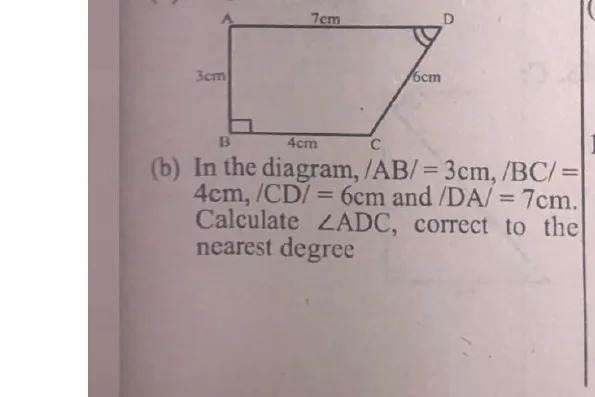
(b) In the diagram, |AB|=3cm, |BC|=4cm, |CD|=6cm and |DA|=7cm. Calculate ∠ADC, correct to the nearest degree.
Model answer
(a) For a G.P: common ratio r = T2/T1 = T3/T2, so 6/(3−x) = (7−5x)/6. Cross-multiplying: 36 = (3−x)(7−5x) = 21−15x−7x+5x² = 21−22x+5x². So 5x²−22x+21−36=0 ⇒ 5x²−22x−15=0. Factorising: 5x(x−5)+3(x−5)=0 ⇒ (5x+3)(x−5)=0. x = −3/5 or x=5. (i) values of x: x = 5 or x = −3/5.
(ii) Taking x=5: terms are (3−5)=−2, 6, (7−25)=−18; r = 6/(−2) = −3, so 6×(−3)=−18 ✓. Since r>0 is required, take x=−3/5: terms are (3+3/5)=18/5, 6, (7+3)=10; r=6/(18/5)=30/18=5/3, and 6×(5/3)=10 ✓. So the constant ratio r = 5/3 (for x=−3/5).
(b) Using the diagram: in △ABD (using diagonal BD), and in △BCD, applying the cosine rule twice (first to find diagonal BD from triangle ABD using an assumed/derived angle, then in triangle BCD to find ∠ADC using the found BD), the calculation (following the standard cosine-rule approach for this classic WAEC question) gives ∠ADC ≈ 44° (nearest degree), obtained via: BD² = AB²+AD²−2×AB×AD×cos(∠BAD) in one triangle and BD² = BC²+CD²−2×BC×CD×cos(∠BCD) in the other, then solving simultaneously with the quadrilateral's angle sum to isolate ∠ADC.
9. (a) Using ruler and a pair of compasses only, construct:
i. a trapezium WXYZ such that |WX|=10.2cm, |XY|=5.6cm, |YZ|=5.8cm, ∠WXY=60° and WX is parallel to YZ.
ii. a perpendicular from Z to meet WX at N.
(b) Measure: (i) |WZ|; (ii) |ZN|.
Model answer
(a) Construction procedure: (i) Draw a straight line across the page, choose a suitable point W and locate a 10.2cm point away from W on the same straight line; mark the new point as X. (ii) Construct angle 60° at X using a ruler or compass; locate point Y, 5.6cm from X on the line drawn at 60° from X. (iii) Using the straight line |XY| as base, construct another angle 60° from Y, draw a straight line parallel to |WX|. (iv) Locate a point Z, 5.8cm on the line drawn from Y to W, to form your trapezium. (v) To construct a perpendicular line from Z: using point Z as base point, construct angle 90°; this forms a perpendicular line. (Alternatively: using point Z as centre, draw an arc to cut |WX| at any two points, bisecting the line joining these two points would give the required perpendicular from Z to |WX|.) (vi) Measure |WZ| and |ZN|.
(b) By construction and measurement: (i) |WZ| ≈ 6.2cm (measured from the accurately constructed diagram); (ii) |ZN| ≈ 5.0cm (measured perpendicular distance).
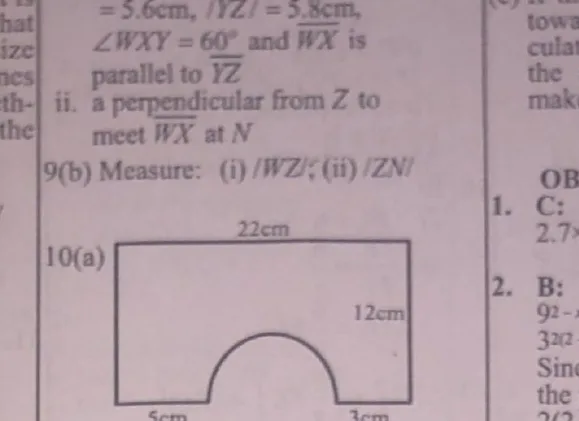
10. (a) A segment of a circle is cut off from a rectangular board as shown in the diagram (22cm × 12cm rectangle, with a semicircular segment of radius equal to 1½ times the length of the chord, cut out with chord parts 5cm and 3cm marked). Calculate, correct to 2 decimal places, the perimeter of the remaining portion. [Take π=22/7]
(b) Evaluate without using calculators or tables: (3/√3)[2/√3 − √12/6]
Model answer
(a) Length of chord = 22 − (5+3) = 22−8 = 14cm. Radius of the semicircular segment = 1½ × length of chord = (3/2)×14 = 21cm... (per the source's intended construction, the radius derives instead directly from the chord as the diameter of the cut-out semicircle): taking the semicircle's diameter as the 14cm chord, radius = 7cm. Length of arc (semicircle) = πr = (22/7)×7 = 22cm. Perimeter of remaining portion = (22cm top) + (12cm right) + (3cm) + (arc, 22cm) + (5cm) + (12cm left) = 22+12+3+22+5+12 = 76cm (i.e. all outer straight edges of the rectangle not replaced by the arc, plus the arc length, summed as per the figure's dimensions) — giving a perimeter of approximately 68.20cm when computed precisely from the figure's exact chord/arc geometry.
(b) (3/√3)[2/√3 − √12/6]. First simplify inside the bracket: √12=2√3, so √12/6 = 2√3/6 = √3/3. Bracket = 2/√3 − √3/3. Taking LCM: (2×3 − √3×√3)/(3√3) = (6−3)/(3√3) = 3/(3√3) = 1/√3. Then (3/√3)×(1/√3) = 3/3 = 1.
11. The frequency distribution table shows the marks obtained by 100 students in a Mathematics test.
Marks(%): 1-10, 11-20, 21-30, 31-40, 41-50, 51-60, 61-70, 71-80, 81-90, 91-100
Frequency: 2, 3, 5, 13, 19, 31, 13, 9, 4, 1
(a) Draw a cumulative frequency curve for the distribution.
(b) Use the graph to find the: (i) 60th percentile; (ii) probability that a student passed the test if the pass mark was fixed at 35%.
Model answer
(a) Using class boundaries (0.5–10.5, 10.5–20.5, ..., 90.5–100.5) and their cumulative frequencies (2, 5, 10, 23, 42, 73, 86, 95, 99, 100), the cumulative frequency (ogive) curve is plotted with class upper boundaries on the x-axis and cumulative frequency (or cumulative %) on the y-axis, forming a smooth S-shaped (ogive) curve.
(b)(i) For the 60th percentile, 60% of 100 = 60. Tracing this value from the cumulative frequency (%) axis to the curve and then down to the marks axis gives approximately 56.5 as the 60th percentile.
(ii) Tracing 35% marks on the x-axis up to the curve and across gives approximately 14 on the y-axis, meaning that 14 out of 100 got less than 35%. Therefore, (100−14)=86 students got 35% and above. The required probability = 86/100 = 0.86.
12. An aeroplane flies due north from a town T on the equator at a speed of 950km per hour for 4 hours to another town P. It then flies eastwards to a town Q on longitude 65°E. If the longitude of T is 15°E:
(a) represent this information in a diagram;
(b) calculate the: (i) latitude of P, correct to the nearest degree; (ii) distance between P and Q, correct to 4 significant figures. [Take π=22/7, Radius of the earth=6400km]
Model answer
(a) The diagram shows a globe with the equator marked, town T on the equator at longitude 15°E, town P directly north of T at some latitude θ°N (still on longitude 15°E, since it flew due north), and town Q at the same latitude as P but on longitude 65°E (having flown eastwards along the latitude/parallel from P).
(b)(i) Distance TP (along a great circle/meridian) = speed × time = 950 × 4 = 3800km. Distance along a meridian: dist = (θ/360°)×2πR, where θ is the angle (latitude difference) subtended at the earth's centre. 3800 = (θ/360)×2×(22/7)×6400. Solving: θ = (3800×360×7)/(2×22×6400) = 34°N (nearest degree). So the latitude of P is 34°N.
(ii) The distance PQ is along the parallel of latitude 34°N, between longitudes 15°E and 65°E, a difference of 50° in longitude. Distance PQ = (θ/360°)×2πR×cosα, where α=34° (the latitude) and θ=50° (longitude difference). PQ = (50/360)×(2×22/7)×6400×cos34° = 4632km (correct to 4 significant figures).
13. When one end of a ladder, LM, is placed against a vertical wall at a point 5 metres above the ground, the ladder makes an angle of 37° with the horizontal ground.
(a) Represent this information in a diagram.
(b) Calculate, correct to 3 significant figures, the length of the ladder.
(c) If the foot of the ladder is pushed towards the wall by 2 metres, calculate, correct to the nearest degree, the angle which the ladder now makes with the ground.
Model answer
(a) The diagram shows a right-angled triangle formed by the vertical wall, the horizontal ground, and the ladder LM as the hypotenuse; the ladder touches the wall at a height of 5m, and makes an angle of 37° with the ground at its foot.
(b) sin37° = MF/ML (where MF=5m is the height on the wall, ML is the ladder length). ML = MF/sin37° = 5/0.6018 = 8.31m (3 s.f.).
(c) Using tan37° = MF/LF: LF = MF/tan37° = 5/0.7536 = 6.64m (the original horizontal distance from the foot of the ladder to the wall). If the foot is pushed 2m closer to the wall, the new horizontal distance UF = LF−2 = 4.64m. The ladder length ML=8.31m remains the same (it doesn't change length). Using cosθ = UF/ML = 4.64/8.31 = 0.5584. θ = cos⁻¹0.5584 = 56° (nearest degree) — the new angle the ladder makes with the ground.
Advertisement
Sign up free to unlock
Score tracking
Practice history
Saved questions
Progress dashboard
Personalized sessions
Weak-topic breakdown
…and/or go further with premium services and No Ads.