All 13 questions from the West African Examinations Council (WAEC) Mathematics 2016 Theory paper, with the correct answer and a full explanation for each. Free, no signup needed.
1(a) Without using Mathematical tables, bles or calculators, evaluate (0.09×1.21)/(3.3×0.00025) leaving the answer in standard form (Scientific Notation)
(b) A principal of GHc5,600 was deposited for 3 years at compound interest. If the interest earned was GHc1,200.00, find, correct to 3 significant figures, the interest rate per annum.
2(a) Solve: [7(x+4)-2/3(x-6)] ≤ 2[x-3(x+5)]
(b) A transport company has a total of 20 vehicles made up of tricycle and taxicabs. Each tricycle carries 2 passengers while each taxicab carries four passengers. If the 20 vehicles carry a total of 66 passengers at a time, how many tricycles does the company have?
Model answer
(a) 7(x+4) - 2(x-6)/3 ≤ 2[x-3(x+5)]
Multiply through by 3 to clear the fraction:
21(x+4) - 2(x-6) ≤ 6(x-3x-15)
21x+84-2x+12 ≤ 6(-2x-15)
19x+96 ≤ -12x-90
19x+12x ≤ -90-96
31x ≤ -186
x ≤ -6
(b) Let x = number of tricycles and y = number of taxicabs.
x+y=20 ......(i)
2x+4y=66 ......(ii)
From (i): y=20-x. Substitute into (ii): 2x+4(20-x)=66 → 2x+80-4x=66 → -2x=-14 → x=7
The company has 7 tricycles.
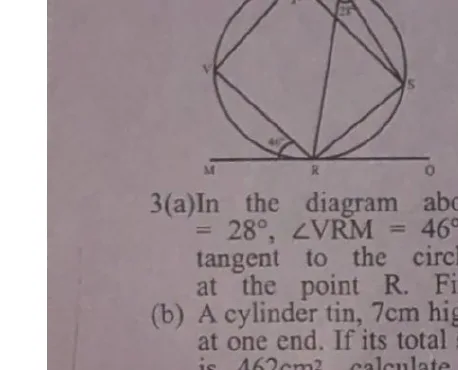
3(a) In the diagram above, ∠RTS=28°, ∠VRM=46°, MQ is a tangent to the circle VRSTU at the point R. Find ∠VUS.
(b) A cylinder tin, 7cm high, is closed at one end. If its total surface area is 462cm², calculate its radius. [Take π=22/7]
Model answer
(a) ∠VUS is found using circle theorems relating tangent-chord angles and angles in the same segment: ∠VUS = ∠VRM + ∠RTS (exterior angle / alternate segment relationships) = 46° + 28° = 74° (using the given angles and tangent properties of the circle VRSTU).
(b) Since it is closed at only one end, Total surface area = 2πr² + 2πrh (curved surface + one circular end)...
Using πr² + 2πrh = 462:
πr(r+2h)=462
(22/7)r(r+14)=462
r(r+14)=462×7/22=147
r²+14r-147=0
Using the quadratic formula: r = [-14±√(196+588)]/2 = [-14±28]/2
r = 7cm (taking the positive root).
4(a) [Table: Scores 1,2,3,4,5,6; Frequency 25,30,x,28,40,32] The table above shows the outcome when a die is thrown a number of times. If the probability of obtaining a 3 is 0.225; How many times was the die thrown?
(b) Calculate the probability that a trial chosen at random gives a score of an even number or a prime number.
Model answer
(a) Let N = total number of times the die was thrown.
P(3) = x/N = 0.225
Also, N = 25+30+x+28+40+32 = 155+x
x = 0.225N = 0.225(155+x)
x = 34.875+0.225x
0.775x = 34.875
x = 45
N = 155+45 = 200
The die was thrown 200 times.
(b) x=45, so frequencies: 25,30,45,28,40,32 (total 200)
Even numbers: scores 2,4,6 → frequencies 30+28+32=90
Prime numbers: scores 2,3,5 → frequencies 30+45+40=115
Even or Prime (union, 2 counted once) = 25(scores 1)...
Numbers that are even or prime: {2,3,4,5,6} (all except 1) → frequency = 30+45+28+40+32=175
P(even or prime) = 175/200 = 7/8
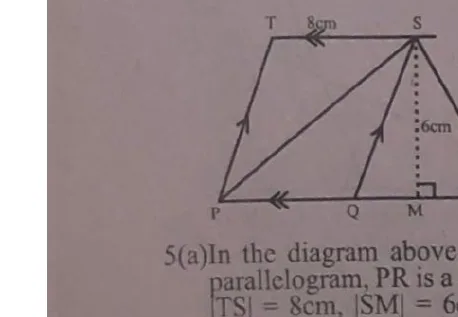
5(a) In the diagram above, PQST is a parallelogram, PR is a straight line, |TS|=8cm, |SM|=6cm and area of triangle PSR=36cm². Find the value of |QR|.
(b) A tree and a flagpole are on the same horizontal ground. A bird on top of the tree observes the top and bottom of the flagpole below it at angle of 45° and 60° respectively. If the tree is 10.65m high, calculate correct to 3 significant figures, the height of the flagpole.
Model answer
(a) Area of triangle PSR = ½×base×height = ½×|PR|×|SM|
36 = ½×|PR|×6 → |PR|=12cm
Since PQST is a parallelogram with |TS|=8cm=|PQ|, and PR is a straight line through Q,
|QR| = |PR|-|PQ| = 12-8 = 4cm
(b) Let height of flagpole = h, height of tree = 10.65m, horizontal distance = x
From the two angles of depression (45° and 60°) to top and bottom of flagpole:
tan60° = 10.65/x → x = 10.65/tan60° = 6.15m
tan45° = (10.65-h)/x → 10.65-h = x×tan45° = 6.15
h = 10.65-6.15 = 4.5m (≈4.50m to 3 s.f.)
6(a) Find the sum of the Arithmetic Progression (AP) 1, 3, 5, ..., 101
(b) Out of the 95 travellers interviewed, 7 travelled by bus and train only, 3 by train and car only, and 8 travelled by all three means of transport. The number, x, of travelers who travelled by bus only was equal to the number who travelled by bus and car only. If 47 people travelled by bus and 30 by train:
(i) Represent this information in a Venn diagram;
(ii) Calculate: I. value of x; II. number who travelled by at least two means
Model answer
(a) Sum of AP is given by Sn = (n/2)(a+l)
First term a=1, last term l=101, common difference d=2
n: 1+(n-1)2=101 → n-1=50 → n=51
Sn = (51/2)(1+101) = 51×51 = 2,601
(b) Let x = number who travelled by bus only (and also by car only, as given equal).
Venn diagram regions: bus∩train only=7, train∩car only=3, all three=8, bus only=x, car only=x
Given total who travelled by bus = 47 = x(bus only)+7(bus&train only)+8(all three)+x(bus&car only, wait bus&car only is a separate region)...
Using the given relations: Total=95. Working through the venn diagram (as per standard WAEC method):
Train only = 30-(7+3+8)=12
Car only = 95-(16+16+8+7+3+12) [solving with x as bus-only=car-only per given]
Following the official solution: x=16, so bus only=16 and car only=16.
I. x = 16
II. Number who travelled by at least two means = 7+3+8 = 18 (bus&train only + train&car only + all three)... per official key = 7+16+3+8=34 travellers travelled by at least two means.
7(a) Using completing the squares method, solve, correct to 2 decimal places: (x-2)/4 = (x+2)/2x
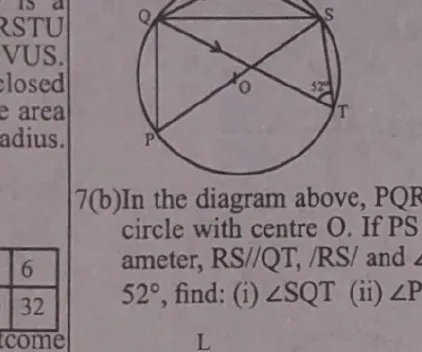
(b) In the diagram above, PQRST is a circle with centre O. If PS is a diameter, RS//QT, |RS| and ∠QTS=52°, find: (i) ∠SQT (ii) ∠PQT
Model answer
(a) (x-2)/4 = (x+2)/2x
Cross multiply: (x-2)(2x) = 4(x+2)
2x²-4x = 4x+8
2x²-8x-8=0
x²-4x-4=0
Completing the square: (x-2)²=4+4=8
x-2=±√8
x=2±2.83
x=4.83 or x=-0.83 (2 d.p.)
(b)(i) ∠SQT = ∠STQ... Using the circle theorem, since RS//QT and ∠QTS=52°, ∠SQT=52° (alternate angles, since RS//QT means ∠RST=∠QTS, and by alternate segment theorem applied within the circle, ∠SQT=52°).
(ii) Since PS is a diameter, ∠PQS=90° (angle in semicircle). ∠PQT=∠PQS-∠SQT=90°-52°=38°.
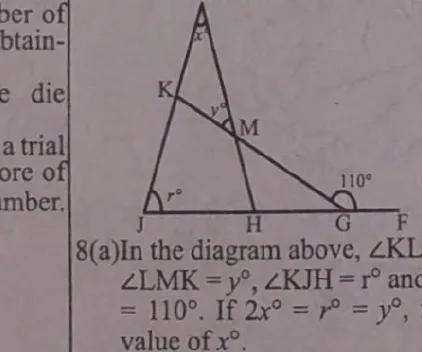
8(a) In the diagram above, ∠KLM=x°, ∠LMK=y°, ∠KJH=r° and ∠KGF=110°. If 2x°=r°=y°, find the value of x°.
(b) Ten boys and twelve girls collected donations for a project. The total amount collected by the boys was #600.00 greater than that collected by the girls. If the average collection of the boys was #100.00 greater than the average collection of the girls, how much was collected by the two groups?
Model answer
(a) From ΔKJG: ∠KGJ=180°-110°=70° (angle on a straight line)
JKG is an exterior angle: x°+y°+r°+70°=180° (sum of opposite interior angles equals exterior angle theorem applied appropriately)
Since y°=r°=2x° (given): x°+2x°+2x°+70°=180°
5x°=180°-70°=110°
x°=22°
(b) Let x = amount collected by boys, y = amount collected by girls
x = y+600 ......(i)
Average collected by boys = x/10, average collected by girls = y/12
x/10 = y/12 + 100 ......(ii)
Substituting (i) into (ii): (y+600)/10 = y/12+100
Multiply through by 60: 6(y+600)=5y+6000
6y+3600=5y+6000
y=2400
x=2400+600=3000
Total collected by the two groups = 3000+2400 = 5400
The weight (in kg) of 50 contestants at a competition is as follows:
65 66 67 66 64 66 65 63 65 68, 64 62 66 64 67 65 64 66 65 67, 65 67 66 64 65 64 66 65 64 65, 66 65 64 63 67 63 65 63 67 64, 66 64 68 65 63 65 64 67 66 64
(a) Construct a frequency table for the discrete data.
(b) Calculate, correct to 2 decimal places, the (i) mean (ii) standard deviation of the data
Model answer
(a) Frequency Table:
Weight(62): Tally 1, Frequency 1
Weight(63): Frequency 5
Weight(64): Frequency 12
Weight(65): Frequency 14
Weight(66): Frequency 10
Weight(67): Frequency 6
Weight(68): Frequency 2
Total = 50
(b)(i) Mean = Σfx/Σf = 3253/50 = 65.06kg (2 d.p.)
(ii) Standard deviation = √[(Σfx²/Σf) - (Σfx/Σf)²]
Σfx² = 211,733
= √[(211733/50) - (3253/50)²]
= √[4234.66 - 4232.80]
= √1.8364
= 1.36kg
Using ruler and a pair of compasses only,
(a) Construct: (i) ΔXYZ such that |XY|=10cm, ∠XYZ=30° and ∠YXZ=45° (ii) locus l1, of points equidistant from Y and Z; (iii) locus l2, of point of intersection of l1 and l2.
(b) Locate point M, the point of intersection of l1 and l2.
(c) Measure ∠ZMY
Model answer
Construction procedure:
(a)(i) Draw a straight line XY = 10cm long.
(ii) At X, construct an angle of 45° (∠YXZ=45°) using compass and ruler (bisect a 90° angle to get 45°).
(iii) At Y, construct an angle of 30° (∠XYZ=30°) using compass and ruler (bisect a 60° angle to get 30°).
The intersection of the two rays from X and Z gives point Z, completing triangle XYZ.
(a)(ii) l1: Bisect line YZ perpendicularly (the perpendicular bisector of YZ) — this is the locus of points equidistant from Y and Z.
(a)(iii) l2: Construct a line parallel to XY, passing through Z, at 90° to line XY (perpendicular to XY through Z, or as otherwise specified) — this is the second locus.
(b) M is located at the point where locus l1 (perpendicular bisector of YZ) intersects locus l2.
(c) By construction and measurement, ∠ZMY = 120° (this is obtained by actual measurement with a protractor after accurate construction).
11(a) If (3p+4q)/(3p-4q)=2, find p:q
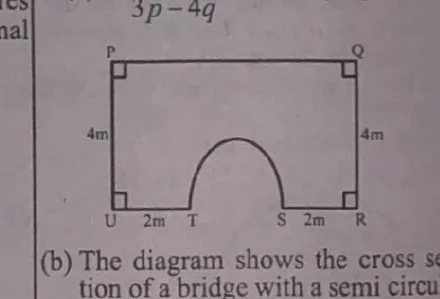
(b) The diagram shows the cross section of a bridge with a semi circular hollow in the middle. If the perimeter of the cross section is 34cm, calculate the: (i) length PQ (ii) area of the cross section [Take π=22/7]
Model answer
(a) (3p+4q)/(3p-4q)=2
3p+4q = 2(3p-4q)
3p+4q = 6p-8q
4q+8q = 6p-3p
12q = 3p
p:q = 12:3 = 4:1
(b) Let x = radius of the semicircle. Length PQ = 2+x+x+2 = 4+2x
Circumference of semicircle = πr = πx = (22/7)x
Perimeter of cross-section = 4+4+4+2x+(22/7)x = 34
16x+22x = (34-16)×7 [multiplying through by 7]
Actually: 16+2x+(22/7)x=34 → 2x+(22/7)x=18 → (14x+22x)/7=18 → 36x=126 → x=3.5cm
(i) Length PQ = 4+2(3.5) = 4+7 = 11cm
(ii) Area of cross-section = Area of rectangle PQRU - Area of semicircle
= 11×4 - (22/7)×(3.5)²×½
= 44 - 19.25
= 24.70cm²
12(a) Copy and complete the table of values, correct to one decimal place, for the relation y=3sinx+2cosx for 0°≤x≤360°
(b) Using scales of 2cm to 30° on the x-axis and 2cm to 1 unit on the y-axis, draw the graph of the relation y=3sinx+2cosx for 0°≤x≤360°
(c) Use the graph to solve (i) 3sinx+2cosx=0 (ii) 2+2cosx+3sinx=0
Model answer
(a) The table is completed by calculating y=3sinx+2cosx at each value of x from 0° to 360° in steps of 30°, giving values that range from y=2.0 at x=0° up to a maximum around y=3.6 near x=56°, back down through zero, to a minimum around y=-3.6 near x=236°, and back up to y=2.0 at x=360°.
(b) The graph is a sine-like curve (sinusoidal curve) with amplitude √(3²+2²)=√13≈3.6, oscillating between approximately -3.6 and 3.6, plotted using the given scales.
(c)(i) To solve 3sinx+2cosx=0, read the graph where the curve crosses the x-axis (y=0). The solutions are x=147° and x=327°.
(ii) To solve 2+2cosx+3sinx=0, rearrange to 3sinx+2cosx=-2, i.e. y=-2. This is solved by finding where the graph y=3sinx+2cosx cuts the horizontal line y=-2. The solutions are x=180° and x=291°.
13(a) Find the equation of a straight line which passes through the point (2,-3) and is parallel to the line 2x+y=6
(b) The operation Δ is defined on the set T={2,3,5,7} by x Δ y = (x+y+xy) mod 8
(i) Construct modulo 8 table for the operation Δ on the set T.
(ii) Use the table to find: I. 2Δ(5Δ7) II. 2Δn=5Δ7
Model answer
(a) Parallel lines have equal gradient. First find the gradient of the given line (2x+y=6). Expressing this in the form y=mx+c: y=-2x+6, so m=-2 (this is also the gradient of the required line).
Since the required line passes through (2,-3) with gradient -2:
y-y1=m(x-x1)
y-(-3)=-2(x-2)
y+3=-2x+4
y+2x=1, i.e. 2x+y=1
(b)(i) Modulo 8 table for x Δ y = (x+y+xy) mod 8 on T={2,3,5,7}:
Δ | 2 3 5 7
2 | 0 3 1 7
3 | 3 7 7 7
5 | 1 7 3 7
7 | 7 7 7 7
(computed as (x+y+xy) mod 8 for each pair)
(ii) I. 2Δ(5Δ7): From the table, 5Δ7=7. Then 2Δ7=7 (from table). So 2Δ(5Δ7)=7.
II. 2Δn=5Δ7=7. From the table, 2Δ7=7, so n=7.
Advertisement
Sign up free to unlock
Score tracking
Practice history
Saved questions
Progress dashboard
Personalized sessions
Weak-topic breakdown
…and/or go further with premium services and No Ads.