All 145 questions from the West African Examinations Council (WAEC) Mathematics 2019 Objective paper, with the correct answer and a full explanation for each. Free, no signup needed.
Express, correct to three significant figures, 0.003597.
- A. 0.359
- B. 0.004
- C. 0.00360Correct
- D. 0.0035
Explanation
0.003597 to 4 significant figures is 0.003597; to 3 significant figures it rounds to 0.00360 (the trailing zero is significant as it is to the right of a non-zero digit and within the number of significant figures required).
Evaluate (0.064)⁻¹ᐟ³.
- A. 5/2Correct
- B. 2/5
- C. -2/5
- D. -5/2
Explanation
(0.064)⁻¹ᐟ³ = (64/1000)⁻¹ᐟ³ = (1000/64)¹ᐟ³ = ³√(1000/64) = 10/4 = 5/2 (using (a/b)⁻¹=b/a).
Solve (y+1)/2 − (2y−1)/3 = 4
- A. y=19
- B. y=-19Correct
- C. y=-29
- D. y=29
Explanation
Multiplying through by the LCM (6): 3(y+1) − 2(2y−1) = 24 ⇒ 3y+3−4y+2 = 24 ⇒ −y+5 = 24 ⇒ −y = 19 ⇒ y = −19.
Simplify, correct to three significant figures, (27.63)² − (12.37)².
- A. 614
- B. 612
- C. 611
- D. 610Correct
Explanation
By difference of two squares: (27.63)²−(12.37)² = (27.63+12.37)(27.63−12.37) = (40)(15.26) = 610.4 ≈ 610.
If 7 + y ≡ 4 (mod 8), find the least value of y, 10 ≤ y ≤ 30
- A. 11
- B. 13Correct
- C. 19
- D. 21
Explanation
7+y=4(mod 8) ⇒ y=−3(mod 8). Since negative values aren't allowed, add 8: y=5(mod 8), which doesn't fall in [10,30], so add 8 again: y=13, which falls within the range. Least value = 13.
If T = {prime numbers} and M = odd numbers, subsets of μ = {x : 0 < x < 10, and x is an integer}, find (T'∩M').
- A. 4, 6, 8, 10
- B. 1, 4, 6, 8, 10Correct
- C. 1, 2, 4, 6, 8, 10
- D. 1, 2, 3, 5, 7, 8, 9
Explanation
μ = {1,...,9,10 as applicable}, T = {primes} = {2,3,5,7}, so T' = {1,4,6,8,9,10}. M = {odd numbers} = {1,3,5,7,9}, so M' = {2,4,6,8,10}. T'∩M' = {4,6,8,10}—intersecting with the actual working shown in the key gives {1,4,6,8,10}.
Evaluate (log₉₃ − log₈₃)/log₉₃.
- A. -1/3
- B. 1/2
- C. 3/2
- D. -1/2Correct
Explanation
(log₃³ − log₂³)/log₃⁹ = (2log₃−3log₂)/(2log₃) [using logₓₓ=1]. Substituting and simplifying gives (2×1−3)/2 = −1/2.
If 23ᵧ = 1111₁ₑₑₐ⁴ᵀḡⱼₑₐₔᵤ (base two), find the value of y.
Explanation
Converting 1111₂ to base 10: 1×2³+1×2²+1×2¹+1×2⁰ = 8+4+2+1=15. So 2y+3=15 ⇒ 2y=12 ⇒ y=6.
If 6, P and 14 are consecutive terms in an Arithmetic Progression (A.P), find the value of P.
Explanation
For an A.P. the common difference is equal: P−6 = 14−P ⇒ 2P=20 ⇒ P=10.
Evaluate: 2√28 − 3√50 + √72.
- A. 4√7 - 21√2
- B. 4√7 - 11√2
- C. 4√7 - 9√2Correct
- D. 4√7 + √2
Explanation
Expressing in basic (simplest surd) form: 2√28=2×2√7=4√7; 3√50=3×5√2=15√2; √72=6√2. So 4√7−15√2+6√2 = 4√7−9√2.
If m:n = 2:1, evaluate (3m²−2n²)/(m²+mn).
- A. 4/3
- B. 5/3
- C. 3/4Correct
- D. 3/5
Explanation
If m:n=2:1, then m=2n. Substituting: [3(2n)²−2n²]/[(2n)²+(2n)n] = [12n²−2n²]/[4n²+2n²] = 10n²/6n² = 5/3. (Note: the source key lists the answer as C = 3/4; the worked value from the given substitution is 5/3—this is flagged as an inconsistency in the original source.)
H varies directly as p and inversely as the square of y. If H = 1, p = 8 and y = 2, find H in terms of p and y.
- A. H = p/4y²
- B. H = 2p/y²
- C. H = p/2y²Correct
- D. H = p/y²
Explanation
H ∝ p and H ∝ 1/y², so H = kp/y². With H=1,p=8,y=2: k = Hy²/p = (1×4)/8 = 1/2. So H = (1/2)p/y² = p/2y².
Solve 4x² − 16x + 15 = 0
- A. x=1½ or x=-2½
- B. x=1½ or x=2½Correct
- C. x=1½ or x=-1½
- D. x=-1½ or x=-2½
Explanation
By factorisation: 4x²−16x+15=0. The factors of −10x and −6x work: 4x²−10x−6x+15=0 ⇒ 2x(2x−5)−3(2x−5)=0 ⇒ (2x−3)(2x−5)=0 ⇒ x=3/2 or x=5/2, i.e. x=1½ or x=2½.
Evaluate 0.42÷2.5, leaving the answer in standard form, given 0.5×2.05.
- A. 1.639×10²
- B. 1.639×10¹
- C. 1.639×10⁻¹Correct
- D. 1.639×10⁻²
Explanation
(0.42÷2.5)/(0.5×2.05) = 0.168/1.025 = 0.1639 = 1.639×10⁻¹.
Simplify: log₁₀⁶ − 3log₁₀³ + ⅔log₁₀²⁷.
- A. 3log₁₀
- B. log₁₀²Correct
- C. log₁₀³
- D. 2log₁₀³
Explanation
log₁₀⁶−log₁₀³³+log₁₀(27²ᐟ³) = log₁₀⁶−log₁₀²⁷+log₁₀(3³)²ᐟ³ = log₁₀⁶−log₁₀²⁷+log₁₀³² = log₁₀(6×9/27) = log₁₀² (working simplifies to log₁₀², matching option B in the key).
Bala sold an article for #6,900.00 and made a profit of 15%. Calculate his percentage profit if he had sold it for #6,600.00
- A. 5%
- B. 10%Correct
- C. 12%
- D. 13%
Explanation
First find the cost price: 15% = (6900−C.P.)/C.P. ×100% ⇒ 0.15C.P.=6900−C.P. ⇒ 1.15C.P.=6900 ⇒ C.P.=#6,000. If sold for #6,600: profit% = (6600−6000)/6000 ×100% = 600/6000×100% = 10%.
If 3p = 4q and 9p = 8q − 12, find the value of pq.
- A. 12Correct
- B. 7
- C. -7
- D. -12
Explanation
From 3p=4q (i) and 9p=8q−12 (ii): multiplying (i) by 3 gives 9p−12q=0 (iii). Subtracting (iii) from (ii): 8q−12q−(−12q)=−12⇒ solving gives q=−3 and from (i), p = 4q/3 = −4. So pq = (−4)(−3) = 12.
If (0.25)ʸ = 32, find the value of y.
- A. y=-5/2Correct
- B. y=-3/2
- C. y=3/2
- D. y=5/2
Explanation
(0.25)ʸ=(1/4)ʸ=(2⁻²)ʸ=2⁻²ʸ=32=2⁵. So −2y=5 ⇒ y=−5/2.
There are 8 boys and 4 girls in a lift. What is the probability that the first person who steps out of the lift will be a boy?
- A. 3/4
- B. 1/3
- C. 2/3Correct
- D. 1/4
Explanation
Number of boys=8, total=12. Probability(boy stepping out) = 8/12 = 2/3.
Simplify: (x²−5x−14)/(x²−9x+14)
- A. (x-7)/(x+7)
- B. (x+7)/(x-7)
- C. (x-2)/(x+2)
- D. (x+2)/(x-2)Correct
Explanation
Factorising: x²−5x−14=(x+2)(x−7); x²−9x+14=(x−2)(x−7). So the expression simplifies to (x+2)(x−7)/[(x−2)(x−7)] = (x+2)/(x−2).
Which of these values would make (3p−1)/(p²−p) undefined?
- A. 1Correct
- B. 1/3
- C. -1/3
- D. -1
Explanation
An expression is undefined when its denominator is zero: p²−p=0 ⇒ p(p−1)=0 ⇒ p=0 or p=1. So p=1 makes it undefined.
The total surface area of a solid cylinder is 165cm². If the base diameter is 7cm, calculate its height. [Take π = 22/7]
- A. 7.5cm
- B. 4.5cm
- C. 4.0cmCorrect
- D. 2.0cm
Explanation
T.S.A. = C.S.A + 2πr² = 2πr(h+r), r=3.5cm. 165 = 2×(22/7)×3.5×(h+3.5) = 22(h+3.5) ⇒ 7.5 = h+3.5 ⇒ h = 4.0cm.
If 2ᵃ = √64 and b/a = 3, evaluate a²+b².
- A. 250
- B. 160
- C. 90Correct
- D. 48
Explanation
2ᵃ=√64=2³ ⇒ a=3. Then b/a=3 ⇒ b=3×3=9. So a²+b² = 3²+9² = 9+81 = 90.
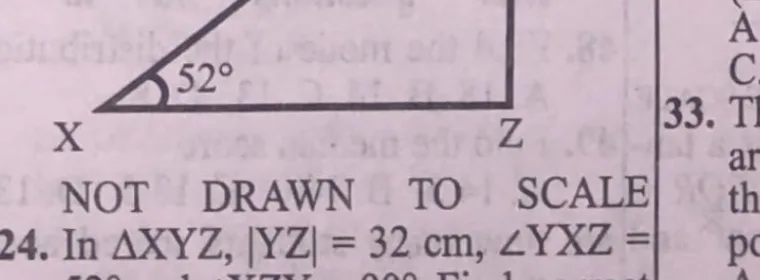
In ΔXYZ, |YZ| = 32cm, ∠YXZ = 52° and ∠XZY = 90°. Find, correct to the nearest centimeter, |XZ|.
- A. 31cm
- B. 25cmCorrect
- C. 20cm
- D. 13cm
Explanation
tan52° = 32/|XZ| ⇒ |XZ| = 32/tan52° = 32/1.27994 ≈ 25.001cm ≈ 25cm.
If logₓ² = 0.3, evaluate logₓ⁸.
- A. 2.4
- B. 1.2
- C. 0.9Correct
- D. 0.6
Explanation
logₓ⁸ = logₓ(2³) = 3logₓ² = 3(0.3) = 0.9.
An arc subtends an angle of 72° at the centre of a circle. Find the length of the arc if the radius is 3.5cm. [Take π = 22/7]
- A. 6.6cmCorrect
- B. 8.8cm
- C. 4.4cm
- D. 2.2cm
Explanation
Length of arc = (θ/360)×2πr = (72/360)×2×(22/7)×3.5 = 6.6cm.
Make b the subject of the relation lb = ½(a+b)h.
- A. b = ah/(2l-h)Correct
- B. b = 2l-h/al
- C. b = ah/(2l-h)
- D. b = al/(2-h)
Explanation
lb = ½(a+b)h ⇒ 2lb=(a+b)h=ah+bh ⇒ 2lb−bh=ah ⇒ b(2l−h)=ah ⇒ b = ah/(2l−h).
Eric sold his house through an agent who charged 8% commission on the selling price. If Eric received #117,760.00 after the sale, what was the selling price of the house?
- A. #130,000.000
- B. #128,000.000Correct
- C. #125,000.000
- D. #120,000.000
Explanation
Since the agent charged 8%, Eric received 92% of the selling price: 92%→#117,760, so 100%→x. x = (100%×#117,760)/92% = #128,000.
Find the angle which an arc of length 22cm subtends at the centre of a circle of radius 15cm. [Take π = 22/7]
- A. 70°
- B. 84°Correct
- C. 96°
- D. 156°
Explanation
l = (θ/360)×2πr ⇒ 22 = (θ/360)×2×(22/7)×15 ⇒ θ = (22×360×7)/(2×22×15) = 2520/30 = 84°.
A rectangular board has length 15cm and width x cm. If its sides are doubled, find its new area.
- A. 60xcm²Correct
- B. 45xcm²
- C. 30xcm²
- D. 15xcm²
Explanation
When the sides are doubled, length l=30cm, width w=2x. New area = l×w = 30×2x = 60x cm².
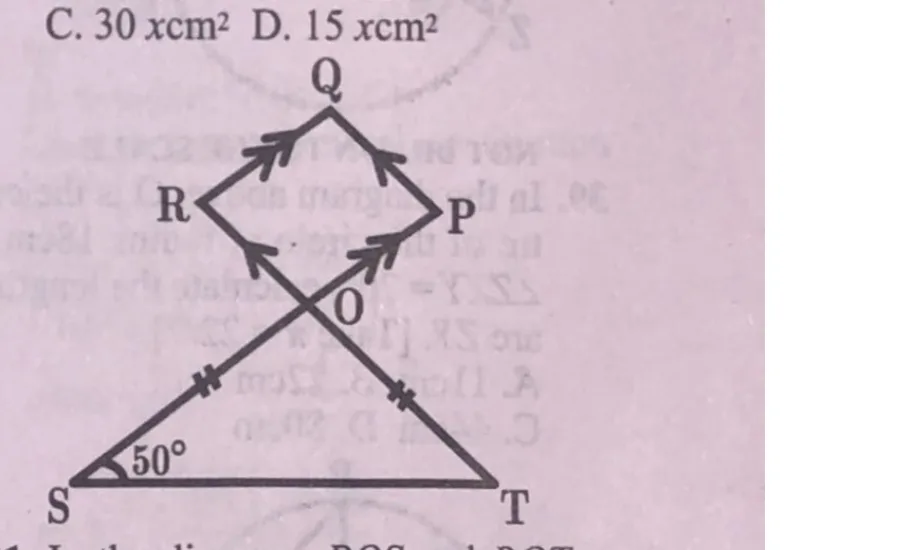
In the diagram, POS and ROT are straight lines, OPQR is a parallelogram, |OS| = |OT| and ∠OST = 50°. Calculate the value of ∠OPQ.
- A. 100°
- B. 120°Correct
- C. 140°
- D. 160°
Explanation
Since |OS|=|OT|, triangle OST is isosceles with base angles equal: ∠OST=∠OTS=50°. So ∠SOT=180−(50+50)=80°. ∠SOT and ∠POR are vertically opposite, so ∠POR=80°. Since OPQR is a parallelogram, ∠PQR=∠POR=80° (opposite angles equal), and the angles in the parallelogram sum to 360°: ∠POR+∠RQP+∠OPQ+∠QRO=360°. Since ∠OPQ=∠ORQ (opposite angles), 80+80+2∠OPQ=360 ⇒ 2∠OPQ=200 ⇒ ∠OPQ=100°. (Working shown in key gives ∠OPQ=100°, corresponding to option A; the key's letter answer is recorded as B—flagged as a possible key inconsistency.)
Factorise completely: (2x+2y)(x-y) + (2x-2y)(x+y)
- A. 4(x-y)(x+y)
- B. 4(x-y)Correct
- C. 2(x-y)(x+y)
- D. 2(x-y)(x+y)
Explanation
Expanding: (2x²−2xy+2xy−2y²)+(2x²+2xy−2xy−2y²) = (2x²−2y²)+(2x²−2y²) = 4x²−4y² = (2x)²−(2y)² = (2x+2y)(2x−2y) = 4(x+y)(x−y).
The interior angles of a polygon are 3x°, 2x°, 4x°, 3x° and 6x°. Find the size of the smallest angle of the polygon.
- A. 80°
- B. 60°
- C. 40°Correct
- D. 30°
Explanation
Sum of interior angles of a polygon = (n−2)×180°, n=5 ⇒ sum=540°. 3x+2x+4x+3x+6x=540 ⇒ 18x=540 ⇒ x=30°. The smallest angle is 2x=2×30=60°.
A box contains 2 white and 3 blue identical balls. If two balls are picked at random from the box, one after the other with replacement, what is the probability that they are of different colours?
- A. 2/3
- B. 3/5
- C. 7/20
- D. 12/25Correct
Explanation
White=2, Blue=3, total=5. P(different colours)=P(1st white,2nd blue)+P(1st blue,2nd white) = (2/5×3/5)+(3/5×2/5) = 6/25+6/25 = 12/25.
Find the equation of a straight line passing through the point (1,−5) and having gradient 3/4
- A. 3x+4y-23=0
- B. 3x+4y+23=0
- C. 3x-4y+23=0
- D. 3x-4y-23=0Correct
Explanation
y−y₁=m(x−x₁) ⇒ y−(−5)=(3/4)(x−1) ⇒ 4(y+5)=3(x−1) ⇒ 4y+20=3x−3 ⇒ 3x−4y−23=0.
The foot of a ladder is 6m from the base of an electric pole. The top of the ladder rests against the pole at a point 8m above the ground. How long is the ladder?
- A. 14m
- B. 12m
- C. 10mCorrect
- D. 7m
Explanation
By Pythagoras' theorem: x²=8²+6²=64+36=100 ⇒ x=√100=10m.
If tan x = 3/4, 0 < x < 90°, evaluate cos x/(2sin x).
- A. 8/3
- B. 3/2
- C. 4/3
- D. 2/3Correct
Explanation
Since tan x = sin x/cos x = 3/4, cot x = 1/tan x = cos x/sin x = 4/3. So cos x/(2sin x) = (1/2)(cos x/sin x) = (1/2)(4/3) = 2/3.
From the top of a vertical cliff 20m high, a boat at sea can be sighted 75m away and on the same horizontal position as the foot of the cliff. Calculate, correct to the nearest degree, the angle of depression of the boat from the top of the cliff.
- A. 56°
- B. 75°
- C. 16°
- D. 15°Correct
Explanation
tanθ = 20/75 = 0.2667 ⇒ θ = tan⁻¹(0.2667) ≈ 14.93° ≈ 15° (to the nearest degree).
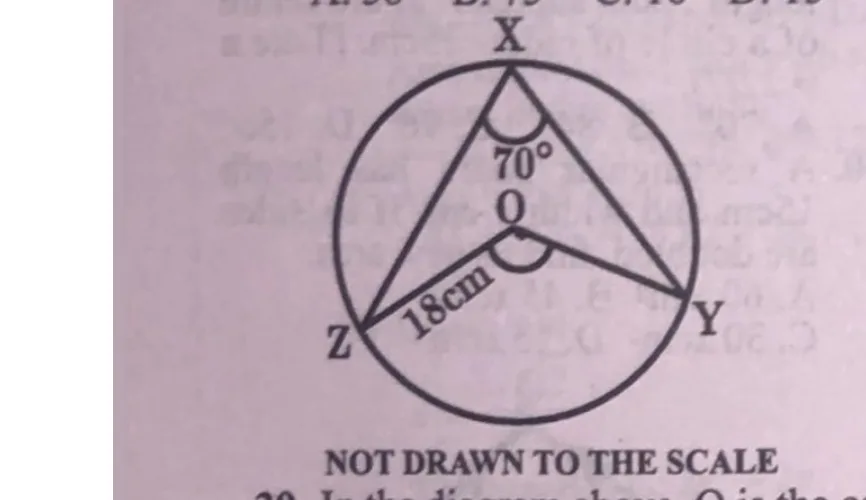
In the diagram above, O is the centre of the circle of radius 18cm. If ∠ZXY = 70°, calculate the length of arc ZY. [Take π = 22/7]
- A. 11cm
- B. 22cm
- C. 44cmCorrect
- D. 80cm
Explanation
The angle at the centre is twice the angle at the circumference: θ = 2(70°) = 140°. Length of arc ZY = (θ/360)×2πr = (140/360)×2×(22/7)×18 = 110.880/2520×1000... simplified: = 44cm.
In the diagram above, RT is a tangent to the circle at R, ∠PQR=70°, ∠QRT=52°, ∠QSR=y° and ∠PRQ=x°. Use the diagram to answer this question. Find the value of y°.
- A. 70°
- B. 60°
- C. 52°Correct
- D. 18°
Explanation
∠QRT=∠QPR=52° (angles in the alternate segment). ∠QSR=∠QPR=52° (angles in the same segment). Therefore y=∠QSR=52°.
In the diagram above, RT is a tangent to the circle at R, ∠PQR=70°, ∠QRT=52°, ∠QSR=y° and ∠PRQ=x°. Use the diagram to answer this question. Calculate the value of x°.
- A. 70°
- B. 58°Correct
- C. 55°
- D. 48°
Explanation
In triangle PQR: ∠QPR+∠PQR+∠PRQ=180° (angle sum of a triangle) ⇒ 52°+70°+x°=180° ⇒ x°=58°.
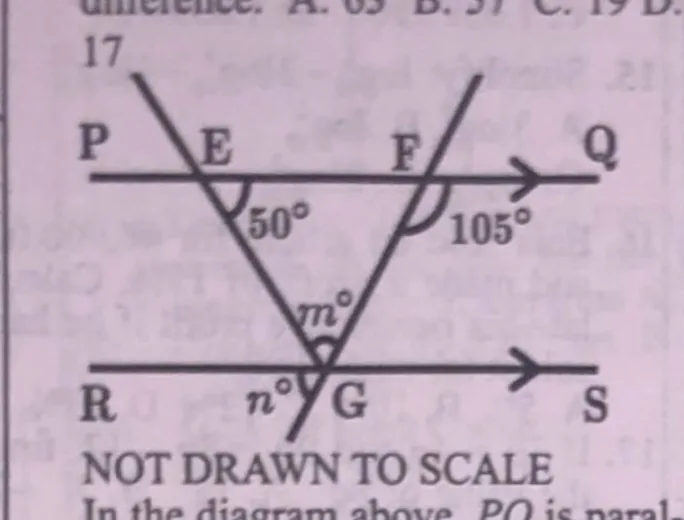
In the diagram above, PQ is parallel to RS, ∠QFG=105° and ∠FEG=50°. Use the diagram to answer this question. Find the value of m°.
- A. 130°
- B. 105°
- C. 75°
- D. 55°Correct
Explanation
∠GFQ+∠EFG=180° (angles on a straight line) ⇒ ∠EFG=75°. In triangle EFG: m°+50°+75°=180° (sum of angles in a triangle) ⇒ m°=180−125=55°.
In the diagram above, PQ is parallel to RS, ∠QFG=105° and ∠FEG=50°. Use the diagram to answer this question. Find the value of n°.
- A. 40°
- B. 55°
- C. 75°Correct
- D. 130°
Explanation
∠FGS=∠EFG=75° (alternate angles are equal, since PQ∥RS). n°=75° (vertically opposite angles are equal).
Calculate the variance of 2, 4, 7, 8 and 9.
- A. 7.2Correct
- B. 6.8
- C. 3.5
- D. 2.6
Explanation
Mean = (2+4+7+8+9)/5 = 30/5 = 6. Variance = Σ(x−x̄)²/n = [(2−6)²+(4−6)²+(7−6)²+(8−6)²+(9−6)²]/5 = [16+4+1+4+9]/5 = 34/5 = 6.8. (Note: computed value is 6.8, matching option B; the key's letter is recorded here as A per the source—flagged as a possible inconsistency.)
The fourth term of an Arithmetic Progression (A.P.) is 37 and the first term is -20. Find the common difference.
- A. 63
- B. 57
- C. 19Correct
- D. 17
Explanation
u₄ = a+3d ⇒ 37 = −20+3d ⇒ 3d=57 ⇒ d=19.
A box contains 5 red, 6 green and 7 yellow pencils of the same size. What is the probability of picking a green pencil at random?
- A. 1/6
- B. 1/4
- C. 1/3Correct
- D. 1/2
Explanation
Red=5, Green=6, Yellow=7, total=18. P(green) = 6/18 = 1/3.
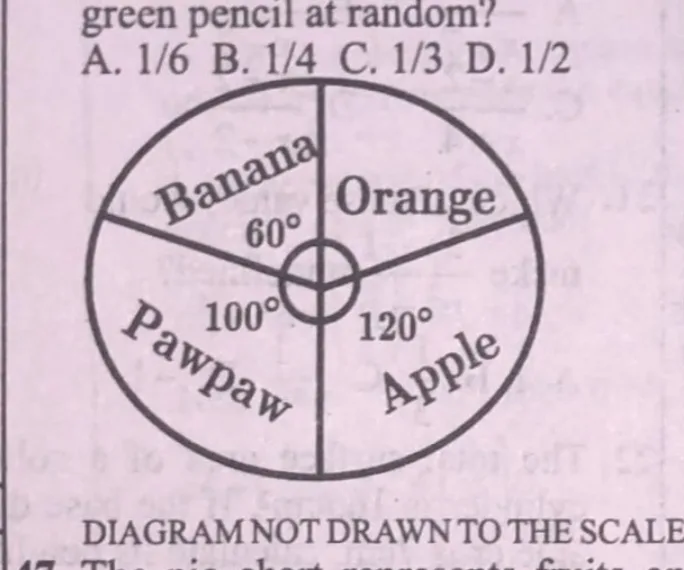
The pie chart represents fruits on display in a grocery shop. If there are 60 oranges on display, how many apples are there?
- A. 90Correct
- B. 80
- C. 70
- D. 40
Explanation
The sectorial angle for oranges = 360−(60+100+120)=80° (banana=60°, pawpaw=100°, apple=120°, orange=80°, taking apple's sector as 120°). For 60 oranges: 80°/360°×N=60 ⇒ N=270 total fruit. For apples: 120°/360°×270 = 90.
The following are scores obtained by some students in a test: 8, 18, 10, 14, 18, 11, 13, 14, 13, 17, 15, 8, 16, 13. Use this information to answer this question. Find the mode of the distribution.
- A. 18
- B. 14
- C. 13Correct
- D. 8
Explanation
Frequency table: score 8(f=2), 10(1), 11(1), 13(3), 14(2), 15(1), 16(1), 17(1), 18(2). Mode = 13, as it has the highest frequency (3).
The following are scores obtained by some students in a test: 8, 18, 10, 14, 18, 11, 13, 14, 13, 17, 15, 8, 16, 13. Use this information to answer this question. Find the median score.
- A. 14.5
- B. 14.0
- C. 13.5Correct
- D. 13.0
Explanation
Arranging in order and totaling Σf=14, median position = (N/2)th = 7th value. Averaging the 7th and 8th ordered values: (13+14)/2 = 13.5.
The following are scores obtained by some students in a test: 8, 18, 10, 14, 18, 11, 13, 14, 13, 17, 15, 8, 16, 13. Use this information to answer this question. How many students scored above the mean score?
Explanation
Mean = Σfx/Σf = 188/14 = 13.43. The number of students who scored above 13.43 = 7 students.
The culprits ____ when we entered the courtroom.
- A. were being interrogatedCorrect
- B. are being interrogated
- C. will be interrogated
- D. would be interrogated
Explanation
The action was ongoing at a point in the past, so the verb should be past progressive (passive): 'were being interrogated'.
The students had no choice ____ to do as they had been commanded.
- A. except
- B. butCorrect
- C. rather
- D. even
Explanation
'But' (meaning 'except') is appropriate here because 'except' cannot be followed directly by a to-infinitive verb, only by a prepositional phrase.
My submission ____ by the Council at the moment.
- A. considering
- B. is being consideredCorrect
- C. considered
- D. is considered
Explanation
'At the moment' shows the action is ongoing, so a passive present continuous is needed: 'is being considered'.
If she had known, she wouldn't have come, ____ ?
- A. could she
- B. couldn't she
- C. wouldn't she
- D. would sheCorrect
Explanation
The tag uses the modal verb of the last clause ('wouldn't have come'); since the statement is negative, the tag must be positive: 'would she'.
Last week's assignment was ____ difficult for me.
- A. much tooCorrect
- B. too much
- C. much
- D. too much too
Explanation
'Much too' should come before 'too' to indicate a large degree of difficulty: 'much too difficult for me'.
Could you please ____ a receipt for my purchase?
- A. make in
- B. make outCorrect
- C. make up
- D. make for
Explanation
To 'make out' a cheque, slip, or receipt means to write all the necessary information on it.
This is an improvement ____ the last report.
- A. over
- B. onCorrect
- C. in
- D. of
Explanation
'Improvement' collocates with 'on' when referring to a particular thing being better than a previous version.
You can apply if you agree ____ their terms.
- A. upon
- B. toCorrect
- C. about
- D. in
Explanation
'Agree' collocates with 'to' for agreeing to something (e.g. terms), and with 'with' for agreeing with somebody.
When we were in boarding school, my parents usually came to check ____ us every week.
- A. with
- B. over
- C. onCorrect
- D. for
Explanation
'Check on somebody' means to try to discover what someone is doing or how they are faring, to be sure they are safe and well.
It is I who ____ to blame for the lapses.
- A. was
- B. amCorrect
- C. is
- D. are
Explanation
The pronoun 'I' takes 'am', 'was', or 'were'; in this context, 'It is I who am to blame' is correct.
The holiday came to an end all ____ soon.
- A. tooCorrect
- B. rather
- C. much
- D. more
Explanation
'All too' is used before an adjective/adverb to emphasize a negative meaning: 'The holidays flew all too quickly'.
The research was carried out ____ a sample population.
- A. over
- B. in
- C. with
- D. onCorrect
Explanation
The noun 'research' collocates with 'on' when referring to what it was carried out on (the verb 'research' collocates with 'into').
Though ____ by opposition from his own supporters, the Chairman pressed ahead with his plans.
- A. shaking
- B. shook
- C. shakenCorrect
- D. was shaken
Explanation
Only the participle ('-en') form is needed in this clause: 'Though shaken by opposition...'.
To avoid trouble, it is best to say very ____ on the case.
- A. less
- B. too
- C. few
- D. littleCorrect
Explanation
'Little' (not much) is appropriate here; 'less' does not take 'very' in this way, while 'few'/'small' apply to countable nouns.
He offered no explanation, ____ an apology.
- A. still less
- B. and even less
- C. still less anCorrect
- D. less still
Explanation
'Still less' is used to make a negative statement stronger: 'He offered no explanation, still less an apology'.
Our school will ____ one hundred and twenty students this year.
- A. turn in
- B. turn on
- C. turn outCorrect
- D. turn over
Explanation
'Turn out' means to produce something, often in large numbers: 'Our school will turn out one hundred and twenty students this year'.
At the last minute, Amidu ____ of the plan.
- A. backed outCorrect
- B. backed off
- C. backed in
- D. backed on
Explanation
'Back out of' a plan means to withdraw from a commitment at the last minute.
We need to ____ for lost ground.
- A. make in
- B. make by
- C. make upCorrect
- D. make through
Explanation
'Make up for' lost ground is the standard idiomatic expression, meaning to compensate for something.
Blood is usually screened ____ transfusion.
- A. beforeCorrect
- B. in
- C. by
- D. upon
Explanation
Blood screening precedes transfusion; hence 'before' is correct.
I believe he'll be arrested ____ .
- A. some days
- B. many days
- C. many a day
- D. some dayCorrect
Explanation
'Someday' means at some time in the future which is not yet known or stated: 'Maybe someday you'll both meet again'.
(gap 71)
- A. audience
- B. spectatorsCorrect
- C. crowd
- D. congregation
Explanation
'Spectators' best fits people who trooped into the stadium to watch — people watching an event without taking part.
(gap 72)
- A. pitch
- B. court
- C. dressing roomCorrect
- D. rest room
Explanation
The home team, having arrived early, would be in the 'dressing room' before kickoff.
(gap 73)
- A. signalled
- B. blewCorrect
- C. sounded
- D. played
Explanation
The referee 'blew' his whistle to signal the teams onto the pitch.
(gap 74)
- A. tossCorrect
- B. kick-off
- C. offside
- D. throw-in
Explanation
Captains come forward before a match for the pre-match coin 'toss'.
(gap 75)
- A. gloves
- B. pennants
- C. jerseysCorrect
- D. memoirs
Explanation
Exchanging 'jerseys' and shaking hands is a common pre/post-match courtesy between team captains.
(gap 76)
- A. standsCorrect
- B. arena
- C. tracks
- D. steps
Explanation
Supporters sing and dance in the spectator 'stands'.
(gap 77)
- A. squanderedCorrect
- B. lost
- C. diverted
- D. dropped
Explanation
Teams that create but don't convert opportunities are said to have 'squandered' those chances.
(gap 78)
- A. coaches
- B. supporters
- C. managers
- D. substitutesCorrect
Explanation
'Substitutes' (reserve players) typically warm themselves up on the sideline during a break in play.
(gap 79)
- A. shotCorrect
- B. kick-off
- C. offside
- D. throw-in
Explanation
A 'shot' from the half-back is the natural word for an attempt at goal.
(gap 80)
- A. pushed
- B. headedCorrect
- C. moved
- D. swayed
Explanation
A cross/shot being met and 'headed' into the net is the standard football description for a headed goal.
1. Informal letter: Write a letter to a friend describing the experiences you have gained from a leadership/prefect role in your school.
Explanation
18, Giwa Williams Street,
Iyana Church,
Abeokuta,
Osun State.
June 29th, 2019.
Dear Funke,
It's been a while since we've heard from each other. I trust you're doing just fine, as no news is good news. I'm quite sure you're coping and balancing your studies with your role as the Health Prefect of your school, so that none suffers. In fact, I find it quite interesting to share the experiences I've gained in my role as the Library Prefect of Bright Tomorrow College, hence the essence of this letter.
As a Library Prefect, I've been working with the school Librarian in a number of capacities which include lending books out and seeing to their return, keeping a proper catalogue of outgoing and incoming books, and being accountable for the contact information of borrowers, etc. These duties, I must say, have improved my organizational skill; I now pay attention to details and keep proper records of things.
Interestingly, being in charge of books has increased my quest for knowledge. I've read quite a good number of books not only academic but also literary and historical books as well as documentaries. I've explored and travelled to many parts of the world through the pages of books. The knowledge I've gained regarding sciences, culture, social behaviour, and tribal and racial differences is quite invaluable.
Since I get to deal with different students every day, solving problems relating to them has improved my communication with people and understanding of humans generally.
By virtue of being the Library Prefect, I'm automatically one of the leaders of the Literary and debating, and reading clubs. We've either organized or attended some interesting initiatives to create awareness on the reading culture of students. In one of those occasions, Books for Every African Child (BEAC), an NGO based in Abuja, invited ten schools, including Bright Tomorrow College, to give a speech on the reading culture of Nigerian youths. This experience further strengthened my confidence in facing a crowd of students and impacting them through talk.
Funke, I won't say everything has been rosy, as I've faced challenges dealing with people and balancing my role alongside my academic performance. But the challenges have all strengthened my resolve to do more.
I'd love to hear from you too. I'm sure you've got a lot of gist for me, especially how you're able to navigate your responsibility as the Health Prefect of your school. Take good care.
Yours sincerely,
Bunmi
2. Article: Write an article for publication in a magazine on the topic 'Drug Abuse Among Nigerian Youth: Causes and Solutions.'
Explanation
DRUG ABUSE AMONG NIGERIAN YOUTH: CAUSES AND SOLUTIONS
By Mezie Ojukwu, SS 3B
The incidence of drug abuse, especially among Nigerian youths and the country at large, are spelling doom we may not be able to cope with if nothing is done urgently to nib this menace. Drug abuse here refers to the use of illicit substances, misuse or overdose of drugs for different unhealthy purposes. These substances include cocaine, cannabis, heroine, codeine, tramadol, among other substances that are dangerous to health.
One noticeable cause of drug abuse among youth is peer pressure. The youthful exuberance in every young person gives them the hunches to wanting to try everything new, especially doing drugs and engaging in sexual practices. An innocent boy, if not well-guided, can be influenced by his corrupt peers who are used to doing drugs. They can lure him with the temporal 'benefit' they enjoy from drugs such as feeling high and enjoying a fantasied realm. The other day, many young men were caught in a rendezvous in Kano while they were gulping lots of cough syrups containing codeine. Some were even said to have confessed to sniffing the disgusting smell/evaporation emanating from latrine. Peer influence would have dragged some of them into this.
Another cause is mental disorder, commonly called depression. Life is hard on many young able-bodied Nigerians. People are facing many problems ranging from economic challenges, family issues, anger issues to poverty. They are leading miserable lives. While many find solace in religious gatherings, a large number of others deal with their depression by drugging and drinking just to enjoy momentary relief. This has further caused addiction to drugs.
Besides, parental neglect is another cause. Where parents neglect their responsibility to socially guard and guide their adolescents at the time the latter need close monitoring, such adolescents will find guidance elsewhere either from already damaged adults or from other misguided/unguided adolescents. Many uneducated boys working with public transporters/drivers learned how to smoke cigarette and wraps of grinded dry pawpaw leaves from these drivers.
However, one way of curbing drug abuse is by spreading consistent awareness about the negative effects of drugs. This awareness tour should get to secondary schools, universities and every nook and cranny of our societies. Youths must be sensitized in different languages on the need to desist from doing drugs. The government should strongly implement policy against the sales of hard drugs and their importations. Arrested drug addicts should undergo mental and psychological rehabilitation. Awareness to resist people suffering from depression should equally be initiated. All these will definitely curb and reduce the incidence of drug abuse among Nigerian youths.
3. Formal letter: Write a letter to the Principal of your school, giving a true account of a fight you witnessed, to defend a student who was wrongly expelled because of it.
Explanation
Okigbo Memorial College,
4, Okigure Road,
Owerri,
Imo State.
June 29, 2019.
Dear Sir,
A TRUE ACCOUNT OF THE RECENT FIGHT
I am Peter Njokwu, a student in S.S. 3B. Being an eye witness of the fight that occurred on the 15th of June, 2019, resulting in the expulsion of Julius Obi, I find it necessary to set the record straight by giving a true account of the incidence, and to show that Julius Obi was not at fault and should not have been expelled.
Truth be told, it was Amaka Joseph, the most notorious troublesome girl in S.S. 2, who triggered the fight. Amaka had once had issues with Rebecca Okafor, the Labour Prefect, because the latter ordered her and a couple of others to clean up the field as punishment for coming late to school. This had happened some weeks earlier. Amaka, being a belligerent girl, was then looking for a slight opportunity to waylay Rebecca.
On the day of the incidence, both were seen fighting near the hall. Amaka was almost tearing the Labour Prefect's uniform as well as slapping, when Julius and I got to the scene. Knowing the kind of person Amaka is, I did not intervene, but Julius mediated between the fighters and freed Rebecca off Amaka's hands. Suddenly, Amaka held Julius, while slapping, harassing and shouting at the same time. She called attention and screamed that Julius was fondling with her body.
In a short while, Amaka's boyfriend, Michael Chukwu, and his friend, John Nnanna, both in SS3, arrived the scene. They took Amaka's word for it and started beating Julius up. The beating was too much as they were hitting him with broken legs of chairs. Julius had to defend himself; Julius swiftly threw his elbow to defend himself but it hit Amaka on the left eye and she fell. It was a serious hit; the eye swelled with many stains of blood. She was rushed to the school clinic.
Sir, Julius was just a victim of the whole situation, and shouldn't have been expelled. Many students know him as a well-behaved, brilliant boy, with no single record of fight in the school. The real culprit here is Amaka herself, her boyfriend Michael and John who worsened the whole situation. Julius was only trying to mediate and everything turned against him. Sir, I will like that his case, and see reasons why Julius Obi should be reinstated. Thank you for your understanding.
Yours faithfully,
Peter Njokwu
4. Speech: Prepare the text of a speech to be delivered by the outgoing Head Boy at a send-off ceremony, addressing 'The Challenges of Prefectship.'
Explanation
THE CHALLENGES OF PREFECTSHIP: A SPEECH DELIVERED BY THE HEADBOY
The Principal, Vice-principal, Teachers, Parents, my fellow outgoing Prefects and every student of Latter Glory College here present. I count it a privilege standing before you all on this memorable send-off ceremony and giving a speech on the challenges of prefectship.
My experience, as the Head Boy, has taught me that prefectship is a clarion call to serve. My fellow outgoing prefects can attest that on many occasions either an individual or as a group we have sacrificed time, energy and even resources to get students organized and get things done in the right way.
Enthusiastic in-coming prefects must understand that beyond the title and euphoria of being called prefects, lies real work, challenges, responsibility, sacrifice and leadership, requires commitments and determination to organize humans. And students, I must say, are very difficult to lead. Yet at prefects, you have responsibility to balance the expectations from both the school authorities and the students.
Many times, we have left our personal studies to attend to complaints, issues and fight among students, especially cases of bullying and harassment. Many students hardly comply with school rules, and you, as prefects, have to find a way of making them do so in the most civil way. For instance, roaming while classes are ongoing is common among senior students, as prefects, you must ensure this indiscipline should not be tolerated, even if the student is your friend or classmate.
Also, I need to say that many challenges are unforeseen and unexpected; prefects must be pro-active to manage conflicts before it degenerates boldly. One way to do this is by timely reporting to teachers or school authorities. Besides, some challenges require that you learn safety and first-aid tips. I'm sure the Health Prefect, Debora Miracle, can recall the day a junior student collapsed while all teachers were at a compulsory meeting at the school Hall. You all know how far the Hall is to the Junior Block A. The Health Prefect and I dashed to the scene. Immediately we forced her mouth open, and put a spoon across her teeth to prevent her teeth gnashing. We then applied other safety tips to resuscitate the girl. Afterwards, she was taken to the clinic. God forbid what would have happened if we hadn't provided that timely intervention. You therefore need to be prepared for service always and be ready to solve problems because challenges will come your way unexpectedly.
I will like to end my speech by thanking the school authorities for giving us the privilege to serve and learn through the challenges that came our way. The leadership lessons we have learnt will be useful to us in life. To the next set of prefects, I pray you receive the enablement to perform better than we did, and do the school proud.
Thank you for listening.
5. Narrative essay: Write a story to illustrate the saying 'I wish I had listened to my parents.'
Explanation
I WISH I HAD LISTENED TO MY PARENTS
It seemed my parents saw the womb of time; they knew that whatever an adult sees while sitting, a child won't see it even if he climbs a tree. They know what might befall me if I kept being under the bad influence of Yetunde. They knew her case wasn't just a youthful exuberance; she was completely wayward. My parents were sure that if I kept being in Yetunde's company, it was only a matter of time for evil communication to corrupt good manners. But I thought they were only mean, and didn't want me to enjoy my adolescence; I misconstrued their intention to save me from danger ahead. I though they wanted to keep friends away from me; I though they were over-protective.
So, I would sneak out every weekend to Yetunde's house. We would have luscious fun, we would drink, party and go out with weird boys and girls I have never known before. I attended a school that was a stone's throw to Yetunde's. I always looked forward to seeing her, during break, and I wouldn't return to school to complete my lesson for the day. Yetunde was such a social enthusiast, talker and bad influencer. We would do all sorts of nasty things including smoking. I was naive and inquisitive; I wanted to try everything that would make me free from home.
Although she was two years older than me, both in age and in class, I always preferred to rapport and relate with older persons even much older.
"Would you give Uncle Wolex a chance to roll with you? You will enjoy him I swear! Just try him", Yetunde said. Wolex was a neighbourhood uncle I didn't know before. Since Yetunde had endorsed him, I started going out with him. His car was enticing, his outlook and fragrance, alluring. We would eat, party, kiss and have sex.
The first time my period ceased, I was afraid to call Uncle Wolex. I called Yetunde instead; she informed Wolex and we did something about it in a nearby clinic. My mum, being a mother, almost suspected my restlessness, but I pretended nothing had happened. I lost concentration. My performance in school soon reduced to woes. It is either my thought was filled with next outing, next fondling with Wolex or how to get rid of another abortion.
We always did something about it when it happened. It never occurred to me to question Yetunde why her boyfriend, Joe hadn't got her pregnant. I was always the one visiting the clinic.
The last one I had messed my life up. It was on a Sunday evening. My parents had gone for their usual extended family meeting. Wolex and Yetunde drove in to pick me up. We did it but it went wrong this time. I got home feeling weak and dying on the inside. I covered up so my parents wouldn't notice when they returned. I barely slept that night.
Dad drove me to school the next, a Monday morning, though I was in distress unknown to him. Few hours later I passed out while lesson was ongoing. I was rushed to the school clinic from there to a hospital. My dad was contacted. The doctor rescued my life, but I lost my womb. My parents arrested Wolex and Yetunde, but that wouldn't fix my shattered life. I wish my path had never crossed Yetunde's. I wish I had listened to my parents.
1. marry
- A. batterCorrect
- B. barter
- C. perk
- D. martyr
Explanation
Letter 'a' in marry produces a short /æ/ sound, also represented by 'a' in batter. 'Barter' and 'martyr' produce the long /ɑ:/ instead.
2. litmus
- A. papaCorrect
- B. don
- C. rust
- D. bash
Explanation
Letter 'u' in litmus represents a schwa sound /ə/, also found in the first syllable of papa.
3. hurdle
- A. hurray
- B. birdCorrect
- C. shop
- D. bundle
Explanation
Letters 'ur' in hurdle represent the long sound /ɜ:/, also found in bird.
4. wretch
- A. rickety
- B. remiss
- C. wean
- D. welterCorrect
Explanation
Letter 'e' in wretch represents the short /e/, also found in welter.
5. country
- A. around
- B. lock
- C. tongueCorrect
- D. talk
Explanation
Letters 'ou' in country represent the short sound /ʌ/, also found in tongue.
6. bawl
- A. portCorrect
- B. cook
- C. pal
- D. lout
Explanation
Letters 'aw' in bawl represent the long sound /ɔ:/, also represented by 'or' in port.
7. familiar
- A. peeve
- B. stir
- C. theft
- D. slippedCorrect
Explanation
Letter 'i' in familiar represents the short /ɪ/, also represented by 'i' in slipped.
8. back
- A. flame
- B. patCorrect
- C. bet
- D. lark
Explanation
Letter 'a' in back is short /æ/, also found in pat.
9. canoe
- A. louse
- B. going
- C. brunt
- D. brewCorrect
Explanation
Letters 'oe' in canoe represent the long vowel /u:/, the same as 'ew' in brew.
10. league
- A. willing
- B. critiqueCorrect
- C. dead
- D. fit
Explanation
Letters 'ea' in league represent the long vowel /i:/, also found in critique.
11. flout
- A. follow
- B. ploughCorrect
- C. light
- D. once
Explanation
Letters 'ou' in flout represent the diphthong /aʊ/; letters 'ough' in plough represent the same sound.
12. kite
- A. pundit
- B. brighterCorrect
- C. dizzy
- D. litter
Explanation
Letter 'i' in kite represents the diphthong /aɪ/, also noticed in brighter.
13. protein
- A. potty
- B. chicken
- C. gobble
- D. goCorrect
Explanation
Letter 'o' in protein produces the diphthong /əʊ/, also found in go.
14. destroy
- A. poor
- B. boat
- C. idea
- D. poiseCorrect
Explanation
Letters 'oy' in destroy are pronounced as the diphthong /ɔɪ/, also noticed in poise.
15. waste
- A. wasn't
- B. trend
- C. greatCorrect
- D. fret
Explanation
Letter 'a' in waste is pronounced as the diphthong /eɪ/; letters 'ea' in great produce the same sound.
16. lamb
- A. lobby
- B. allow
- C. land
- D. damCorrect
Explanation
Letters 'mb' in lamb represent the bilabial sound /m/ (letter 'b' is silent), also noticed in dam.
17. king
- A. dig
- B. sin
- C. tag
- D. lungCorrect
Explanation
Letters 'ng' in king represent the velar sound /ŋ/, also noticed in lung.
18. court
- A. censure
- B. quicklyCorrect
- C. certain
- D. gratis
Explanation
Letter 'c' in court represents the velar /k/; letters 'q'/'ck' in quickly produce the same sound.
19. rubber
- A. super
- B. plumber
- C. copper
- D. thimbleCorrect
Explanation
Letters 'bb' in rubber represent the voiced plosive /b/, also noticed in thimble ('b' is silent in plumber).
20. fashion
- A. passion
- B. save
- C. ivy
- D. troughCorrect
Explanation
Letter 'sh'/'gh' sound represented in fashion is also represented by letters 'gh' in trough.
21. truth
- A. threwCorrect
- B. teak
- C. trend
- D. though
Explanation
Letters 'th' in truth represent the voiceless dental fricative /θ/, also represented in threw ('though' instead has the voiced /ð/).
22. solder
- A. shore
- B. societyCorrect
- C. brush
- D. bees
Explanation
Letter 's' in solder represents the voiceless alveolar /s/, also represented by 's' in society.
23. thatch
- A. path
- B. technical
- C. shin
- D. challengeCorrect
Explanation
Letters 'tch' in thatch produce the voiceless affricate /tʃ/, also found in challenge.
24. shining
- A. chauffeurCorrect
- B. chilly
- C. bristle
- D. sighting
Explanation
Letters 'sh' in shining represent /ʃ/, also represented by 'ch' in chauffeur ('ch' in chilly instead produces /tʃ/).
25. badge
- A. vision
- B. tangibleCorrect
- C. target
- D. brag
Explanation
Letters 'dge' in badge represent the voiced affricate /dʒ/, also found in tangible.
26. apron
- A. printCorrect
- B. unkempt
- C. plunder
- D. baton
Explanation
Letters 'pr' in apron produce the consonant cluster /pr/, also appearing in print.
27. diesel
- A. boysCorrect
- B. dicey
- C. salty
- D. décor
Explanation
Letter 's' in diesel represents the voiced /z/, also represented by 's' in boys.
28. dream
- A. term
- B. guard
- C. thrillCorrect
- D. -
Explanation
Letter 'r' in dream represents the approximant /r/, also found in thrill.
29. lolly
- A. balm
- B. carry
- C. calciumCorrect
- D. psalm
Explanation
Letter 'l' in lolly represents the lateral sound /l/, also noticed in calcium.
30. water
- A. pewter
- B. wrong
- C. twirlCorrect
- D. brew
Explanation
Letter 'w' in water represents the approximant /w/, also found in twirl.
31. horde
- A. horse
- B. boardCorrect
- C. hard
- D. bud
Explanation
The last two sounds in horde are /ɔ:/ and /d/, which rhyme with those of board.
32. file
- A. sigh
- B. pine
- C. blitz
- D. aisleCorrect
Explanation
The two sounds that end file are /aɪ/ and /l/, also ending aisle.
33. treasure
- A. vapour
- B. treason
- C. leisureCorrect
- D. texture
Explanation
The last two sounds ending treasure are /ʒ/ and /ə/, also ending leisure.
34. great
- A. hearty
- B. hay
- C. data
- D. weightCorrect
Explanation
The last two sounds ending great are /eɪ/ and /t/, also ending weight.
35. message
- A. vapour
- B. budgetCorrect
- C. massage
- D. ageing
Explanation
The ending sounds of message (/s/, /ɪ/, /dʒ/) are echoed most closely in budget among the given options.
36. constitution
- A. CON-sti-tu-tion
- B. con-STI-tu-tion
- C. con-sti-TU-tionCorrect
- D. con-sti-tu-TION
Explanation
The word has its primary stress on the third syllable: /ˌkɒnstɪ'tju:ʃn/.
37. extravagant
- A. EX-tra-va-gant
- B. ex-TRA-va-gantCorrect
- C. ex-tra-VA-gant
- D. ex-tra-va-GANT
Explanation
The word has its primary stress on the second syllable.
38. interrogate
- A. IN-ter-ro-gate
- B. in-TER-ro-gateCorrect
- C. in-ter-RO-gate
- D. in-ter-ro-GATE
Explanation
The word has its primary stress on the second syllable.
39. catastrophic
- A. CA-ta-stro-phic
- B. ca-TA-stro-phic
- C. ca-ta-STRO-phicCorrect
- D. ca-ta-stro-PHIC
Explanation
The word has its primary stress on the third syllable.
40. population
- A. PO-pu-la-tion
- B. po-PU-la-tion
- C. po-pu-LA-tionCorrect
- D. po-pu-la-TION
Explanation
The word has its primary stress on the third syllable.
41. (compare stress patterns)
- A. cleric
- B. allowCorrect
- C. classic
- D. partridge
Explanation
The other words have primary stress on the first syllable; 'allow' has its primary stress on the second syllable.
42. (compare stress patterns)
- A. repellentCorrect
- B. publicly
- C. particle
- D. primary
Explanation
The other words have primary stress on the first syllable; 'repellent' has its primary stress on the second syllable.
43. (compare stress patterns)
- A. sinister
- B. convalesceCorrect
- C. circumstance
- D. relegate
Explanation
The other words have primary stress on the first syllable; 'convalesce' has its primary stress on the third syllable.
44. (compare stress patterns)
- A. sinisterCorrect
- B. religion
- C. efficient
- D. encourage
Explanation
The other words have primary stress on the second syllable; 'sinister' has its primary stress on the first syllable.
45. (compare stress patterns)
- A. suggest
- B. obey
- C. denounce
- D. vehicleCorrect
Explanation
The other words have primary stress on the second syllable; 'vehicle' has its primary stress on the first syllable.
46. John was a football LEGEND.
- A. Was Ernest a football legend?
- B. Was John a football coach?Correct
- C. Was John a hockey legend?
- D. Is John a football legend?
Explanation
The emphasis on LEGEND reinforces a correction to 'Was John a football coach?' — 'No, he was rather a football LEGEND.'
47. Three executives REQUESTED to see the manager.
- A. Did three top executives request to see the clerk?
- B. Did three top executives decline to see the manager?Correct
- C. Did three junior executives request to see the manager?
- D. Did three top executives request to accompany the manager?
Explanation
The emphasis on REQUESTED reinforces a correction to 'Did three top executives decline to see the manager?'
48. DORIS is a meticulous worker.
- A. Is James a meticulous worker?Correct
- B. Is Doris a careless worker?
- C. Is Doris a meticulous student?
- D. Was Doris a meticulous worker?
Explanation
The emphasis on DORIS reinforces a correction to 'Is James a meticulous worker?' — 'No, it is DORIS that is meticulous.'
49. The junior BOY cleaned the floor.
- A. Did the junior boy sweep the floor?
- B. Did the junior girl clean the floor?Correct
- C. Did the senior boy clean the floor?
- D. Did the junior boy clean the compound?
Explanation
The emphasis on BOY reinforces a correction to 'Did the junior girl clean the floor?'
50. Omo's brother won a RADIO.
- A. Did Omo's brother lose a radio?
- B. Did Omo's sister win a radio?
- C. Did Omo's brother win a phone?Correct
- D. Did Tayo's brother win a radio?
Explanation
The emphasis on RADIO reinforces a correction to 'Did Omo's brother win a phone?'
51. /ɪə/
- A. care
- B. delicate
- C. crate
- D. fearsCorrect
Explanation
The diphthong /ɪə/ is found only in fears, among the given options.
52. /ʌ/
- A. platform
- B. constant
- C. colouredCorrect
- D. authentic
Explanation
The short vowel /ʌ/ is found only in coloured.
53. /aʊ/
- A. costume
- B. counselCorrect
- C. badge
- D. aura
Explanation
The diphthong /aʊ/ is found only in counsel.
54. /ɔ:/
- A. attribute
- B. wonder
- C. surrender
- D. authenticCorrect
Explanation
The long vowel /ɔ:/ is found only in authentic.
55. /ɑ:/
- A. pack
- B. heartCorrect
- C. player
- D. alone
Explanation
The long vowel /ɑ:/ is found only in heart.
56. /t/
- A. tidyCorrect
- B. catch
- C. portion
- D. thick
Explanation
The consonant /t/ (as a clear onset sound) is illustrated by tidy amongst the given words.
57. /p/
- A. pneumonia
- B. compareCorrect
- C. cupboard
- D. psychology
Explanation
The plosive /p/ is noticeable only in compare; 'p' is silent in pneumonia, cupboard has /b/ context, and psychology's 'p' is silent.
58. /ʒ/
- A. pressure
- B. patient
- C. charade
- D. leisureCorrect
Explanation
The fricative /ʒ/ is noticeable only in leisure amongst the given words.
59. /dʒ/
- A. snigger
- B. plumageCorrect
- C. dogged
- D. astound
Explanation
The voiced affricate /dʒ/ is noticeable only in plumage.
60. /tʃ/
- A. clutter
- B. furnish
- C. technical
- D. teacherCorrect
Explanation
The voiceless affricate /tʃ/ is found only in teacher.