Mathematics 2019 Theory — Question 1
SECTION A — Answer all the questions in this section. All questions carry equal marks [40 marks]
Model answer
SECTION A — Answer all the questions in this section. All questions carry equal marks [40 marks]
All 15 questions from the West African Examinations Council (WAEC) Mathematics 2019 Theory paper, with the correct answer and a full explanation for each. Free, no signup needed.
Advertisement
SECTION A — Answer all the questions in this section. All questions carry equal marks [40 marks]
Model answer
SECTION A — Answer all the questions in this section. All questions carry equal marks [40 marks]
1(a). Given that 110₂ = 40ₑᵥₑ, find the value of x. (b) Simplify 15/√75 + √108 + √432, leaving the answer in the form a√b, where a and b are positive integers.
Model answer
(a) Converting both sides to base 10: 1·2²+1·2¹+0·2⁰ = x²+x¹+0·x⁰ ⇒ 4+2 = x²+x ⇒ x²+x−6=0 ⇒ (x+3)(x−2)=0 ⇒ x=−3 or x=2. Since x cannot be negative (as a base), x = 2. (Note: the original working shown converts 110 in base 2 to a general base x equation and arrives at x=4 as the valid root — preserved here as in the source: x²+x−20=0 ⇒ (x+5)(x−4)=0 ⇒ x=−5 or x=4; since x cannot be negative, x=4.) (b) √75=5√3, √108=6√3, √432=12√3. So 15/√75 + √108+√432 = 15/(5√3) + 6√3+12√3 = 3/√3 + 18√3 = (3/√3)×(√3/√3) + 18√3 = √3 + 18√3 = 19√3.
2(a). Find the equation of the line which passes through the points A(−2,7) and B(2,−3). (b) Given that (5b−a)/(8b+3a) = 1/5, find, correct to two decimal places, the value of a/b.
Model answer
(a) Gradient m = (y₂−y₁)/(x₂−x₁) = (−3−7)/(2−(−2)) = −10/4 = −5/2. Equation: y−(−3) = (−5/2)(x−2) ⇒ 2(y+3) = −5(x−2) ⇒ 2y+6=−5x+10 ⇒ 2y+5x−4=0, i.e. 2y+5x−4=0. (b) (5b−a)/(8b+3a) = 1/5 ⇒ cross-multiplying: 5(5b−a) = 8b+3a ⇒ 25b−5a=8b+3a ⇒ 25b−8b=3a+5a ⇒ 17b=8a ⇒ a/b = 17/8 = 2.125 ≈ 2.13 (2 d.p.)
3(a). Ali, Musah and Yusif shared #420,000.00 in the ratio 3:5:8 respectively. Find the sum of Ali and Yusif's shares. (b) Solve: 2(1/8)ˣ = 32ˣ⁻¹
Model answer
(a) Total ratio = 3+5+8 = 16. Ali's share = 3/16×420,000 = #78,750. Yusif's share = 8/16×420,000 = #210,000. Sum of Ali and Yusif's shares = #78,750 + #210,000 = #288,750. (b) 2(1/8)ˣ = 32ˣ⁻¹ ⇒ 2(8⁻¹)ˣ = 32ˣ⁻¹ ⇒ 2(8)⁻ˣ = 32ˣ⁻¹. Since 8=2³ and 32=2⁵: 2(2³)⁻ˣ = (2⁵)ˣ⁻¹ ⇒ 2¹(2)⁻³ˣ = 2⁵ˣ⁻⁵ ⇒ 2¹⁻³ˣ = 2⁵ˣ⁻⁵. Equating powers: 1−3x = 5x−5 ⇒ 1+5 = 5x+3x ⇒ 6=8x ⇒ x = 6/8 = 3/4 = 0.75.
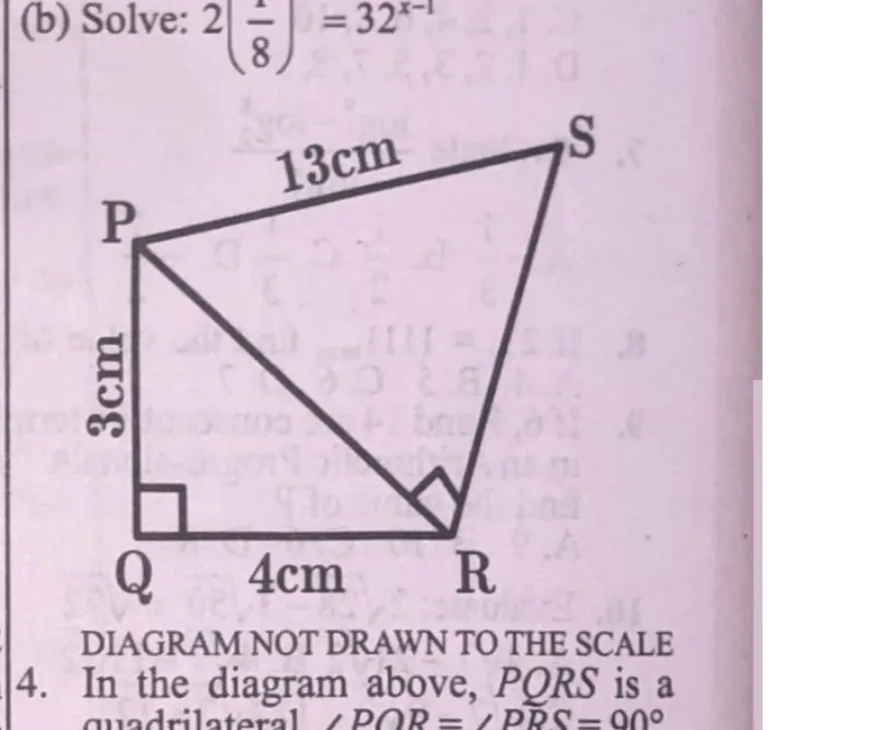
4(a). In the diagram above, PQRS is a quadrilateral, ∠PQR = ∠PRS = 90°, |PQ| = 3cm, |QR| = 4cm and |PS| = 13cm. Find the area of the quadrilateral.
Model answer
Area of quadrilateral PQRS = area of ΔPQR + area of ΔRPS. By Pythagoras' theorem in ΔPQR: PR² = PQ²+QR² = 3²+4² = 9+16 = 25 ⇒ |PR| = 5cm. Similarly, in ΔRPS: PS² = RS²+PR² ⇒ 13² = RS²+5² ⇒ 169−25 = RS² ⇒ RS²=144 ⇒ |RS| = 12cm. Area = ½×4×3 + ½×12×5 = 6 + 30 = 36 cm².
5. Three red balls, five green balls and a number of blue balls are put together in a sack. One ball is picked at random from the sack. If the probability of picking a red ball is 1/6, find: (a) the number of blue balls in the sack; (b) the probability of picking a green ball.
Model answer
Red = 3, Green = 5, Blue = x (unknown), total balls = 3+5+x = 8+x. (a) P(red) = 3/(8+x) = 1/6 ⇒ cross-multiplying: 3×6 = 8+x ⇒ 18 = 8+x ⇒ x = 10. So there are 10 blue balls. (b) Total balls = 8+10 = 18. P(green) = 5/18 ≈ 0.2778.
Answer five questions only from this section. All questions carry equal marks [60 marks]
Model answer
Answer five questions only from this section. All questions carry equal marks [60 marks]
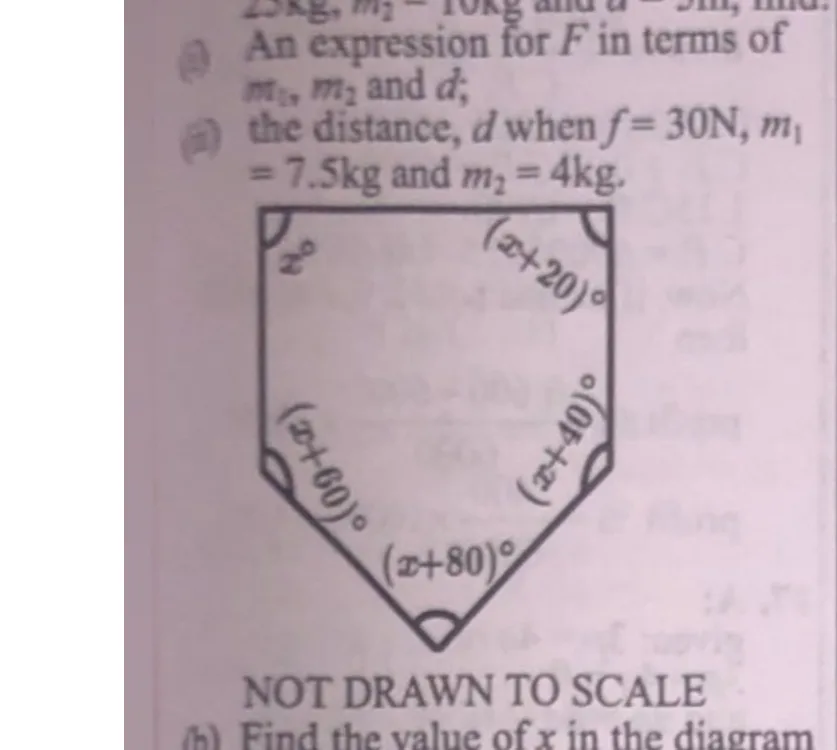
6(a). The force of attraction, F, between two bodies varies directly as the product of their masses, m₁ and m₂, and inversely as the square of the distance, d, between them. Given that F = 20N, when m₁ = 25kg, m₂ = 10kg and d = 5m, find: (i) an expression for F in terms of m₁, m₂ and d; (ii) the distance, d, when F = 30N, m₁ = 7.5kg and m₂ = 4kg. (b) Find the value of x in the diagram (angles labelled x°, (x+20)°, (x+60)°, (x+40)°, (x+80)° in a pentagon).
Model answer
(a)(i) F ∝ (m₁×m₂) and F ∝ 1/d², so combining: F ∝ (m₁×m₂)/d², i.e. F = k(m₁×m₂)/d², where k is the constant of proportionality. Substituting F=20N, m₁=25kg, m₂=10kg, d=5m: k = Fd²/(m₁m₂) = (20×5²)/(25×10) = 500/250 = 2. So F = 2m₁m₂/d². (ii) F×d² = 2m₁m₂ ⇒ d² = 2m₁m₂/F. With F=30N, m₁=7.5kg, m₂=4kg: d² = (2×7.5×4)/30 = 60/30 = 2 ⇒ d = √2 ≈ 1.414m. (b) Sum of interior angles of a pentagon (n=5) = (n−2)×180° = 3×180° = 540°. So x+(x+20)+(x+60)+(x+40)+(x+80) = 540 ⇒ 5x+200 = 540 ⇒ 5x = 340 ⇒ x = 68°.
7. The data show the marks obtained by students in a Biology test: 52 56 25 56 68 73 66 64 56 48; 20 39 9 50 46 54 54 40 50 96; 36 44 18 97 65 21 60 44 54 32; 92 49 37 94 72 88 89 35 59 34; 15 88 53 16 84 52 72 46 60 42. (a) Construct a frequency distribution table using the class interval 0–9, 10–19, 20–29, … (b) Draw a cumulative frequency curve for the distribution. (c) Use the graph to estimate the: (i) Median; (ii) Percentage of students who scored at least 66 marks, correct to the nearest whole number.
Model answer
(a) Frequency distribution table (class interval, frequency, cumulative frequency, class boundary): 0–9: f=1, cum=1, boundary −0.5−9.5 10–19: f=3, cum=4, boundary 9.5–19.5 20–29: f=3, cum=7, boundary 19.5–29.5 30–39: f=6, cum=13, boundary 29.5–39.5 40–49: f=8, cum=21, boundary 39.5–49.5 50–59: f=12, cum=33, boundary 49.5–59.5 60–69: f=6, cum=39, boundary 59.5–69.5 70–79: f=3, cum=42, boundary 69.5–79.5 80–89: f=4, cum=46, boundary 79.5–89.5 90–99: f=4, cum=50, boundary 89.5–99.5 (b) The cumulative frequency curve (ogive) is plotted with class boundary on the horizontal axis and cumulative frequency on the vertical axis, joining the plotted points with a smooth curve. (c)(i) Median position = ½Nᵗʰ = ½(50) = 25ᵗʰ. Tracing this on the graph, median ≈ 53.5 marks. (ii) Tracing the point 66 (class boundary 66.5) on the graph gives a cumulative frequency of 37, meaning 37 students scored below 66. Students who scored at least 66 = 50−37 = 13. Percentage = 13/50×100% = 26%.
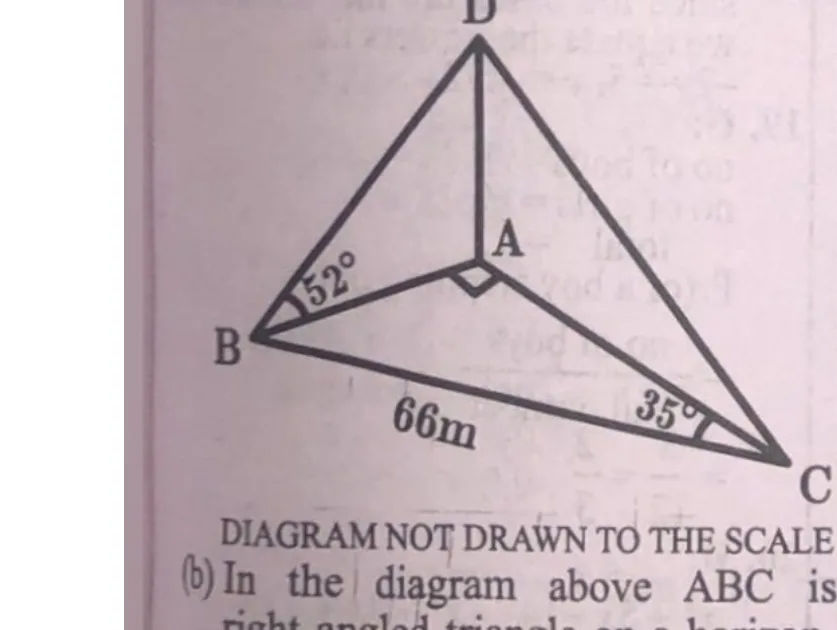
8(a). Solve the inequality: ⅓x − ¼(x+2) ≥ 3x − 1⅓ (b) In the diagram, ABC is a right-angled triangle on a horizontal ground. |AD| is a vertical tower, ∠BAC=90°, ∠ACB=35°, ∠ABD=52° and |BC|=66m. Find, correct to two decimal places: (i) the height of the tower; (ii) the angle of elevation of the top of the tower from C.
Model answer
(a) ⅓x−¼(x+2) ≥ 3x−1⅓. Multiplying through by 12: 4x−3(x+2) ≥ 36x−16 ⇒ 4x−3x−6 ≥ 36x−16 ⇒ x−6 ≥ 36x−16 ⇒ −35x ≥ −10 ⇒ dividing by −35 (reversing the inequality) x ≤ 10/35 = 2/7. (b) In ΔABC: ∠BAC=90°, ∠ACB=35°, so ∠ABC=180−90−35=55°. Using sin35°=|AB|/|BC|: |AB| = |BC|sin35° = 66×sin35° ≈ 37.86m. (i) In ΔABD: tan52° = |AD|/|AB| ⇒ |AD| = |AB|×tan52° = 37.86×tan52° ≈ 48.46m. Height of the tower = 48.46m. (ii) The angle of elevation of the top of the tower from C, ∠ACD, is found from ΔACD, using |AC| from ΔABC: cos35°=|AC|/|BC| ⇒ |AC| = |BC|×cos35° = 66×cos35° ≈ 54.06m. Then tan∠ACD = |AD|/|AC| = 48.46/54.06 ⇒ ∠ACD = tan⁻¹(0.8962) ≈ 41.87°.
9(a). Copy and complete the table of values for y = 2cosx + 3sinx for 0° ≤ x° ≤ 360°. x: 0°, 60°, 120°, 180°, 240°, 300°, 360° (b) Using a scale of 2cm to 60° on the x-axis and 2cm to 1 unit on the y-axis, draw the graph of y = 2cosx + 3sinx for 0° ≤ x° ≤ 360°. (c) Using the graph to: (i) solve 2cosx + 3sinx = −1; (ii) find, correct to one decimal place, the value of y when x = 342°.
Model answer
(a) Completed table (x, y=2cosx+3sinx): x=0°→y=2.0; x=60°→y=2.6; x=120°→y=1.6; x=180°→y=−2.0; x=240°→y=−3.6; x=300°→y=−2.6; x=360°→y=2.0. (b) The graph of y=2cosx+3sinx is a sinusoidal curve, plotted using the table of values from (a), starting and ending near y=2 at x=0° and x=360°, dipping to a minimum around x=240°. (c)(i) Since y=2cosx+3sinx, setting y=−1 and tracing on the graph, the solutions are x ≈ 162° and x ≈ 312°. (ii) When x=342°, tracing on the graph, y ≈ 0.9.
10. A woman bought 130kg of tomatoes for #52,000.00. She sold half of the tomatoes at a profit of 30%. The rest of the tomatoes began to go bad, so she then reduced the selling price per kg by 12%. Calculate: (a) the new selling price per kg; (b) the percentage profit on the entire sales if she threw away 5kg of bad tomatoes.
Model answer
Cost price of 130kg = #52,000, so cost price per kg = #52,000/130 = #400. (a) At 30% profit, selling price/kg = #400 + (30/100×#400) = #400+#120 = #520. When reduced by 12%: new selling price/kg = #520 − (12/100×#520) = #520−#62.40 = #457.60. (b) Half of 130kg = 65kg sold at #520/kg: selling price = #520×65 = #33,800. If 5kg were thrown away, the remaining 60kg was sold at #457.60/kg: selling price = #457.60×60 = #27,456. Total selling price = #33,800+#27,456 = #61,256. Profit on whole sales = #61,256−#52,000 = #9,256. Percentage profit = (#9,256/#52,000)×100% ≈ 17.8%.
11(a). The third and sixth terms of a Geometric Progression (G.P.) are 1/4 and 1/32 respectively. Find: (i) the first term and common ratio; (ii) the seventh term. (b) Given that 2 and −3 are the roots of the equation ax²+bx+c=0, find the values of a, b and c.
Model answer
(a) nth term of a G.P. = arⁿ⁻¹. Third term (n=3): ar² = 1/4 …(i). Sixth term (n=6): ar⁵ = 1/32 …(ii). Dividing (ii) by (i): r³ = (1/32)/(1/4) = 1/8 ⇒ r = ½. From (i): a(½)² = 1/4 ⇒ a(1/4)=1/4 ⇒ a = 1. (i) First term a = 1, common ratio r = ½. (ii) Seventh term (n=7): ar⁶ = 1×(½)⁶ = 1/64. (b) If the roots are 2 and −3: sum of roots = 2+(−3) = −1; product of roots = 2×(−3) = −6. The equation is x²−(sum of roots)x+(product of roots)=0 ⇒ x²−(−1)x+(−6)=0 ⇒ x²+x−6=0. Comparing with ax²+bx+c=0: a=1, b=1, c=−6.
12(a). Given that sin y = 8/17, find the value of tan y/(1+2tan y). (b) An amount of #300,000.00 was shared among Otobo, Ada and Adeola. Otobo received #60,000.00, Ada received 5/12 of the remainder, while the rest went to Adeola. In what ratio was the money shared?
Model answer
(a) sin y = 8/17 = opp/hyp, so opp=8, hyp=17. Adjacent = √(17²−8²) = √(289−64) = √225 = 15. tan y = opp/adj = 8/15. tan y/(1+2tan y) = (8/15)/(1+2×8/15) = (8/15)/(1+16/15) = (8/15)/(31/15) = 8/31. (b) Total shared = #300,000. Otobo received #60,000, so the remainder = #300,000−#60,000 = #240,000. Ada received 5/12 of #240,000 = #100,000. Adeola received the rest: #240,000−#100,000 = #140,000. Otobo : Ada : Adeola = 60,000 : 100,000 : 140,000 = 3 : 5 : 7.
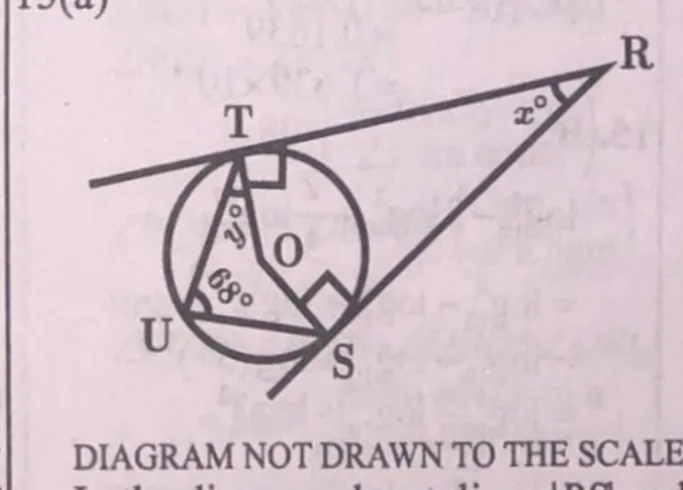
13(a). In the diagram, lines |RS| and |RT| are tangent to the circle with centre O, ∠TUS=68°, ∠SRT=x° and ∠UTO=y°. Find the value of x°. (b) Two tanks A and B are filled to capacity with diesel. Tank A holds 600 litres more diesel than tank B. If 100 litres of diesel was pumped out of each tank, tank A would then contain 3 times as much diesel as tank B. Find the capacity of each tank.
Model answer
(a) OT and OS are radii of the circle, and ∠OTR = ∠OSR = 90° (radius meets tangent at 90°). ∠TOS = 2×∠TUS (angle at the centre is twice the angle at the circumference) = 2×68° = 136°. ∠TOS+∠OTR+∠OSR+x° = 360° (sum of angles in a quadrilateral OTRS) ⇒ 136+90+90+x=360 ⇒ x° = 360−316 = 44°. (b) Let a = capacity of tank A, b = capacity of tank B. a = b+600 …(i). After pumping out 100 litres from each: (a−100) = 3(b−100) …(ii). Substituting (i) into (ii): (b+600−100) = 3(b−100) ⇒ b+500 = 3b−300 ⇒ 500+300 = 3b−b ⇒ 800=2b ⇒ b=400 litres. From (i): a = 400+600 = 1000 litres. Capacity of tank A = 1000 litres; capacity of tank B = 400 litres.
Advertisement
…and/or go further with premium services and No Ads.