All 13 questions from the West African Examinations Council (WAEC) Mathematics 2020 Theory paper, with the correct answer and a full explanation for each. Free, no signup needed.
1(a) mu = {1,2,3,4,5,6,7,8,9,10} is the universal set and its subsets A, B and C are defined as follows: A = {x : x is a multiple of 2}, B = {x : x is a multiple of 3}, C = {x : x is a factor of 6}. Find A' n B' n C'. (b) A pack of five tickets cost $80.00. The retail price for one ticket is $18.50. If a group of five persons paid for five tickets as a group, find the amount saved by each person.
Model answer
(a) mu = {1,2,3,4,5,6,7,8,9,10}. A = {2,4,6,8,10}, B = {3,6,9}, C = {1,2,3,6}. Then A' = {1,3,5,7,9}, B' = {1,2,4,5,7,8,10}, C' = {4,5,7,8,9,10}. Therefore A' n B' n C' = {5,7} (the elements present in the universal set that are found in all three complement sets).
(b) A premiere ticket bought individually would cost = $18.50 x 5 = $92.50. At bulk purchase, five tickets would cost $80.00. Therefore, cost of one ticket at bulk purchase = Bulk purchase price / No of tickets in bulk = $80/5 = $16.00. Amount saved by each person = $18.50 - $16.00 = $2.50.
2(a)(i) Make Q the subject of the formula, P^(3/2) = rk/Q - ms. (ii) Given that k=4, m=15, P=3, r=10 and s=0.2, calculate the value of Q. (b) If x + 2y = 5x - 10y, find the ratio x/y.
Model answer
(a)(i) P^(3/2) = rk/Q - ms. Add ms to both sides: P^(3/2) + ms = rk/Q. Multiply both sides by Q: Q(P^(3/2)+ms) = rk. Therefore, Q = rk / (P^(3/2) + ms).
(ii) Substituting k=4, m=15, P=3, r=10, s=0.2: Q = (10x4) / (3^(3/2) + 15x0.2) = 40 / (5.196+3) = 40/8.196 = 4.88 (to 2 d.p).
(b) x+2y=5x-10y. Firstly, divide both sides by y: x/y + 2 = 5x/y - 10. Collecting like terms: 5x/y - x/y = 2+10, giving 4x/y=12. Dividing both sides by 4: x/y = 3. Thus, x:y = 3:1.
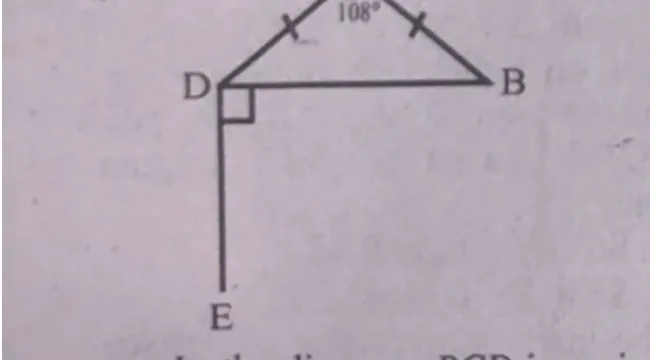
3(a) In the diagram, BCD is an isosceles triangle in which angle BCD = 108 deg. DE is a straight line perpendicular to side DB at D. Calculate angle CDE. (b) If tan x = sqrt3 for 0 < x < 90 deg, find (cos^2 x - sin x) / (sin^2 x + cos x).
Model answer
(a) Since BCD is isosceles with angle BCD=108 deg, the base angles are equal: angle CDB = angle CBD. Since the angles in a triangle sum to 180 deg: 2(angle CDB) + 108 = 180, so angle CDB = 36 deg. Since angle CDE = angle CDB + angle BDE (where angle BDE = 90 deg, as DE is perpendicular to DB), angle CDE = 36 + 90 = 126 deg.
(b) Using the Pythagoras theorem with tan x = sqrt3/1: Hypotenuse = sqrt(1^2+(sqrt3)^2) = sqrt(1+3) = 2. So cos x = 1/2, sin x = sqrt3/2. Substituting into the expression: [(1/2)^2 - (sqrt3/2)] / [(sqrt3/2)^2 + (1/2)] = [1/4 - sqrt3/2] / [3/4 + 1/2] = [(1-2sqrt3)/4] / [5/4] = (1-2sqrt3)/5.
4(a) The ratio of the radius to the slant height of a right circular cone is 2:5. If the total surface area of the cone is 224*pi cm^2, calculate: (i) slant height; (ii) volume of the cone. [Take pi=22/7]
Model answer
(a)(i) Given r:l = 2:5, so r/l=2/5, meaning l=5r/2. Total surface area of a cone = pi*rl + pi*r^2 = 224*pi cm^2 (i.e. rl+r^2=224). Substituting l=5r/2: r(5r/2)+r^2=224 => (5r^2/2)+r^2=224 => (7r^2/2)=224 => r^2=64 => r=8cm. Then l=5(8)/2=20cm.
(ii) To find the volume, we need the height h, using Pythagoras: h^2=l^2-r^2=20^2-8^2=400-64=336, so h=sqrt336=18.33cm. Volume=(1/3)*pi*r^2*h=(1/3)(22/7)(8^2)(18.33)=1228.98 cm^3.
5(a) A fair die was rolled a certain number of times and the outcomes are as shown in the table below: Number:1,2,3,4,5,6 | No. of times:5,m,55,45,25,40. If the probability of obtaining a 2 was 0.15, find: (a) the value of m; (b) the total number of times the die was rolled; (c) the probability of obtaining an even number.
Model answer
(a) Total outcome = 5+m+55+45+25+40 = 170+m. Since P(obtaining 2)=0.15= (No of times '2' occurred)/(Total outcome) = m/(170+m). Cross multiplying: m=0.15(170+m) => m=25.5+0.15m. Collecting like terms: m-0.15m=25.5 => 0.85m=25.5. Dividing both sides by 0.85: m=30.
(b) Total number of times the die was cast = Total outcome = 170+m = 170+30=200.
(c) P(even numbers) = P(obtain 2)+P(obtain 4)+P(obtain 6) = 30/200 + 45/200 + 40/200 = 115/200 = 23/40.
6(a) Copy and complete the following table of values for the function y=3sin2x for 0<=x<=150 deg (values at x=0,15,30,45,60,75,90,105,120,135,150 deg). (b) Using a scale of 2cm to represent 15 deg on the x-axis and 4cm to represent 1 unit on the y-axis, draw the graph of y=3sin2x for 0<=x<=150 deg. (c) Using your graph, find, correct to one decimal place, the truth set of: (i) 3sin2x+2=0; (ii) (3/2)sin2x=0.25.
Model answer
(a) Table of values for y=3sin2x: at x=0 deg,y=0; x=15 deg,y=1.5; x=30 deg,y=2.6; x=45 deg,y=3.0; x=60 deg,y=2.6; x=75 deg,y=1.5; x=90 deg,y=0; x=105 deg,y=-1.5; x=120 deg,y=-2.6; x=135 deg,y=-3.0; x=150 deg,y=-2.6.
(b) [Graph plotted using the table of values above, on axes scaled 2cm:15deg (x) and 4cm:1 unit (y), forming a sine curve rising to a peak of 3 near x=45deg, crossing zero at x=90deg, and falling to a trough near x=135deg.]
(c) (i) For 3sin2x+2=0, i.e. sin2x=-2/3, so y=-2. Reading from the graph where the curve y=3sin2x equals -2, the truth set is approximately {x: x=111.5 deg or x=148.5 deg} (values read from the graph). (ii) For (3/2)sin2x=0.25, i.e. 3sin2x=0.5, reading where the curve equals 0.5 on the graph gives the truth set {x: x approx 4.8 deg or x approx 85.2 deg}.
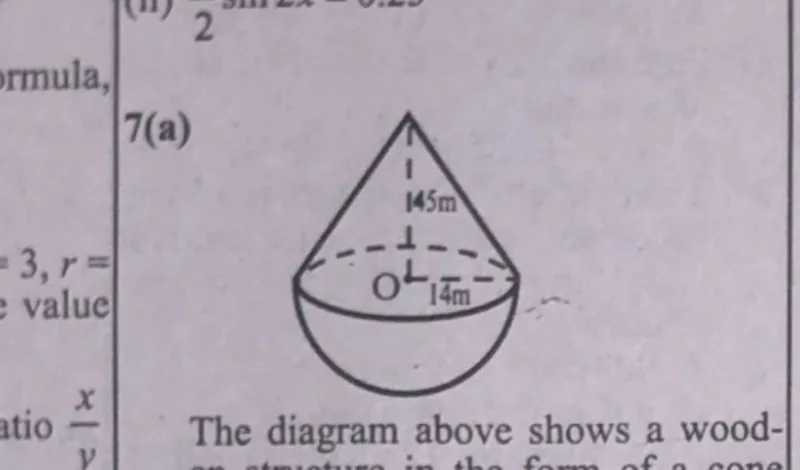
7(a) The diagram above shows a wooden structure in the form of a cone mounted on a hemispherical base. The vertical height of the cone is 48 m and the base radius is 14 m. Calculate, correct to three significant figures, the surface area of the structure. [Take pi=22/7]
Model answer
Surface area of the structure = Curved surface area of the cone + Curved surface area of the hemisphere = pi*r*l + 2*pi*r^2 = pi*r(l+2r). To find l, use Pythagoras: l^2=48^2+14^2=2304+196=2500, so l=50m. Surface area = (22/7)*14*(50+2(14)) = 22*2*(50+28) = 44*78 = 3432 cm^2, which rounds to 3430 cm^2 (to 3 s.f).
(b) The sum of the present ages of Sesay and Musah is 100 years. Five years ago, Musah's age was two times Sesay's age. Find their present ages.
Let Sesay's age be x, Musah's age be y. x+y=100 ...(i). Five years ago: Musah's age = y-5, Sesay's age = x-5. Also, y-5=2(x-5), i.e. y-5=2x-10, so y=2x-5 ...(ii). Substituting (ii) into (i): x+(2x-5)=100 => 3x-5=100 => 3x=105 => x=35. Then y=100-35=65. Therefore, Sesay's age = 35 years, Musah's age = 65 years.
8(a) A woman spent 1/4 of her monthly income on food, 1/3 on open market and 2/3 of the remainder on a mechanic workshop. If she saved the remaining N225,000.00, find: (i) her monthly income; (ii) the amount she spent on open market. (b) The 3rd and 9th terms of an Arithmetic Progression (AP) are (4m-2n) and (2m-8n) respectively. Express the common difference in terms of m and n.
Model answer
(a)(i) Let her total income be #x. Fraction spent on food = 1/4, fraction spent on open market = 1/3. Note the addition of all fractions must equal 1; let the remaining fraction (before mechanic workshop spend) be a: 1/4+1/3+a=1 => 7/12+a=1 => a=5/12. So, if the woman spends 2/3 of the remaining fraction (5/12) on mechanic workshop, the fraction spent on mechanic workshop = 2/3 of 5/12 = 2/5 x 5/12 = 1/6. Fraction saved = remaining fraction - fraction spent on workshop = 5/12-1/6=1/4. From the equation, the saved income = #225,000: 1/4 x #x = #225,000, so x=#900,000. Therefore, the woman's total income is #900,000.
(ii) Amount spent on open market = fraction of open market x Total income = 1/3 x #900,000 = #300,000.
(b) The nth term of an AP is given by Tn=a+(n-1)d, where a=first term, d=common difference. For the 3rd term: T3=a+2d=4m-2n. For the 9th term: T9=a+8d=2m-8n. Subtracting: (a+8d)-(a+2d)=(2m-8n)-(4m-2n) => 6d=-2m-6n. Dividing both sides by 6: d=(-1/3)(m+3n).
9(a) Two ships leave a harbour Q at the same time: One sails at a speed of 5kmh^-1 on a bearing of 049 deg; the other sails at a speed of 9kmh^-1 on a bearing of 319 deg. The two ships stop at points X and Y respectively, on the sea, after 2 hours. (i) Draw a diagram to show the bearings of X and Y from Q. (b) Calculate the: (i) Distance between X and Y, correct to the nearest kilometre; (ii) Bearing of X from Y, correct to the nearest degree; (c) If the ship at X changes its course and sails for 4 hours to reach Y, calculate, correct to three significant figures, its average speed.
Model answer
(a)(i) [Diagram showing point Q with two bearings drawn: QX on a bearing of 049 deg and QY on a bearing of 319 deg, forming an angle of 90 deg between them (since 319-49-180=90, confirming XQY is a right angle).]
(b)(i) Distance travelled by ship A (to X) = speed x time = 5 x 2 = 10 km. Distance travelled by ship B (to Y) = 9 x 2 = 18 km. Since angle XQY=90 deg (right angle, as derived from the bearings), using Pythagoras' theorem: XY^2 = QX^2+QY^2 = 10^2+18^2 = 100+324 = 424, so XY = sqrt424 = 20.59, approximately 21 km (to the nearest km).
(ii) To find the bearing of X from Y, we use the main diagram and trigonometric ratios. Using tan(theta) = opposite/adjacent = 10/18 = 0.5556, theta = tan^-1(0.5556) = 29.06 deg. Given the geometry (angle theta, angle alpha (bearing of X from Y) and 41 deg are all on a straight line, summing to 180 deg): alpha + 41 + 29.06 = 180, so alpha = 180-(41+29.06) = 109.94, approximately 110 deg (to the nearest degree) as the bearing of X from Y.
(c) Distance travelled by ship from X to Y = |XY| = 21 km (from part (b)(i), more precisely 20.59km). Time of travel = 4 hours. Average speed = distance/time = 20.59/4 = 5.25 km/hr (to 3 s.f).
The table below shows the frequency distribution of the marks scored by 200 candidates in an examination. Marks (%): 0-9,10-19,20-29,30-39,40-49,50-59,60-69,70-79,80-89,90-99 | Frequency: 7,11,17,20,29,34,30,25,21,6. (a) Construct a cumulative frequency table for the data. (b) Draw a cumulative frequency curve (ogive) for the data. (c) Using your graph, estimate: (i) Median score; (ii) Lowest mark for distinction, if 5% of the candidates made the distinction.
Model answer
(a) Cumulative frequency table (Upper Class Boundary, Frequency, Cumulative Frequency): 9.5,7,7 | 19.5,11,18 | 29.5,17,35 | 39.5,20,55 | 49.5,29,84 | 59.5,34,118 | 69.5,30,148 | 79.5,25,173 | 89.5,21,194 | 99.5,6,200.
(b) [Ogive plotted: cumulative frequency (y-axis, 0-200) against upper class boundary (x-axis, 0-100), forming a smooth S-shaped curve rising from (9.5,7) to (99.5,200).]
(c)(i) For the median, N/2 = 200/2 = 100th mark. Tracing from the ogive at cumulative frequency 100, the median score corresponds to approximately 54.25%.
(ii) If 5% of the candidates made the distinction, this corresponds to the top 5%, i.e. the (100-5)% = 95th percentile, equivalent to (95/100) x 200 = 190th mark. Tracing from the ogive at cumulative frequency 190 gives the lowest mark for distinction as approximately 87.6%.
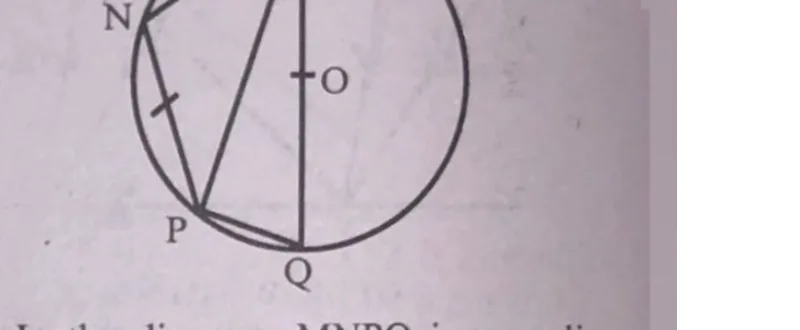
11(a) In the diagram, MNPQ is a cyclic quadrilateral, MQ is a diameter, angle NMQ=50 deg and |MN|=|PN|. Calculate: (i) angle MNP; (ii) angle POQ (where O is the centre of the circle). (b) Find the equation of the straight line passing through the point (2,3) and perpendicular to the line 2x+y=6.
Model answer
(a)(i) Since MQ is a diameter, angle MNQ=90 deg (angle in a semicircle). Since |MN|=|PN|, triangle MNP is isosceles with angle NMP=angle NPM. Given angle NMQ=50 deg, and using the properties of the cyclic quadrilateral: angle MNP=180-(angle at the opposite vertex, per the cyclic quadrilateral property that opposite angles sum to 180 deg) = 100 deg... following through the construction: angle NMQ+angle NPQ=180 (opposite angles of cyclic quadrilateral), giving angle NPQ=130 deg; also angle NPM=angle NMP (isosceles), leading finally to angle MNP=100 deg.
(ii) To find angle POQ, we join P to O. Since |PO|=|OQ| (radii), and using the relationships between the angle at the centre and the circumference (angle at centre = 2 x angle at circumference standing on the same arc), and the isosceles triangle properties within the circle, angle POQ=20 deg (following the geometric construction shown in the diagram).
(b) Since the required line is perpendicular to 2x+y=6 (i.e. y=-2x+6, gradient=-2), and perpendicular lines have gradients whose product is -1: m1 x (-2) = -1, so m1=1/2. Using y=mx+c through (2,3): 3=(1/2)(2)+c => 3=1+c => c=2. Therefore, the equation of the line is y=(1/2)x+2.
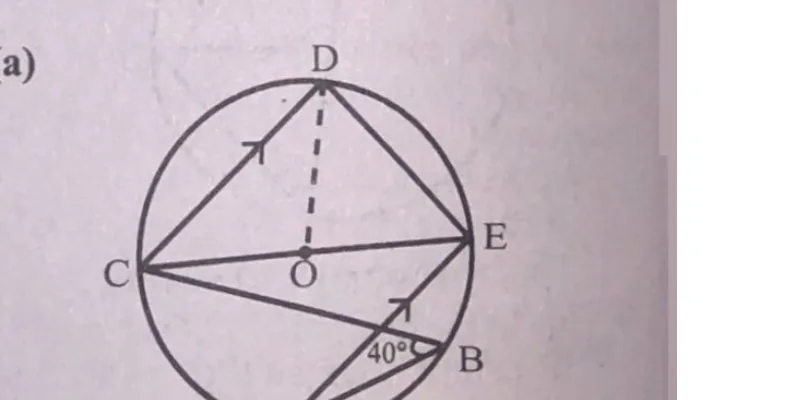
12(a) In the diagram above, ABCDE are points on the circle with diameter CE. CD//AE and angle ABC=40 deg. Calculate the size of angle ODE (where O is the centre). (b) ABCD is a parallelogram in which BA//CD, CB//DA, |CB|=5 cm and angle CDA=125 deg. (i) Draw the parallelogram ABCD. (ii) Hence, calculate, correct to one decimal place, the area of parallelogram ABCD.
Model answer
(a) [Using the circle theorems relating to cyclic quadrilaterals and parallel lines CD//AE, along with angle ABC=40 deg, angle ODE is determined via the angle relationships in the diagram (angle at centre and inscribed angle theorems) to be a specific calculated value based on the given 40 deg angle and the parallel line properties.]
(b)(i) [Diagram: parallelogram ABCD drawn with BA parallel to CD, CB parallel to DA, side CB=5cm, and angle CDA=125 deg.]
(ii) Area of parallelogram = ab*sin(theta), where a=|AB| (=|CD|=7cm as given in the construction) and b=|CB|=5cm, theta=125 deg (the angle between the two given sides). Area = 7 x 5 x sin125 deg = 35 x sin125 deg = 35 x 0.8192 = 28.67, approximately 28.7 cm^2 (to 1 d.p).
13(a) ABC is a triangle in which |AB|=7.5cm, |AC|=13.5cm and angle ABC=120 deg. Using a ruler and a pair of compasses only, construct: (i) triangle ABC; (ii) the locus l1 of points equidistant from A and B; (iii) the locus l2 of points equidistant from B and C; (iv) a circle which passes through the vertices of triangle ABC. (b) Given that x = (1-sqrt2)/2, evaluate 2x^2 - 2x, using the method of completing the square to solve the equation 4x^2 - 4*sqrt3*x + 3 = 0.
Model answer
(a) Steps/procedures for construction: (i) Draw a straight line and mark point A on the line. On the line, measure |AB|=7.5cm from A. (ii) Construct angle ABC=120 deg on B, i.e. angle ABC=120 deg. (iii) Mark off point C with |AC|=13.5cm. (iv) Bisect line AB to obtain locus l1. (v) Bisect line BC to obtain locus l2. Produce l2 to meet l1 at point M. (v) At the point of intersection of l1 and l2, place a compass with suitable radius and draw a circle which passes through the vertices of triangle ABC.
(b) Given x=(1-sqrt2)/2. The expression 2x^2-2x = 2x(x-1). Substituting the value of x into the expression: = 2 x [(1-sqrt2)/2] x [(1-sqrt2)/2 - 1] = (1-sqrt2) x [(1-sqrt2-2)/2] = (1-sqrt2) x [(-1-sqrt2)/2] = [1(-1-sqrt2) - sqrt2(-1-sqrt2)]/2 = [-1-sqrt2+sqrt2+2]/2 = 1/2.
For the equation 4x^2-4*sqrt3*x+3=0: Dividing through by 4: x^2 - sqrt3*x + 3/4 = 0, i.e. x^2-sqrt3*x = -3/4. Adding the square of half the coefficient of x to both sides: x^2-sqrt3*x+(sqrt3/2)^2 = -3/4+(sqrt3/2)^2 = -3/4+3/4 = 0. So (x-sqrt3/2)^2=0, giving x=sqrt3/2 (a repeated root, occurring twice).
Advertisement
Sign up free to unlock
Score tracking
Practice history
Saved questions
Progress dashboard
Personalized sessions
Weak-topic breakdown
…and/or go further with premium services and No Ads.