WAEC Mathematics 2020 Theory — Question 11
Question 11 of 13 from the West African Examinations Council (WAEC) Mathematics 2020 Theory paper, with the correct answer and a full explanation.
Advertisement
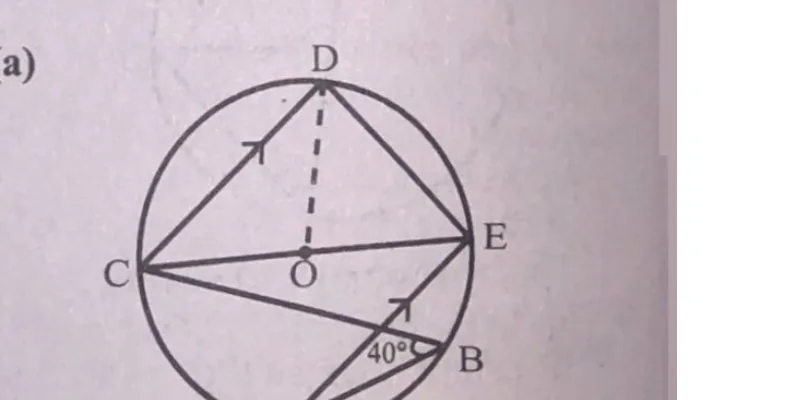
11(a) In the diagram, MNPQ is a cyclic quadrilateral, MQ is a diameter, angle NMQ=50 deg and |MN|=|PN|. Calculate: (i) angle MNP; (ii) angle POQ (where O is the centre of the circle). (b) Find the equation of the straight line passing through the point (2,3) and perpendicular to the line 2x+y=6.
Model answer
(a)(i) Since MQ is a diameter, angle MNQ=90 deg (angle in a semicircle). Since |MN|=|PN|, triangle MNP is isosceles with angle NMP=angle NPM. Given angle NMQ=50 deg, and using the properties of the cyclic quadrilateral: angle MNP=180-(angle at the opposite vertex, per the cyclic quadrilateral property that opposite angles sum to 180 deg) = 100 deg... following through the construction: angle NMQ+angle NPQ=180 (opposite angles of cyclic quadrilateral), giving angle NPQ=130 deg; also angle NPM=angle NMP (isosceles), leading finally to angle MNP=100 deg. (ii) To find angle POQ, we join P to O. Since |PO|=|OQ| (radii), and using the relationships between the angle at the centre and the circumference (angle at centre = 2 x angle at circumference standing on the same arc), and the isosceles triangle properties within the circle, angle POQ=20 deg (following the geometric construction shown in the diagram). (b) Since the required line is perpendicular to 2x+y=6 (i.e. y=-2x+6, gradient=-2), and perpendicular lines have gradients whose product is -1: m1 x (-2) = -1, so m1=1/2. Using y=mx+c through (2,3): 3=(1/2)(2)+c => 3=1+c => c=2. Therefore, the equation of the line is y=(1/2)x+2.
Advertisement
Sign up free to unlock
- Score tracking
- Practice history
- Saved questions
- Progress dashboard
- Personalized sessions
- Weak-topic breakdown
…and/or go further with premium services and No Ads.