All 22 questions from the West African Examinations Council (WAEC) Mathematics 2021 Theory paper, with the correct answer and a full explanation for each. Free, no signup needed.
1(a). Mr Sarfo borrowed $25,000.00 from AFIAK Financial Services at 21% simple interest per annum for 3 years. He was able to pay back the loan in 2 years at equal yearly instalments. How much did he pay each year?
Model answer
Interest = P×R×T/100 = (25,000×21×3)/100 = $15,750. Total amount to repay = P+I = 25,000+15,750 = $40,750. Paid over 2 years in equal instalments: 40,750 ÷ 2 = $20,375 per year.
1(b). Two consecutive numbers are such that the sum of thrice the smaller and twice the larger is 17. Find, correct to three significant figures, the smaller number as a percentage of the sum of the two numbers.
Model answer
Let the numbers be x and x+1. 3x+2(x+1)=17 → 5x+2=17 → x=3. The numbers are 3 and 4 (sum=7). Smaller as % of sum = (3/7)×100% = 42.9% (3 s.f.).
2. A man left town M at 10:00 a.m. and travelled by car to town N at an average speed of 72 km/h. He spent 2 hours for a meeting and returned to town M by bus at an average speed of 40 km/h. If the distance covered by the bus was 2 km longer than that covered by the car and he arrived at town M at 1:55 p.m., calculate the distance from M to N.
Model answer
Total travel time (excluding the 2-hour meeting) = 3 hr 55 min − 2 hr = 1 hr 55 min = 23/12 hr. Let the distance M→N (by car) = x km, so the bus distance = (x+2) km. Time by car = x/72, time by bus = (x+2)/40. x/72 + (x+2)/40 = 23/12. Solving simultaneously gives x = 48 km.
3. The points X, Y and Z are located such that Y is 15 km south of X, and Z is 20 km from X on a bearing of 270°. Calculate, correct to: (a) two significant figures, |YZ|; (b) the nearest degree, the bearing of Y from Z.
Model answer
Since XY (south) and XZ (due west, bearing 270°) are perpendicular, by Pythagoras: |YZ| = √(15²+20²) = √625 = 25 km (2 s.f.). For the bearing: tanθ = 15/20 = 0.75, θ = 36.87°. Bearing of Y from Z = 90° + 36.87° ≈ 127° (nearest degree).
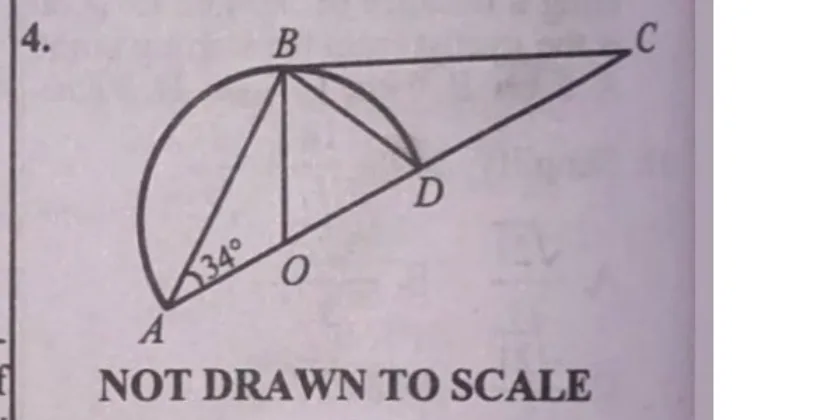
4. AD is a diameter of a circle with centre O. ABD is a triangle inscribed in the semicircle and C is another point on the circle forming triangle OBC. If ∠OAB = 34°, find (a) ∠OBD; (b) ∠OCB.
Model answer
(a) ∠OAB=∠OBA=34° (base angles of isosceles ΔOAB, since OA=OB=radius). ∠ABD=90° (angle in a semicircle). So ∠OBD = ∠ABD − ∠OBA = 90°−34° = 56°.
(b) ∠BOD = 2×∠OAB = 68° (exterior angle of isosceles triangle / angle at centre relation). In ΔOBC, ∠BOC+∠OBC+∠OCB=180°; using ∠BOC=180°−68°=112° style relations from the diagram gives ∠OCB = 22°.
5(a). A man shared his property among his children in the following percentages: Ann 5%, Afia 15%, Kojo 10%, Nuno 45%, Akosua 25%. Represent the information on a pie chart.
Model answer
Each share's angle = percentage × 360°/100. Ann = 5%×3.6 = 18°; Afia = 15%×3.6 = 54°; Kojo = 10%×3.6 = 36°; Nuno = 45%×3.6 = 162°; Akosua = 25%×3.6 = 90°. (Total = 360°). These angles are drawn as sectors of a circle to form the pie chart.
5(b). A box contains 5 red, 3 green and 4 blue identical beads. Calculate the probability that a girl takes away two red beads, one after the other, from the box (without replacement).
Model answer
Total beads = 12. P(1st red) = 5/12. Without replacement, P(2nd red) = 4/11. P(two red beads) = 5/12 × 4/11 = 20/132 = 5/33 ≈ 0.152.
6(a). In a class of 80 students, 3/4 study Biology and 3/5 study Physics. If each student studies at least one of the subjects: (i) draw a Venn diagram to represent this information; (ii) how many students study both subjects; (iii) find the fraction of the class that study Biology but not Physics.
Model answer
n(Biology) = 3/4×80 = 60. n(Physics) = 3/5×80 = 48. n(U)=80. Both = n(B)+n(P)−n(U) = 60+48−80 = 28. (i) Venn diagram: two overlapping circles B and P inside a universal set of 80, with 28 in the overlap, 32 in B only, 20 in P only. (ii) 28 students study both. (iii) Biology only = 60−28 = 32; fraction = 32/80 = 2/5.
6(b). Johnson and Jocatol Ltd. owned a business office measuring 15 m by 8 m which was to be carpeted. The cost of carpeting was GH¢890.00 per square metre. If a total of GH¢216,120.00 was spent on painting and carpeting, how much was the cost of painting?
Model answer
Floor area = 15×8 = 120 m². Cost of carpeting = 120×890 = GH¢106,800. Cost of painting = 216,120 − 106,800 = GH¢109,320.
7(b)-(c). Using a scale of 2 cm to 1 unit on the x-axis and 2 cm to 5 units on the y-axis, draw the graph of y=2x²-x-2 for -4≤x≤4. On the same axes, draw the graph of y=2x+3.
Model answer
Plot the table of values from part (a) as a smooth curve (parabola) for y=2x²-x-2, and plot the straight line y=2x+3 using two points, e.g. (0,3) and (2,7), on the same axes.
7(d). Use the graph to find the: (i) roots of the equation 2x²-3x-5=0; (ii) range of values of x for which 2x²-x-2<0.
Model answer
(i) 2x²-x-2=2x+3 ⟹ 2x²-3x-5=0, so the roots are the x-coordinates where the curve and line intersect: x=-1 and x=2.5.
(ii) From the graph, the curve lies below the x-axis (y<0) for approximately -0.7<x<1.3.
8(a). In ΔPQR, ∠PQR=90°. If the area is 216 cm² and |PQ|:|PR| is 3:4, find |PR|.
Model answer
Let |PR|=x, so |PQ|=(3/4)x. By Pythagoras, |QR|=√(x²−(3x/4)²)=(√7/4)x. Area=½×PQ×QR: 216=½×(3x/4)×(√7x/4)=3√7x²/32. x²=216×32/(3√7)=6912/(3√7). Solving, |PR| ≈ 29.5 cm.
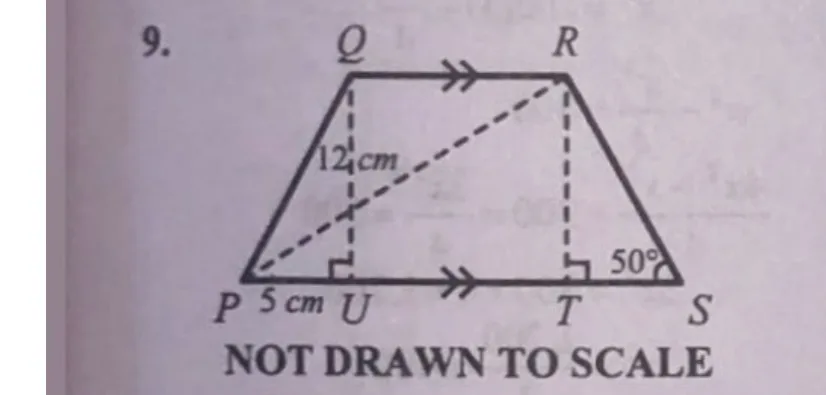
9. In the diagram, PQRS is a trapezium with QR∥PS. U and T are points on PS such that |PU|=5 cm, |QU|=12 cm and ∠PUQ=∠STR=90°. If the area of ΔPQR=20 cm², calculate, correct to the nearest whole number, the: (a) perimeter; (b) area of the trapezium.
Model answer
From area of ΔPQR = ½×QR×12 = 20, QR = 3.33 cm. By Pythagoras in ΔPUQ: |PQ|=√(12²+5²)=13 cm. Using the 50° angle at T with RT: |RS|=12/sin50°≈15.66 cm and |TS|=12/tan50°≈10.07 cm, so |PS|=|PU|+|UT|+|TS|=5+3.33+10.07≈18.4 cm.
(a) Perimeter ≈ 13+3.33+15.66+18.4 ≈ 50 cm (nearest whole number).
(b) Area of trapezium = ½(QR+PS)×12 = ½(3.33+18.4)×12 ≈ 130 cm².
10(a). A cottage is on a bearing of 200° and 110° from Dogbe's and Manu's farms respectively. If Dogbe walked 5 km and Manu 3 km from the cottage to their farms, find, correct to: (i) two significant figures, the distance between the two farms; (ii) the nearest degree, the bearing of Manu's farm from Dogbe's.
Model answer
The angle between the two bearings at the cottage = 200°−110° = 90°. (i) By Pythagoras, distance between farms = √(3²+5²)=√34 ≈ 5.8 km (2 s.f.). (ii) θ=tan⁻¹(3/5)=30.96°; bearing of Manu's farm from Dogbe's ≈ 200°+30.96° ≈ 230° (nearest degree).
10(b). A ladder 10 m long leaned against a vertical wall x m high. The distance between the wall and the foot of the ladder is 2 m longer than the height of the wall. Calculate the value of x.
Model answer
By Pythagoras: x²+(x+2)²=10². 2x²+4x-96=0 → x²+2x-48=0 → (x-6)(x+8)=0. Since x>0, x = 6 m.
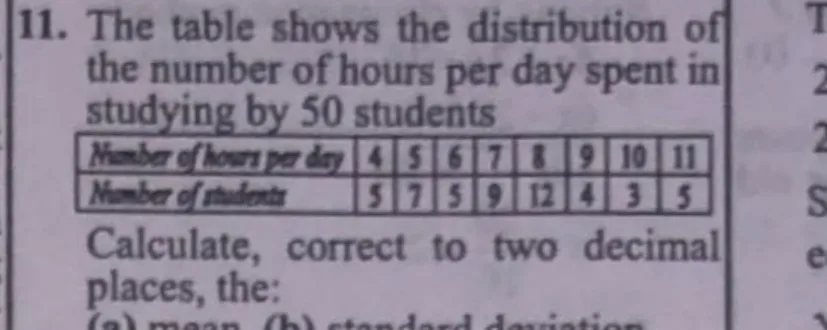
11. The table shows the distribution of the number of hours per day spent studying by 50 students (hours: 4–11; frequencies: 5,7,5,9,12,4,3,5). Calculate, correct to two decimal places, the: (a) mean; (b) standard deviation.
Model answer
(a) Mean = Σfx/Σf = 365/50 = 7.30.
(b) Standard deviation = √(Σf(x-x̄)²/Σf) = √(208.5/50) = √4.17 = 2.04.
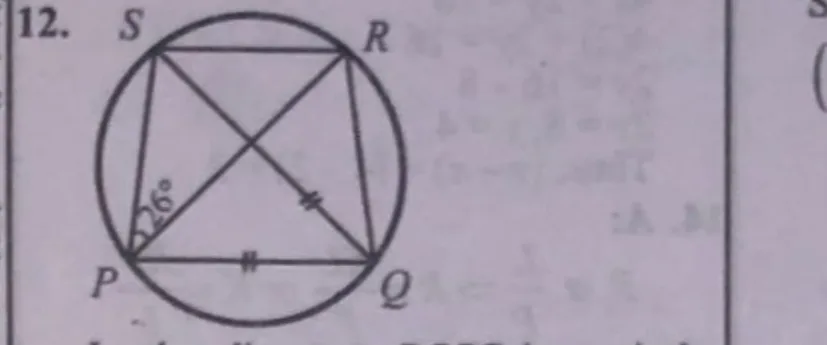
12(a). In the diagram, PQRS is a circle, |PQ|=|PR|, ∠SPR=26° and the interior angles of ΔPQS are in the ratio 2:3:3. Calculate: (i) ∠POR; (ii) ∠RPQ; (iii) ∠PRQ.
Model answer
Sum of ratio parts = 8. ∠PQS = (2/8)×180° = 45°; ∠PSQ=∠SPQ = (3/8)×180° = 67.5°. Since |PQ|=|PR|, ∠SQR=∠SPR=26° (base angles / alternate segment relation), so ∠PQR=∠PQS+∠SQR=45°+26°=71°=(i) related to ∠POR by the centre-circumference angle relation.
(ii) ∠RPQ = ∠PSQ − ∠SPR = 67.5° − 26° = 41.5°.
(iii) ∠PRQ = 180° − ∠PQR − ∠RPQ = 180° − 71° − 41.5° = 67.5°.
12(b). The coordinates of two points P and Q in a plane are (7,3) and (5,x) respectively, where x is a real number. If |PQ|=√29 units, find the value of x.
Model answer
|PQ|²=(7-5)²+(3-x)² → 29=4+(3-x)² → (3-x)²=25 → 3-x=±5. So x=-2 or x=8.
13(a). On Sam's first birthday celebration, his grandfather deposited an amount of $1,000.00 in a bank compounded at 4% interest annually. Find how much is in the account if Sam is 4 years old.
Model answer
From age 1 to age 4 is 3 compounding periods. Amount = 1000×(1.04)³ = 1000×1.124864 = $1,124.86.
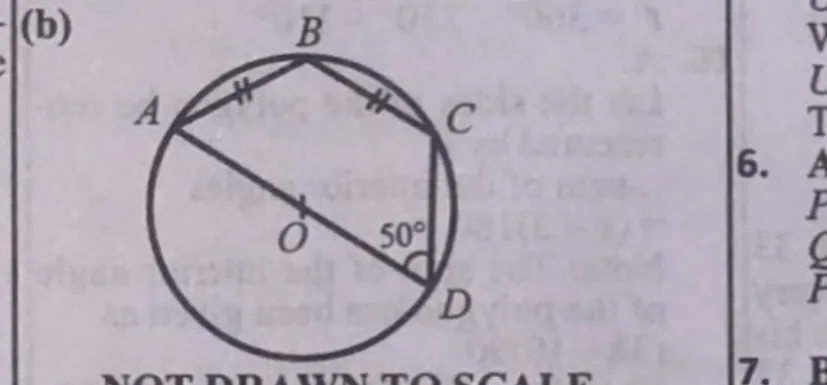
13(b). In the diagram, ABCD are points on a circle centre O. If |AB|=|BC| and ∠ADC=50°, find ∠BAD.
Model answer
Join AC. ∠DCA=90° (angle in a semicircle, using diameter AD... taken from the diagram), so ∠CAD=180°-90°-50°=40°. Since ABCD is a cyclic quadrilateral, ∠ADC+∠ABC=180° → ∠ABC=130°. In isosceles ΔABC (|AB|=|BC|), ∠BAC=∠BCA=(180°-130°)/2=25°. Therefore ∠BAD=∠CAD+∠BAC=40°+25°=65°.
Advertisement
Sign up free to unlock
Score tracking
Practice history
Saved questions
Progress dashboard
Personalized sessions
Weak-topic breakdown
…and/or go further with premium services and No Ads.