WAEC Physics 2012 Theory — Question 12
Question 12 of 15 from the West African Examinations Council (WAEC) Physics 2012 Theory paper, with the correct answer and a full explanation.
Advertisement
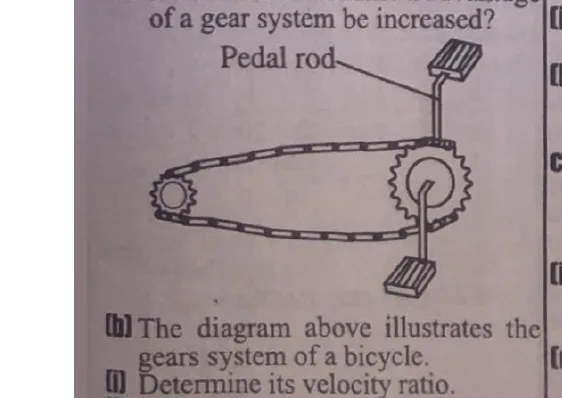
(a)(i) What is a machine? (ii) State two uses of gears. (iii) Define the velocity ratio for a pair of gear wheels. (iv) How can the mechanical advantage of a gear system be increased? (b) The diagram above illustrates the gears system of a bicycle. (i) Determine its velocity ratio. (ii) If the bicycle has an efficiency of 90%, calculate the effort required to overcome a load of 70N. (iii) Why is the calculated effort less than the actual effort required?
Model answer
(a)(i) A machine is any device that makes work easier to perform, typically by allowing a small effort to overcome a larger load, or by changing the direction of an applied force. (ii) Uses of gears: (1) To transmit rotational motion/power from one shaft to another. (2) To change the speed or torque of a rotating system (e.g. in a bicycle, to make pedalling easier or to increase speed). (iii) The velocity ratio for a pair of gear wheels is defined as the ratio of the number of teeth on the driven gear to the number of teeth on the driving gear (or equivalently, the ratio of the radii of the two gears, or the distance moved by the effort to the distance moved by the load). (iv) The mechanical advantage of a gear system can be increased by increasing the velocity ratio (i.e. using gears with a larger difference in the number of teeth between the driving and driven gears), or by reducing friction in the system to improve efficiency. (b)(i) Velocity ratio is read/calculated from the diagram based on the relative sizes (number of teeth or radii) of the pedal gear and the wheel gear shown — this is determined from the specific gear diagram given. (ii) Mechanical advantage (M.A) = Efficiency × Velocity ratio. Effort = Load/M.A. Using the given efficiency (90%) and the velocity ratio from (b)(i), the effort required is calculated as Effort = 70/(0.9×V.R). (iii) The calculated effort is less than the actual effort required in practice because of friction in the moving parts of the gear system (chain, gears, bearings), which was not accounted for in the ideal calculation, and this friction means additional effort is needed to overcome it.
Advertisement
Sign up free to unlock
- Score tracking
- Practice history
- Saved questions
- Progress dashboard
- Personalized sessions
- Weak-topic breakdown
…and/or go further with premium services and No Ads.