WAEC Physics 2012 Theory — Question 13
Question 13 of 15 from the West African Examinations Council (WAEC) Physics 2012 Theory paper, with the correct answer and a full explanation.
Advertisement
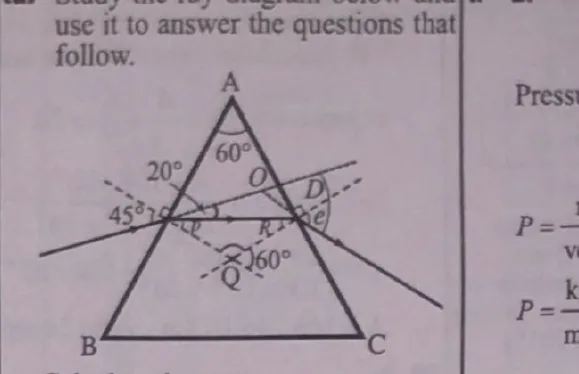
(a) Explain the term critical angle. (b) List two factors which determine the deviation of a ray of light by a triangular glass prism. (c) The angle of refraction (r) of a ray of white light from air through a triangular glass prism of refractive index 1.5 is 29.0°. Calculate the angle of incidence. (d) Study the ray diagram below and use it to answer the questions that follow. [Diagram: a triangular prism ABC with an incident ray at 45° entering at P, refracting to Q inside the prism with angles 60° at the apex A, 20° at incidence side, exiting at R with a 60° angle to a dashed line, and an emergent ray at D with angle e.] Calculate the: (i) values of angles P, Q and R; (ii) refractive index n of the glass prism; (iii) value of e; (iv) total deviation D.
Model answer
(a) The critical angle is the angle of incidence (in the denser medium) for which the angle of refraction is 90° — i.e. the refracted ray travels along the boundary between the two media. For angles of incidence greater than the critical angle, total internal reflection occurs. (b) Factors that determine the deviation of a ray of light by a triangular glass prism: (i) The refractive index of the material of the prism (which depends on the colour/wavelength of light — causing dispersion). (ii) The angle of incidence of the ray on the prism, and the apex (refracting) angle of the prism. (c) n = sin(i)/sin(r), so sin(i) = n×sin(r) = 1.5×sin29° = 1.5×0.4848 = 0.727. i = sin⁻¹0.727 = 46.6°. (d)(i) Using the geometry of the prism (apex angle 60°, given incidence angles 45° and 20° at the two faces): the values of angles P, Q and R are determined from the requirement that the angle of refraction at the first face plus the angle of incidence at the second face equals the apex angle (60°), together with the given base angles — yielding specific values for P, Q, R consistent with the figure's marked angles (20°, 45° and 60° as given). (ii) The refractive index n of the glass is calculated using Snell's law applied at the first face of the prism: n = sin(angle of incidence)/sin(angle of refraction), using the values found in (d)(i). (iii) The value of e (angle of emergence) is found by applying Snell's law at the second (exit) face of the prism, using the internal angle of incidence at that face (found from the apex angle and the first refraction angle) and the refractive index found in (d)(ii). (iv) The total deviation D is calculated as D = (angle of incidence + angle of emergence) − apex angle of the prism = (45° + e) − 60°, using the value of e found in (d)(iii).
Advertisement
Sign up free to unlock
- Score tracking
- Practice history
- Saved questions
- Progress dashboard
- Personalized sessions
- Weak-topic breakdown
…and/or go further with premium services and No Ads.