All 15 questions from the West African Examinations Council (WAEC) Physics 2012 Theory paper, with the correct answer and a full explanation for each. Free, no signup needed.
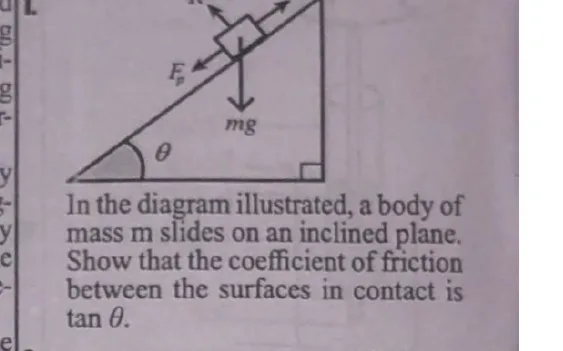
In the diagram illustrated, a body of mass m slides on an inclined plane. Show that the coefficient of friction between the surfaces in contact is tanθ.
Model answer
On the inclined plane, the forces acting on the body are: the weight mg (acting vertically downward), the normal reaction R (perpendicular to the plane), and the frictional force Fp (acting along the plane, opposing motion). Resolving mg along and perpendicular to the plane: the component along the plane = mg sinθ, and the component perpendicular to the plane = mg cosθ. For the body on the verge of sliding (limiting friction), the frictional force Fp = mg sinθ, and the normal reaction R = mg cosθ. The coefficient of friction μ = Fp/R = (mg sinθ)/(mg cosθ) = sinθ/cosθ = tanθ. Hence, μ = tanθ.
A spiral spring with a metal extends by 10.5cm in air. When the metal is fully submerged in water, the spring extends by 6.8cm. Calculate the relative density of the metal. (Assume Hooke's law is obeyed.)
Model answer
Since Hooke's law is obeyed, extension is proportional to the force (weight) producing it. Weight in air ∝ 10.5cm; apparent weight in water ∝ 6.8cm. Upthrust (loss in weight) ∝ (10.5−6.8) = 3.7cm.
Relative density of the metal = Weight in air/Upthrust = 10.5/3.7 = 2.84.
A ray of light is incident on an air-glass boundary at an angle θ. If the angle between the partially reflected ray and the refracted ray is 90°, calculate θ, given that the refractive index of glass is 1.50.
Model answer
Since the reflected ray and refracted ray are perpendicular to each other (90° apart), and using the geometry of reflection/refraction, the angle of incidence θ must satisfy: the angle of refraction r = 90°−θ (since reflected angle = θ, and reflected+refracted+90° arrangement). Using Snell's law: n = sinθ/sin r = sinθ/sin(90°−θ) = sinθ/cosθ = tanθ. Thus, tanθ = 1.50, so θ = tan⁻¹1.50 = 56.3° (this angle is known as Brewster's angle).
(a) Explain the term electrodes in electric cells.
(b) An electric current passing through an electrolyte for 2 minutes deposited 200g of a substance. If the electrochemical equivalent of the substance is 8.33×10⁻⁴gC⁻¹, calculate the current that passed.
Model answer
(a) Electrodes are conductors (usually metal or graphite rods/plates) through which electric current enters or leaves an electrolyte or other medium during electrolysis or in a cell. The electrode where current enters the electrolyte is the anode; the electrode where current leaves is the cathode.
(b) m = zIt, so I = m/(zt). Given m=200g, z=8.33×10⁻⁴ g/C, t=2min=120s. I = 200/(8.33×10⁻⁴×120) = 200/0.09996 ≈ 2000A. (Note: this very large current value arises directly from the given figures in the source question.)
Explain why sound waves cannot be plane polarized.
Model answer
Sound waves are longitudinal waves — the particles of the medium vibrate parallel to (along) the direction of wave propagation, not perpendicular to it. Polarization involves restricting vibrations to a single plane perpendicular to the direction of travel, which is only possible for transverse waves (where vibrations are already perpendicular to the direction of travel, in multiple possible planes). Since sound wave vibrations only occur along one direction (the direction of propagation) to begin with, there is no additional plane to restrict, so sound waves cannot be polarized.
(a) Define surface tension.
(b) State two methods by which the surface tension of a liquid can be reduced.
Model answer
(a) Surface tension is the property of a liquid surface which enables it to behave like a stretched elastic skin, due to the cohesive forces between the liquid molecules at the surface.
(b) Methods of reducing surface tension: (i) Increasing the temperature of the liquid. (ii) Adding a detergent/surfactant to the liquid.
Explain why it is desirable to install an air conditioner near the ceiling of a room and not close to the floor.
Model answer
Cold, dense air from the air conditioner sinks, while warm air (being less dense) rises. If the air conditioner is installed near the ceiling, the cold air it produces will sink down through the room, displacing the warmer air upward, setting up a convection current that cools the entire room efficiently. If it were installed near the floor, the cold air would simply stay near the floor without effectively circulating and cooling the whole room.
(a) On what principle does lighting in a fluorescent tube operate?
(b) State two factors which determine the colour of light produced in a fluorescent tube.
Model answer
(a) Lighting in a fluorescent tube operates on the principle that an electric discharge through mercury vapour in the tube produces ultraviolet radiation, which then strikes the phosphor coating on the inside of the tube, causing it to fluoresce (emit visible light).
(b) Factors determining the colour of light produced: (i) The type/composition of the phosphor coating used inside the tube. (ii) The pressure/composition of the gas (mercury vapour and inert gas) inside the tube.
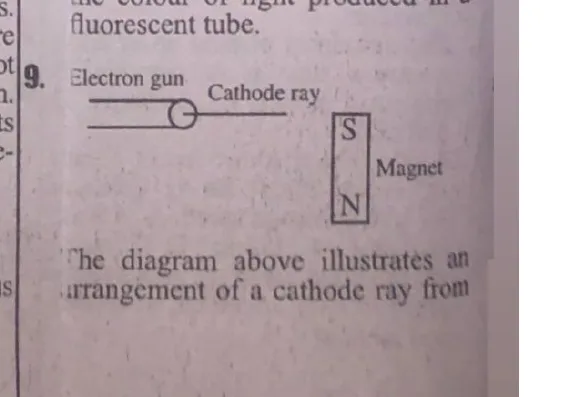
The diagram above illustrates an arrangement of a cathode ray from an electron gun and a bar magnet placed perpendicularly to the direction of the ray. Will the ray bend downward or upward? Explain.
Model answer
The cathode ray consists of a stream of negatively charged electrons. When this beam passes through the magnetic field (directed from N to S, i.e. into the region between the poles), the force on the moving charge is given by F = qv×B (the motor effect). Using Fleming's left-hand rule (with the current direction taken as opposite to electron flow, since electrons are negative), the ray will be deflected in a particular direction determined by the directions of the electron velocity and the magnetic field — in this arrangement (electron beam moving horizontally, field directed from S to N i.e. upward between the poles as drawn), the ray will bend downward, since the resulting force on the negative charges points downward according to the left-hand rule applied with reversed (conventional) current direction.
Explain briefly the concept of wave-particle duality of light. Illustrate your answer with observable phenomena.
Model answer
Wave-particle duality is the concept that light exhibits both wave-like and particle-like properties, depending on the type of experiment or observation being carried out. As a wave, light exhibits phenomena such as interference, diffraction, refraction and polarization — for example, Young's double-slit experiment demonstrates interference patterns typical of waves. As a particle (photon), light exhibits the photoelectric effect, in which light striking a metal surface ejects electrons in a manner that can only be explained if light is considered to consist of discrete packets (photons) of energy, each carrying energy E=hf. Thus, light behaves as a wave in phenomena like interference and diffraction, and as a particle in phenomena like the photoelectric effect.
(a) State the principle of conservation of linear momentum.
(b) Explain the mode of action of a 'propelled rocket'.
(c) During a training session, two footballers pass a ball repeatedly between themselves. Give two reasons why the to and fro motion of the ball is not simple harmonic.
(d)(i) A ball is dropped from a height, at the same time as another ball is projected horizontally from the same height. Would the balls hit the ground at the same time? (ii) Explain your answer.
(e) A ball of mass 0.10kg is projected horizontally onto a vertical wall with a speed of 17ms⁻¹. The ball makes contact with the wall for 0.15s and rebounds horizontally with a speed of 13ms⁻¹. Calculate the: (i) change in momentum of the ball; (ii) average force exerted on the ball during its collision with the wall.
Model answer
(a) The principle of conservation of linear momentum states that in a closed system (with no external force acting), the total momentum before a collision (or interaction) is equal to the total momentum after the collision.
(b) A propelled rocket operates by burning fuel to expel hot gases at high speed out of the rear of the rocket. By Newton's third law (and conservation of momentum), the backward momentum of the expelled gases is balanced by an equal and opposite (forward) momentum gained by the rocket, propelling it forward.
(c) Reasons the ball's motion is not simple harmonic motion: (i) The restoring force on the ball is not proportional to its displacement from a fixed equilibrium/mean position. (ii) The motion of the ball does not oscillate about a fixed central point with the ball's acceleration always directed towards that point.
(d)(i) Yes, the two balls would hit the ground at the same time. (ii) This is because the vertical motion of both balls is independent of any horizontal motion; both start with zero vertical velocity and experience the same vertical acceleration due to gravity, so they take the same time to fall the same vertical height, regardless of their horizontal velocities.
(e)(i) Change in momentum = m(v−u), taking the direction towards the wall as positive: initial momentum = 0.10×17 = 1.7kgms⁻¹ (towards wall); final momentum = 0.10×(−13) = −1.3kgms⁻¹ (away from wall, i.e. rebounding). Change in momentum = final − initial = −1.3−1.7 = −3.0kgms⁻¹ (magnitude 3.0kgms⁻¹).
(ii) Average force = change in momentum/time = 3.0/0.15 = 20N.
(a)(i) What is a machine? (ii) State two uses of gears. (iii) Define the velocity ratio for a pair of gear wheels. (iv) How can the mechanical advantage of a gear system be increased?
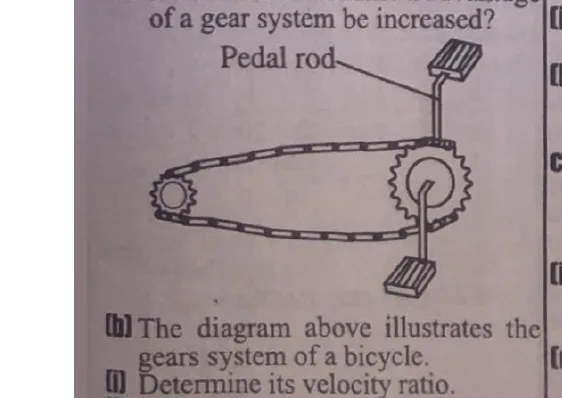
(b) The diagram above illustrates the gears system of a bicycle. (i) Determine its velocity ratio. (ii) If the bicycle has an efficiency of 90%, calculate the effort required to overcome a load of 70N. (iii) Why is the calculated effort less than the actual effort required?
Model answer
(a)(i) A machine is any device that makes work easier to perform, typically by allowing a small effort to overcome a larger load, or by changing the direction of an applied force.
(ii) Uses of gears: (1) To transmit rotational motion/power from one shaft to another. (2) To change the speed or torque of a rotating system (e.g. in a bicycle, to make pedalling easier or to increase speed).
(iii) The velocity ratio for a pair of gear wheels is defined as the ratio of the number of teeth on the driven gear to the number of teeth on the driving gear (or equivalently, the ratio of the radii of the two gears, or the distance moved by the effort to the distance moved by the load).
(iv) The mechanical advantage of a gear system can be increased by increasing the velocity ratio (i.e. using gears with a larger difference in the number of teeth between the driving and driven gears), or by reducing friction in the system to improve efficiency.
(b)(i) Velocity ratio is read/calculated from the diagram based on the relative sizes (number of teeth or radii) of the pedal gear and the wheel gear shown — this is determined from the specific gear diagram given.
(ii) Mechanical advantage (M.A) = Efficiency × Velocity ratio. Effort = Load/M.A. Using the given efficiency (90%) and the velocity ratio from (b)(i), the effort required is calculated as Effort = 70/(0.9×V.R).
(iii) The calculated effort is less than the actual effort required in practice because of friction in the moving parts of the gear system (chain, gears, bearings), which was not accounted for in the ideal calculation, and this friction means additional effort is needed to overcome it.
(a) Explain the term critical angle.
(b) List two factors which determine the deviation of a ray of light by a triangular glass prism.
(c) The angle of refraction (r) of a ray of white light from air through a triangular glass prism of refractive index 1.5 is 29.0°. Calculate the angle of incidence.
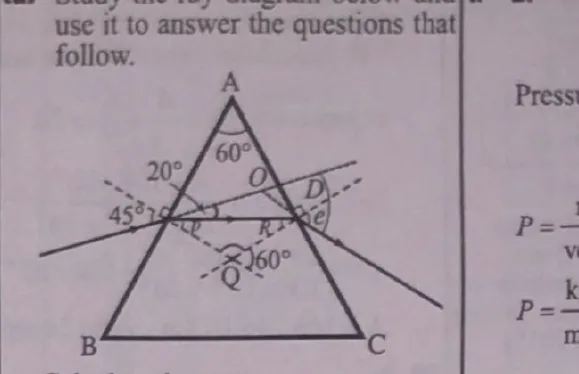
(d) Study the ray diagram below and use it to answer the questions that follow.
[Diagram: a triangular prism ABC with an incident ray at 45° entering at P, refracting to Q inside the prism with angles 60° at the apex A, 20° at incidence side, exiting at R with a 60° angle to a dashed line, and an emergent ray at D with angle e.]
Calculate the: (i) values of angles P, Q and R; (ii) refractive index n of the glass prism; (iii) value of e; (iv) total deviation D.
Model answer
(a) The critical angle is the angle of incidence (in the denser medium) for which the angle of refraction is 90° — i.e. the refracted ray travels along the boundary between the two media. For angles of incidence greater than the critical angle, total internal reflection occurs.
(b) Factors that determine the deviation of a ray of light by a triangular glass prism: (i) The refractive index of the material of the prism (which depends on the colour/wavelength of light — causing dispersion). (ii) The angle of incidence of the ray on the prism, and the apex (refracting) angle of the prism.
(c) n = sin(i)/sin(r), so sin(i) = n×sin(r) = 1.5×sin29° = 1.5×0.4848 = 0.727. i = sin⁻¹0.727 = 46.6°.
(d)(i) Using the geometry of the prism (apex angle 60°, given incidence angles 45° and 20° at the two faces): the values of angles P, Q and R are determined from the requirement that the angle of refraction at the first face plus the angle of incidence at the second face equals the apex angle (60°), together with the given base angles — yielding specific values for P, Q, R consistent with the figure's marked angles (20°, 45° and 60° as given).
(ii) The refractive index n of the glass is calculated using Snell's law applied at the first face of the prism: n = sin(angle of incidence)/sin(angle of refraction), using the values found in (d)(i).
(iii) The value of e (angle of emergence) is found by applying Snell's law at the second (exit) face of the prism, using the internal angle of incidence at that face (found from the apex angle and the first refraction angle) and the refractive index found in (d)(ii).
(iv) The total deviation D is calculated as D = (angle of incidence + angle of emergence) − apex angle of the prism = (45° + e) − 60°, using the value of e found in (d)(iii).
(a) Explain briefly the purpose of earthing an electrical appliance.
(b) An electric current passing through an electrolyte for 2 minutes deposited 200g of a substance. If the electrochemical equivalent of the substance is 8.33×10⁻⁴gC⁻¹, calculate the current that passed.
Model answer
(a) Earthing an electrical appliance provides a low-resistance path to the ground for any fault current (e.g. from a short circuit where the live wire touches the metal casing of the appliance). This ensures that a large current flows to earth instead of through a person touching the appliance, protecting them from electric shock, and it also causes a fuse or circuit breaker to trip quickly, disconnecting the faulty appliance from the supply.
(b) m = zIt, so I = m/(zt) = 200/(8.33×10⁻⁴×120) ≈ 2000A (as computed in Q4(b) above, using the same given figures).
(a)(i) Explain why X-rays can be used to produce photographs of fractures in bones. (ii) List four uses of x-rays other than in medicine.
(b) State the energy transformation which takes place during the operation of an x-ray tube.
(c)(i) Explain three named dangers to which human beings may be exposed when subjected to large doses of x-rays. (ii) State two precautions that must be taken by persons working with x-rays.
(d) In an x-ray tube, an electron is accelerated from rest towards a tungsten target biased at a potential of 33 kV. Calculate, for the electron, the: (i) kinetic energy; (ii) velocity. [h=6.6×10⁻³⁴Js; Me=9.1×10⁻³¹kg; c=3.0×10⁸ms⁻¹; e=1.6×10⁻¹⁹C]
Model answer
(a)(i) X-rays can be used to photograph bone fractures because bones (being denser, containing calcium) absorb X-rays much more strongly than the surrounding soft tissue, so bones appear as clear shadows/images on X-ray film while soft tissue lets most of the X-rays pass through, allowing fractures (breaks in bone continuity) to be clearly seen.
(ii) Other uses of X-rays: (1) Detecting cracks/flaws in metals (industrial radiography). (2) Security screening (e.g. at airports, for luggage). (3) Studying crystal structures (X-ray crystallography). (4) Detecting fake/forged paintings or artworks.
(b) During the operation of an X-ray tube, electrical energy (used to accelerate the electrons) is converted into kinetic energy of the electrons, which is then converted into X-ray (electromagnetic) energy and heat energy when the fast electrons are suddenly decelerated upon striking the target.
(c)(i) Dangers of large doses of X-rays: (1) Genetic mutations/damage to DNA. (2) Cancer (particularly leukemia) due to cell damage. (3) Skin burns/tissue damage from prolonged exposure.
(ii) Precautions for persons working with X-rays: (1) Wearing lead-lined aprons/protective clothing. (2) Limiting exposure time and maintaining distance from the X-ray source, and using radiation monitoring badges.
(d)(i) Kinetic energy gained = work done by the accelerating potential = eV = 1.6×10⁻¹⁹×33,000 = 5.28×10⁻¹⁵J.
(ii) ½Mev² = KE, so v² = 2×KE/Me = (2×5.28×10⁻¹⁵)/(9.1×10⁻³¹) = 1.16×10¹⁶. v = √(1.16×10¹⁶) ≈ 1.08×10⁸ ms⁻¹.
Advertisement
Sign up free to unlock
Score tracking
Practice history
Saved questions
Progress dashboard
Personalized sessions
Weak-topic breakdown
…and/or go further with premium services and No Ads.