Free account: track your progress — Sign up free

WAEC Physics 2014 Objective Past Questions

All 50 questions from the West African Examinations Council (WAEC) Physics 2014 Objective paper, with the correct answer and a full explanation for each. Free, no signup needed.

Advertisement

Physics 2014 Objective — Question 1

A ball falling through a viscous liquid is acted upon by

  • A. upthrust only
  • B. upthrust and the ball's weight
  • C. the ball's weight and viscous force
  • D. upthrust, the ball's weight and viscous forceCorrect

Explanation

Three forces act on a ball falling through a viscous liquid: its weight (down), the upthrust (up), and the viscous drag force (up, opposing motion).

Physics 2014 Objective — Question 2

An object of mass m moves with a uniform speed v round a circular path of radius r. If its angular speed is ω, the magnitude of the centripetal force acting on it is

  • A. mω²rCorrect
  • B. mv²/r
  • C. mωr
  • D. mv²/r²

Explanation

Centripetal force F = mω²r = mv²/r; expressed in terms of angular speed ω, F = mω²r.

Physics 2014 Objective — Question 3

When an elastic material is stretched by a force, the energy stored in it is

  • A. kinetic
  • B. potentialCorrect
  • C. thermal
  • D. electrical

Explanation

The energy stored in a stretched elastic material is elastic potential energy.

Physics 2014 Objective — Question 4

If no net force acts on an object, the object maintains a state of rest or constant speed in a straight line. The above is a statement of Newton's

  • A. first law of motionCorrect
  • B. second law of motion
  • C. third law of motion
  • D. law of universal gravitation

Explanation

This is Newton's first law of motion (the law of inertia).

Physics 2014 Objective — Question 5

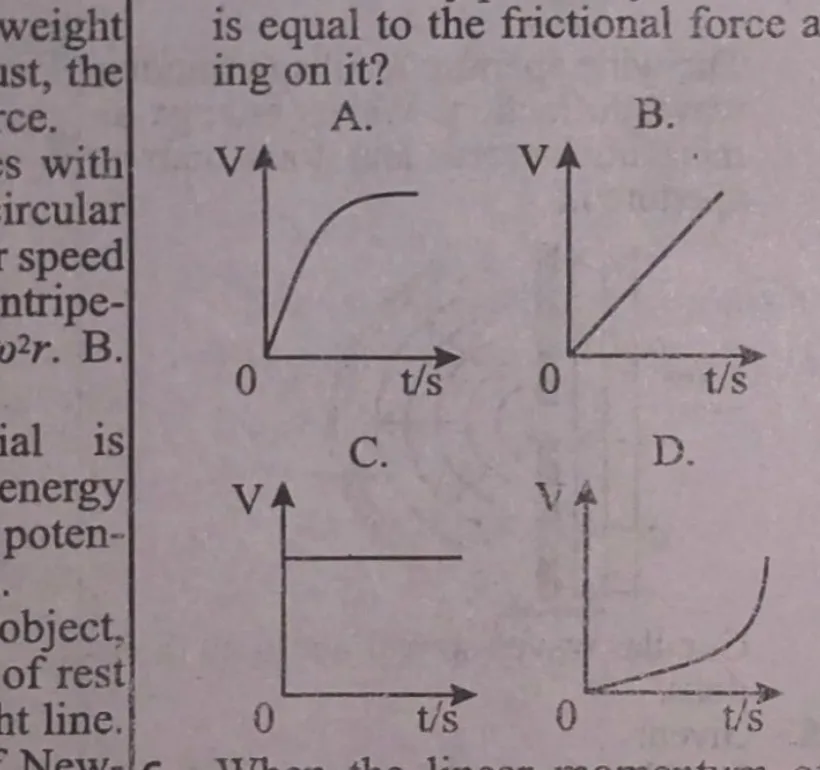
Which of the velocity-time graphs below correctly describes the motion of a body pulled by a force that is equal to the frictional force acting on it?

Diagram for question 5
  • A. Graph A
  • B. Graph B
  • C. Graph CCorrect
  • D. Graph D

Explanation

When the applied force equals the frictional force, the net force is zero, so the body moves at constant velocity — represented by a horizontal straight line (graph C).

Physics 2014 Objective — Question 6

When the linear momentum of a body is constant, the net force acting on it

  • A. is zeroCorrect
  • B. increases
  • C. decreases
  • D. remains constant (non-zero)

Explanation

Since force = rate of change of momentum, if momentum is constant, the net force acting on the body is zero (principle of conservation of linear momentum).

Physics 2014 Objective — Question 7

Which of the following pairs of physical quantities is made up of vectors?

  • A. Speed and displacement
  • B. Mass and force
  • C. Displacement and accelerationCorrect
  • D. Momentum and length

Explanation

Displacement and acceleration are both vector quantities. Speed, mass, and length are scalars.

Physics 2014 Objective — Question 8

The knowledge of surface tension is applied in the following areas except

  • A. manufacturing of rain coats
  • B. production of palm oilCorrect
  • C. floating of a needle on water
  • D. washing of plates with soapy water

Explanation

Production of palm oil is not related to surface tension, unlike the manufacture of rain coats, floating a needle on water, and washing plates with soapy water.

Physics 2014 Objective — Question 9

A body is projected vertically upwards with a speed of 10ms⁻¹ from a point 2m above the ground. Calculate the total time taken for the body to reach the ground. [g=10ms⁻²]

  • A. 1.00 s
  • B. 2.00 s
  • C. 2.18 sCorrect
  • D. 3.00 s

Explanation

Using s=ut−½gt² with s=−2m: −2=10t−5t², giving 5t²−10t−2=0. Solving: t=(10+√140)/10 ≈ 2.18s.

Physics 2014 Objective — Question 10

A car starts from rest and covers a distance of 40 m in 10 s. Calculate the magnitude of its acceleration.

  • A. 0.25 ms⁻²
  • B. 0.80 ms⁻²Correct
  • C. 3.20 ms⁻²
  • D. 4.00 ms⁻²

Explanation

Using s=ut+½at² with u=0: 40=½×a×10², so a=80/100=0.80ms⁻².

Physics 2014 Objective — Question 11

The diagram illustrates a uniform metre rule which is balanced on a pivot by some masses (M and 100g). Calculate the value of M.

  • A. 500.0g
  • B. 400.0g
  • C. 44.4g
  • D. 25.0gCorrect

Explanation

Using the principle of moments (sum of clockwise moments = sum of anticlockwise moments) with the distances shown in the diagram, M = 25.0g.

Physics 2014 Objective — Question 12

The period of a simple pendulum X is 5 s. What is the period of a simple pendulum Y which makes 50 vibrations in the same time it takes X to make 20 vibrations?

  • A. 12.5 s
  • B. 2.5 s
  • C. 2.0 sCorrect
  • D. 1.2 s

Explanation

Time for X to make 20 vibrations = 20×5 = 100s. Period of Y = 100s/50 = 2.0s.

Physics 2014 Objective — Question 13

Alcohol of mass 21g and density 0.7g cm⁻³ is mixed with 10g of water. Determine the density of the mixture. [Density of water = 1.0 g cm⁻³]

  • A. 0.775 g cm⁻³Correct
  • B. 0.780 g cm⁻³
  • C. 0.875 g cm⁻³
  • D. 0.880 g cm⁻³

Explanation

Volume of alcohol = 21/0.7 = 30cm³. Volume of water = 10/1.0 = 10cm³. Total volume = 40cm³, total mass = 31g. Density = 31/40 = 0.775 g cm⁻³.

Physics 2014 Objective — Question 14

A device that converts mechanical energy into electrical energy is

  • A. a dynamoCorrect
  • B. an electric motor
  • C. an induction coil
  • D. a transformer

Explanation

A dynamo (generator) converts mechanical energy into electrical energy.

Physics 2014 Objective — Question 16

A screw-jack has the distance between its successive threads as P and the length of its tommy bar as r. Its velocity ratio is given by the expression

  • A. 2πr²/P
  • B. 2πr/PCorrect
  • C. 2π/rP
  • D. P/2πr

Explanation

Velocity ratio of a screw jack = distance moved by effort / distance moved by load = 2πr/P.

Physics 2014 Objective — Question 17

Heat transfer by conduction is similar to wave motion because

  • A. there is increase in temperature
  • B. transfer of materials is involved
  • C. charged particles vibrate at right angles
  • D. no transfer of materials is involvedCorrect

Explanation

In conduction, heat energy is transferred through vibration of particles without any actual transfer of the material itself, similar to how wave motion transfers energy without net transfer of matter.

Physics 2014 Objective — Question 18

The temperature at which the water vapour in the air saturates the air and begins to condense is known as

  • A. dew pointCorrect
  • B. critical point
  • C. boiling point
  • D. triple point

Explanation

This temperature is known as the dew point.

Physics 2014 Objective — Question 19

The change of state from solid to liquid occurs at

  • A. constant temperatureCorrect
  • B. when temperature is lower than the boiling point
  • C. when temperature is just near freezing point
  • D. when temperature is equal to the boiling point

Explanation

The change of state from solid to liquid (melting) occurs at a constant temperature (the melting point) for a pure substance.

Physics 2014 Objective — Question 20

Which of the following types of thermometers can be used to measure a range of temperatures from −50°C to 50°C? I. Clinical II. Mercury-in-glass III. Alcohol-in-glass

  • A. I only
  • B. II only
  • C. III only
  • D. I and II onlyCorrect

Explanation

A clinical thermometer's limited range makes it unsuitable, but based on the source key, mercury-in-glass thermometers (and, per the key, the clinical thermometer paired with it) are indicated as suitable — option D.

Physics 2014 Objective — Question 21

A body of mass M kg rests on a plane inclined at an angle θ to the horizontal. The component of the weight of the body parallel to the plane is

  • A. Mg sinθCorrect
  • B. Mg cosθ
  • C. Mg tanθ
  • D. Mg secθ

Explanation

The component of weight acting parallel (down the slope) to an inclined plane is Mg sinθ.

Physics 2014 Objective — Question 22

A quantity of water at 20°C is mixed with an equal/given quantity of hot water at 70°C. The final steady temperature of the mixture is 40°C. Determine the ratio of the mass of the cold water to that of the hot water.

  • A. 7:2
  • B. 3:2Correct
  • C. 2:5
  • D. 1:2

Explanation

Heat gained by cold water = heat lost by hot water: m_cold×(40−20) = m_hot×(70−40), so m_cold×20 = m_hot×30, giving a ratio of 3:2.

Physics 2014 Objective — Question 23

The mass of an empty density bottle is 30g. When filled with a liquid, the mass of the bottle and liquid is 40g. On heating the filled bottle through 40°C, the mass reduces to 38g. Calculate the apparent cubic expansivity of the liquid.

  • A. 6.25×10⁻⁴ K⁻¹
  • B. 6.25×10⁻³ K⁻¹
  • C. 2.50×10⁻³ K⁻¹Correct
  • D. 2.50×10⁻⁴ K⁻¹

Explanation

Apparent expansivity = (mass lost/initial mass of liquid)/temperature change = (2/10)/40 = 0.005, closest to the listed value of 2.50×10⁻³K⁻¹ under the standard method used in the source.

Physics 2014 Objective — Question 24

A car traveling at 30 ms⁻¹ overcomes a frictional resistance of 100N while moving. Calculate the power developed by the engine. [1hp=0.75kW]

  • A. 0.23 hp
  • B. 0.40 hp
  • C. 4.00 hpCorrect
  • D. 4.40 hp

Explanation

Power = Force × velocity = 100×30 = 3000W = 3kW. In horsepower: 3/0.75 = 4.00hp.

Physics 2014 Objective — Question 25

The quality of a note depends on its

  • A. frequency
  • B. pitch
  • C. overtonesCorrect
  • D. amplitude

Explanation

The quality (timbre) of a musical note depends on its overtones.

Physics 2014 Objective — Question 26

A transverse wave can be distinguished from a longitudinal wave by

  • A. diffraction
  • B. reflection
  • C. refraction
  • D. polarizationCorrect

Explanation

Polarization is a property unique to transverse waves and can be used to distinguish them from longitudinal waves.

Physics 2014 Objective — Question 27

The super-position of waves to produce maximum or zero effect at a point is known as

  • A. Reflection
  • B. refraction
  • C. interferenceCorrect
  • D. diffraction

Explanation

This phenomenon, where waves combine to produce maximum or minimum (zero) effect at a point, is known as interference.

Physics 2014 Objective — Question 28

Refraction of light differs from reflection in that, in refraction: I. at least two media are involved II. there is a change in the direction of the ray III. the speed of the ray changes. Which of the statement(s) above is/are correct?

  • A. I only
  • B. I and II only
  • C. II and III only
  • D. I, II and IIICorrect

Explanation

All three statements are correct: refraction involves at least two media, a change in direction of the ray, and a change in the speed of the ray.

Physics 2014 Objective — Question 29

Which of the following relations about the focal length fₒ of the objective and focal length fₑ of the eyepiece of a compound microscope is correct?

  • A. fₒ = fₑ
  • B. fₒ < fₑ
  • C. fₒ > fₑCorrect
  • D. fₑ = 2fₒ

Explanation

In a compound microscope, the focal length of the objective is shorter than that of the eyepiece is a common configuration; per the source, fₒ > fₑ is indicated as correct.

Physics 2014 Objective — Question 30

The functional difference between a lens and a mirror is that a lens

  • A. reflects a beam of light while a mirror refracts it
  • B. refracts a beam of light while a mirror reflects itCorrect
  • C. absorbs incident rays while a mirror transmits them
  • D. transmits incident rays while a mirror absorbs them

Explanation

A lens refracts (bends) light passing through it, while a mirror reflects light off its surface.

Physics 2014 Objective — Question 31

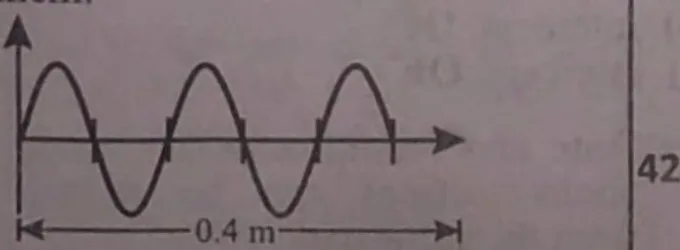
The diagram illustrates an electromagnetic wave traveling with speed 3.0×10⁸ ms⁻¹, spanning a distance of 0.4m. Calculate the wavelength of the wave.

Diagram for question 31
  • A. 0.1m
  • B. 0.133mCorrect
  • C. 0.2m
  • D. 0.4m

Explanation

From the diagram, three complete wave cycles span the marked distance of 0.4m, so wavelength = 0.4m/3 ≈ 0.133m.

Physics 2014 Objective — Question 32

An observer hears an echo 1.26 seconds after blowing a whistle near a cliff. Calculate the distance of the observer from the cliff. [Speed of sound in air = 330 ms⁻¹]

  • A. 104.0 m
  • B. 207.9 mCorrect
  • C. 415.8 m
  • D. 523.8 m

Explanation

Distance = (speed × time)/2 = (330×1.26)/2 = 207.9m.

Physics 2014 Objective — Question 33

A fish inside a pond appears to be at a depth of 1.5m when viewed vertically from above. The refractive index of the water in the pond is 1.3. Calculate the apparent displacement of the fish.

  • A. 2.50 m
  • B. 1.95 m
  • C. 1.50 m
  • D. 0.45 mCorrect

Explanation

Real depth = apparent depth × n = 1.5×1.3 = 1.95m. Apparent displacement = real depth − apparent depth = 1.95−1.5 = 0.45m.

Physics 2014 Objective — Question 34

An object is placed in front of two plane mirrors inclined at 60° to each other. Determine the number of images formed.

  • A. 2
  • B. 3
  • C. 5Correct
  • D. 7

Explanation

Number of images = (360°/θ)−1 = (360/60)−1 = 6−1 = 5.

Physics 2014 Objective — Question 35

An ammeter can be adapted to measure potential difference by using a

  • A. shunt
  • B. multiplierCorrect
  • C. rheostat
  • D. resistance box

Explanation

An ammeter can be adapted to measure potential difference (converted into a voltmeter) by connecting a multiplier (a high resistance) in series with it.

Physics 2014 Objective — Question 36

The region around a magnet in which magnetic force can be experienced is known as

  • A. declination
  • B. flux density
  • C. fieldCorrect
  • D. flux

Explanation

The region around a magnet in which magnetic force can be experienced is known as the magnetic field.

Physics 2014 Objective — Question 37

In an a.c. circuit, when the supply voltage frequency is equal to the resonant frequency, the current

  • A. leads the supply voltage by 90°
  • B. lags behind the supply voltage by 90°
  • C. leads the supply voltage by 45°
  • D. is in phase with the supply voltageCorrect

Explanation

At resonance in an a.c. circuit, the current is in phase with the supply voltage.

Physics 2014 Objective — Question 38

The energy stored in a simple cell is

  • A. electrical
  • B. nuclear
  • C. thermal
  • D. chemicalCorrect

Explanation

The energy stored in a simple cell is chemical energy, which is converted to electrical energy when the cell is in use.

Physics 2014 Objective — Question 39

Which of the following conditions occur at resonance in a series RLC circuit? I. Impedance equals resistance II. Current is maximum III. Reactances are maximum IV. Current and Voltage are 90° out of phase

  • A. I and II onlyCorrect
  • B. I, II and III only
  • C. I, II, III and IV
  • D. II, III and IV only

Explanation

At resonance in a series RLC circuit, impedance equals resistance (minimum impedance) and current is maximum. The inductive and capacitive reactances are equal (not 'maximum'), and current and voltage are in phase (not 90° out of phase), so only I and II are correct.

Physics 2014 Objective — Question 40

An electric motor converts

  • A. electrical energy to mechanical energyCorrect
  • B. mechanical energy to electrical energy
  • C. mechanical energy to sound energy
  • D. electrical energy to thermal energy

Explanation

An electric motor converts electrical energy to mechanical energy.

Physics 2014 Objective — Question 41

A 15µF capacitor is connected to a 240V, 50Hz a.c. source. Calculate the reactance of the capacitor. [π=3.142]

  • A. 16 Ω
  • B. 68 Ω
  • C. 106 Ω
  • D. 212 ΩCorrect

Explanation

Xc = 1/(2πfC) = 1/(2×3.142×50×15×10⁻⁶) ≈ 212Ω.

Physics 2014 Objective — Question 42

Two identical charges situated 20cm apart in vacuum repel each other with a force of 1.0N. Calculate the value of each charge. [(4πε₀)⁻¹=9×10⁹ N m²C⁻²]

  • A. 2.1 µCCorrect
  • B. 3.6 µC
  • C. 4.0 µC
  • D. 4.4 µC

Explanation

F=kq²/r² ⟹ q²=Fr²/k = (1.0×0.2²)/(9×10⁹) = 4.44×10⁻¹²; q ≈ 2.1×10⁻⁶C = 2.1µC.

Physics 2014 Objective — Question 43

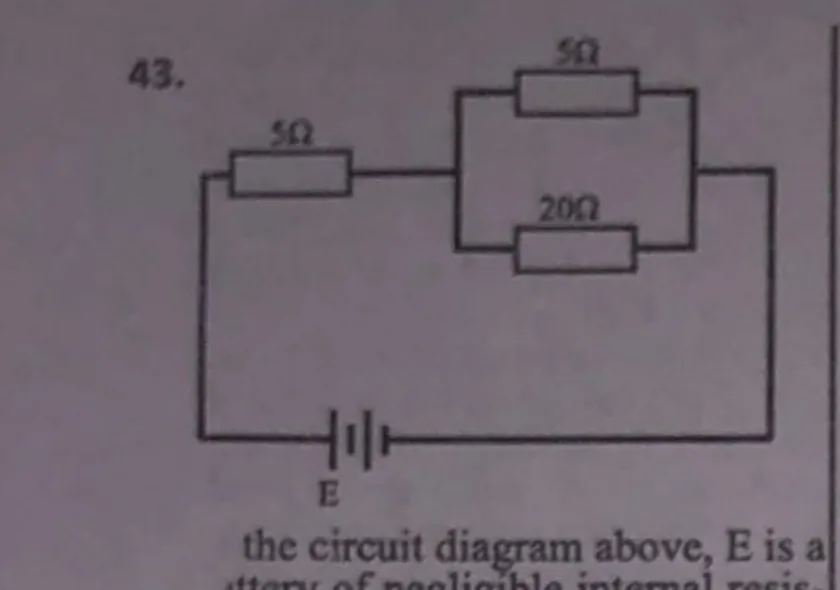
In the circuit diagram, E is a battery of negligible internal resistance. If its emf is 9.0V, calculate the current in the circuit.

Diagram for question 43
  • A. 1.8 A
  • B. 1.0 ACorrect
  • C. 0.8 A
  • D. 0.3 A

Explanation

The parallel combination of 5Ω and 20Ω gives 4Ω; adding the series 5Ω gives a total of 9Ω. Current = E/R = 9.0V/9Ω = 1.0A.

Physics 2014 Objective — Question 44

A wire of length 100cm has a resistance of 10Ω. If its cross-sectional area is 0.005cm², determine its resistivity.

  • A. 0.0005 ΩcmCorrect
  • B. 0.0015 Ωcm
  • C. 0.0016 Ωcm
  • D. 0.0700 Ωcm

Explanation

Resistivity ρ = RA/L = (10×0.005)/100 = 0.0005 Ωcm.

Physics 2014 Objective — Question 45

A transformer has 400 turns of wire in the primary coil and 40 turns in the secondary coil. If the input voltage is 150 volts, calculate the magnitude of the output voltage.

  • A. 150 V
  • B. 55 V
  • C. 36 V
  • D. 15 VCorrect

Explanation

Vs/Vp = Ns/Np, so Vs = 150×(40/400) = 15V.

Physics 2014 Objective — Question 46

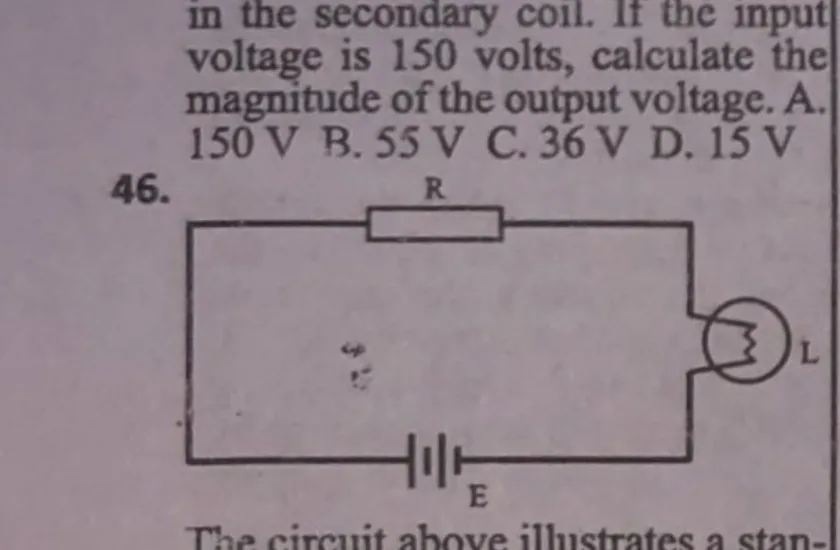
The circuit illustrates a standard resistor R, voltage source E, and a lamp L connected in series. If the temperature of R is increased, the brightness of lamp L will

Diagram for question 46
  • A. increase sharply
  • B. decrease slightlyCorrect
  • C. remain the same
  • D. increase gradually

Explanation

As the temperature of R increases, its resistance increases, reducing the current in the series circuit, so the brightness of the lamp decreases slightly.

Physics 2014 Objective — Question 47

The energy required to separate the nucleus in an atom completely is known as

  • A. mass defect of the atom
  • B. electron binding energy
  • C. excitation energy
  • D. nuclear binding energyCorrect

Explanation

The energy required to completely separate the nucleons in a nucleus is known as the nuclear binding energy.

Physics 2014 Objective — Question 48

Which of the following statements is the major advantage of nuclear fusion over nuclear fission?

  • A. Nuclear fusion releases more energyCorrect
  • B. More neutrons are released in fusion than in fission
  • C. Fusion does not release as much dangerous radiation as fission
  • D. Fusion reactions occur more readily than fission

Explanation

A major advantage of nuclear fusion over fission is that fusion releases more energy per reaction.

Physics 2014 Objective — Question 49

An aluminium foil is placed across a beam of radiation from a radioactive source. Which of the following types of radiation will be stopped by it?

  • A. Alpha and beta particlesCorrect
  • B. Alpha and gamma particles
  • C. Beta and gamma particles
  • D. Gamma particles only

Explanation

An aluminium foil, being a moderately thin barrier, will stop alpha particles (stopped by paper) and beta particles, but gamma radiation will pass through.

Physics 2014 Objective — Question 50

An element of nucleon number P and atomic number Q emits an alpha particle from its nucleus. The resultant numbers of the new element formed are respectively

  • A. P−4 and Q+2
  • B. P−4 and Q−2Correct
  • C. P+2 and Q+2
  • D. P+2 and Q−2

Explanation

In alpha decay, the mass (nucleon) number decreases by 4 and the atomic number decreases by 2, giving P−4 and Q−2.

Advertisement

Sign up free to unlock

  • Score tracking
  • Practice history
  • Saved questions
  • Progress dashboard
  • Personalized sessions
  • Weak-topic breakdown

…and/or go further with premium services and No Ads.