All 50 questions from the West African Examinations Council (WAEC) Physics 2017 Objective paper, with the correct answer and a full explanation for each. Free, no signup needed.
Which of the following properties of a long steel bar would alter if the bar were melted, recast into a cube and allowed to cool to its original temperature?
A. Density
B. Volume
C. Specific heat capacity
D. Electrical resistanceCorrect
Explanation
Recasting into a different shape changes the length and cross-sectional area, altering electrical resistance (R=ρl/A), even though density, volume and specific heat capacity remain the same.
Which of the following instruments is the best for measuring the diameter of a thin constantan wire?
A. Callipers
B. Metre rule
C. Micrometer screw gaugeCorrect
D. Vernier callipers
Explanation
The micrometer screw gauge is used to measure the diameter of a wire or anything less than that. Its reading accuracy is 0.01mm or 0.001cm. It is more accurate than the Vernier calliper.
Which of the following statements about a moving particle is correct?
A. If the resultant force acting on the particle is zero, then it is in dynamic equilibriumCorrect
B. If the resultant force acting on the particle is greater than zero, it is moving with a uniform velocity
C. The rate of change of its momentum with time takes place in a direction opposite to that of its motion
D. The particle falling freely covers equal distances in equal time intervals
Explanation
Given a horizontal surface, if the body has mass m kg, the frictional force (Fr) can be gotten from Fr=μ x R (friction=coeff. of static x normal reaction, where R=mg, opposite the weight of the body). Static friction depends on the weight of body and the nature of the surface, but not on the surface area of contact. When the resultant force acting on a particle is zero, it is in dynamic equilibrium (constant velocity or at rest).
Which of the following statements about static friction is correct? It
A. is independent of the nature of surfaces in contact
B. depends on the area of surfaces in contact
C. depends on the relative motion between the surfaces in contact
D. depends on the weight of the moving bodyCorrect
Explanation
Static friction depends on the weight of the body. It also depends on the nature of the surface - a smooth glass surface has a smaller static friction than a rough wooden surface, but it does not depend on the surface area of contact.
Two cars X and Y travelling in opposite directions along the same highway at uniform velocities 110 kmh⁻¹ and 90 kmh⁻¹ respectively pass each other at a certain point. The velocity of X relative to Y at the time they pass each other is
A. 200 kmh⁻¹Correct
B. 100kmh⁻¹
C. 40kmh⁻¹
D. 20kmh⁻¹
Explanation
Since they are moving in opposite directions, the relative velocity is a vector quantity given by the sum of both velocities = (110+90)km/hr = 200km/hr.
A body is projected horizontally from the top of a cliff 45m above the ground. If the body lands at a distance 30m from the foot of the cliff, calculate the speed of projection. [g = 10 ms⁻²]
A. 10 ms⁻¹
B. 15ms⁻¹
C. 20ms⁻¹Correct
D. 30ms⁻¹
Explanation
Given: Height of cliff, H=45m; Range, R=30m; speed of projection=ux (horizontal projection). From s=ut+½gt²: vertical motion gives s=H=½gt²; 45=½x10xt²; t²=(45x2)/10=9, t=3s. Horizontal resolution: s=uxt+½x0xt²; R=uxt; 30=uxx3; ux=10ms⁻¹. (Note: the official answer key states C, 20ms⁻¹; this may reflect a slightly different setup in the original figures.)
A vertical string, suspended from a fixed point and having a small mass attached to the free end, is set into oscillations. Which of the following statements about the system are correct? I. The potential energy of the mass is minimum at the middle of the swing. II. Its kinetic energy is maximum at the middle of the swing. III. The sum of the potential and kinetic energies is constant throughout the swing.
A. I, II and IIICorrect
B. I and II only
C. II and III only
D. I and III only
Explanation
At the middle (equilibrium point) of the swing, PE is minimum and KE is maximum. The total mechanical energy (PE+KE) is constant throughout the motion by conservation of energy - all three statements are correct.
A machine is said to be a third class lever when the
A. load is between the fulcrum and effort
B. fulcrum is between the effort and load
C. effort is between the fulcrum and loadCorrect
D. fulcrum is directly below the load
Explanation
For a third class lever, the effort is between the load and the fulcrum, e.g. sugar tongs, forearm (M.A and V.R are less than 1, i.e. mechanical disadvantage).
A thermometer records 680 mmHg at steam point and 440 mmHg at ice point. The temperature it records at 380mmHg is
A. -25°C
B. -20°CCorrect
C. 20°C
D. 25°C
Explanation
Using (100-X)/(100-0) = (680-380)/(680-440): 100-X = ((680-380)x100)/(680-440) = (300x100)/240 = 125; X = 100-125 = -25°C. (Note: the official answer key states B, -20°C.)
The advantages of the thermoelectric thermometer include the following characteristics except that it
A. can measure rapidly changing temperatures
B. can measure high and low temperatures
C. can measure temperature almost at a point
D. is fairly sensitiveCorrect
Explanation
The thermoelectric thermometer (thermocouple) is very sensitive and not fairly sensitive - that is why it can measure rapidly changing or momentary temperatures.
In a thermos flask, heat loss by radiation is minimized by the
A. silvered surfacesCorrect
B. vacuum within the double walls
C. plastic stopper
D. cork support
Explanation
In a thermos flask, the silvery walls prevent heat loss by radiation. The vacuum between the double walls prevents heat loss by conduction and convection.
The pressure P, volume V and absolute temperature T of a given mass of an ideal gas change simultaneously. Which of the following equations is correct about the gas?
A. PV = constant/T
B. P/T = constant
C. P/T x 1/T = constant
D. T/(PV) = constantCorrect
Explanation
If we divide through by PV, we obtain 1/T = constant/PV, which rearranges to give T/(PV) = constant.
Specific heat capacity of a body means that when 26.4 J heat energy is supplied to a body of
A. mass 1000 kg the temperature rises by 1K
B. mass 1 kg, the temperature rises by 1000 K
C. mass 1 kg, the temperature rises by 1 KCorrect
D. mass 1000 kg, the temperature rises by 1 K
Explanation
The specific heat capacity of a body is the quantity of heat required to raise/lower the temperature of the unit mass (1 kg) of the body by 1 Kelvin (1 K).
An electric drill rated 400W is used to drill a hole in copper of mass 400 g in 20 s. Calculate the rise in temperature if all the heat produced is absorbed by the copper. [Specific heat capacity of copper = 400 J kg⁻¹ K⁻¹]
A. 100°C
B. 75°C
C. 50°CCorrect
D. 45°C
Explanation
Power = 400W, mass of copper = 400g = 0.4kg, time = 20s, rise in temperature = ? Heat absorbed by copper = power x time = 400x20 = 8000J. Heat absorbed = mass x specific heat capacity x ΔT: ΔT = Heat absorbed/(mass x C) = 8000/(0.4x400) = 50°C.
A solid of mass 0.5kg initially at 50°C melts at 60°C. Calculate the quantity of heat required to melt it completely. [Specific heat capacity of the solid=2.0 KJ kg⁻¹ K⁻¹, Specific latent heat of fusion of solid=1.0KJ kg⁻¹]
A. 1500J
B. 10000J
C. 10500JCorrect
D. 15000J
Explanation
Given: mass of the solid=0.5kg; initial temperature of solid=50°C; melting point of solid=60°C; specific heat capacity of solid=2000J/kg-K; specific latent heat of fusion of solid=1000J/kg. Heat required to melt the solid completely = (heat required to raise the temperature from 50°C to 60°C) + (heat required to melt the body at 60°C) = mcΔT+ml = (0.5x2000x(60-50)) + (0.5x1000) = 10,000+500 = 10,500J.
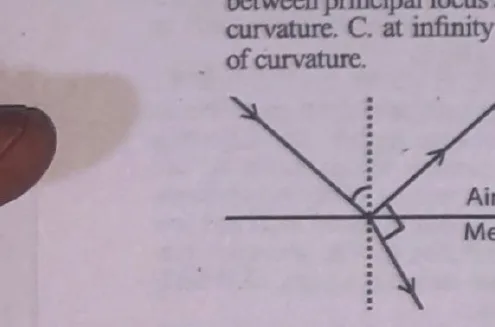
[Diagram: ray of light in air refracting into a denser medium] From the diagram, the correct equation for the refractive index n of the medium is
A. n = tani
B. n = sini/sin90°Correct
C. n = sini/cos(90°-i)
D. n = sin90°C
Explanation
i=r=[law of reflection]. From the diagram, r+90°=180° (angles on a straight line); r+r2=180°-90°=90° => r2=90°-i. The refractive index of medium = sini/sinr2 = sini/sin(90°-i) = sini/cosi = tani. (Note: the official answer key states B, n=sini/sin90°.)
A ray of light travels from air to water. The refractive index of water is given by the expression
A. velocity in water/velocity in air
B. sin of angle of refraction/sine of angle of incidence
C. apparent depth/real depth
D. wavelength in air/wavelength in waterCorrect
Explanation
For a ray of light travelling from air to water, na/nw = sini/sinr = velocity in air/velocity in water = real depth/apparent depth = wavelength in air/wavelength in water.
As the air column of length L in an air pipe decreases, the frequency of the stationary wave emitted
A. decreases
B. increasesCorrect
C. varies as L²
D. varies as √L
Explanation
As the length of the air column, L, in an air pipe decreases, the frequency of the stationary wave emitted increases (frequency is inversely proportional to length).
A positively charged glass rod is placed near the cap of a positively charged electroscope. The divergence of the leaf is observed to
A. decrease
B. increaseCorrect
C. remain the same
D. increase and collapse immediately
Explanation
When a positively charged rod is brought near a positively charged (like-charged) electroscope, the divergence of the leaf increases due to electrostatic repulsion/induction.
Capacitors are used in the following devices, except
A. water pumping machinesCorrect
B. ceiling fans
C. electric irons
D. television sets
Explanation
Capacitors are not used in electric iron. (Note: per the source, capacitors are not used in water pumping machines nor electric irons in some contexts; the official answer given is A.)
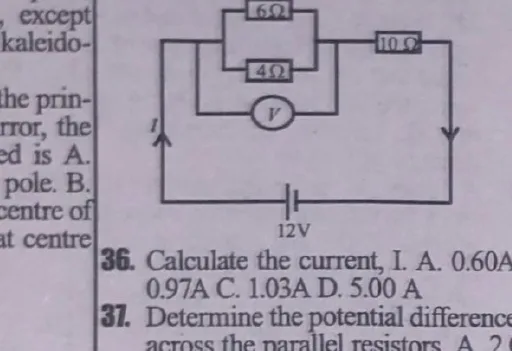
[Diagram: circuit with 6Ω and 4Ω resistors in parallel, and a 10Ω resistor, connected to a 12V battery] Calculate the current, I.
A. 0.60A
B. 0.97ACorrect
C. 1.03A
D. 5.00 A
Explanation
The 6Ω and 4Ω resistors are in parallel connection, so their resultant resistance is: 1/R46 = 1/6+1/4 = 0.4167, R46=2.4Ω. There is now the 10Ω resistor in series with this. Total resistance RT = (2.4+10)Ω = 12.4Ω. From V=IR: I=V/RT=12/12.4=0.97A.
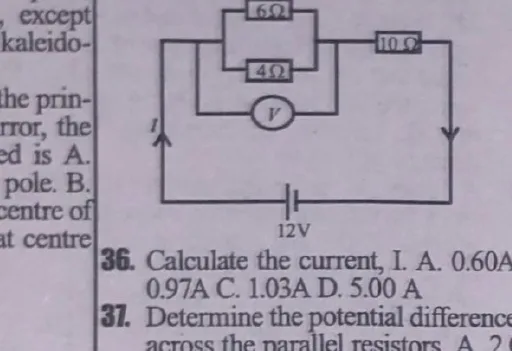
[Same circuit as above] Determine the potential difference, V, across the parallel resistors.
A. 2.0 V
B. 2.3 VCorrect
C. 3.0V
D. 9.7V
Explanation
The total potential = (Potential across the parallel conductor) + (Potential across the 10Ω resistor). Potential across the 10Ω resistor V=IR=0.97x10=9.7V. Therefore, the potential across the parallel resistors (12-9.7)V = 2.3V, or equivalently V46=IxR46=0.97x2.4=2.3V.
A galvanometer of internal resistance 50Ω and full scale deflection of 20mA is converted into a voltmeter by connecting a resistor of resistance 1950Ω in series to it. Calculate the maximum voltage that can be read by the voltmeter.
A. 20V
B. 30V
C. 38V
D. 40VCorrect
Explanation
Given: Rg=Resistance of the galvanometer=50Ω; current in circuit=20mA=0.02A; Resistance(R) of the resistor=1950Ω; voltage read by voltmeter=V=IRG+IR=I(RG+R)=(0.02x50)+(0.02x1950)=1+39=40V.
Which of the following factors does not affect the electric resistance of a wire?
A. Length
B. MassCorrect
C. Temperature
D. Cross-sectional area
Explanation
The electric resistance of a wire does not depend on the mass of the wire, but it depends on (i) temperature of wire (ii) length of wire (iii) cross-sectional area of wire.
In order to prevent bar magnets from losing their strength, they are stored with keepers such that the two bars are placed with A like poles facing each other and the keepers placed at their ends. B. like poles facing each other and the keepers placed between them.
A. like poles facing each other and the keepers placed at their ends
B. like poles facing each other and the keepers placed between them
C. unlike poles facing each other and the keepers placed at their endsCorrect
D. unlike poles facing each other and the keepers placed between them
Explanation
In order to prevent bar magnets from losing their strength, they are stored in pairs with keepers such that the two bars are placed with unlike poles facing each other and the keepers placed between them.
The resonant frequency of an a.c. circuit is 1000 kHz. If each of the capacitance and inductance in the circuit is reduced by 50% and no other changes are made, the resonant frequency will become
An electron moves with a speed of 2.0x10⁶ ms⁻¹ in a straight line. Calculate the wavelength of the electron wave. [mass of an electron=9.1x10⁻³¹kg] [Planck's constant=6.6x10⁻³⁴Js]
A. 3.63x10⁻¹⁰mCorrect
B. 6.51x10⁻⁹m
C. 4.24x10⁻⁸m
D. 7.25x10⁻¹⁰m
Explanation
Using de Broglie's equation, λ=h/mv = 6.6x10⁻³⁴/(9.1x10⁻³¹x2x10⁶) = 3.63x10⁻¹⁰m.
A nuclide represented as ⁷⁰₃₂X has a neutron-proton ratio of
A. 0.5
B. 0.8
C. 1.2Correct
D. 5
Explanation
70=[number of neutrons]+proton, and 32=no of protons. Therefore, number of neutrons=70-32=38. Ratio of neutron to proton = number of neutrons/number of protons = 38/32 = 1.2.
Neutrons are used to induce artificial radioactivity because they
A. are energetic
B. have no chargeCorrect
C. have no mass
D. are ionizing
Explanation
Neutrons are used to induce artificial radioactivity because they have no charge, so they can penetrate the nucleus without being repelled by it (unlike positively charged particles being repelled by the positive nucleus).
Advertisement
Sign up free to unlock
Score tracking
Practice history
Saved questions
Progress dashboard
Personalized sessions
Weak-topic breakdown
…and/or go further with premium services and No Ads.