WAEC Physics 2023 Theory — Question 10
Question 10 of 14 from the West African Examinations Council (WAEC) Physics 2023 Theory paper, with the correct answer and a full explanation.
Advertisement
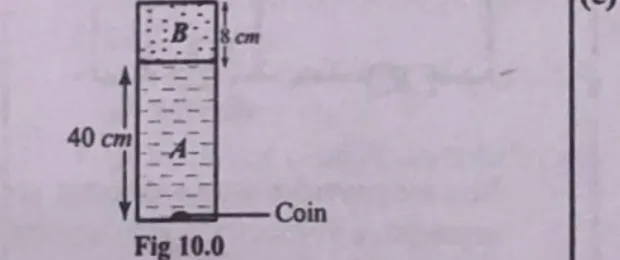
10(a)(i). Why are parabolic mirrors suitable for use in headlamps of vehicles? 10(a)(ii). Draw a ray diagram to illustrate the answer in 10(a)(i). 10(b)(i). State two applications of echoes. 10(b)(ii). An observer standing at a point, P, on the same horizontal ground as the foot, H, of a tower shouts and hears the echo 1.20s later; he then moves to another point, Q, 40 m from P, and shouts again, hearing the echo after 1.45s. Calculate: I. distance between P and H; II. speed of sound in air. 10(c)(i). Define absolute refractive index of a medium. 10(c)(ii). A piece of coin falls accidently into a tank containing two immiscible liquids A and B as illustrated in Fig 10.0. Calculate the displacement of the coin when viewed vertically from above. [refractive index of A=1.3, refractive index of B=1.4].
Model answer
(a)(i) Parabolic mirrors are suitable for use in vehicle headlamps because they are able to produce a parallel beam of light with the same intensity over a long distance. (ii) A ray diagram would show light rays originating from a point source at the focus of the parabolic mirror, reflecting off the mirror surface and emerging as parallel rays. (b)(i) Applications of echoes: location of ores/solid minerals; determination of the depth of sea/ocean floor; navigation; determination of the speed of sound; used in radars; location of wreckage; used in MRI/ultrasound. (ii) Using v=2d/t for both positions and equating, the distance PH and speed of sound can be solved simultaneously: distance |PH| = 192 m (worked using the given echo timings and 40 m separation), and speed of sound in air, v = 2(192)/1.2 = 320 ms⁻¹. (c)(i) Absolute refractive index of a medium is defined as the ratio of the speed of light in vacuum/air to the speed of light in the medium, OR the ratio of the sine of the angle of incidence in vacuum/air to the sine of the angle of refraction in the medium. (ii) The apparent displacement of the coin due to each liquid is calculated using d=t(1-1/n), where t is the real depth and n is the refractive index; the total displacement is the sum of the displacements due to liquid A and liquid B, e.g. dA=0.4(1-1/1.3)=0.092m=9.2cm and dB=0.08(1-1/1.4)=0.023m=2.3cm, giving a total displacement of about 0.115 m or 11.5 cm.
Advertisement
Sign up free to unlock
- Score tracking
- Practice history
- Saved questions
- Progress dashboard
- Personalized sessions
- Weak-topic breakdown
…and/or go further with premium services and No Ads.