All 14 questions from the West African Examinations Council (WAEC) Physics 2023 Theory paper, with the correct answer and a full explanation for each. Free, no signup needed.
The force, F, acting on the wings of an aircraft moving through air of velocity, v, and density, ρ, is given by the equation F=kvᵖρᵠAᶻ, where k is a dimensionless constant and A is the surface area of the wings. Use dimensional analysis to determine the values of x, y and z.
Model answer
By dimensional analysis: F=[MLT⁻²], v=[LT⁻¹], ρ=[ML⁻³], A=[L²]. Equating: MLT⁻²=(LT⁻¹)ˣ(ML⁻³)ʸ(L²)ᶻ. Comparing powers: for M: y=1; for T: -x=-2 → x=2; for L: x-3y+2z=1 → 2-3+2z=1 → 2z=2 → z=1. Thus x=2, y=1, z=1.
2(a). Define strain energy.
2(b). Write an expression for the energy stored, E, in a stretched wire of original length, l, cross-sectional area, A, extension, e, and Young's modulus, Y, of the material of the wire.
Model answer
(a) Strain energy is the energy (potential energy) stored in a material or object when it is deformed, stretched or compressed by an applied force.
(b) E = YAe²/2l.
3(a). A projectile is fired at an angle, θ, to the horizontal with velocity, u. Show that at any time, t, during the motion: (i) the horizontal component of the velocity is independent of t; (ii) the vertical component of the velocity depends on t.
3(b). State the assumption on which projectile motion is based.
Model answer
(a)(i) Horizontal component: vₓ=uₓ-gt sin0=uₓ (since gₓ=0, there is no horizontal acceleration), so vₓ=uₓ=u cosθ, which is independent of t.
(ii) Vertical component: v_y=u_y-gt=u sinθ-gt, which clearly depends on t.
(b) Assumption: the only force acting on the body is its weight/force of gravity — all other external forces (e.g. air resistance) are negligible.
State three differences between geostationary and polar satellites.
Model answer
Geostationary satellite vs Polar satellite: (i) Period of revolution is the same as the period of rotation of the earth (24 hrs/1 day) for geostationary, while for polar satellites the period of revolution is not the same as the period of rotation of the Earth (it varies). (ii) Geostationary satellites orbit directly along the equator/latitude, while polar satellites travel from pole to pole along the longitude. (iii) A geostationary satellite appears to be in a stationary position above a point on the Earth's surface relative to the Earth, while a polar satellite is not always in the same position relative to Earth. (iv) A geostationary satellite provides continuous coverage of a specific region/area, while a polar satellite provides global coverage.
5(a). Using the kinetic theory, explain the term diffusion of fluid molecules.
5(b). Name one phenomenon that demonstrates that light behaves as: (i) a wave; (ii) a particle.
Model answer
(a) Diffusion is the process where fluid molecules move randomly and collide with neighbouring molecules due to the possession of kinetic energy, resulting in their spreading/mixing throughout the fluid.
(b)(i) Wave: Refraction, Reflection, Diffraction or Interference or Polarisation demonstrate that light behaves as a wave.
(ii) Particle: Photoelectric effect, Compton effect/scattering, or Black body radiation demonstrate that light behaves as a particle.
6(a). State the difference between intrinsic and extrinsic semiconductors.
6(b). Sketch a circuit to show full wave smoothing rectification.
Model answer
(a) Intrinsic semiconductors are pure semiconductors with no impurities, have an equal number of charge carriers (holes and electrons), and have low electrical conductivity (high resistivity). Extrinsic semiconductors contain impurities (are doped), have an unequal number of charge carriers, have high electrical conductivity (low resistivity), and the charge carriers are thermally generated (intrinsic) versus resulting from doping (extrinsic).
(b) A full-wave smoothing rectification circuit consists of an AC input connected through diodes (D1, D2 in a bridge or centre-tap arrangement) to a smoothing capacitor (C) in parallel with the load resistor (RL). The diodes rectify (remove the negative component of) the input voltage and convert it into pulsed DC, which is then smoothed by the capacitor to produce a nearly steady DC output signal.
7(a). What is fibre optics?
7(b). State two reasons why optical fibres are preferred to copper cables in the telecommunication industry.
Model answer
(a) Fibre optics (optical fibre) refers to the technology that transmits information or data using pulses of light through a thin transparent fibre made of high-quality glass or plastic.
(b) Reasons optical fibres are preferred to copper cables: they have greater bandwidth and are capable of transmitting signals/data at faster speed over longer distances; they have greater efficiency; they have higher-quality transmission with low resistance.
8(a)(i). State the reason why simple harmonic motion is periodic.
8(a)(ii). State two factors affecting the period of oscillation of a simple pendulum.
8(a)(iii). Sketch a graph of the total mechanical energy, E, against displacement, y, for the motion of a simple pendulum from one extreme position to the other.
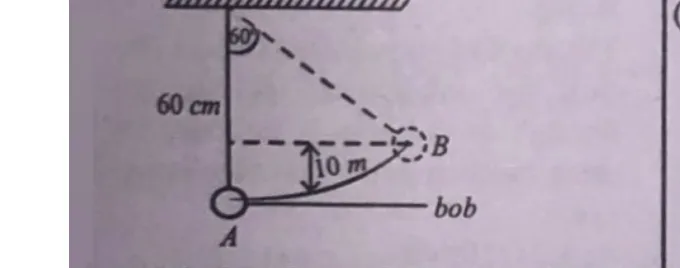
8(b). The diagram below illustrates an oscillatory pendulum. Calculate the workdone in raising the pendulum to point B, if the mass of the bob is 50g. [g=10ms⁻²]
8(c). A spiral spring of spring constant, k, and natural length, l, has a scale pan of mass 0.04kg hanging on its lower end while the upper end is firmly fixed to a support. When an object of mass 0.20 kg is placed on the scale pan, the length of the spring becomes 0.055 m and when the object is replaced with another object of mass 0.28 kg, the length of the spring becomes 0.6 m. Calculate the values of k and l. [g=10 ms⁻²]
Model answer
(a)(i) Simple harmonic motion is periodic due to the balance between the restoring force and the inertial force or weight of the oscillating body.
(ii) Factors affecting the period of oscillation of a simple pendulum: length of the pendulum; acceleration due to gravity.
(iii) The graph of total mechanical energy E against displacement y is a horizontal straight line (constant), since total energy (KE+PE) remains constant throughout SHM, while kinetic energy and potential energy vary in a complementary sinusoidal manner between the extremes.
(b) Workdone = mgl(1-cosθ) = 0.05×10×0.6×(1-cos60°) = 0.05×10×0.6×(1-0.5) = 0.15 J.
(c) Using Hooke's law with the two given loads and extensions, and solving the resulting simultaneous equations: k=80 Nm⁻¹ and l=0.0025 m (i.e. l₀=0.0025m, before adding e₁=0.055-0.0025 and e₂=0.6-0.0025 as the extensions for each load).
9(a). Define each of the following terms as used with simple machines: (i) pivot; (ii) load; (iii) efficiency.
9(b). A truck of mass 1.2×10³ kg is pulled from rest by a constant horizontal force of 25.2 N on a levelled road. If the process is 60 km h⁻¹, calculate: (i) work done by the force; (ii) distance travelled by the truck in reaching the maximum speed.
9(c). State two differences between absolute zero temperature and ice point.
Model answer
(a)(i) Pivot is the point about which turning effect occurs in a machine.
(ii) Load is the force overcarried by effort.
(iii) Efficiency of a machine is the ratio of work/energy output to the work or energy input, expressed as a percentage.
(b)(i) v=60kmh⁻¹=16.67ms⁻¹. Work done by the force=change in kinetic energy=½mv²=½×1.2×10³×16.67²=1.67×10⁵ J.
(ii) Distance travelled = W/F = 1.67×10⁵/25.2 ≈6630 m = 6.63 km.
(c) Differences: Absolute zero is the temperature at which all molecules are at rest, has a value of 0K/-273.15°C, and is not a fixed point on the Celsius scale. Ice point is the temperature at which vibratory motion still occurs, has a value of 0°C/273.15°C on the absolute scale, and is a fixed lower point on the Celsius scale.
10(a)(i). Why are parabolic mirrors suitable for use in headlamps of vehicles?
10(a)(ii). Draw a ray diagram to illustrate the answer in 10(a)(i).
10(b)(i). State two applications of echoes.
10(b)(ii). An observer standing at a point, P, on the same horizontal ground as the foot, H, of a tower shouts and hears the echo 1.20s later; he then moves to another point, Q, 40 m from P, and shouts again, hearing the echo after 1.45s. Calculate: I. distance between P and H; II. speed of sound in air.
10(c)(i). Define absolute refractive index of a medium.
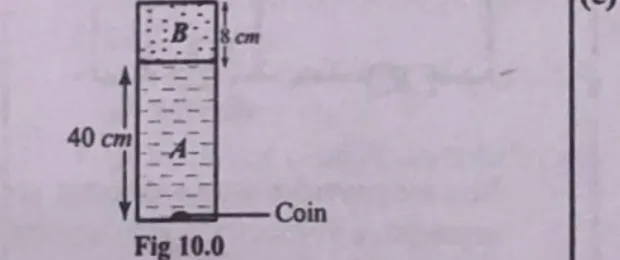
10(c)(ii). A piece of coin falls accidently into a tank containing two immiscible liquids A and B as illustrated in Fig 10.0. Calculate the displacement of the coin when viewed vertically from above. [refractive index of A=1.3, refractive index of B=1.4].
Model answer
(a)(i) Parabolic mirrors are suitable for use in vehicle headlamps because they are able to produce a parallel beam of light with the same intensity over a long distance.
(ii) A ray diagram would show light rays originating from a point source at the focus of the parabolic mirror, reflecting off the mirror surface and emerging as parallel rays.
(b)(i) Applications of echoes: location of ores/solid minerals; determination of the depth of sea/ocean floor; navigation; determination of the speed of sound; used in radars; location of wreckage; used in MRI/ultrasound.
(ii) Using v=2d/t for both positions and equating, the distance PH and speed of sound can be solved simultaneously: distance |PH| = 192 m (worked using the given echo timings and 40 m separation), and speed of sound in air, v = 2(192)/1.2 = 320 ms⁻¹.
(c)(i) Absolute refractive index of a medium is defined as the ratio of the speed of light in vacuum/air to the speed of light in the medium, OR the ratio of the sine of the angle of incidence in vacuum/air to the sine of the angle of refraction in the medium.
(ii) The apparent displacement of the coin due to each liquid is calculated using d=t(1-1/n), where t is the real depth and n is the refractive index; the total displacement is the sum of the displacements due to liquid A and liquid B, e.g. dA=0.4(1-1/1.3)=0.092m=9.2cm and dB=0.08(1-1/1.4)=0.023m=2.3cm, giving a total displacement of about 0.115 m or 11.5 cm.
11(a)(i). Define the electric potential at a point in an electric field.
11(a)(ii). An uncharged body, A, was charged electrostatically by a test charge, B, using the method of induction and the method of contact. State two differences between the two methods.
11(b). State an important precaution during an electricity experiment involving opening the circuit when no readings are being taken, and give two reasons for the precaution.
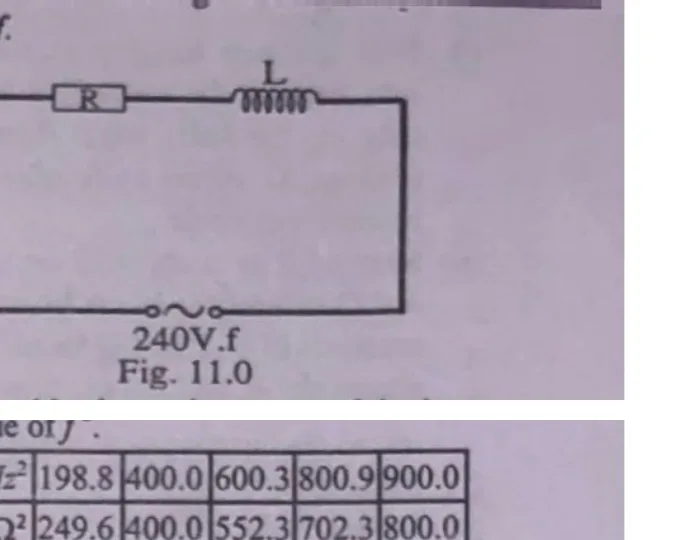
11(c)(i). Fig. 11.0 is a circuit diagram in which a coil of inductance, L, and a resistor of resistance, R, are connected to a.c, f. The table shows the square of the impedance, Z², corresponding to each value of f². Write down the equation for Z in terms of f², R² and L². Plot a graph of Z² against F² and use it to deduce (I) L (II) R.
Model answer
(a)(i) Electric potential at a point in an electric field is the work done per unit positive charge in bringing the charge from infinity to that point.
(ii) Differences between induction and contact methods of charging: In induction, there is no direct contact between A and B (B never touches A), while in contact, there is direct contact between A and B. In induction, the polarity of B (induced charge) is opposite to that of A, while in contact, the polarity of B is the same as A. In induction, the charge on B is repelled to the opposite end and remains on A, while in contact, charge is transferred to the same side of contact. Induction requires earthing, while contact requires no earthing.
(b) Precaution: to open the circuit when no readings are being taken. Reasons: (i) to prevent/minimize overheating (in the load); (ii) to prevent the cell from running down or draining quickly; (iii) to allow the depolarizer to recover.
(c)(i) From the phasor diagram, Z²=X_L²+R², and since X_L=2πfL, Z²=R²+4π²f²L². Comparing this with y=mx+c, a graph of Z² against f² gives a straight line with slope=4π²L² and intercept=R² on the Z² axis. From the graph's slope and intercept, L and R can each be deduced (e.g. L≈0.137H, R≈10Ω, using the specific table data shown: f²/Hz² 198.8, 400.0, 600.3, 800.9, 900.0 against Z²/Ω² 249.6, 400.0, 552.3, 702.3, 800.0).
12(a)(i). State the function of each of the following parts of a modern X-ray tube: heater; high tension source; cooling fins.
12(b). State one design feature each for: the glass envelope being highly evacuated; the target being a metal of very high melting point; the cooling fins being located outside the glass envelope.
12(c). In a nuclear fission reaction, a nuclide ²³⁵₉₂U is bombarded with a neutron to produce ⁹³₃₆Kr and ¹⁴¹₅₆Ba with additional neutrons; the energy involved in the process is Q. (i) Write the balanced nuclear reaction equation. (ii) State with reason whether Q is absorbed or released. (iii) Calculate the value of Q in joules.
12(d). State three differences between nuclear fusion and nuclear fission.
Model answer
(a)(i) Heater: heats up the filament to release thermoelectrons. High tension source: accelerates the liberated thermoelectrons towards the target. Cooling fins: reduce/dissipate the intense heat produced at the target by radiation.
(b) The glass envelope is highly evacuated to prevent gaseous ionization in the tube (which could interfere with the process). The target is a metal of very high melting point to withstand the high energy generated from collisions of thermoelectrons with the target, to prevent it from melting. The cooling fins are located outside the glass envelope to prevent a possible breakup/crack of the glass due to heat generated, and to increase the rate of cooling.
(c)(i) Balanced equation: ²³⁵₉₂U + ¹₀n → ⁹³₃₆Kr + ¹⁴¹₅₆Ba + 2¹₀n + Q.
(ii) Q is released, because the sum of the masses of the reactants (235.044+1.009=236.053u) is greater than the sum of the masses of the products (91.898+140.914+2(1.009)=234.830u); the mass defect is converted to energy which is released.
(iii) Δm=236.053u-234.830u=1.223u=1.223×1.66×10⁻²⁷kg. Q=Δmc²=1.223×1.66×10⁻²⁷×(3×10⁸)²=1.83×10⁻¹⁰ J.
(d) Differences between nuclear fission and nuclear fusion: In fission, a heavy nucleus splits into lighter nuclei; in fusion, lighter nuclei combine to form a heavy nucleus. Fission produces harmful by-products; fusion produces harmless by-products. Fission produces less energy than fusion, which produces greater energy. Fission has a lower initiation temperature requirement; fusion has a higher initiation temperature requirement. Fission uses expensive/less abundant raw materials; fusion uses cheaper and more abundant raw materials.
PRACTICAL 1. You are provided with a rectangular block, a drawing board, drawing sheets, four optical pins and other necessary materials. Use the given diagram as a guide to: measure and record the width of the block; draw the outline ABCD of the block on a drawing sheet; mark a point, Q, on AB such that AQ=1.5cm; draw the normal RQT; draw a line UQ making an angle of 10° with the normal RQT; insert pins P1 and P2 on UQ, look through side DC and insert two other pins P3 and P4 so they appear in line with the images of P1 and P2; remove the block and mark the positions of P3 and P4; draw a straight line joining P3 and P4 and extend it to meet DC at E; produce a line UQ to meet DC at the point F; measure and record the angle r, length EF=D, and evaluate tan i, tan r and V=(tan i - tan r); repeat for i=20°,30°,40° and 50°, recording r, d and V each time; tabulate the results; plot a graph with d on the vertical axis and V on the horizontal axis; determine the slope, s, of the graph; state two precautions taken to ensure good results.
Model answer
This experiment determines the refractive index of the rectangular glass block using the pin (real/apparent depth) method. For each angle of incidence i (20°,30°,40°,50°), the corresponding angle of refraction r is measured, and tan i and tan r are recorded along with V=tan i-tan r and the displacement d=EF. Plotting d (vertical axis) against V (horizontal axis) gives a straight line through the origin, and the slope, s, of this graph relates to the refractive index and width of the block (s=width/refractive index, approximately). Precautions: avoid parallax error when taking readings on the metre rule/drawing sheet; ensure the pins are vertically fixed and properly aligned before taking sightings; ensure the block does not move while marking pin positions.
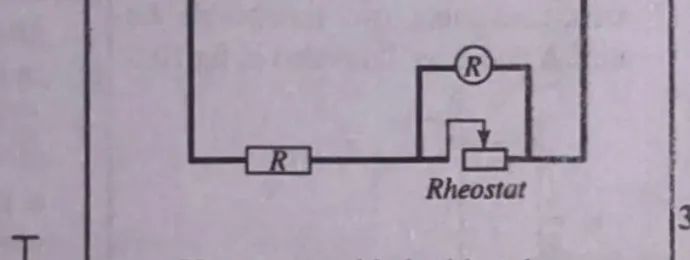
PRACTICAL 2. You are provided with a rheostat, an ammeter, a voltmeter, a 1Ω standard resistor, a key, a source of electricity of emf E and connecting wires. (i) Use the electrical components provided to connect the circuit as shown in the diagram, leaving the circuit open. (ii) Connect the voltmeter to the terminals of the battery and record the voltmeter reading, V_T. (iii) Close the key and adjust the rheostat so that the ammeter reads I=0.3A. Record the corresponding voltmeter reading V. (iv) Evaluate I⁻¹ and G=1/I. (v) Repeat the experiment for four other values of I=0.5A, 0.7A, 0.9A and 1.1A. In each case, record the corresponding value of V and evaluate I⁻¹ and G. (vi) Tabulate the results. (vii) Plot a graph with I⁻¹ on the vertical axis and G on the horizontal axis. (viii) Determine the slope, s, of the graph. (ix) Using the graph, determine the value of V for G=2.5. (x) State two precautions taken to ensure good results.
Model answer
This experiment investigates the relationship between current and the internal resistance/emf of the circuit using the given rheostat-ammeter-voltmeter setup. For each set current I (0.3A to 1.1A), the corresponding voltmeter reading V is recorded, and I⁻¹ and G=1/I are computed. Plotting I⁻¹ against G produces a straight line, and its slope gives information related to the emf/internal resistance of the source. From the sample data and graph: slope s=(3.45-1.5)/(3.5-0.975)VA⁻¹=0.772V·A⁻¹. From the graph, when G=2.5VA⁻¹, I⁻¹=2.7A⁻¹. Since G=V/I, V=G×I=G÷I⁻¹=2.5VA⁻¹/2.7A⁻¹≈0.926V.
Precautions: ensure tight electrical connections throughout the circuit; avoid parallax error when taking readings on the ammeter/voltmeter.
Advertisement
Sign up free to unlock
Score tracking
Practice history
Saved questions
Progress dashboard
Personalized sessions
Weak-topic breakdown
…and/or go further with premium services and No Ads.