WAEC Physics 2023 Theory — Question 11
Question 11 of 14 from the West African Examinations Council (WAEC) Physics 2023 Theory paper, with the correct answer and a full explanation.
Advertisement
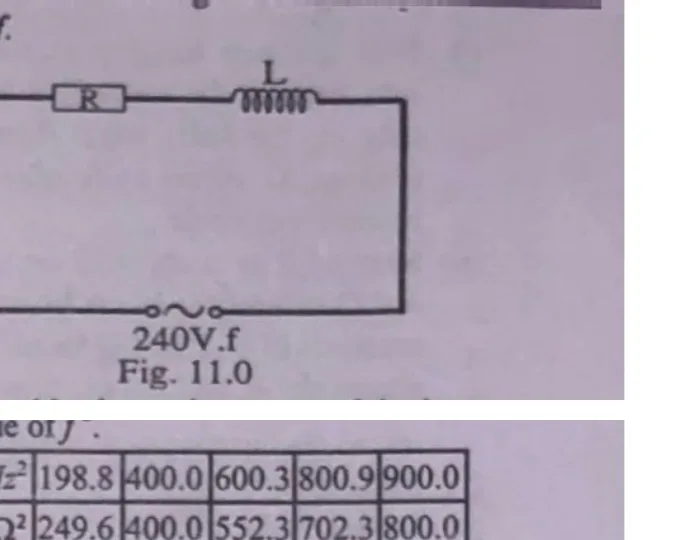
11(a)(i). Define the electric potential at a point in an electric field. 11(a)(ii). An uncharged body, A, was charged electrostatically by a test charge, B, using the method of induction and the method of contact. State two differences between the two methods. 11(b). State an important precaution during an electricity experiment involving opening the circuit when no readings are being taken, and give two reasons for the precaution. 11(c)(i). Fig. 11.0 is a circuit diagram in which a coil of inductance, L, and a resistor of resistance, R, are connected to a.c, f. The table shows the square of the impedance, Z², corresponding to each value of f². Write down the equation for Z in terms of f², R² and L². Plot a graph of Z² against F² and use it to deduce (I) L (II) R.
Model answer
(a)(i) Electric potential at a point in an electric field is the work done per unit positive charge in bringing the charge from infinity to that point. (ii) Differences between induction and contact methods of charging: In induction, there is no direct contact between A and B (B never touches A), while in contact, there is direct contact between A and B. In induction, the polarity of B (induced charge) is opposite to that of A, while in contact, the polarity of B is the same as A. In induction, the charge on B is repelled to the opposite end and remains on A, while in contact, charge is transferred to the same side of contact. Induction requires earthing, while contact requires no earthing. (b) Precaution: to open the circuit when no readings are being taken. Reasons: (i) to prevent/minimize overheating (in the load); (ii) to prevent the cell from running down or draining quickly; (iii) to allow the depolarizer to recover. (c)(i) From the phasor diagram, Z²=X_L²+R², and since X_L=2πfL, Z²=R²+4π²f²L². Comparing this with y=mx+c, a graph of Z² against f² gives a straight line with slope=4π²L² and intercept=R² on the Z² axis. From the graph's slope and intercept, L and R can each be deduced (e.g. L≈0.137H, R≈10Ω, using the specific table data shown: f²/Hz² 198.8, 400.0, 600.3, 800.9, 900.0 against Z²/Ω² 249.6, 400.0, 552.3, 702.3, 800.0).
Advertisement
Sign up free to unlock
- Score tracking
- Practice history
- Saved questions
- Progress dashboard
- Personalized sessions
- Weak-topic breakdown
…and/or go further with premium services and No Ads.