All 50 questions from the West African Examinations Council (WAEC) Physics 2025 Objective paper, with the correct answer and a full explanation for each. Free, no signup needed.
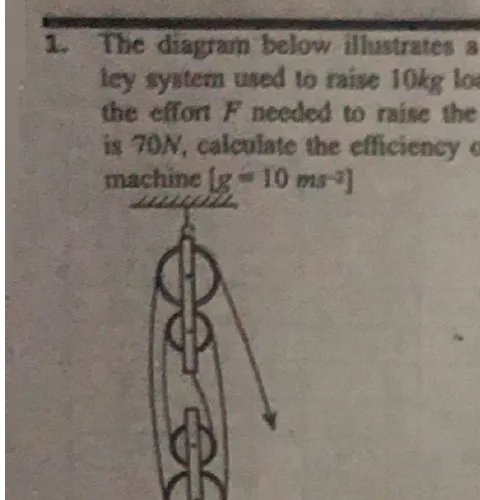
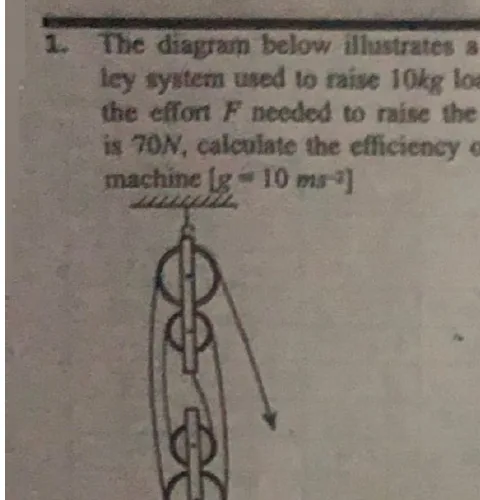
The diagram below illustrates a pulley system used to raise a 10kg load. If the effort F needed to raise the load is 70N, calculate the efficiency of the machine [g = 10 ms⁻²]
A. 20.0%
B. 35.7%Correct
C. 50.0%
D. 75.0%
Explanation
MA = Load/Effort = (10×10)/70 = 10/7. VR = number of pulleys/strings = 4. Efficiency = MA/VR × 100 = (10/7)/4 × 100 = 35.71%.
For a charged body moving in an electric and magnetic crossed field, the ratio of the electric field intensity, E to the magnetic flux density, B is known as
A. Lorentz ratio
B. Charge ratio
C. Velocity selectorCorrect
D. Electrochemical equivalence
Explanation
In crossed E and B fields, only a charged particle with velocity v = E/B passes through undeflected — this ratio defines the velocity selector.
A note, K from a keyboard has an amplitude of 0.5 cm and frequency 2000 Hz. Another note, M from a guitar has an amplitude of 1.5 cm and frequency 2000 Hz. Which of the following statements is true if the two notes are compared?
A. K is louder than M
B. M is louder than KCorrect
C. M has a higher pitch than K
D. K and M have same timbre
Explanation
Loudness depends on amplitude; M has a larger amplitude (1.5cm) than K (0.5cm), so M is louder. Same frequency means same pitch, but different instruments (sources) give different timbre.
A simple pendulum of length 0.8m is set oscillating on a planet. If the pendulum completes 20 oscillations in 60s, calculate the acceleration due to gravity on this planet. [π = 3.14]
A. 2.5 ms⁻²
B. 3.0 ms⁻²
C. 3.5 ms⁻²Correct
D. 3.8 ms⁻²
Explanation
T = t/n = 60/20 = 3s. T = 2π√(L/g) → g = 4π²L/T² = 0.8/0.2279 ≈ 3.51 ms⁻² ≈ 3.5 ms⁻².
A liquid of mass 2kg at 61°C is kept in a lagged vessel. If another 2kg of the same liquid at 21°C is added to the liquid in the vessel, calculate the final temperature of the mixture.
A. 50°C
B. 41°CCorrect
C. 30°C
D. 15°C
Explanation
Heat lost by hot liquid = heat gained by cold liquid: mc(61-T) = mc(T-21) → 60-T = T-21 → 2T = 82 → T = 41°C.
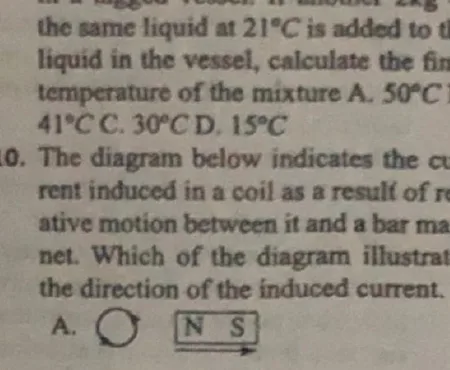
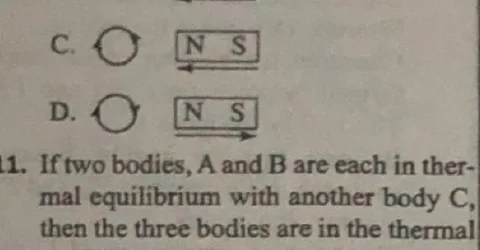
The diagram below indicates the current induced in a coil as a result of relative motion between it and a bar magnet. Which of the diagrams illustrates the direction of the induced current?
A. Option ACorrect
B. Option B
C. Option C
D. Option D
Explanation
By Lenz's law (the induced current opposes the change in flux producing it), the direction shown in option A is consistent with the relative motion of the magnet and coil.
If two bodies, A and B are each in thermal equilibrium with another body C, then the three bodies are in thermal equilibrium with each other. This is a statement of
A. Zeroth law of thermodynamicsCorrect
B. First law of thermodynamics
C. Second law of thermodynamics
D. Third law of thermodynamics
Explanation
This is the definition of the zeroth law of thermodynamics. The first law deals with energy conservation (ΔQ = ΔU + W); the second law deals with entropy and direction of heat flow.
A constant voltage source in the circuit below supplies a sinusoidal alternating e.m.f. The voltages marked against the components are the peak values. Determine the peak value of the applied e.m.f.
A vibrator is used to generate ripples in a ripple tank. If the distance between two successive troughs is 3.5cm and the wave travels a distance of 31.5cm in 1.5s, calculate the frequency of the vibrator.
Use the circuit diagram below to answer this question. The current passing through the 6Ω resistor is 1.5A. Calculate the current in the 3Ω resistor.
A. 1.20A
B. 0.90A
C. 0.75A
D. 0.60ACorrect
Explanation
The 2Ω and 3Ω resistors are in parallel and share the total current of 1.5A. By the current-divider rule: I(3Ω) = R(2Ω)/(R(2Ω)+R(3Ω)) × I = 2/5 × 1.5 = 0.6A.
Which of the statements is correct about the nucleus of an atom? I. It is centrally located in the atom II. It contains the nucleons and electrons III. It is positively charged due to the protons IV. It decays when there is instability inside
A. I, II and IV only
B. I, III and IV onlyCorrect
C. I, II and III only
D. I and II only
Explanation
The nucleus is centrally located in the atom, is positively charged due to the protons, and an unstable nucleus undergoes radioactive disintegration to become more stable. (Statement II is false — electrons orbit outside the nucleus.)
A radioactive element of mass 16g was isolated and stored. It was discovered that after 40 days only 1g of the element remained undecayed. Calculate the half-life of the element.
A bucket of water of mass 10kg is swung in a vertical circle of radius 1.2m. While at the lowest position of the swing, its speed is 5 ms⁻¹. Determine the tension in the string. [g = 10 ms⁻²]
A. 41.7N
B. 141.7N
C. 208.3N
D. 308.3NCorrect
Explanation
At the lowest point, T = mg + mv²/r = (10×10) + (10×5²)/1.2 = 100 + 250/1.2 = 100 + 208.3 = 308.3N.
Which of the following statements about a stationary wave is NOT true?
A. Particles between adjacent nodes vibrate out of phase with each otherCorrect
B. Successive nodes or antinodes occur at intervals of half a wavelength
C. Particles between adjacent nodes vibrate in phase with each other
D. Particles between adjacent nodes have different amplitudes
Explanation
In a stationary wave, particles between two adjacent nodes vibrate IN phase (move together in the same direction at the same time), so statement A is the false (not true) statement.
A hospital received 16g of a radioactive substance at 1300 hour GMT. At 1700 hour GMT, the fraction of the substance left undecayed was 1/16. Determine the half-life of the substance.
An electron moving with a speed of 5.0×10⁵ ms⁻¹ enters a uniform magnetic field at 90°. Calculate the magnitude of the magnetic force on the electron if the magnetic field intensity is 0.25T. [e = 1.6×10⁻¹⁹C]
A. 1.0×10⁻¹⁴N
B. 2.0×10⁻¹⁴NCorrect
C. 3.0×10⁻¹⁴N
D. 4.0×10⁻¹⁴N
Explanation
F = qvB sinθ; sin90° = 1. F = 1.6×10⁻¹⁹×5×10⁵×0.25 = 2.0×10⁻¹⁴N.
A boy pushes a box of mass 80kg along a horizontal floor with a force of 200N. If the box is pushed with a uniform velocity, what is the coefficient of friction between the box and the floor? [g = 10 ms⁻²]
A. 0.25Correct
B. 0.40
C. 0.50
D. 0.65
Explanation
Uniform velocity means net force = 0, so the applied force equals the frictional force: F = Fr = μmg. μ = F/(mg) = 200/(80×10) = 200/800 = 0.25.