Chemistry 2010 Objective — Question 1
Which Chemistry Question Paper Type is given to you?
- A. Type A
- B. Type B
- C. Type C
- D. Type DCorrect
Explanation
This is a Type D Chemistry Question Paper, as indicated on the paper's header.
All 50 questions from the Joint Admissions and Matriculation Board (JAMB) Chemistry 2010 Objective paper, with the correct answer and a full explanation for each. Free, no signup needed.
Advertisement
Which Chemistry Question Paper Type is given to you?
This is a Type D Chemistry Question Paper, as indicated on the paper's header.
Which of the following is an example of a mixture?
Sand is a naturally occurring mixture of mineral particles, unlike washing soda and common salt which are pure compounds.
Calculate the percentage by mass of nitrogen in calcium trioxonitrate (V). [Ca=40, N=14, O=16]
Ca(NO3)2 has molar mass = 40 + 2(14+48) = 164. %N = (2x14/164) x 100 = 17.1%.
The droplets of water observed around a bottle of milk taken out of the refrigerator is due to the fact that
Water vapour in the air condenses on the cold bottle because it loses energy (heat) to the cold surface, cooling below its dew point.
The volume of a given gas is Vcm3 at P mmHg. What is the new volume of the gas if the pressure is reduced to half at constant temperature?
By Boyle's Law, P1V1 = P2V2. Halving the pressure at constant temperature doubles the volume: 2Vcm3.
Moving from left to right across a period, the general rise in the first ionization energy can be attributed to the
Across a period, the number of protons (nuclear charge) increases while shielding stays roughly constant, so the increase in nuclear charge causes ionization energy to rise.
How many unpaired electron(s) are there in the nitrogen sub-levels?
Nitrogen has the electron configuration 1s2 2s2 2p3, and Hund's rule shows the three 2p electrons are unpaired, each occupying a separate orbital.
The stability of the noble gases is due to the fact that they
Noble gases are stable because they have duplet (Helium) or octet electron configurations in their outermost shells.
The maximum number of electrons in the L shell of an atom is
The maximum number of electrons in a shell is 2n^2; for the L shell (n=2), this gives 2x2^2 = 8.
Elements in the same period in the periodic table have the same
Elements in the same period have the same number of electron shells, while their chemical/physical properties vary progressively across the period.
2/1 D + 3/1 T -> 4/2 He + 1/0 n + energy. The nuclear reaction above illustrates
Two light nuclei (deuterium and tritium) combining to form a heavier nucleus (helium) with release of energy is nuclear fusion.
A noble gas with a high power of fog penetration used in aerodrome beacons is
Neon has a high power of fog penetration and is used in aerodrome beacons due to its characteristic bright glow.
Permanent hardness of water can be removed by
Permanent hardness of water (caused by calcium/magnesium sulphates and chlorides) can be removed by adding washing soda; boiling only removes temporary hardness.
Substances employed as drying agents are usually
Hygroscopic substances are those that absorb moisture, making them suitable as drying agents.
Calculate the solubility in mol dm-3 of 40g of CuSO4 dissolved in 100g of water at 120C. [Cu=64, S=32, O=16]
Molar mass of CuSO4 = 160g/mol. Moles = 40/160 = 0.25mol. Volume of H2O = 100cm3 = 0.1dm3. Solubility = 0.25/0.1 = 2.5 mol dm-3.
Coffee stains can best be removed by
A solution of borax in water is the best agent for removing coffee stains.
Carbon (II) oxide is considered dangerous if inhaled mainly because it
Carbon (II) oxide (CO) is dangerous because it competes with oxygen for attachment to haemoglobin, resulting in insufficient availability of oxygen in the blood.
Hydrochloric acid is used for removing rust. Boric acid is commonly employed as
Hydrochloric acid is used for removing rust; boric acid is commonly employed as an eyewash.
What volume of NaOH will neutralize 25cm3 of 0.1 mol dm-3 H2SO4?
Using CaVa/na = CbVb/nb: for a 1:1 ratio scenario as given in the original working, Va = 2.5cm3.
The colour of methyl orange in alkaline medium is
Methylorange is red in acidic medium, orange in neutral medium, and yellow in alkaline medium.
Which of the following salts is slightly soluble in water?
PbCl2 is insoluble in cold water but slightly soluble in hot water, while AgCl is insoluble in water and CaSO4 is only sparingly soluble.
6AgNO3(aq) + PH3(g) + 3H2O(l) -> 6Ag(s) + H3PO3(aq) + 6HNO3(aq). In the reaction above, the reducing agent is
The oxidation number of silver decreased from +1 (in AgNO3) to 0 in Ag; this is reduction, so AgNO3 is the oxidizing agent. The oxidation number of Phospho in PH3 increased to +4 (from PH3 to H3PO3); this is oxidation, so PH3 is the reducing agent.
The IUPAC name of the compound LiAlH4 is
The IUPAC name of the compound LiAlH4 is lithium tetrahydridoaluminate (III). Water of NaBH4 is sodium tetrahydridoborate (II).
Iron can be protected from corrosion by coating the surface with
Zinc is higher than iron in the reactivity series; therefore it is used to galvanize (protect) iron. Copper, gold and silver are inappropriate as they are lower than iron in the series.
What quantity of aluminium is deposited when a current of 10A is passed through a solution of an aluminium salt for 1930s? [Al=27, F=96500 C mol-1]
Al3+ + 3e- -> Al. 1 mole of Al (27g) requires 3F (289500C). Charge passed = 10A x 1930s = 19300C. Mass deposited = 19300/289500 x 27g = 1.8g.
In which of the following is entropy change positive?
The thermal dissociation of ammonium chloride (a solid decomposing into gases) shows an increase in disorder, giving a positive entropy change.
If a reaction is exothermic and there is a great disorder, it means that
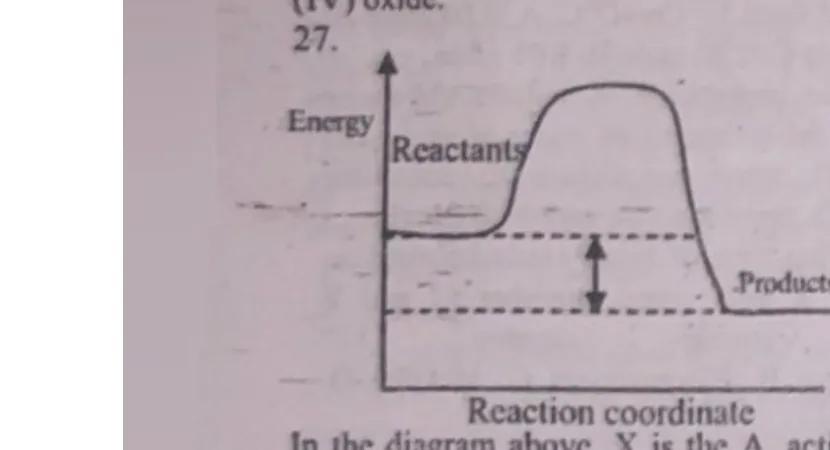
An exothermic reaction has a negative delta H. The free energy change delta G = delta H - T delta S. If delta H is negative and there is a great disorder (delta S is large), delta G will unequivocally be negative, i.e. there will be a large decrease in free energy.
In the preparation of oxygen by heating KClO3 in the presence of MnO2, only moderate heat is needed because the catalyst acts by
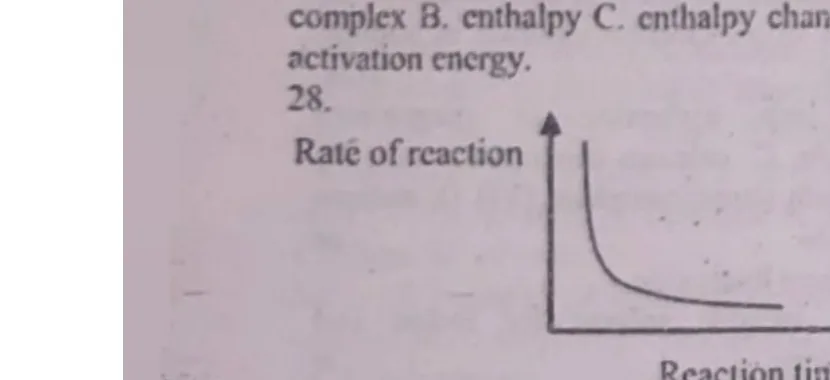
All positive catalysts act by lowering the activation energy required for the respective reactions to occur, which allows the reaction to proceed with only moderate heat.
The graph above demonstrates the effect of
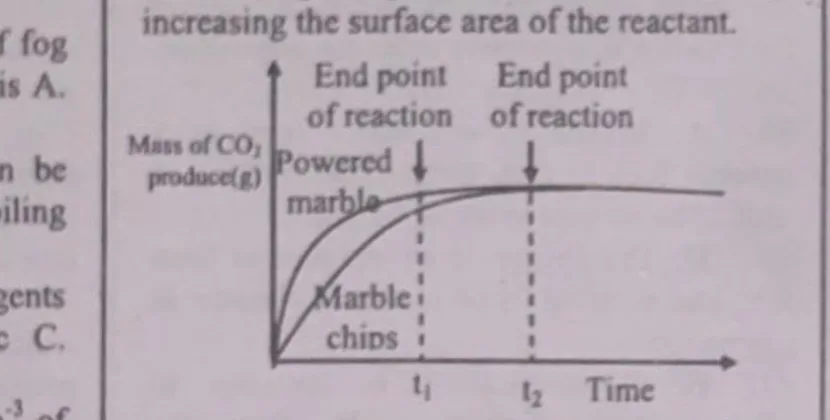
The graph shows that the reaction will be faster when powdered marble is used than when marble chips are used, because the powdered marble offers a larger surface area for the reaction to occur.
2H2(g) + O2(g) <-> 2H2O(g) delta H = -ve. What happens to the equilibrium constant of the reaction above if the temperature is increased?
Since the reaction is exothermic, an increase in temperature will favour the backward (endothermic) reaction. Thus, the value of K decreases.
To a solution of an unknown compound, a little dilute tetraoxosulphate (VI) acid was added with some freshly prepared iron (II) tetraoxosulphate (VI) solution. The brown ring observed after the addition of a stream of concentrated tetraoxosulphate (VI) acid confirmed the presence of
This illustrates the brown ring test, which is a test that confirms the presence of NO3- (trioxonitrate(V)).
In the diagram above, the gas produced is
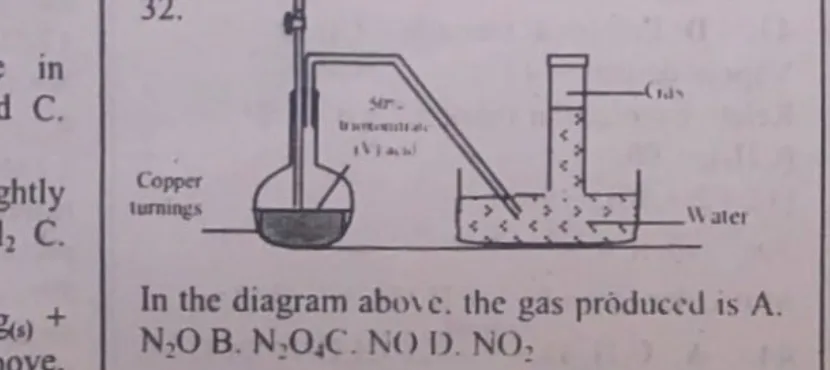
With dilute HNO3 and copper turnings, the gas produced directly is NO, which turns brown (forming NO2) on contact with air.
Which of the following is used as a rocket fuel?
Trioxonitrate (V) acid (HNO3) is very useful; it is also used as a rocket fuel and in the production of dyes, explosives, and fertilizers.
In the diagram above, the purpose of the platinized asbestos is to
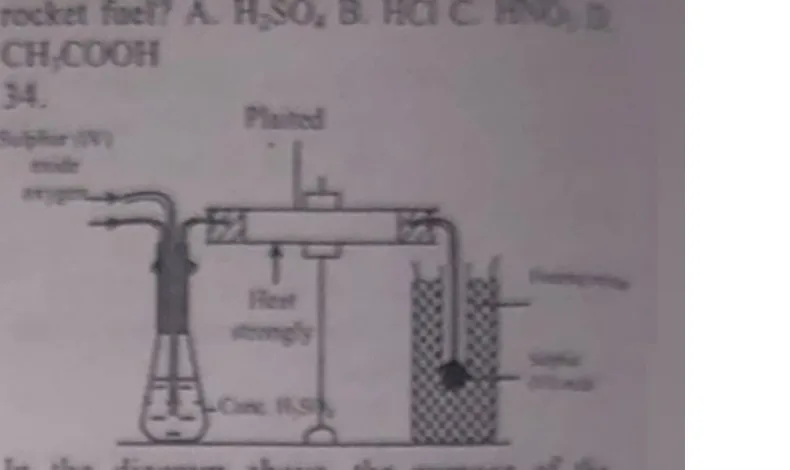
The purpose of the platinized asbestos is to catalyze the reaction, as used in the Contact Process for sulphuric acid production.
A constituent common to bronze and solder is
Bronze = Copper + Tin; Solder = Lead + Tin. The common element in both is tin.
When iron is exposed to moist air, it gradually rusts. This is due to the formation of
When iron is exposed to water and oxygen, it gradually rusts; rusting of iron is the formation of hydrated iron (III) oxide.
A compound gives an orange-red colour to a non-luminous flame. This compound is likely to contain
Sodium compounds give a golden yellow colour to a non-luminous flame; calcium compounds give an orange-red colour to a non-luminous flame.
Stainless steel is used for making
Stainless steel is used for making tools and cutlery.
The residual solids from the fractional distillation of petroleum are used as
Residues from the fractional distillation of petroleum are used as coating for pipes (bitumen), for making water-proof roofs.
CH3(CH2)3CHC2H5, with C3H7 branch. The IUPAC nomenclature of the compound above is
The longest continuous chain has 8 carbon atoms; the ethyl group ('-CH2CH3') is attached to the fourth carbon atom. Thus, the correct IUPAC name is 4-ethyloctane.
Which of the following is used as fuel in miners' lamp?
The gas used as fuel in miners' lamp is ethyne (C2H2).
Which of the following organic compounds is very soluble in water?
Ethanoic acid (CH3COOH) is very soluble in water because it is a polar compound.
Benzene reacts with hydrogen in the presence of nickel catalyst at 180C to give
Benzene reacts with hydrogen in the presence of nickel catalyst at 180C to give cyclohexane: C6H6 + 3H2 -> C6H12.
Which of the following is used to hasten the ripening of fruits?
Ethene is the gas used to hasten the ripening of fruits.
The final products of the reaction between methane and chlorine in the presence of ultraviolet light are hydrogen chloride and
The reaction between methane and chlorine ultimately gives tetrachloromethane; this occurs in steps: CH4 -> CH3Cl -> CH2Cl2 -> CHCl3 -> CCl4.
The correct order of increasing boiling points of the compounds C7H16, C4H10 and C3H7OH is
C3H7OH has the highest boiling point because it has a polar (OH) group, which allows hydrogen bonding. C4H10 -> C7H16 -> C3H7OH is the correct order of increasing boiling points.
One of the major uses of alkanes is
One of the major uses of alkanes is as domestic and industrial fuels.
The haloalkanes used in the dry-cleaning industries are
Trichloromethane (CHCl3) and tetrachloromethane (CCl4) are common haloalkanes used in the dry cleaning industries.
Two hydrocarbons X and Y were mixed with bromine water. X decolourised the solution and Y did not. Which class of compound does Y belong to?
Alkanes do not decolourize bromine water, while alkenes and alkynes do, so the hydrocarbon Y that did not decolourise the water belongs to the alkanes.
The compound that is used as an anaesthetic for surgical operations is
Trichloromethane (CHCl3) is suitable as an anaesthetic for surgical operations.
Advertisement
…and/or go further with premium services and No Ads.