Free account: track your progress — Sign up free

JAMB Chemistry 2011 Objective Past Questions

All 49 questions from the Joint Admissions and Matriculation Board (JAMB) Chemistry 2011 Objective paper, with the correct answer and a full explanation for each. Free, no signup needed.

Advertisement

Chemistry 2011 Objective — Question 1

What is the concentration of a solution containing 2g of NaOH in 100cm³ of solution? [Na=23, O=16, H=1]

  • A. A. 0.30 mol dm⁻³
  • B. B. 0.40 mol dm⁻³
  • C. C. 0.50 mol dm⁻³Correct
  • D. D. 0.05 mol dm⁻³

Explanation

Mass = 2g. Volume = 100cm³ = 0.1dm³. Molar mass of NaOH = 40gmol⁻¹. Mole = 2/40 = 0.05mol. Concentration = 0.05mol/0.1dm³ = 0.50 mol dm⁻³.

Chemistry 2011 Objective — Question 2

Which of the following properties is NOT peculiar to matter?

  • A. A. Random motion of particles increases from gas to solidCorrect
  • B. B. Kinetic energy of particles increases from solid to gas
  • C. C. Random motion of particles increases from liquid to gas
  • D. D. Orderliness of particles increases from gas to liquid

Explanation

The highest entropy is found in gases while solids have the lowest entropy. Random motion of particles increases from solids to gases, not the other way round, so option A is the false statement.

Chemistry 2011 Objective — Question 3

The principle of column chromatography is based on the ability of column constituents to

  • A. A. react with each other in the column
  • B. B. move at different speeds in the columnCorrect
  • C. C. dissolve in each other in the column
  • D. D. react with the solvent in the column

Explanation

The principle of column chromatography is based on the ability of constituents to move at different speeds in the column.

Chemistry 2011 Objective — Question 4

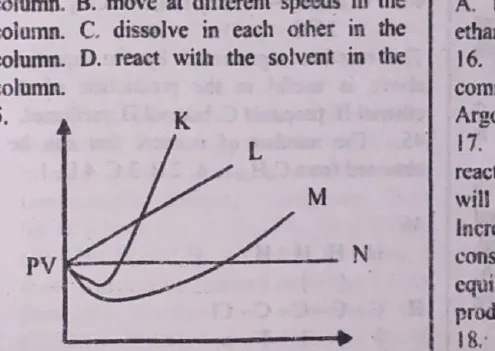
[Diagram: PV vs Temperature graph with lines K, L, M, N] From the diagram above, an ideal gas can be represented by

Diagram for question 4
  • A. A. L
  • B. B. M
  • C. C. NCorrect
  • D. D. K

Explanation

For an ideal gas, the product PV is constant at all temperatures, represented by the horizontal line N on the graph.

Chemistry 2011 Objective — Question 5

Which of the following statements is correct about the periodic table?

  • A. A. Elements in the same period have the same number of valence electrons
  • B. B. The non-metallic properties of the elements tend to decrease across each period
  • C. C. The valence electrons of the elements increase progressively across the periodCorrect
  • D. D. Elements in the same group have the same number of electron shells

Explanation

Elements in the same period have the same number of electron shells, and the number of valence electrons increases progressively across the period.

Chemistry 2011 Objective — Question 6

The relative atomic mass of a naturally occurring lithium consisting of 90% Li and 10% Li is

  • A. A. 6.8
  • B. B. 6.9Correct
  • C. C. 7.1
  • D. D. 6.2

Explanation

R.A.M. = (Mass1x%1 + Mass2x%2)/100 = ((7x90)+(6x10))/100 = 6.9.

Chemistry 2011 Objective — Question 7

An isotope has atomic number of 15 and a mass number of 31. The number of protons it contains is

  • A. A. 31
  • B. B. 16
  • C. C. 15Correct
  • D. D. 46

Explanation

Atomic number = proton number = 15.

Chemistry 2011 Objective — Question 8

The molecular lattice of iodine is held together by

  • A. A. van der Waal's forcesCorrect
  • B. B. dative bond
  • C. C. metallic bond
  • D. D. hydrogen bond

Explanation

The molecular lattice of iodine is held together by Van der Waal's forces, the weakest of the intermolecular forces.

Chemistry 2011 Objective — Question 9

The arrangement of particles in crystal lattices can be studied using

  • A. A. β-rays
  • B. B. x-raysCorrect
  • C. C. γ-rays
  • D. D. α-rays

Explanation

The arrangement of particles in crystal lattices can be studied using X-rays. This is known as X-ray crystallography.

Chemistry 2011 Objective — Question 10

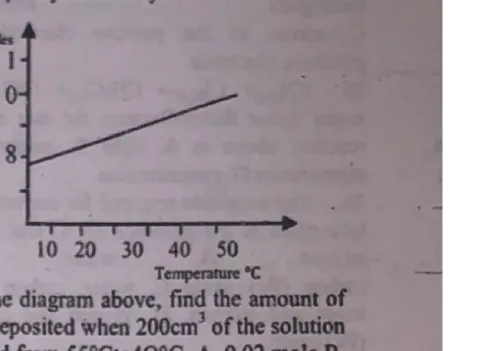
[Diagram: number of moles of solute vs temperature graph] From the diagram above, find the amount of solute deposited when 200cm³ of the solution is cooled from 55°C to 40°C.

Diagram for question 10
  • A. A. 0.02 mole
  • B. B. 0.10 mole
  • C. C. 0.20 moleCorrect
  • D. D. 0.01 mole

Explanation

From the graph, solubility at 55°C = 6 moldm⁻³ and at 40°C = 5 moldm⁻³. Mole present in 200cm³ at 55°C = (200/1000)x6 = 1.2 mole. Mole present at 40°C = (200/1000)x5 = 1.0 mole. Mole crystallized out = 1.2 - 1.0 = 0.2 mole.

Chemistry 2011 Objective — Question 11

The importance of sodium aluminate (III) in the treatment of water is to

  • A. A. kill germs
  • B. B. cause coagulationCorrect
  • C. C. neutralize acidity
  • D. D. prevent goitre and tooth decay

Explanation

The use of sodium aluminate (III) in water treatment is to cause coagulation of fine particles in water.

Chemistry 2011 Objective — Question 12

What type of bond exists between an element X with atomic number 12 and Y with atomic number 17?

  • A. A. Dative
  • B. B. ElectrovalentCorrect
  • C. C. Metallic
  • D. D. Covalent

Explanation

X=12X (2,8,2); Y=17Y (2,8,7). To attain octet, X loses two electrons while Y gains an electron, so two atoms of Y combine with one atom of X. The bonding type involving transfer of electrons is electrovalent bond.

Chemistry 2011 Objective — Question 13

Hardness of water is mainly due to presence of

  • A. A. calcium chloride or sodium chloride
  • B. B. calcium hydroxide or magnesium hydroxide
  • C. C. calcium trioxocarbonate (IV)Correct
  • D. D. sodium or magnesium hydroxide

Explanation

Ca(HCO3)2 and Mg(HCO3)2 are responsible for temporary hardness of water, while CaSO4 and MgSO4 are responsible for permanent hardness; calcium trioxocarbonate (IV), CaCO3, is the underlying compound mainly responsible for hardness.

Chemistry 2011 Objective — Question 14

A suitable solvent for iodine and naphthalene is

  • A. A. benzene
  • B. B. carbon (IV) sulphideCorrect
  • C. C. ethanol
  • D. D. water

Explanation

Carbon disulphide (CS2) is a suitable solvent for iodine and naphthalene.

Chemistry 2011 Objective — Question 15

Which of the following noble gases is commonly found in the atmosphere?

  • A. A. ArgonCorrect
  • B. B. Xenon
  • C. C. Neon
  • D. D. Helium

Explanation

Argon is the most abundant noble gas in the atmosphere.

Chemistry 2011 Objective — Question 16

N2O4(g) ⇌ 2NO2(g); ΔH=+ve. In the reaction above, an increase in temperature will

  • A. A. shift the equilibrium to the left
  • B. B. increase the value of the equilibrium constantCorrect
  • C. C. decrease the value of the equilibrium constant
  • D. D. increase the reactant production

Explanation

Since the forward reaction is endothermic (ΔH=+ve), an increase in temperature will shift the equilibrium to the right and increase the value of the equilibrium constant.

Chemistry 2011 Objective — Question 17

CH3COOH(aq)+OH(aq) ⇌ CH3COO(aq)+H2O(l). In the reaction above, CH3COO(aq) is the

  • A. A. conjugate acid
  • B. B. conjugate baseCorrect
  • C. C. acid
  • D. D. base

Explanation

A Bronsted-Lowry acid donates a proton, while the base accepts a proton. A conjugate acid-base pair differ by a proton. CH3COOH and CH3COO constitute a conjugate acid-base pair, with CH3COO as the conjugate base.

Chemistry 2011 Objective — Question 18

How many cations will be produced from a solution of potassium tetraoxosulphate (VI)?

  • A. A. 2
  • B. B. 3
  • C. C. 4
  • D. D. 1Correct

Explanation

Potassium tetraoxosulphate (VI), K2SO4, having the formula with '2' does not mean it produces two different cations - it produces just one type of cation, the potassium ion (K+). It is only a double salt that can have two different cations.

Chemistry 2011 Objective — Question 20

An effect of thermal pollution on water bodies is that the

  • A. A. level of oxygen reducesCorrect
  • B. B. volume of water reduces
  • C. C. chemical waste increases
  • D. D. level of oxides of nitrogen increases

Explanation

The solubility of gases decreases as temperature increases. Thus, thermal pollution (raising water temperature) reduces the level of dissolved oxygen in water bodies.

Chemistry 2011 Objective — Question 21

Which of the following is a deliquescent compound?

  • A. A. Na2CO3.10H2O
  • B. B. Na2CO3
  • C. C. CaCl2Correct
  • D. D. CuO

Explanation

CaCl2 is deliquescent. Na2CO3.10H2O is efflorescent, while CuO is hygroscopic.

Chemistry 2011 Objective — Question 22

A chemical reaction in which the hydration energy is greater than the lattice energy is referred to as

  • A. A. a reversible reaction
  • B. B. a spontaneous reaction
  • C. C. an endothermic reactionCorrect
  • D. D. an exothermic reaction

Explanation

For an exothermic reaction, the lattice energy is greater than the hydration energy, while the reverse (hydration energy greater than lattice energy) is the case for an endothermic reaction.

Chemistry 2011 Objective — Question 23

The function of zinc electrode in a galvanic cell is that it

  • A. A. uses up electrons
  • B. B. undergoes reduction
  • C. C. serves as the positive electrode
  • D. D. produces electronsCorrect

Explanation

The function of the zinc electrode in a galvanic cell is that it produces electrons (it is oxidized, releasing electrons).

Chemistry 2011 Objective — Question 24

CH4(g)+Cl2(g)→CH3Cl(g)+HCl(g). The major factor that influences the rate of the reaction above is

  • A. A. lightCorrect
  • B. B. catalyst
  • C. C. temperature
  • D. D. concentration

Explanation

This reaction is catalyzed by light, i.e. it is a photochemical reaction, so light is the major factor influencing its rate.

Chemistry 2011 Objective — Question 25

The condition required for corrosion to take place is the presence of

  • A. A. water and oxygenCorrect
  • B. B. water
  • C. C. water, carbon (IV) oxide and oxygen
  • D. D. oxygen and carbon (IV) oxide

Explanation

Moisture (water) and oxygen are the two requirements for corrosion to take place.

Chemistry 2011 Objective — Question 26

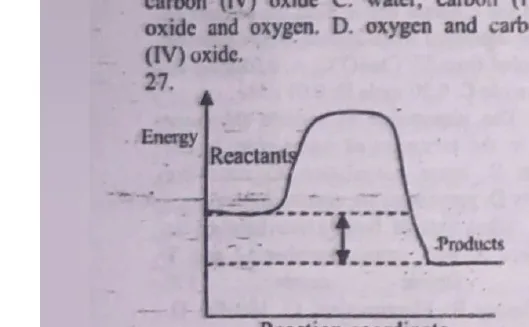
[Diagram: energy profile diagram with reactants → products, X labeled] In the diagram above, X is the

Diagram for question 26
  • A. A. activated complex
  • B. B. enthalpy
  • C. C. enthalpy changeCorrect
  • D. D. activation energy

Explanation

X denotes the difference between the energy content of the products and that of the reactants, i.e. the enthalpy change.

Chemistry 2011 Objective — Question 27

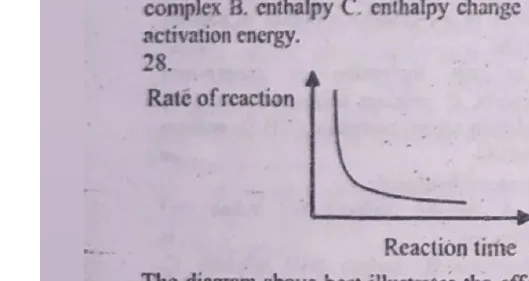
[Diagram: rate of reaction decreasing over reaction time] The diagram above best illustrates the effect of decrease in

Diagram for question 27
  • A. A. pressure
  • B. B. surface area
  • C. C. temperature
  • D. D. concentrationCorrect

Explanation

The graph represents the effect of a decrease in the concentration of reactants on reaction rate. As the concentration of reactant decreases, the reaction rate decreases as well.

Chemistry 2011 Objective — Question 28

MnO4(aq)+Y+5Fe2+(aq)→Mn2+(aq)+5Fe3+(aq)+4H2O(l). In the equation above, Y is

  • A. A. 8H+(aq)Correct
  • B. B. 5H+(aq)
  • C. C. 4H+(aq)
  • D. D. 10H(aq)

Explanation

The balanced equation for the redox reaction between MnO4 and Fe2+ is: MnO4+8H+5Fe2+ → Mn2++5Fe3++4H2O. Thus, Y = 8H+(aq).

Chemistry 2011 Objective — Question 29

Given that M is the mass of a substance deposited during electrolysis and Q is the quantity of electricity consumed, then Faraday's first law can be written as [E=Electrochemical equivalent]

  • A. A. M=E/Q
  • B. B. M=E/Q
  • C. C. M=EQCorrect
  • D. D. M=Q/E

Explanation

Faraday's first law states that the mass deposited is directly proportional to the quantity of electricity: M=EQ, where E is the electrochemical equivalent.

Chemistry 2011 Objective — Question 30

The impurities formed during the laboratory preparation of chlorine gas are removed by

  • A. A. HCl
  • B. B. H2OCorrect
  • C. C. NH3
  • D. D. H2SO4

Explanation

In the laboratory preparation of chlorine gas, hydrogen chloride gas is produced as an impurity. It is removed by passing the gas into water, since HCl is highly soluble in water.

Chemistry 2011 Objective — Question 31

The effect of the presence of impurities such as carbon and sulphur on iron is that they

  • A. A. lower its melting pointCorrect
  • B. B. give it high tensile strength
  • C. C. make it malleable and ductile
  • D. D. increase its melting point

Explanation

Presence of impurities in iron lowers its melting point (and also increases the boiling point of a liquid it may be dissolved in, per the general effect of impurities).

Chemistry 2011 Objective — Question 32

A few drops of concentrated HNO3 is added to an unknown solution and boiled for a while. If this produces a brown solution, the cation present is likely to be

  • A. A. Fe2+Correct
  • B. B. Pb2+
  • C. C. Cu2+
  • D. D. Fe3+

Explanation

The unknown solution originally contains Fe2+, whose heating with HNO3 will oxidize it to Fe3+, which manifests as brown coloration.

Chemistry 2011 Objective — Question 33

The bleaching action of chlorine gas is effective due to the presence of

  • A. A. oxygen
  • B. B. hydrogen chloride
  • C. C. waterCorrect
  • D. D. air

Explanation

The bleaching action of chlorine gas is effective due to the presence of water: Cl2+H2O→HCl+HOCl, then HOCl + coloured material → HCl+[O]+bleached material.

Chemistry 2011 Objective — Question 34

In the laboratory preparation of oxygen, dried oxygen is usually collected over

  • A. A. tetraoxosulphate (IV) acid
  • B. B. hydrochloric acid
  • C. C. mercuryCorrect
  • D. D. calcium chloride

Explanation

Dried oxygen is usually collected over mercury in the laboratory.

Chemistry 2011 Objective — Question 35

The property of concentrated H2SO4 that makes it suitable for preparing HNO3 is its

  • A. A. dehydrating property
  • B. B. boiling pointCorrect
  • C. C. density
  • D. D. oxidizing property

Explanation

The property of H2SO4 that makes it suitable for preparing HNO3 is its boiling point (high boiling point, low volatility) - it is common practice to prepare a more volatile acid from a less volatile one.

Chemistry 2011 Objective — Question 36

Bronze is preferred to copper in the making of medals because it has

  • A. A. low tensile strength
  • B. B. is strongerCorrect
  • C. C. can withstand low temperature
  • D. D. is lighter

Explanation

Bronze is stronger and more corrosion resistant than copper, making it preferred for medals.

Chemistry 2011 Objective — Question 37

The constituent of baking powder that makes the dough to rise is

  • A. A. NaCl
  • B. B. NaHCO3Correct
  • C. C. NaOH
  • D. D. Na2CO3

Explanation

The constituent that makes dough rise is NaHCO3. The rising is due to CO2 gas filling the spaces within the flour, released upon decomposition: 2NaHCO3 → Na2CO3+H2O+CO2.

Chemistry 2011 Objective — Question 38

Which of the following compounds is used as a gaseous fuel?

  • A. A. CH3-CH=CH2
  • B. B. CH3-C≡CH
  • C. C. CH3-CH2-CH3Correct
  • D. D. CH3-CH2-CH2-COCH3

Explanation

Propane (CH3-CH2-CH3) is commonly used as a gaseous fuel; the cooking gas ('utilgas') used at home is propane or butane.

Chemistry 2011 Objective — Question 39

The ability of carbon to form long chains is referred to as

  • A. A. carbonation
  • B. B. alkylation
  • C. C. acylation
  • D. D. catenationCorrect

Explanation

The ability of an element to form long chains using its own atoms is known as catenation.

Chemistry 2011 Objective — Question 40

Which of the following compounds will undergo polymerization reaction?

  • A. A. C2H5OH
  • B. B. C2H4Correct
  • C. C. C2H5COOH
  • D. D. C2H6

Explanation

Polymerization is common to alkenes and alkynes. C2H4 (ethene) readily undergoes polymerization - important in the plastic industry.

Chemistry 2011 Objective — Question 41

[Structure: CH3-C(OH)(COOH)-H] The compound above exhibits

  • A. A. positional isomerism
  • B. B. geometric isomerism
  • C. C. optical isomerismCorrect
  • D. D. structural isomerism

Explanation

This compound will exhibit optical isomerism, since it possesses at least one carbon atom surrounded by four different atoms/groups.

Chemistry 2011 Objective — Question 42

An organic compound has an empirical formula CH2O and vapour density of 45. What is its molecular formula? [C=12,H=1,O=16]

  • A. A. C3H7OH
  • B. B. C2H5OH
  • C. C. C3H6O3Correct
  • D. D. C3H6O6

Explanation

Relative molecular mass = 2 x vapour density = 90. (CH2O)n = 90; (12+2+16)n = 90; 30n = 90; n = 3. Molecular formula = (CH2O)3 = C3H6O3.

Chemistry 2011 Objective — Question 43

C6H12O6 -zymase(25°C)→ 2C2H5OH+2CO2. The reaction represented by the equation above is useful in the production of

  • A. A. ethanolCorrect
  • B. B. propanol
  • C. C. butanol
  • D. D. methanol

Explanation

This reaction demonstrates fermentation, which is useful in the production of ethanol.

Chemistry 2011 Objective — Question 44

The number of isomers that can be obtained from C4H10 is

  • A. A. 2Correct
  • B. B. 3
  • C. C. 4
  • D. D. 1

Explanation

Butane, C4H10, has only two isomers: n-butane and 2-methylpropane (isobutane).

Chemistry 2011 Objective — Question 45

[Structure: H-C-C-C-C-Cl with H's and an OH shown] The functional groups present in the compound above are

  • A. A. hydroxyl and halo-group
  • B. B. alkene and halo-group
  • C. C. hydroxyl and chloro-groupCorrect
  • D. D. alkene and chloro-group

Explanation

The functional groups present are hydroxyl and chloro group (the term 'halo group' is ambiguous, so the more specific 'chloro-group' is correct).

Chemistry 2011 Objective — Question 46

Which of the following is a primary amine?

  • A. A. (CH3)2NH
  • B. B. (CH3)3N
  • C. C. CH3CH2NH2 (or similar secondary structure)
  • D. D. CH3-NH2Correct

Explanation

A primary amine has only one alkyl group attached to the nitrogen atom, e.g. CH3NH2. A secondary amine has two alkyl groups, e.g. (CH3)2NH, while a tertiary amine has three, e.g. (CH3)3N.

Chemistry 2011 Objective — Question 47

Two organic compounds K and L were treated with a few drops of Fehling's solution respectively. K formed a brick-red precipitate while L remains unaffected. The compound K is an

  • A. A. alkanone
  • B. B. alkanol
  • C. C. alkane
  • D. D. alkanalCorrect

Explanation

Fehling's solution distinguishes alkanals (aldehydes) from alkanones (ketones). Alkanals produce a red precipitate with Fehling's solution (they have an oxidizable hydrogen atom, R-CHO) while alkanones do not (R-CO-R).

Chemistry 2011 Objective — Question 48

Which of the following statements is true about 2-methylpropane and butane?

  • A. A. They have the same chemical propertiesCorrect
  • B. B. They are members of the same homologous series
  • C. C. They have the same boiling points
  • D. D. They have different number of carbon atoms

Explanation

2-methylpropane and butane are isomers - they have the same molecular formula and chemical properties, but different physical properties such as boiling point.

Chemistry 2011 Objective — Question 49

CH3COOH + C2H5OH -Conc.H2SO4→ CH3COOC2H5 + H2O. The reaction above is best described as

  • A. A. neutralization
  • B. B. esterificationCorrect
  • C. C. condensation
  • D. D. saponification

Explanation

This equation demonstrates esterification - the reaction between an alkanoic acid and an alkanol (in the presence of H+ catalyst) to produce an ester and water.

Advertisement

Sign up free to unlock

  • Score tracking
  • Practice history
  • Saved questions
  • Progress dashboard
  • Personalized sessions
  • Weak-topic breakdown

…and/or go further with premium services and No Ads.