Chemistry 2013 Objective — Question 1
Which Question Paper Type of Chemistry is given to you?
- A. Type D
- B. Type I
- C. Type B
- D. Type UCorrect
Explanation
This is a Type U Chemistry Question Paper.
All 50 questions from the Joint Admissions and Matriculation Board (JAMB) Chemistry 2013 Objective paper, with the correct answer and a full explanation for each. Free, no signup needed.
Advertisement
Which Question Paper Type of Chemistry is given to you?
This is a Type U Chemistry Question Paper.
The presence of an impurity in a substance will cause the melting point to
The presence of impurity causes the boiling point of a liquid to increase and the melting point of a solid to decrease.
What volume of carbon(II) oxide is produced by reacting excess carbon with 10dm³ of oxygen?
2C(s) + O2(g) → 2CO(g). Since the mole ratio of oxygen to carbon(II) oxide (from the balanced equation) is 1:2, 10dm³ of oxygen will produce 20dm³ of carbon(II) oxide.
From the diagram above, at P a real gas is represented by
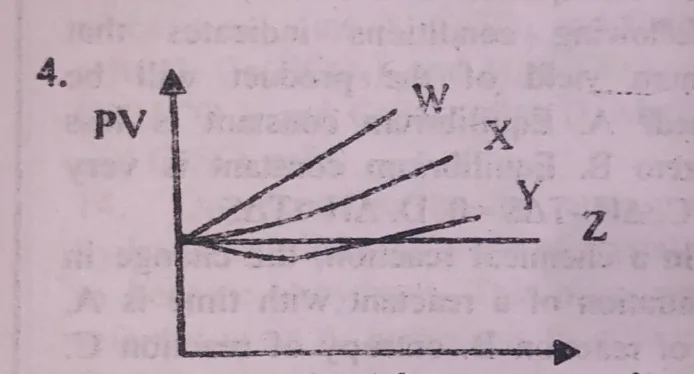
Graph Z portrays a typical ideal gas. For an ideal gas, the value of PV is constant regardless of the value of pressure. A real gas (at low pressure P) deviates from this and is represented by curve Z's neighbouring/curving line — per the printed key the answer is C.
The rate of diffusion of a gas Y is twice that of Z. If the relative molecular mass of Y is 64 and the two gases diffuse under the same conditions, find the relative molecular mass of Z.
Using Graham's law: R₁/R₂ = √(M₂/M₁). Since R(Y)=2R(Z): 2 = √(M(Z)/64), so M(Z)/64 = 4, giving M(Z) = 256. This value does not match any of the given options — the printed key states 'No Correct Option'.
The radioisotope used in industrial radiography for the rapid checking of faults in welds and casting is
The radioisotope used in industrial radiography for the rapid checking of faults in welds and casting is cobalt-60.
How many unpaired electrons are in the p-orbitals of a fluorine atom?
F = 1s²2s²2p⁵. As can be seen, there is only one unpaired electron, and it is in the 2p orbital.
The radioactive emission with the least ionization power is
Gamma rays have the lowest ionization power and the highest penetration power. The opposite is true for alpha particles.
The shape of the carbon(IV) oxide molecule is
Carbon(IV) oxide is a linear molecule. Other linear molecules include BeCl2, H2, O2, N2, F2, Cl2, Br2 and I2.
Which of the following molecules is held together by hydrogen bond?
Hydrogen bonding occurs in compounds where hydrogen is linked to very small electronegative atoms such as nitrogen, oxygen and fluorine. The strongest hydrogen bonding occurs in hydrogen fluoride (HF).
The bond formed between two elements with electron configurations 1s²2s²2p⁶3s¹ and 1s²2s²2p⁵ is
The element with configuration 1s²2s²2p⁶3s¹ will lose an electron to the one with 1s²2s²2p⁵; each then attains 1s²2s²2p⁶. This is ionic bonding.
The constituent of air that acts as a diluent is
Nitrogen is an important diluent of air. Without nitrogen, combustion would proceed out of proportion.
Steam changes the colour of anhydrous cobalt(II) chloride from
Water (steam or otherwise) turns anhydrous cobalt(II) chloride from blue to pink. Anhydrous CuSO4, by contrast, changes from white to blue when water is added.
An example of a hygroscopic substance is
Hygroscopic substances absorb water and become sticky when exposed to the atmosphere. CaO is a good example.
If 24.4g of lead(II) trioxonitrate(V) were dissolved in 42g of distilled water at 20°C, calculate the solubility of the solute in gdm⁻³.
Volume of water = 42cm³ = 0.042dm³ (taking density of water as 1gcm⁻³). Solubility = 24.4g ÷ 0.042dm³ = 580.95 ≈ 581gdm⁻³.
The solvent used for removing grease stain is
In laundries, liquid ammonia is a favourite choice for removing grease and oil stains.
In a water body, too much sewage leads to
Too much sewage causes the population of (usually aerobic) bacteria to increase, which consequently decreases the level of oxygen in the water body.
10.0dm³ of water added to 2.0dm³ of 2.5dm³ solution of HCl. What is the concentration of the final solution in moldm⁻³?
C₁=2moldm⁻³, V₁=2.5dm³, V₂=10dm³+2.5dm³=12.5dm³. Using C₁V₁=C₂V₂: C₂ = (2×2.5)/12.5 = 0.4moldm⁻³.
Three drops of a 1.0moldm⁻³ solution of HCl was added to 20cm³ of a solution of pH 6.4. The pH of the resulting solution will
Adding HCl (an acid) to a solution makes it more acidic, so the pH value will decrease (be less than 6.4).
Which of the following compounds is not a salt?
Sodium trioxocarbonate(IV), zinc chloride and sodium hydrogen trioxosulphate(IV) are salts, while aluminium oxide (Al2O3) is an amphoteric oxide, not a salt.
An insoluble salt can be prepared by
The best way of preparing insoluble salts is double decomposition. For instance, silver chloride (AgCl) can be produced from the double decomposition reaction between AgNO3 and NaCl.
2H2O(l) + 2F2(g) ⇌ 4HF(aq) + O2(g). In the reaction above, the substance that undergoes reduction here is
The substance that undergoes reduction is fluorine. Its oxidation number decreases from 0 in F2 to -1 in HF.
Zn(s) + CuSO4(aq) → ZnSO4(aq) + Cu(s). In the reaction above, the oxidizing agent is
The oxidation number of zinc increases from zero to +2 in ZnSO4; zinc has undergone oxidation, so it is the reducing agent, while CuSO4 is the oxidizing agent.
In an electrochemical cell, polarization is caused by
Polarization is caused by the formation of hydrogen (from reduction) coating the electrode; it is reduced by the use of depolarizers such as manganese(IV) oxide (MnO2). The gas responsible for polarization here is oxygen/hydrogen gas evolved at the electrode — per the printed key the answer is D.
Calculate the volume in cm³ of oxygen evolved at s.t.p. when a current of 5A is passed through acidified water for 193s.
4OH⁻ → 2H2O + O2 + 4e⁻. Q = It = (5×193)C = 965C. 1 mole of O2 (22400cm³) requires 4F (96500C×4) of electricity. Thus 965C produces (22400/(96500×4))×965 = 56cm³ — per the printed key the selected answer is A.
In an endothermic reaction, if there is a loss in entropy, the reaction will
In an endothermic reaction, if there is a loss in entropy, the reaction will not be spontaneous.
2SO2(g) + O2(g) ⇌ 2SO3(g) ΔH = -395.7kJmol⁻¹. In the reaction above, the concentration of SO3(g) can be increased by
Since the reaction is exothermic, the forward reaction (production of more SO3) is favoured by a decrease in temperature.
The minimum amount of energy required for a reaction to take place is
For a reaction to take place, the colliding particles must have energies greater than or equal to the activation energy.
In the graph above, the activation energy of the catalyzed reaction is
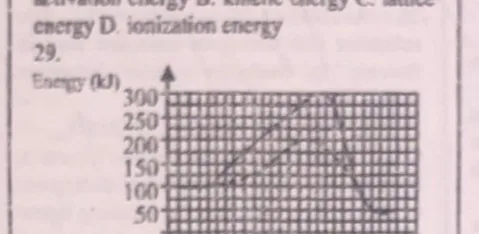
The lower of the two curves is always the profile diagram of the catalysed reaction. For the catalyzed reaction, activation energy = 200kJ − 100kJ = 100kJ.
3Fe(s) + 4H2O(g) ⇌ Fe3O4(s) + 4H2(g). The equilibrium constant K of the reaction above is represented as
For a heterogeneous equilibrium, species in the solid and liquid phases are not featured in the expression for the equilibrium constant. K = [H2]⁴/[H2O]⁴.
Which of the following compounds is a neutral oxide?
Sulphur(IV) oxide, carbon(IV) oxide and sulphur(VI) oxide are acidic oxides, while carbon(II) oxide is a neutral oxide.
In the laboratory preparation of ammonia, the flask is placed in a slanting position so as to
The flask is placed in a slanting position to prevent condensed water from flowing back and breaking the hot reaction flask.
Which of the following gases is employed as an anaesthesia?
Dinitrogen oxide, N2O, also known as laughing gas, is used as a mild anaesthetic for minor surgical operations.
Sulphur(IV) oxide is a strong reducing agent in the presence of water due to the formation of
Sulphur(IV) oxide is a good reducing agent in water, as it produces trioxosulphate(IV) ion in solution — a species that readily donates electrons to potential oxidizing agents.
A metal that forms soluble trioxosulphate (IV) salt is
All salts of sodium, potassium and ammonium are soluble, regardless of the accompanying negative ion.
Copper is displaced from the solution of its salts by most metals because it
Copper is commonly displaced from its solutions by most metals because it is almost at the bottom of the electrochemical (activity) series. Only mercury, silver, gold and platinum are less reactive than copper.
The coloured nature of transition metal ions is associated with their partially filled
The coloured nature of transition metal ions is associated with their partially filled d-orbital.
Aluminium containers are frequently used to transport trioxonitrate (V) acid because aluminium
No matter how concentrated the acid is, aluminium does not react with trioxonitrate(V) acid — this is attributable to the formation of the protective aluminium oxide layer.
2-methylbutan-2-ol is an example of a
2-methylbutan-2-ol is a tertiary alkanol — a tertiary alkanol is one in which the carbon bearing the hydroxyl group is attached to three alkyl groups.
The reaction between ammonia and ethylethanoate produces
Ammonia reacts with ethylethanoate to produce ethanol and ethanamide: CH3COOC2H5 + NH3 → CH3CONH2 + C2H5OH.
The decarboxylation of ethanoic acid will produce carbon(IV) oxide and
The decarboxylation of ethanoic acid produces carbon(IV) oxide and methane: CH3COOH → CH4 + CO2.
The compound H–C(OH)(H)–C(H)(H)–H (structure showing an -OH on a carbon chain) above is an
The compound shown has a hydroxyl (–OH) group attached to a carbon chain, making it an alkanol.
The compound that will react with sodium hydroxide to form salt and water only is
A compound that reacts with sodium hydroxide (a base) to give salt and water only must be an acid. CH3CH2COOH (propanoic acid) is an acid: CH3CH2COOH + NaOH → CH3CH2COONa + H2O.
Which of the following compounds in solution turn red litmus paper blue?
Just like ammonia, amines (RNH2) can turn damp red litmus paper blue.
The dehydration of ammonium salt of alkanoic acids produces a compound with the general formula
The dehydration of the ammonium salt of alkanoic acids produces alkanamides. Amides/alkanamides have the general formula RCONH2.
Which of the following fractions is used as raw material for the cracking process?
In cracking, less volatile crude oil fractions (such as diesel oils) are passed through a chamber at very high temperature to produce more volatile fractions.
An organic compound with a pleasant smell is likely to have a general formula
Alkanoates (esters) are sweet-smelling organic compounds. Their general molecular formula is CnH2n+1COOCnH2n+1, or RCOOR', where R and R' may be the same or different alkyl/aryl groups.
A primary amide is generally represented by the formula
A primary amide has the general formula RCONH2.
The IUPAC nomenclature for the compound CH3-C(CH3)(H)-CH2-CH=CH2 above is
The longest continuous chain has five carbon atoms with a double bond starting at the first carbon atom. The parent name is pent-1-ene, with a methyl attachment on carbon-4. Hence the complete name is 4-methylpent-1-ene.
An organic compound contains 60% carbon, 13.3% hydrogen and 26.7% oxygen. Calculate the empirical formula.
Moles: C = 60/12 = 5, H = 13.3/1 = 13.3, O = 26.7/16 = 1.67. Dividing by the smallest (1.67): C = 3, H = 8, O = 1. Empirical formula = C3H8O.
Advertisement
…and/or go further with premium services and No Ads.