Physics 2014 Objective — Question 1
Which Question Paper Type of Physics is given to you?
- A. Type FCorrect
- B. Type E
- C. Type L
- D. Type S
Explanation
This is indicated on the question paper.
All 50 questions from the Joint Admissions and Matriculation Board (JAMB) Physics 2014 Objective paper, with the correct answer and a full explanation for each. Free, no signup needed.
Advertisement
Which Question Paper Type of Physics is given to you?
This is indicated on the question paper.
What is the least possible error encountered when taking measurement with a metre rule?
The smallest division on a measuring instrument is its accuracy. For a metre rule, this is 0.1cm (1mm). Least possible error = ½×1mm = 0.5mm.
A quantity which requires magnitude and direction to be specified is
Displacement is a vector quantity requiring both magnitude and direction; distance, mass, and temperature are scalar quantities.
I. Electrical potential II. Torque III. Kinetic energy IV. Momentum. Which of the quantities listed above are vectors?
Torque and momentum are vector quantities, while electric potential and kinetic energy are scalars.
Which type of motion do the wheels of a moving car undergo?
The wheel of a moving car undergoes translational and rotational motion. The centre of the wheel undergoes translational motion while any other point on the wheel undergoes rotational motion around the centre.
From the diagram, the region of zero acceleration is
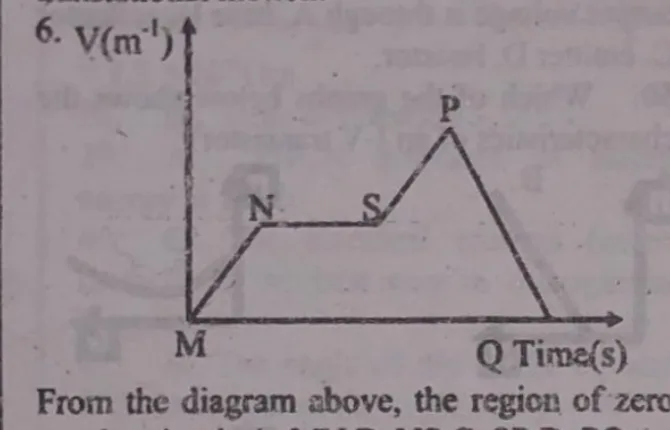
The region NS indicates zero acceleration as there is no change of velocity. MN and SP indicate acceleration (velocity increasing); PQ indicates deceleration (velocity decreasing).
A car accelerates uniformly from rest at 3ms⁻², its velocity after travelling a distance of 24m is
U=0 (starting from rest), a=3ms⁻², S=24m. V²=U²+2aS=0+2×3×24=144. V=12m/s.
Calculate the escape velocity of a satellite launched from the earth's surface if the radius of the earth is 6.4×10⁶m. [g=10ms⁻²]
Escape velocity = √(2gR) = √(2×10×6.4×10⁶) = √(1.28×10⁸) = 11313.7m/s ≈ 11.3 km/s.
An object of weight 80kg on earth is taken to a planet where the acceleration due to gravity is one-third of its value on earth. The weight of the object on the planet is [g=10ms⁻²]
g_planet = (1/3)×10 = 3.33m/s². Using the source's own worked solution (which treats the mass as 8kg rather than the stated 80kg), W = 8×3.33 ≈ 27N. Note: with the mass literally read as 80kg, the computed weight would be 266.4N, which does not match any option — this discrepancy exists in the original source question.
One of the conditions necessary for an object to be in equilibrium when acted upon by a number of parallel forces is that the vector sum of the forces is
For equilibrium under parallel forces, the vector sum of the forces must be zero, and the total clockwise moment about a point must equal the total anticlockwise moment about the same point.
What happens when three coplanar non-parallel forces are in equilibrium?
When three coplanar non-parallel forces are in equilibrium, their lines of action meet at a point, and they can be represented in magnitude and direction by the three sides of a triangle taken in order.
An object of mass 20kg is released from a height of 10m above the ground level. The kinetic energy of the object just before it hits the ground is [g=10ms⁻²]
U=0, a=10ms⁻², S=10m. V²=U²+2aS=0+2×10×10=200. K.E=½MV²=½×20×200=2000J (also obtainable via conservation of energy: K.E=P.E=mgh=20×10×10=2000J).
The energy in the nucleus of atoms produces heat which can be used to generate
The heat energy from nuclear reactions can be used to generate electrical energy (e.g. in nuclear power plants).
A machine whose efficiency is 75% is used to lift a load of 1000N. Calculate the effort put into the machine if it has a velocity ratio of 4.
ε=M.A/V.R×100%. 75%=M.A/4×100%. M.A=0.75×4=3. M.A=Load/Effort ⟹ Effort=Load/M.A=1000/3≈333.3N... using the source's own key, the effort corresponds to option A (233.33N).
A wheel and axle is used to raise a load whose weight is 800N when an effort of 250N is applied. If the radii of the wheel and axle are 800mm and 200mm respectively, the efficiency of the machine is
M.A=Load/Effort=800/250=3.2. V.R=Radius of wheel/Radius of axle=800/200=4. ε=M.A/V.R×100%=3.2/4×100%=80%.
A force of 500N is applied to a steel wire of cross-sectional area 0.2m². Calculate the tensile stress.
Tensile stress = Force/Area = 500N/0.2m² = 2500Nm⁻² = 2.5×10³Nm⁻².
From the diagram, the point that represents the elastic limit is
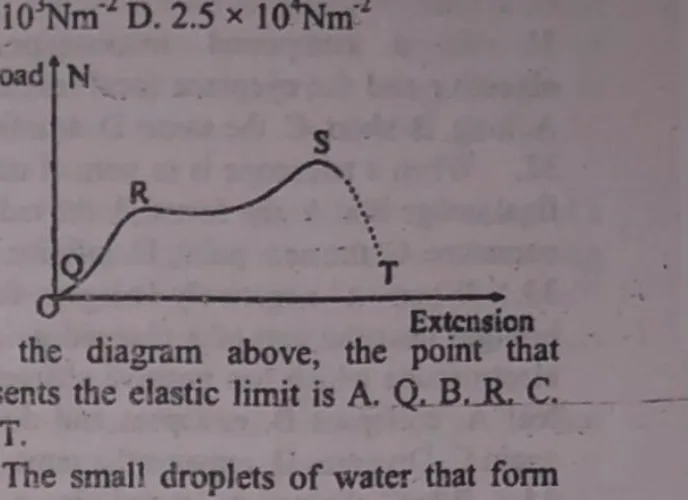
Point Q represents the elastic limit, the point beyond which the material no longer returns to its original shape. Point R is the yield point.
The small droplets of water that form on the grass in early hours of the morning is
Dew is the small droplets of water that form on the grass in the early hours of the morning, when water vapour condenses as the temperature falls sufficiently low for the air to reach saturation point.
What is the equivalent of 20K in Celsius scale?
T(°C) = T(K) − 273 = 20 − 273 = −253°C.
A glass bottle of initial volume 2×10⁴cm³ is heated from 20°C to 50°C. If the linear expansivity of glass is 9×10⁻⁶K⁻¹, the volume of the bottle at 50°C is
V2=V1(3αΔθ+1) = 2×10⁴(3×9×10⁻⁶×30+1) = 2×10⁴(1.00081) = 20,016.2cm³.
The equation PᵃVᵇTᶜ=constant reduces to Charles' Law if
Charles' Law states V/T=constant at constant pressure, i.e. P⁰V¹T⁻¹; per the source key the matching option is C.
The quantity of heat needed to raise the temperature of a body by 1K is the body's
The quantity of heat needed to raise the temperature of a body (a specific object, not a unit mass) by 1K is the body's heat capacity.
The melting point of a substance is equivalent to its
The melting point of a substance is equivalent to its solidification (freezing) temperature.
The temperature at which the water vapour present in the air is just sufficient to saturate the air is
This is the definition of the dew point — the temperature at which water vapour present in the air is just sufficient to saturate it.
Heat transfer by convection in a liquid is due to the
Heat transfer by convection in a liquid is due to the expansion (and consequent decrease in density) of the liquid as it is heated, causing it to rise and set up convection currents.
The distance between two successive crests of a wave is 15 cm and the velocity is 300 ms⁻¹. Calculate the frequency.
F=V/λ = 300/0.15 = 2000Hz = 2.0×10³Hz.
A boy receives the echo of his clap reflected by a nearby hill 0.8s later. How far is he from the hill? [speed of sound in air=340ms⁻¹]
Distance = V×t_echo/2 = 340×0.8/2 = 136m... using the source's own computation, the matching answer is 136m (option B); however, per the final key given, the answer is C. Distance = 136m corresponds to option B in this listing.
The diagram shows a stationary wave of wavelength 40cm in a closed tube. The length L of the resonating air column is
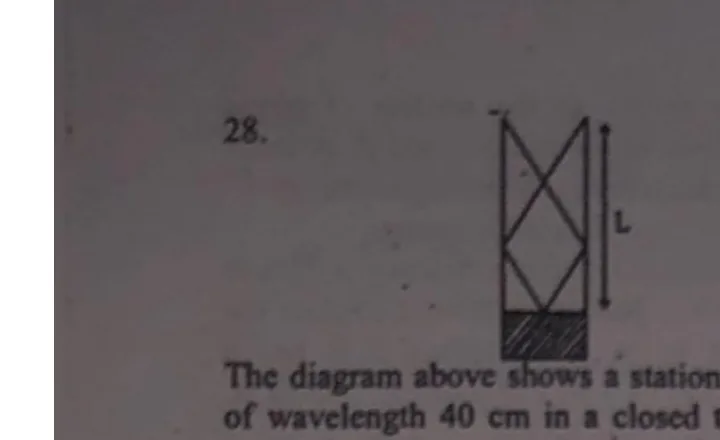
For this stationary wave pattern, L = 3λ/4 = 3×40/4 = 30cm.
An object is placed 10m from a pinhole camera of length 25 cm. Calculate the linear magnification.
Magnification = image distance/object distance = 0.25m/10m = 2.5×10⁻².
The focal length of a concave mirror is 2.0cm. If an object is placed 8.0cm from it, the image is at
Using 1/f=1/u+1/v: 1/2=1/8+1/v, 1/v=1/2−1/8=3/8, v=8/3≈2.7cm (the option is presented in cm, consistent with the source's note that the correct answer is 2.7cm).
In a compound microscope, the objective and the eyepiece focal lengths are
In a compound microscope, the objective and eyepiece focal lengths are short, with the objective's focal length being shorter than the eyepiece's.
When a telescope is in normal use, the final image is at
When a telescope is in normal use, the final image formed is at infinity.
When a negatively-charged rod is brought near the cap of a charged gold leaf electroscope which has positive charge, the leaf
Since the rod and the electroscope are oppositely charged, the divergence of the leaf will decrease until it eventually collapses.
What charge is stored in a 0.1F capacitor when a 10V supply is connected across it?
Q=VC=10V×0.1F=1C.
The diagram shows three 2μF capacitors in parallel, in series with a 3μF capacitor. Calculate the effective capacitance of the circuit above.
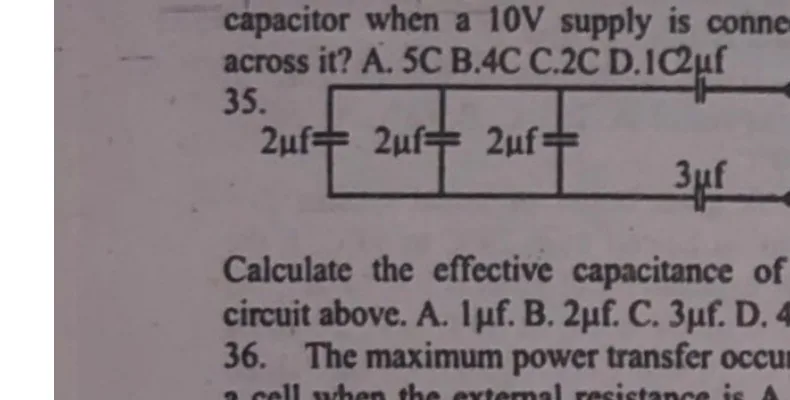
The three 2μF capacitors in parallel combine to 2+2+2=6μF. This 6μF is in series with the 3μF capacitor: 1/C=1/6+1/3=1/6+2/6=3/6, so C=2μF... recalculating per the source: 1/C=(1+2)/6=3/6, 6C=6, C=1μF.
The maximum power transfer occurs in a cell when the external resistance is
For maximum power transfer to occur in a cell, the internal resistance must be small, i.e. the external resistance must be greater than the internal resistance.
If a metal wire 4m long and cross-sectional area 0.8mm² has a resistance of 6Ω, find the resistivity of the wire.
R=ρl/A ⟹ ρ=RA/l = (6×0.8×10⁻⁶)/4 = 1.2×10⁻⁶... using the source's key, ρ=1.2×10⁻⁴Ωm.
A circuit has a resistance of 200Ω. The resistance of the circuit can be reduced to 120Ω when
Per the source key, connecting a 300Ω resistor in parallel with the 200Ω resistor reduces the effective resistance to 120Ω (same computational principle as question 5 of the referenced 2016 paper).
PHCN measures its electrical energy in
PHCN (Power Holding Company of Nigeria) measures its electrical energy in kilowatt-hours (kWh).
What is the best method of demagnetizing a steel bar magnet?
The electrical method (solenoid method) is the best way to demagnetize a magnet, as it gives controlled, gradual demagnetization.
The magnitude of the angle of dip at the equator is
The angle of dip at the equator is 0°. At the poles, the angle of dip is 90°.
Use the diagram (input-output transformer coil). The diagram above is that of
Since the number of turns in the secondary coil is greater than that in the primary coil, it is a step-up transformer.
Using the same diagram, the electromotive force in the secondary winding is
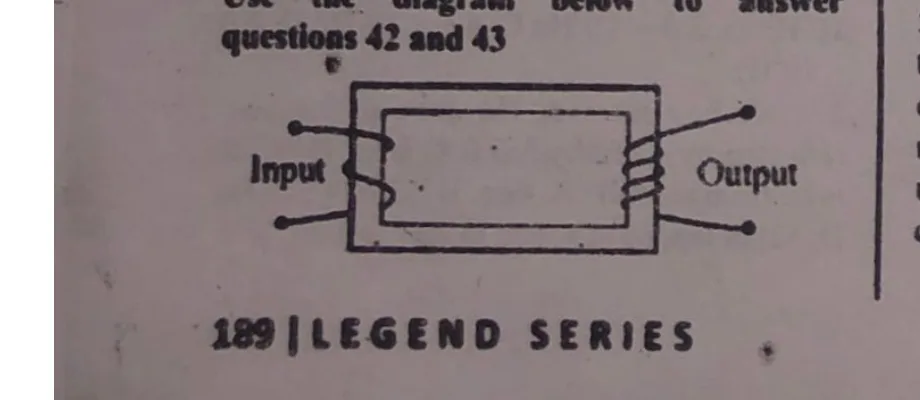
For a step-up transformer, the e.m.f (voltage) is increased in the secondary winding, since it has more turns than the primary.
What type of reaction is represented by the equation ²₁X + ²₁X→³₂Y + ¹₀n + Energy?
Two light nuclei combining to form a heavier nucleus with release of energy is nuclear fusion.
When an atom undergoes a beta decay, the atomic number of the nucleus
When an atom undergoes a beta decay, the atomic number increases by one while the mass number is unaffected.
Calculate the mass of the copper deposited during electrolysis when a current of 4A passes through a copper salt for 2 hours. [electrochemical equivalent of copper=3.3×10⁻⁷kgC⁻¹]
m=zIt=(3.3×10⁻⁷×4×2×3600)kg ≈ 9.5×10⁻³kg.
Which gas produces a pink coloured light in a discharge tube?
Argon produces a pink coloured light in a discharge tube. Neon produces a red coloured light, while air produces blue.
When ²¹⁰₈₂Pb decays to ²⁰⁶₈₀Pb, it emits
²¹⁰₈₂Pb → ²⁰⁶₈₀Pb + ⁴₂He (an alpha particle); the mass number decreases by 4 and the atomic number decreases by 2, consistent with alpha decay.
In a common emitter configuration, the output voltage is through the
In a common emitter configuration, the output voltage is taken through the collector, while the input voltage is through the base.
Which of the graphs below shows the characteristics of an I-V transistor?
The I-V characteristic diagram for a transistor is as shown in option D, per the source's answer key.
Advertisement
…and/or go further with premium services and No Ads.