Free account: track your progress — Sign up free

JAMB Physics 2019 Objective Past Questions

All 40 questions from the Joint Admissions and Matriculation Board (JAMB) Physics 2019 Objective paper, with the correct answer and a full explanation for each. Free, no signup needed.

Advertisement

Physics 2019 Objective — Question 1

A particular metal has a work function of 2.0eV. If light of wave-length 151nm falls on it, the maximum energy of the photo electron emitted is

  • A. 3.2×10⁻¹⁹J
  • B. 9.972×10⁻¹⁹JCorrect
  • C. 1.3172×10⁻¹⁸J
  • D. 1.51×10⁻¹⁹J

Explanation

W₀=2.0eV=1.6×10⁻¹⁹×2=3.2×10⁻¹⁹J. Energy of light E=hc/λ=(6.63×10⁻³⁴×3×10⁸)/(1.51×10⁻⁷)=1.3172×10⁻¹⁸J. Kinetic energy = E−W₀ = 1.3172×10⁻¹⁸−3.2×10⁻¹⁹ = 9.972×10⁻¹⁹J.

Physics 2019 Objective — Question 2

The efficiency of a machine is 75%. If the machine can overcome a force of 6000N with another force of 2000N, what is the velocity ratio of the machine?

  • A. 4Correct
  • B. 5
  • C. 3
  • D. 2

Explanation

Mechanical Advantage (M.A) = Load/Effort = 6000/2000 = 3. Efficiency = M.A/V.R × 100% ⇒ 75% = 3/V.R ×100% ⇒ V.R = 300/75 = 4.

Physics 2019 Objective — Question 3

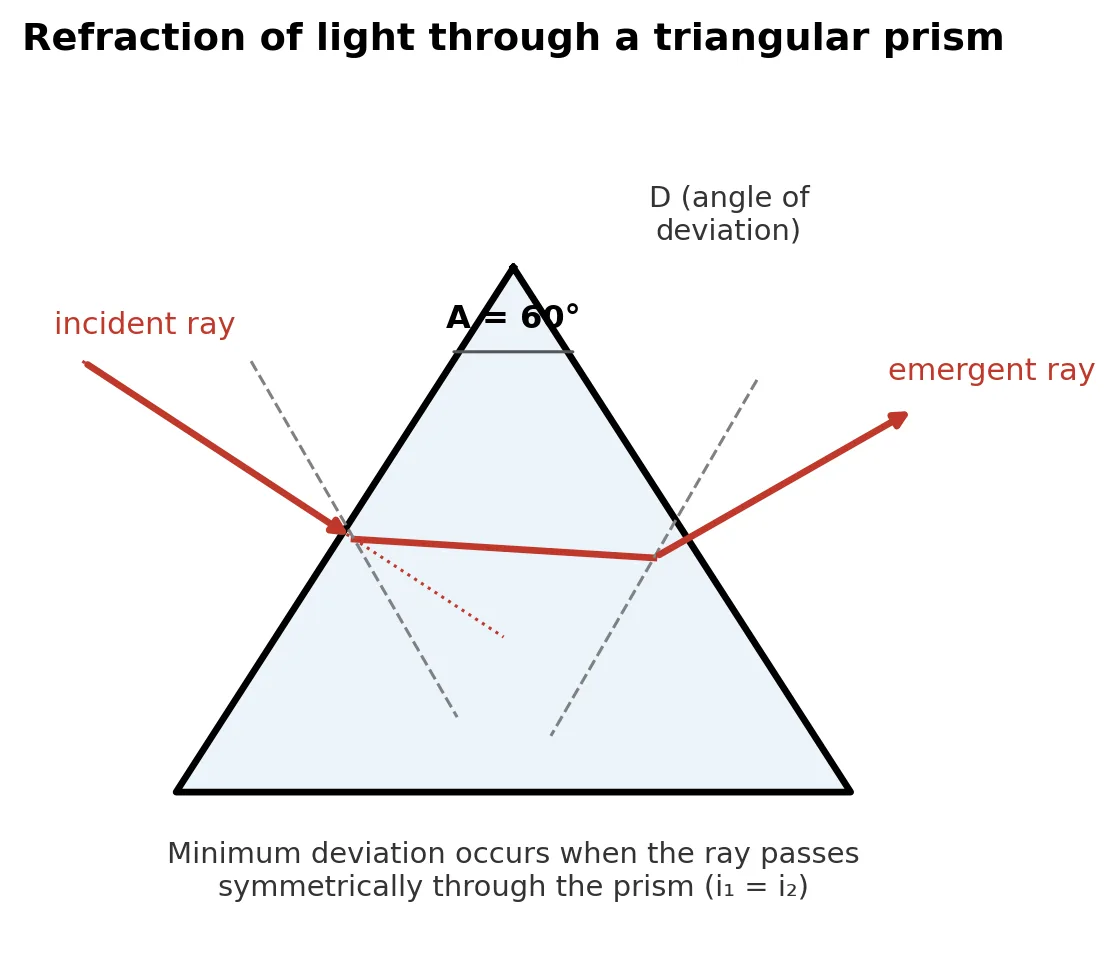
Calculate the angle of minimum deviation when light is refracted through an equilateral triangular prism of refractive index 1.5

Diagram for question 3
  • A. 40°
  • B. 37°
  • C. 40.2°
  • D. 37.2°Correct

Explanation

Angle of prism A=60°. n=sin[(A+Dm)/2]/sin(A/2) ⇒ 1.5=sin[(60+Dm)/2]/sin30° ⇒ sin[(60+Dm)/2]=0.75 ⇒ (60+Dm)/2=48.59° ⇒ Dm=(2×48.59)−60≈ 37.2°.

Physics 2019 Objective — Question 4

A force of 14N is applied to a spring of stiffness 220N/m. Calculate the energy stored in the spring

  • A. 3080J
  • B. 15.71J
  • C. 0.4455JCorrect
  • D. 0.02835J

Explanation

Extension e=F/K=14/220=0.06364m. Energy stored = ½Fe = ½×14×0.06364 = 0.4455J.

Physics 2019 Objective — Question 5

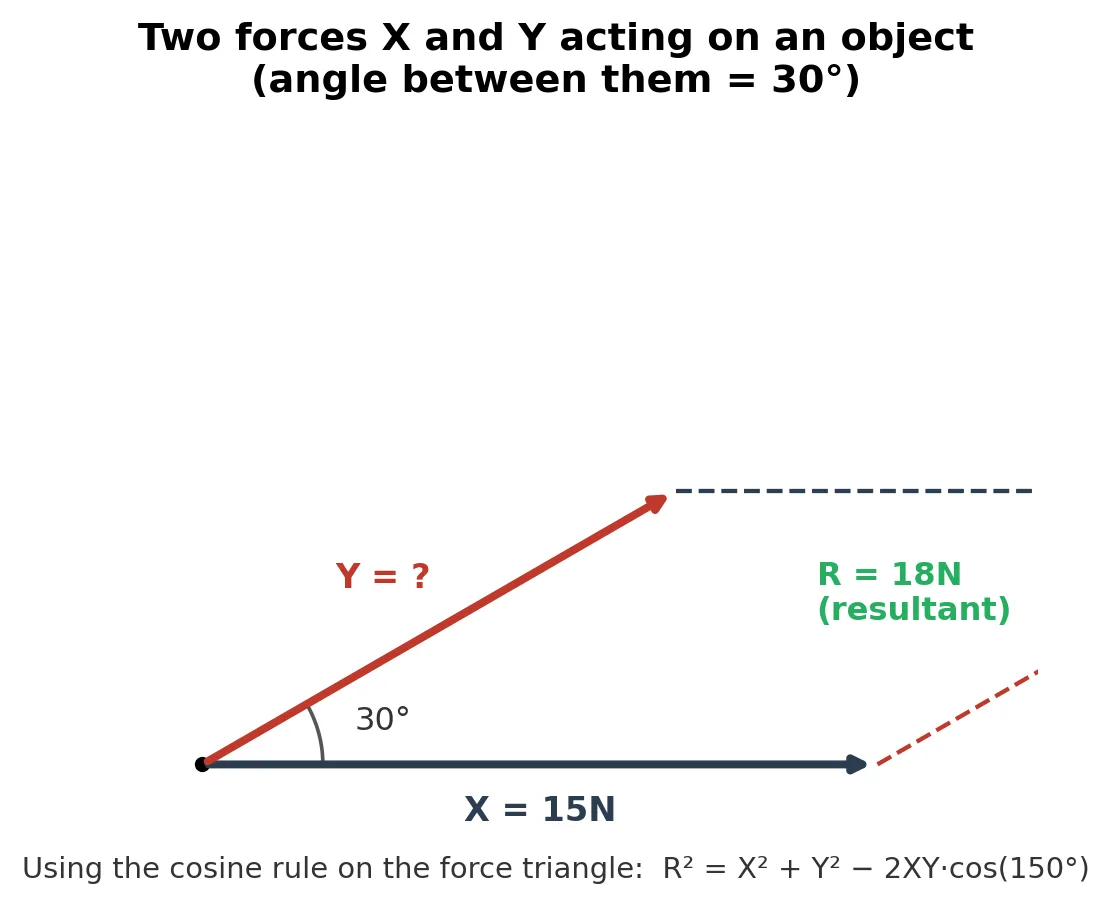
Two forces X and Y act on an object. The angle between the forces is 30°. Given that the magnitude of X is 15N while that of the resultant is 18N, what is Y?

Diagram for question 5
  • A. 3.375NCorrect
  • B. 4.47N
  • C. 2.0142N
  • D. 5.59N

Explanation

Using the cosine rule with the supplementary angle (150°) between X and Y in the force triangle: 18²=15²+Y²−2(15)(Y)cos150° ⇒ Y²+25.98Y−99=0. Solving the quadratic gives Y=3.375N (taking the positive root).

Physics 2019 Objective — Question 6

For a body executing simple harmonic motion, it is true that

  • A. the velocity is maximum at the equilibrium positionCorrect
  • B. the acceleration is maximum at the equilibrium position
  • C. the velocity is minimum at the equilibrium position
  • D. the acceleration and velocity are both maximum at the equilibrium position

Explanation

Using a=−ω²x and v=ω√(A²−x²): at the equilibrium position (x=0), acceleration is zero while velocity is maximum. At the extreme ends, acceleration is maximum while velocity is zero.

Physics 2019 Objective — Question 7

A little sag is left in overhead telephone wires because

  • A. the sag allows for the effect of a rise in temperature due to heating effect of current flowing through them
  • B. the sag allows for the effect of a fall in temperature of the surrounding atmosphereCorrect
  • C. tact wires do not conduct sound easily
  • D. the acceleration is constant throughout

Explanation

A fall in temperature causes contraction of the wire (while a rise causes expansion); the sag allows room for this contraction so the wire does not snap.

Physics 2019 Objective — Question 8

Which of the following is true about electromagnetic waves?

  • A. they are longitudinal
  • B. they can be seen
  • C. they travel at the same speed in vacuumCorrect
  • D. they have the same frequency in vacuum

Explanation

Electromagnetic waves are transverse (not longitudinal), most cannot be seen, and they all travel at the same speed in vacuum, though they have different frequencies and wavelengths (radio, infrared, visible light, UV, X-ray, gamma ray — increasing frequency, decreasing wavelength).

Physics 2019 Objective — Question 9

The angle of incidence in the denser medium when the angle of refraction in the less dense medium is 90° is called

  • A. critical angleCorrect
  • B. refracted angle
  • C. optical angle
  • D. emergent angle

Explanation

This defines the critical angle — the angle of incidence in the denser medium beyond which total internal reflection occurs.

Physics 2019 Objective — Question 10

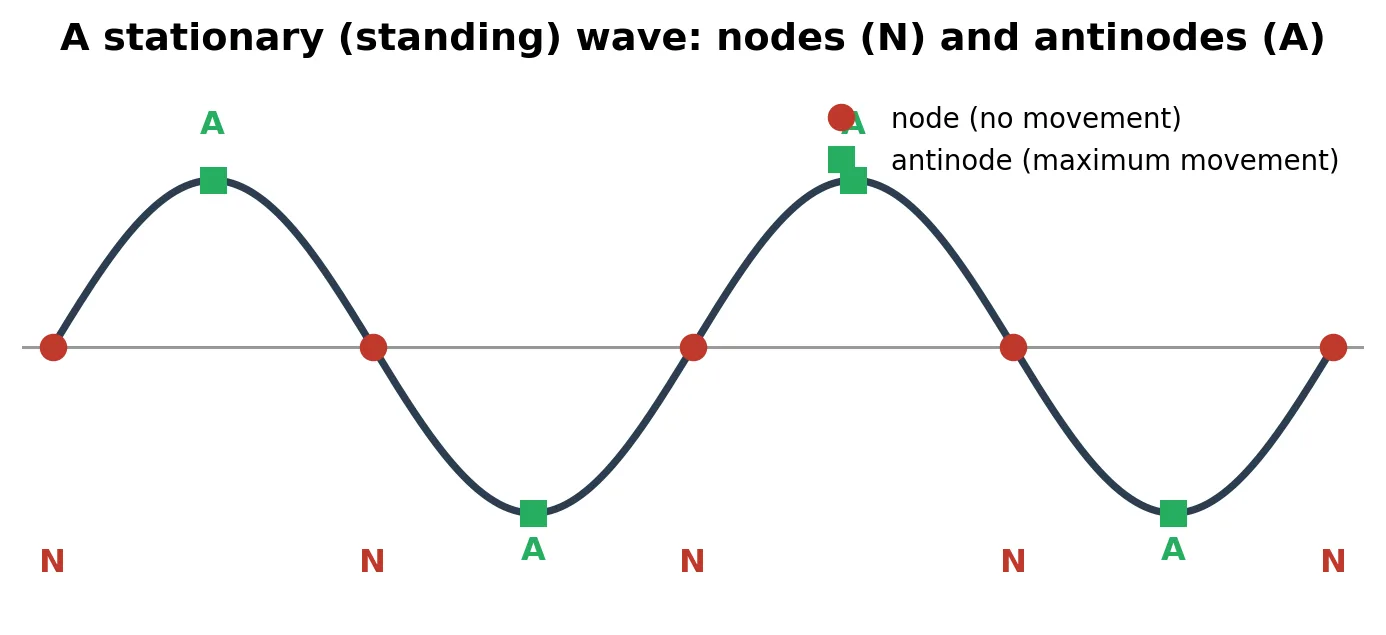
A point on a stationary wave where there is no movement of the medium is called

Diagram for question 10
  • A. crest
  • B. nodeCorrect
  • C. antinode
  • D. amplitude

Explanation

A node is a point on a stationary wave with no movement of the medium; the antinode is the point of maximum movement.

Physics 2019 Objective — Question 11

Which of the following properties is not common to all waves?

  • A. reflection
  • B. refraction
  • C. diffraction
  • D. polarizationCorrect

Explanation

Polarization is an exclusive property of transverse waves; longitudinal waves cannot be polarized. Reflection, refraction, and diffraction are common to all waves.

Physics 2019 Objective — Question 12

A plane progressive wave is represented by y=2sin(100πt−0.2πx) where all the symbols have their usual meanings. What is the velocity of the wave?

  • A. 100m/s
  • B. 200m/s
  • C. 500m/sCorrect
  • D. 400m/s

Explanation

From 2πft=100πt: f=50Hz. From 2πx/λ=0.2πx: λ=10m. Velocity V=fλ=50×10=500m/s.

Physics 2019 Objective — Question 13

The angle between the earth's magnetic field and the horizontal is known as the angle of

  • A. dipCorrect
  • B. declination
  • C. compass
  • D. variation

Explanation

The angle between the earth's magnetic field and the horizontal is the angle of dip (or inclination). (The angle between the magnetic meridian and geographic meridian is the angle of declination/variation.)

Physics 2019 Objective — Question 14

An organ pipe closed at one end is 110cm. What is the frequency of the fundamental note, assuming that the speed of sound in air is 330m/s?

  • A. 100Hz
  • B. 75HzCorrect
  • C. 50Hz
  • D. 25Hz

Explanation

For a closed pipe, fundamental frequency f₀=V/4L. L=110cm=1.10m. f₀=330/(4×1.10)=75Hz.

Physics 2019 Objective — Question 15

A tuning fork, a violin string and a loudspeaker cone are producing sounds. This is because they are all in a state of

  • A. rarefaction
  • B. compression
  • C. vibrationCorrect
  • D. amplitude

Explanation

Sound is produced when there is vibration of a material medium; all three sources are vibrating.

Physics 2019 Objective — Question 16

Two cars of equal mass moving with a velocity of 50m/s collide head-on. Calculate the velocity of each after the collision if they stick together

  • A. 50m/s
  • B. 30m/s
  • C. 10m/s
  • D. 0m/sCorrect

Explanation

For a head-on collision, the cars travel in opposite directions. With equal mass x: (x×50)−(x×50)=(2x)V ⇒ 0=(2x)V ⇒ V=0.

Physics 2019 Objective — Question 17

An object weighing 200kg hangs at the end of a rope. If g=9.8m/s², what is the acceleration, when the tension in the rope is 2000N?

  • A. 20m/s²
  • B. 25m/s²
  • C. 2000m/s²
  • D. 0.2m/s²Correct

Explanation

Resultant force = T−mg = 2000−200(9.8) = 2000−1960 = 40N. F=ma ⇒ a=40/200=0.2m/s².

Physics 2019 Objective — Question 18

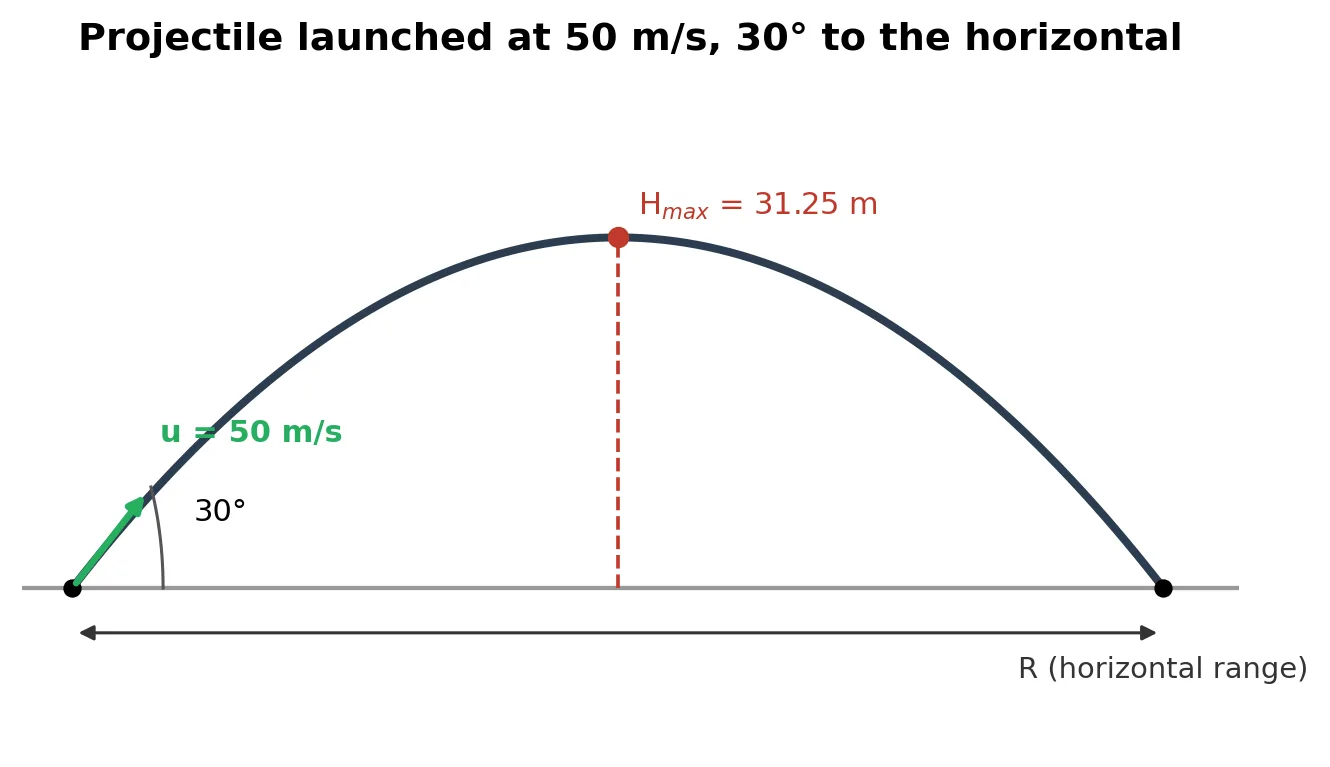
An object was launched with velocity of 50m/s at an angle of 30° to the horizontal, the maximum height reached is:

Diagram for question 18
  • A. 55m
  • B. 30m
  • C. 31.25mCorrect
  • D. 11.1m

Explanation

Vertical component Uᵧ=50sin30°=25m/s. At maximum height V=0: 0²=25²+2(−10)Hₘₐₓ ⇒ Hₘₐₓ=625/20=31.25m.

Physics 2019 Objective — Question 19

A dynamo converts

  • A. mechanical energy into electrical energyCorrect
  • B. electrical energy into kinetic energy
  • C. potential energy into kinetic energy
  • D. kinetic energy into potential energy

Explanation

A dynamo is a generator that converts mechanical energy into electrical energy.

Physics 2019 Objective — Question 20

The quality of sound depends on

  • A. frequency
  • B. harmonicsCorrect
  • C. velocity
  • D. wavelength

Explanation

The pitch of a sound depends on frequency; the quality/timbre depends on overtone (harmonics); the loudness depends on amplitude.

Physics 2019 Objective — Question 21

Which of the following is correct?

  • A. metals have forbidden band gaps while semiconductors do not
  • B. metals are always harder than non-metals
  • C. the resistance of metals decreases with temperature while the reverse is the case for semi-conductors
  • D. the resistance of metals increases with temperature while the reverse is the case for semi-conductorsCorrect

Explanation

The resistance of metals increases with temperature (as conductivity decreases), while for semiconductors, resistance decreases with temperature (conductivity increases) as more charge carriers become available.

Physics 2019 Objective — Question 22

Which of the following is most strongly deflected by a magnetic field?

  • A. gamma rays
  • B. X-rays
  • C. Beta particlesCorrect
  • D. Alpha particle

Explanation

Gamma rays and X-rays are not charged and are not deflected by electric or magnetic fields. Alpha and beta particles are charged and are deflected, but beta particles are more strongly deflected since they are far lighter than alpha particles.

Physics 2019 Objective — Question 23

Three capacitors 2μF, 3μF and 6μF are connected in series. If the p.d across the system is 12v, the p.d across the 6μF capacitor is

  • A. 4v
  • B. 6v
  • C. 12v
  • D. 2vCorrect

Explanation

1/C_T = 1/2+1/3+1/6 = 1 ⇒ C_T=1μF. Total charge Q_T=V×C_T=12×1×10⁻⁶=1.2×10⁻⁵C. In series, all capacitors carry the same charge, so V(6μF)=Q_T/6μF=1.2×10⁻⁵/6×10⁻⁶=2V.

Physics 2019 Objective — Question 24

The purpose of a dielectric material in a parallel plate capacitor is to

  • A. increase its conductivity
  • B. decrease its capacitance
  • C. increase the magnetic field between them
  • D. increase its capacitanceCorrect

Explanation

From C=Akε₀/d, introducing a dielectric (with dielectric constant k>1) between the plates increases the capacitance.

Physics 2019 Objective — Question 25

A boat travels due east with a speed of 40m/s across a river flowing due south at 30m/s. What is the resultant speed of the boat?

  • A. 1.3m/s
  • B. 10m/s
  • C. 50m/sCorrect
  • D. 70m/s

Explanation

By Pythagoras' theorem: V_R²=40²+30²=1600+900=2500 ⇒ V_R=√2500=50m/s.

Physics 2019 Objective — Question 26

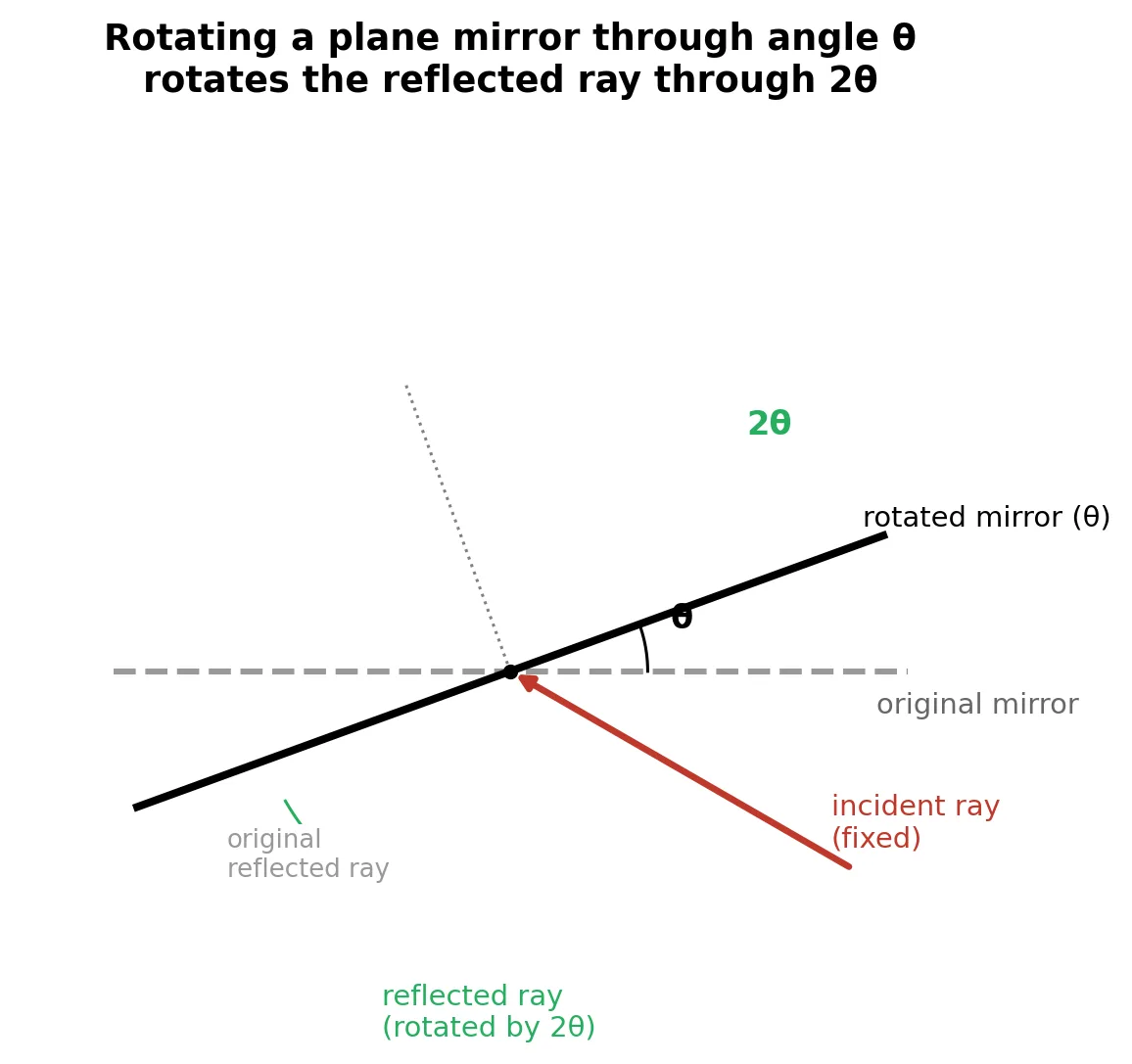
When a plane mirror with a ray of light incident on it is rotated through angle θ, the reflected ray will be rotated through

Diagram for question 26
  • A. θ/2
  • B. θ
  • C. Correct
  • D.

Explanation

When a plane mirror is rotated through an angle (with the incident ray fixed), the reflected ray rotates through twice that angle.

Physics 2019 Objective — Question 27

In an AC circuit that contains only a capacitor, the voltage

  • A. leads the current by 90°
  • B. lags the current by 90°Correct
  • C. leads the current by 180°
  • D. leads the current by 45°

Explanation

In a purely capacitive AC circuit, the current leads the voltage by 90° — equivalently, the voltage lags the current by 90°.

Physics 2019 Objective — Question 28

If the distance between two point charges is increased by a factor of four, the magnitude of the electrostatic force between them will be

  • A. increased to double
  • B. reduced to one-sixteenth of the initial valueCorrect
  • C. increased by a quarter
  • D. quadrupled

Explanation

From F=Kq₁q₂/r², F∝1/r². If distance increases by 4× (r₂=4r₁): F₂=F₁r₁²/(4r₁)²=F₁/16 — reduced to one-sixteenth.

Physics 2019 Objective — Question 29

Which of the following is a set of vectors?

  • A. force, mass and momentum
  • B. acceleration, velocity and momentumCorrect
  • C. mass, weight and density
  • D. mass, volume and density

Explanation

Vector quantities require both magnitude and direction: force, weight, velocity, acceleration and momentum. Mass, volume and density are scalar quantities.

Physics 2019 Objective — Question 30

A transformer has a primary coil with 500 turns and a secondary coil with 2500 turns. When the voltage input to the primary is 120v, the output is

  • A. 6000v
  • B. 600vCorrect
  • C. 240v
  • D. 60v

Explanation

Nₛ/Nₚ = Vₛ/Vₚ ⇒ Vₛ = Vₚ×(Nₛ/Nₚ) = 120×(2500/500) = 600V.

Physics 2019 Objective — Question 31

If two parallel wires carry currents flowing in the same direction, the wires will

  • A. attract each otherCorrect
  • B. have no effect on each other
  • C. repel each other
  • D. both move in the same direction

Explanation

Current-carrying wires create magnetic fields around themselves; when both currents flow in the same direction, the force between the wires is attractive (opposite directions produce a repulsive force).

Physics 2019 Objective — Question 32

In what range of temperature is the expansion of water anomalous?

  • A. +20°C to +28°C
  • B. -80°C to 76°C
  • C. +96°C to 100°C
  • D. 0°C to 4°CCorrect

Explanation

The anomalous expansion of water occurs between 0°C and 4°C: heating water in this range causes it to contract (instead of expand), and cooling it causes it to expand (instead of contract).

Physics 2019 Objective — Question 33

A certain radioactive substance has a half life of 20 years. How long will it take the activity to become 1/4 of its original?

  • A. 20years
  • B. 40yearsCorrect
  • C. 60years
  • D. 80years

Explanation

Decay constant λ=0.693/t½=0.693/20=0.034651/yr. When activity is ¼ of original: ¼=e^(−λt) ⇒ −λt=ln(¼)=−1.3863 ⇒ t=1.3863/0.034651≈40 years.

Physics 2019 Objective — Question 34

Two balls of masses 5kg and 10kg were dropped from a height at the same time. If the ball with the smaller mass reached the ground after 4s, the time taken by the bigger ball to reach the ground is

  • A. 4sCorrect
  • B. 2.5s
  • C. 8s
  • D. 2s

Explanation

Neglecting air resistance, all objects released from the same height at the same time reach the ground at the same time, since they experience the same acceleration due to gravity, regardless of mass.

Physics 2019 Objective — Question 35

The dimensions of pressure and density are respectively

  • A. ML⁻²T² & ML⁻¹T²
  • B. ML⁻¹T⁻² & ML⁻³Correct
  • C. ML⁻² & ML⁻¹T²
  • D. ML⁻¹T² & ML²

Explanation

Pressure = Force/Area = (M×LT⁻²)/L² = ML⁻¹T⁻². Density = Mass/Volume = M/L³ = ML⁻³.

Physics 2019 Objective — Question 36

A conducting sphere has a net charge of -4.8×10⁻¹⁷C. What is the approximate number of excess electrons on the sphere if the fundamental natural charge is -1.6×10⁻¹⁹C?

  • A. 100
  • B. 300Correct
  • C. 200
  • D. 400

Explanation

Number of electrons = Total charge/Charge per electron = (−4.8×10⁻¹⁷)/(−1.6×10⁻¹⁹) = 300.
Physics 2019 Objective — Question 37

The process of adding impurity to a semi-conductor to increase its conductivity is called

  • A. dopingCorrect
  • B. annealing
  • C. heating
  • D. hardening

Explanation

This process is called doping; the resulting semiconductor is known as an extrinsic semiconductor.

Physics 2019 Objective — Question 38

The electromotive force induced is in such a direction as to oppose the motion or change producing it. This is a statement of

  • A. Faraday's law
  • B. Lenz's lawCorrect
  • C. Maxwell's law
  • D. Ampere's law

Explanation

This is Lenz's law. (Faraday's law gives the magnitude of the induced e.m.f.; Lenz's law gives its direction.)

Physics 2019 Objective — Question 39

The transfer of energy from the sun to the Earth's surface is known as

  • A. evaporation
  • B. convection
  • C. radiationCorrect
  • D. conduction

Explanation

Heat transfer from the sun to the earth is by radiation — the only method of heat transfer that does not require a material medium.

Physics 2019 Objective — Question 40

The instrument used for measuring the relative humidity is known as

  • A. hydrometer
  • B. hygrometerCorrect
  • C. wind vane
  • D. anemometer

Explanation

A hygrometer measures relative humidity. (A hydrometer measures relative density; a wind vane shows wind direction; an anemometer measures wind speed.)

Advertisement

Sign up free to unlock

  • Score tracking
  • Practice history
  • Saved questions
  • Progress dashboard
  • Personalized sessions
  • Weak-topic breakdown

…and/or go further with premium services and No Ads.