All 19 questions from the West African Examinations Council (WAEC) Biology 2015 Theory paper, with the correct answer and a full explanation for each. Free, no signup needed.
1(a). Briefly describe sexual reproduction in Rhizopus (a named fungus).
Model answer
Reproduction in Rhizopus can occur sexually (by conjugation) or asexually (by spore formation). In conjugation, two compatible hyphae strains come together to form a zygospore. The zygospore then germinates and develops into a new plant under favourable conditions. Note that conjugation also occurs in other organisms such as Mucor and Spirogyra.
1(b)(i). A student suddenly stepped on a big ant, he cried for help and ran away. Name the hormone produced in the reaction. (ii) In which part of the human body is this hormone produced? (iii) State five changes that must have taken place in the body as a result of this hormone.
Model answer
(i) The hormone produced is adrenalin.
(ii) Adrenalin is produced by the adrenal glands, which are located above the kidneys.
(iii) Changes produced by adrenalin include: increase in the rate of heartbeat; increase in the rate of respiration; dilation of blood vessels; dilation of the pupils; and an increase in muscular tone (readiness for 'fight or flight').
1(c)(i). In tabular form, state three differences between excretion in flowering plants and excretion in humans. (ii) List two organelles found in a plant cell that are responsible for the excretion of metabolic wastes.
Model answer
(i) Differences:
• Humans have well-defined excretory organs (skin, lungs, liver and kidney), while flowering plants have no definite excretory organ.
• In humans, excretory products (e.g. urea, water and salt) are released at a fast rate; in plants, excretory products are released at a slow rate.
• Humans produce excretory products (urea, water, salt) in large quantities; plants produce excretory products (gums, alkaloids, resins and tannins) in small quantities.
(ii) The organelles linked to the excretion of metabolic waste in a plant cell are the mitochondria and the vacuoles.
2(a). Explain how the leaf of a flowering plant is adapted for photosynthesis.
Model answer
Adaptations of the leaf for photosynthesis include:
• Possession of a broad surface which ensures a large surface area is exposed to sunlight.
• Possession of chloroplasts, which contain chlorophyll for trapping sunlight.
• Possession of a thin lamella (leaf blade) which enhances the penetration of light.
• Possession of stomata, which open for the diffusion of gases (CO₂ and O₂).
• Possession of large intercellular air spaces, which facilitate the diffusion of gases.
2(b). Describe briefly the mode of feeding in tapeworm.
Model answer
Tapeworm is an endoparasite. It absorbs already digested food from the host (through its entire body surface), which explains why it lacks a digestive system of its own. In the gut of man, the tapeworm uses its hooks and suckers only to hold/attach itself in position (not to feed - it does not use suckers for sucking food).
2(c). Name one mineral element each needed for the proper functioning of: (i) bones; (ii) red blood cell; (iii) thyroid gland.
Model answer
(i) An essential mineral element for proper functioning of the bone is calcium/phosphorus.
(ii) An essential mineral element for proper functioning of red blood cells is iron.
(iii) An essential mineral element for proper functioning of the thyroid gland is iodine.
2(d)(i). State three benefits of including roughages in the diet of humans. (ii) State three reasons why proteins are important to humans.
Model answer
(i) Benefits of roughages: it prevents constipation; it stimulates bowel movement; and it reduces obesity (it does not contribute to weight gain).
(ii) Importance of proteins: repair of worn-out tissues; body building/growth; and proteins are used for making enzymes, hormones, and antibodies.
3(a)(i). What is sewage? (ii) State five effects of releasing untreated sewage into a stagnant water body.
Model answer
(i) Sewage simply refers to used water and waste substances that are produced by human bodies, and which are carried away from houses and factories through special pipes/drains.
(ii) Effects of releasing untreated sewage into a stagnant water body: it poses danger to the lives of aquatic organisms; it reduces the oxygen content of the water body; it produces repugnant odour; it causes rapid growth of algae, thereby clogging up the water body; and it renders the water unfit for human consumption.
3(b). Explain surface terracing as a soil conservation method.
Model answer
Surface terracing may be used as an effective soil conservation method. Here, flat horizontal areas (like steps) are cut into a slope or the side of a hill. This construction reduces the speed of water running down the slope (erosion), and planting can be done on the flattened areas.
3(d). Explain two ways by which each of the following organisms adapt to their habitats: (i) hydrophytes; (ii) xerophytes.
Model answer
(i) Adaptation of hydrophytes: possession of large air spaces in the parenchyma for buoyancy; possession of a long flower stalk to enhance pollination; and presence of pneumatophores (breathing roots) for gaseous exchange.
(ii) Adaptation of xerophytes: possession of thick succulent stems for storing water (e.g. cactus, baobab and Euphorbia); possession of succulent leaves for water storage (e.g. Aloe, Portulaca and Bryophyllum); and reduction of leaves to spines or scale leaves to cut down transpirational water loss.
4(a)(i). What is a test cross? (ii) What is a monohybrid cross?
Model answer
(i) A test cross is the crossing of an organism whose genotype is unknown with a homozygous recessive organism, in order to determine the unknown genotype.
(ii) A monohybrid cross involves the crossing of organisms which differ with respect to only one pair of contrasting characters.
4(b). In a mango plant, the allele for bean-shaped seed is r and is recessive to round-shaped seed R. With the aid of a genetic diagram, determine the genotypes of the offspring if: (i) a homozygous bean-shaped parent (rr) is crossed with a homozygous round-shaped parent (RR); (ii) a heterozygous bean-shaped parent is crossed with a heterozygous round-shaped parent.
Model answer
Let r = bean shape (recessive), R = round shape (dominant).
(i) Cross rr × RR: all gametes from the rr parent are r, and all gametes from the RR parent are R. Every offspring genotype is Rr (round-shaped, since round is dominant) - i.e. the F1 generation is 100% heterozygous round-shaped (Rr).
(ii) Since 'bean shape' is recessive to round shape, a bean-shaped seed can never be expressed in a heterozygous condition (bean shape can only appear as rr). Therefore, the phrase 'heterozygous bean-shaped' describing a parent is not biologically correct/possible, since the bean-shaped phenotype can only occur in the homozygous recessive form (rr).
5(a). Copy and complete the table below on the diseases Kidney stones, Nephritis and Diuresis, showing one effect and one remedy for each.
Model answer
Kidney stones - One effect: passing urine is a severe/great difficulty, with severe abdominal pains and high blood pressure. One remedy: drinking enough fluid; avoiding foods that are hard to digest; using prescribed drugs.
Nephritis - One effect: puffiness in the face, swellings in the feet and ankle, oedema. One remedy: use of a dialysis machine; drinking water must be properly boiled.
Diuresis - One effect: thirst and dehydration, high blood pressure, loss of appetite, weakness and nausea. One remedy: avoiding excessive drinking of alcohol; kidney transplant (in severe cases).
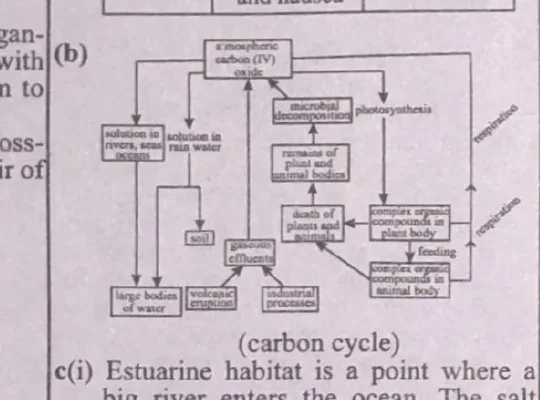
5(b). Make a labelled diagram of the carbon cycle.
Model answer
The carbon cycle diagram shows: atmospheric carbon (IV) oxide (CO₂) at the top, linked by arrows labelled 'photosynthesis' down to green plants, and by 'respiration' up from plants and animals back to the atmosphere. CO₂ dissolves in river/sea water and is used by aquatic plants. Plants and animals form complex organic compounds in the plant/animal body; upon death and decay (through decomposers/microbial decomposition), large bodies of carbon are returned to the soil, released as CO₂ through decomposition, or converted over long periods into fossil fuels/industrial processes, which release CO₂ back into the atmosphere upon combustion, completing the cycle.
5(c)(i). What is Estuarine habitat? (ii) Construct a food chain typical of an estuarine habitat.
Model answer
(i) An estuarine habitat is a point where a big river enters the ocean/sea. The salt water from the ocean mixes with the fresh water from the river to form an intermediate body of water known as brackish water.
(ii) A typical estuarine food chain: photoplankton → barnacles → fish → bird.
5(d)(i). Name two diseases that can attack plant crops. (ii) State three ways of controlling plant diseases.
Model answer
(i) Diseases that can attack plant crops include: corn smut, groundnut rosette, root knot, rice blast, sigatoka and cassava mosaic (name any two).
(ii) Ways of controlling plant diseases: by growing resistant varieties of crops; by using appropriate chemicals (e.g. fungicides/pesticides); by using the biological method (i.e. using the natural enemies of the pests).
5(e). State four functions of a public health authority.
Model answer
(i) Controlling infectious diseases.
(ii) Administering immunization.
(iii) Providing public health awareness/education.
(iv) Ensuring the neatness of public places, and providing quarantine services.
5(f). State four ways of maintaining food hygiene in the community.
Model answer
(i) Keeping the kitchen/cooking places clean.
(ii) Properly washing cooking utensils before and after use.
(iii) Proper preservation of perishable food items.
(iv) Washing hands thoroughly before preparing food.
Advertisement
Sign up free to unlock
Score tracking
Practice history
Saved questions
Progress dashboard
Personalized sessions
Weak-topic breakdown
…and/or go further with premium services and No Ads.