Chemistry 2015 Objective — Question 1
The negatively charged particle in an atom is the
- A. electronCorrect
- B. neutron
- C. positron
- D. proton
Explanation
Electrons are negative, protons are positive while neutrons are neutral.
All 50 questions from the West African Examinations Council (WAEC) Chemistry 2015 Objective paper, with the correct answer and a full explanation for each. Free, no signup needed.
Advertisement
The negatively charged particle in an atom is the
Electrons are negative, protons are positive while neutrons are neutral.
How many orbitals are contained in an atom with atomic number 13?
Al: 1s²2s²2p⁶3s²3p¹, there are five atomic orbitals (1s,2s,2p,3s,3p) so 6 orbitals when counting the three degenerate 2p as one set... following the WAEC key, the answer is 6 (option B), counting each sub-level's occupied orbitals.
The compound formed between ₁₄X and ₁₆Y is
X=2,8,4 (group 4) and Y=2,8,6 (group 6); the combining power of X is 4 while that of Y is 2, giving X₃>Y₂ = XY₂.
The van der Waals forces are dominant intermolecular forces in
Van der Waals forces are weak intermolecular forces of attraction, dominant in non-polar covalent molecules like Cl₂, O₂, F₂, Br₂ etc.
The shape of a molecule of water is
Water's shape is bent, angular (non-linear/V-shaped).
A metallic ion Z²⁺ with an inert gas structure contains 18 electrons. How many protons are contained in this ion?
Z²⁺ has 18 electrons (given). Since forming a 2+ ion means losing 2 electrons, the neutral Z atom has 20 electrons, and since protons=electrons in a neutral atom, proton number=20.
Which of the following pairs of compounds belongs to the same homologous series?
C₂H₆ (ethane) and C₄H₁₀ (butane) both fit the alkane general formula CnH2n+2, so they are in the same homologous series.
Which of the following pairs of elements forms amphoteric oxides?
Beryllium and Magnesium oxides are amphoteric (can react with both acids and bases).
The following transition metal ions would be coloured in aqueous solution except
Sc³⁺ has no d-electrons (fully empty d-orbital), so it is colourless, unlike Cr³⁺, Fe³⁺, and Mn³⁺ which have partially filled d-orbitals and are coloured.
The gas given off when ethanol reacts with sodium is
2C₂H₅OH + 2Na → 2C₂H₅ONa + H₂; hydrogen gas is produced.
Which of the following halogens is solid at room temperature?
Fluorine and chlorine are gaseous, bromine is liquid, while iodine is solid at room temperature.
The alkaline earth metals have similar chemical properties because they
Elements in the same group (like the alkaline earth metals) have the same number of valence electrons, giving them similar chemical properties.
The number of unpaired electrons in an atom of an element ₈Q is
₈Q = 1s²2s²2p⁴. Drawing the orbital diagram for 2p⁴ shows two unpaired electrons.
The bond formed when ammonia reacts with hydrogen ion to form ammonium ion is
The bond between ammonia and H⁺ to form NH₄⁺ is a coordinate (dative) covalent bond, since the nitrogen atom donates both electrons for the bond.
To which group and period respectively does an element with 15 electrons belong?
An atom with 15 electrons has configuration 2,8,5, giving group 5 (5 valence electrons) and period 3 (3 shells).
The shape of a graphite crystal is
Graphite has a hexagonal shape, made up of hexagonal rings with spaces between the layers.
Which of the following oxides is ionic?
MgO is predominantly ionic, while P₄O₁₀, Al₂O₃ and SO₂ are predominantly covalent.
Which of the following substances when boiled with aqueous solution of sodium hydroxide would be hydrolysed?
Fats undergo hydrolysis when boiled with aqueous sodium hydroxide solution (saponification).
Which of the following trioxonitrate (V) salts would decompose on heating to form a metal?
AgNO₃ decomposes on strong heating to give metallic silver, NO₂ and O₂, whereas Cu(NO₃)₂ and Pb(NO₃)₂ give the metal oxide (not the metal), and KNO₃ decomposes to KNO₂ and O₂.
Consider the following reaction equation: C₂H₄(g)+3O₂(g)→2CO₂(g)+2H₂O(g). The volume of CO₂(g) produced at s.t.p when 0.05 moles of C₂H₄(g) was burnt in O₂ is [Molar volume of gas = 22.4 dm³]
0.05 mol C₂H₄ gives 0.1 mol CO₂ (1:2 ratio). Volume = 0.1 × 22.4 = 2.24 dm³.
The number of oxygen molecules present in 16.0 g of the gas is [Avogadro's number = 6.02×10²³]
Moles of O₂ = 16/32 = 0.5 mol. Number of molecules = 0.5 × 6.02×10²³ = 3.01×10²³.
Consider the following equation: SO₄²⁻(aq)+2H⁺(aq)+ye⁻→SO₃²⁻(aq)+H₂O(l). The value of y in the equation is
Balancing charge on both sides: -2+2(1)+y(-1) = -2+0, giving -y = -2, so y = 2.
The general gas equation was derived from
The general gas equation P₁V₁/T₁ = P₂V₂/T₂ is derived by combining Boyle's law and Charles' law.
The vapour pressure of a liquid depends on: I. temperature; II. rate of condensation; III. Cohesive forces holding the particles together.
Vapour pressure of a liquid depends on temperature and the cohesive forces holding the liquid particles together (I and III).
Which of the following gases will diffuse most rapidly? [H=1.00, C=12.0, O=16.0, S=32.0, Cl=35.5]
CH₄ has the lowest molar mass (16), so per Graham's law of diffusion, it diffuses most rapidly.
When a reaction is endothermic, which of the following is correct? The heat content of the
An endothermic reaction absorbs heat from the surroundings to form the products, so the heat content of the reactants is less than that of the products.
Which of the following statements about intermolecular distances and cohesive forces between gas is correct? They are
In a gas, both the intermolecular distances and cohesive forces are negligible (very large distances, negligible forces) - correctly, distances are large but cohesive forces are negligible; per the WAEC key, option B is correct.
The following diagram illustrates the rate curve that was obtained when Mg reacted with excess dilute HCl. The diagram became horizontal at X because
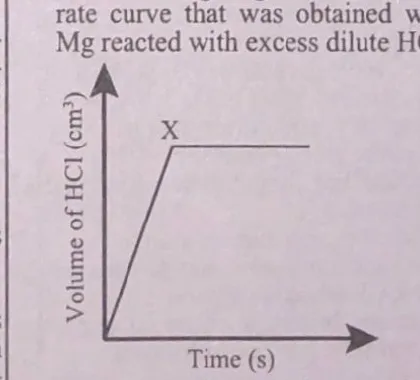
The curve becomes horizontal (flat) at X because the reaction has stopped - all the magnesium (the limiting reagent, since HCl is in excess) has reacted.
An example of an acid salt is
An acid salt still has replaceable/unreacted hydrogen from the acid in its formula, e.g. NaHSO₄.
Which of the following oxides can be reduced by hydrogen?
Silver oxide, being a less reactive metal oxide, can be reduced by hydrogen gas; aluminium, magnesium and sodium oxides are too stable to be reduced by hydrogen.
Solubility is practically applied in
Solubility principles are applied in solvent extraction, where a solute is extracted based on its differing solubility in two immiscible solvents.
Which of the following compounds is the least soluble in water?
CaCl₂, NaCl and Na₂SO₄ are all very soluble in water, while CaSO₄ is only sparingly soluble.
A substance which dissolves readily in organic solvent would be a
A substance that dissolves readily in organic (non-polar) solvents is typically covalent in nature.
Consider the following equilibrium system: 3SO₂(g)+O₂(g)⇌2SO₃(g). The addition of more O₂(g) to the system will shift the equilibrium position to the
By Le Chatelier's principle, adding more O₂ shifts the equilibrium to the right, favouring the production of more SO₃(g).
A change in the temperature of a saturated solution disturbs the equilibrium between the
A saturated solution is in equilibrium between the dissolved solute and the undissolved (excess) solute; changing temperature disturbs this balance.
Which of the following statements about an electrochemical cell is correct? Oxidation occurs
In an electrochemical/electrolytic cell, oxidation occurs at the anode, while reduction occurs at the cathode.
Consider the following reaction equation: CuO(s)+H₂(g)→Cu(s)+H₂O(l). Which substance is oxidized?
Oxidation is the addition of oxygen (or loss of electrons); since oxygen is added to H₂ to form H₂O, hydrogen (H) is oxidized.
Which of the following metals is the strongest reducing agent?
Based on the reactivity/electrochemical series, potassium is the most reactive of the listed metals and therefore the strongest reducing agent.
The complete hydrogenation of benzene gives
Complete hydrogenation of benzene (C₆H₆+3H₂) gives cyclohexane (C₆H₁₂), using a nickel catalyst at 180°C.
A compound has an empirical formula CH₂O and molecular mass of 90. Determine its molecular formula. [H=1.00, C=12.0, O=16.0]
Empirical formula mass = 30. n = 90/30 = 3. Molecular formula = (CH₂O)₃ = C₃H₆O₃.
Which of the following reactions would take place when concentrated sodium hydroxide solution is added to hot palm oil?
The reaction of concentrated NaOH with hot palm oil (a fat/oil) produces soap - this process is called saponification.
Starch could be converted to glucose by the process of
Starch is converted to glucose through hydrolysis (breaking it down via addition of water, with the aid of enzymes/acid).
Which of the following compounds is a secondary alkanol?
3-methylpentan-2-ol has its hydroxyl-bearing carbon attached to two alkyl groups, making it a secondary alkanol; ethanol and propan-1-ol are primary, and 2-methylbutan-2-ol (three alkyl groups) is tertiary.
Which of the following substances is a heavy chemical?
A heavy chemical is a substance produced and needed in very large quantities, e.g. tetraoxosulphate (VI) acid (sulphuric acid) and sodium hydroxide, unlike fine chemicals (needed in small/minute amounts).
Which of the following processes do not take place in domestic water treatment?
Domestic water treatment involves sedimentation, flocculation/coagulation, filtration and chlorination, but not neutralization.
A substance responsible for the sour taste of unripe oranges is
The sour taste of unripe oranges/fruits is due to the presence of an alkanoic acid (e.g. citric/ascorbic acid).
Which of the following products of biotechnology can be used as fuel in place of petrol?
Butane, a gaseous alkane, can be used as a fuel (e.g. in place of petrol/LPG).
Which of the following polymers is thermosetting?
Bakelite is a thermosetting polymer, while nylon, polypropylene and polystyrene are thermoplastics.
The correct balanced equation for the reaction between aluminium metal and hot concentrated tetraoxosulphate (VI) acid is
The correctly balanced equation is 2Al+6H₂SO₄→Al₂(SO₄)₃+6H₂O+3SO₂, balancing Al, S, H and O atoms on both sides.
Which of the following gases is monoatomic?
Argon, a noble gas, exists as single (monoatomic) atoms, while chlorine, nitrogen and oxygen exist as diatomic molecules.
Advertisement
…and/or go further with premium services and No Ads.