All 49 questions from the West African Examinations Council (WAEC) Chemistry 2015 Theory paper, with the correct answer and a full explanation for each. Free, no signup needed.
Esterification is the reaction between an alkanol (alcohol) and an alkanoic acid (carboxylic acid) to give an alkanoate (ester) and water, in the presence of a mineral acid catalyst: ROH + R'COOH ⇌ R'COOR + H₂O. For example, ethanol (C₂H₅OH) reacts with ethanoic acid (CH₃COOH) to yield ethylethanoate (CH₃COOC₂H₅) and water.
(i) It is a poor conductor of heat and electricity.
(ii) It is resistant to corrosion.
(Also acceptable: it can be moulded into different shapes; it can be recycled.)
1(d). What is meant by each of the following terms: (i) Raw material; (ii) Primary product?
Model answer
(i) A raw material simply refers to a starting material employed in producing/manufacturing a substance.
(ii) A primary product is a product that can still be converted to another product.
Charles' law states that the volume of a given mass of a gas is directly proportional to its absolute temperature, provided the pressure is kept constant.
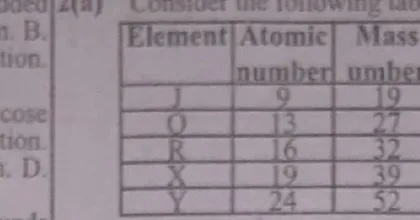
2(a)(i). 'J' is a halogen. If the atomic number of J is quoted as q, using this, the electronic structure of J will be 2,7 (outer shell has seven electrons). Identify the group to which element 'J' belongs, and identify a second element 'Y', a transition element, showing paramagnetism, from the same period. Also identify 'X', an element in group 1, period 4, whose outermost shell contains one electron.
Model answer
'J' belongs to group VII (halogens) since it has 7 electrons in its outer shell. 'Y' is a transition element (period 4) which shows paramagnetism due to unpaired d-electrons. 'X' is an element in group 1 (period 4) with just one electron in its outermost shell, so 'X' loses an electron to 'J' to form an ionic bond, and both attain octet/stable structures - the compound formed between X and R (another element) is X₂R (electrovalent/ionic bond).
2(a)(ii). What type of bond would exist between J and X when they combine?
Model answer
An electrovalent (ionic) bond would exist between J (a halogen, group VII) and X (an alkali metal, group I), since X loses an electron to J to form oppositely charged ions that attract each other.
2(a)(iii). How many neutrons are there in Q? (Consider the table: Element J, O, R, X, Y with given Atomic and Mass numbers.)
Model answer
Number of neutrons = Mass number − Atomic number. Using the atomic and mass numbers given for the relevant element in the table, the neutron number is calculated as mass number minus atomic number.
2(a)(iv). Write the formula of the compound formed when R combines with X.
Model answer
Using the group/valency of R and X (as deduced from their electronic configurations in the table), the formula of the compound formed is derived by cross-balancing their combining powers/valencies, e.g. X₂R or XR depending on their respective valencies.
2(a)(v). State the element which exists as diatomic molecule.
Model answer
The element that exists as a diatomic molecule among those listed is the halogen-type element (e.g. J), since halogens exist as diatomic molecules (e.g. Cl₂, Br₂).
2(a)(vi). Select the element which would belong to the d-block of the periodic table.
Model answer
The transition element (Y) identified in the table, which shows paramagnetism due to partially-filled d-orbitals, belongs to the d-block of the periodic table.
2(b)(ii). State three postulates of Dalton's atomic theory. List two limitations of this theory in the study of the atom.
Model answer
Postulates of Dalton's atomic theory:
(I) An atom is the indivisible part of an element.
(II) An atom can neither be created nor destroyed.
(III) Atoms of the same element are alike in every aspect and differ from atoms of other elements.
Limitations:
(I) An atom can still be divided into three sub-atomic particles (protons, neutrons and electrons).
(II) Atoms of the same element may not be exactly identical (the concept of isotopy illustrates this).
2(b)(iii). Describe briefly the structure of sodium chloride in its solid state.
Model answer
In the solid form, sodium chloride has a face-centred cubic structure, made up of alternating Na⁺ and Cl⁻ ions held together by strong electrostatic (ionic) forces of attraction in a regular lattice arrangement.
2(c)(ii). Determine the volume of carbon (IV) oxide produced at s.t.p, and the moles of oxygen used up in the process at s.t.p. [C=12.0, O=16.0, Molar volume Vm=22.4 dm³]
Model answer
Time = 30 × 60 = 1800 s. Mass of carbon burnt = 0.50 g/s × 1800 s = 900 g.
Moles of carbon = 900/12 = 75 mol.
From the equation, 1 mole of carbon produces 1 mole of CO₂ and uses 1 mole of O₂, so moles of CO₂ produced = 75 mol, and moles of O₂ used = 75 mol.
Volume of CO₂ at s.t.p = 75 × 22.4 dm³ = 1680 dm³.
3(a)(i). Give three characteristics of homologous series.
Model answer
(i) All members have the same general/functional formula.
(ii) All members have a general chemical/molecular formula.
(iii) Successive/consecutive members differ by a CH₂ group in their molecular formula and by 14 in their relative molecular mass.
3(b). A saturated organic compound A containing two carbon atoms reacted with ethanoic acid in the presence of a mineral acid to form a compound B with a sweet smell. (i) Name the functional group present in A. (ii) Draw the structure of A. (iii) Write a chemical equation to show the formation of B. (iv) Name the compound B.
Model answer
(i) The functional group present in A is the hydroxyl group (–OH), since A is an alkanol (ethanol) that reacts with an acid to form a sweet-smelling ester.
(ii) The structure of A (ethanol, C₂H₅OH) is: H–C(H)(H)–C(H)(H)–OH (i.e. CH₃CH₂OH).
(iii) CH₃CH₂OH(l) + CH₃COOH(l) → CH₃COOCH₂CH₃(l) + H₂O(l).
(iv) Compound B is ethylethanoate (an ester with a sweet smell).
3(c)(i). Write a balanced equation for the reaction between ethyne and excess bromine.
Model answer
C₂H₂ + 2Br₂ → C₂H₂Br₄ (since ethyne is present in excess bromine, only one mole of ethyne is needed to fully react with the bromine, giving the tetrabromo product).
3(d)(i). Outline the preparation of ethanol from starch.
Model answer
The starchy material is first ground and hot water is added to liberate the starch; the temperature is maintained around 57.5°C. Malt (partially germinated barley), which contains the enzyme diastase, is added, converting the starch to maltose. The temperature is then lowered to around 20°C and yeast is added; the enzyme maltase in the yeast converts maltose to glucose (via hydrolysis), and the enzyme zymase converts the glucose to ethanol, carbon (IV) oxide, and energy.
4(b). Aluminium can be prepared commercially by the application of electrolysis. (i) Name the electrolyte used in the process; the ore from which the electrolyte is obtained; and the electrodes used in the electrolysis. (ii) Give two reasons why cryolite, Na₃AlF₆, is added to the electrolyte.
Model answer
(i) Electrolyte used: molten alumina (Al₂O₃) dissolved in molten cryolite. Ore: Bauxite. Electrodes: graphite (carbon) is used as both the anode and the cathode.
(ii) Cryolite serves as a solvent for the alumina, and it reduces the melting point of the alumina, making the electrolysis more energy-efficient.
4(c)(iii). Give a reason for your answer in 4(c)(ii).
Model answer
Water gas contains carbon monoxide and hydrogen, both of which are combustible, while producer gas contains carbon monoxide and nitrogen, with nitrogen being non-combustible. This means the entirety of water gas will burn, while only a part of producer gas (the CO portion) will contribute to burning.
4(c)(iv). Write a balanced equation for the production of each gaseous fuel.
Model answer
For water gas: C(s) + H₂O(g) → CO(g) + H₂(g).
For producer gas: 2C(s) + O₂(g) + 4N₂(g) → 2CO(g) + 4N₂(g) (i.e. air is passed over hot coke, giving a mixture of CO and unreacted N₂).
4(d)(i). For each of the following reactions, state what would be observed: I. chlorine gas is bubbled through aqueous sodium iodide; II. chlorine gas passed over heated iron in a hard glass tube; III. aqueous silver trioxonitrate (V) is added to aqueous sodium bromide.
Model answer
I. When chlorine gas is bubbled through aqueous sodium iodide, the solution turns reddish-brown (iodine is displaced).
II. When chlorine gas is passed over heated iron, a brownish solid (iron (III) chloride, FeCl₃) is formed.
III. When aqueous silver trioxonitrate (V) is added to aqueous sodium bromide, a pale (cream) precipitate of silver bromide is observed.
5(b)(i). Define each of the following terms: I. solubility; II. saturated solution.
Model answer
I. Solubility is defined as the amount (mass) of a given solute that is required to saturate 1 dm³ of a solvent at a particular temperature.
II. A saturated solution is one which contains the maximum amount of solute that it can hold at that particular temperature in the presence of undissolved solute.
5(b)(iii). A salt Z of mass 10.2 g was dissolved in 15.4cm³ of distilled water at 40°C. Calculate the solubility of Z in mol/dm³ at 40°C. [MM (Z) = 331]
Model answer
Moles of Z = mass/molar mass = 10.2/331 = 0.0308 mol.
Volume = 15.4 cm³ = 0.0154 dm³.
If 0.0308 mol is present in 0.0154 dm³, then 1 dm³ would hold (0.0308/0.0154) = 2 mol.
Thus, the solubility of Z at 40°C is 2 mol/dm³.
5(c)(i). Town water that has passed through iron pipes contains P and Q ions. In the presence of air, P ions are slowly converted to Q ions. I. Identify P and Q ions. II. Write a balanced equation for the reaction between P ions, hydrogen ions and oxygen to give Q ions and water.
Model answer
I. P ions are Fe²⁺ (iron(II)) ions, while Q ions are Fe³⁺ (iron(III)) ions.
II. 4Fe²⁺(aq) + O₂(g) + 4H⁺(aq) → 4Fe³⁺(aq) + 2H₂O(l).
5(c)(ii). Explain briefly a test to confirm the purity of water.
Model answer
The water should be boiled, and the boiling point should be noted using a thermometer. If it boils at exactly 100°C, the water sample is pure; if otherwise (boiling point differs from 100°C), it is impure.
5(c)(iii). State the effect of: I. boiling a temporary hard water; II. adding sodium trioxocarbonate (IV) crystals to permanent hard water.
Model answer
I. Boiling temporary hard water removes the (temporary) hardness, since it decomposes the dissolved calcium/magnesium hydrogen carbonate into insoluble carbonate, which precipitates out: Ca(HCO₃)₂ →(Δ) CaCO₃(s) + H₂O(l) + CO₂(g).
II. Adding sodium trioxocarbonate (IV) (washing soda) to permanent hard water removes the permanent hardness by precipitating out the calcium/magnesium ions as insoluble carbonates.