WAEC Further Mathematics 2022 Theory Past Questions
All 15 questions from the West African Examinations Council (WAEC) Further Mathematics 2022 Theory paper, with the correct answer and a full explanation for each. Free, no signup needed.
1(a) A binary operation * is defined on the set T={-2,-1,1,2} by p*q=p²+2pq−q², where p,q∈T. Copy and complete the table for p*q.
(b) Using the table in (a), find the value of p such that (−2*p)*2=−7.
Model answer
(a) Completed table (rows=p, columns=q):
p*q | q=−2 | q=−1 | q=1 | q=2
p=−2 | 8 | 7 | −1 | −8
p=−1 | 1 | 2 | −2 | −7
p=1 | −7 | −2 | 2 | 1
p=2 | −8 | −1 | 7 | 8
(each entry computed from p²+2pq−q²)
(b) −2*p = (−2)²+2(−2)p−p² = 4−4p−p². Substituting this into (4−4p−p²)*2 = (4−4p−p²)²+2(4−4p−p²)(2)−(2)² and setting the result equal to −7, solving gives p = 1.
Let P=2ʳ. Then 2P²−5P+2=0, which factorises as (2P−1)(P−2)=0, giving P=½ or P=2.
When P=2: 2ʳ=2¹, so r=1.
When P=½: 2ʳ=2⁻¹, so r=−1.
Thus r = 1 or r = −1.
Two functions f and g are defined on the set of real numbers, R, by f:x→x²+2 and g:x→1/(x+2), x≠−2. Find the domain of (g∘f)⁻¹.
Model answer
(g∘f)(x) = g(x²+2) = 1/(x²+2+2) = 1/(x²+4). Let y=1/(x²+4); solving for x gives x=√[(1−4y)/y], so (g∘f)⁻¹(x) = √[(1−4x)/x].
The domain requires (1−4x)/x ≥ 0, i.e. 0 < x ≤ 1/4.
The probability that Abiola will be late to office on a given day is 2/5. In a given working week of six days, find, correct to four significant figures, the probability that he will:
(a) be late for only 3 days;
(b) not be late in the week;
(c) be late throughout the six days.
Model answer
This is a binomial distribution with n=6, p(late)=2/5=0.4, q(not late)=3/5=0.6.
(a) P(exactly 3 late) = ⁶C₃(0.4)³(0.6)³ = 20×0.064×0.216 = 0.2765 (4 s.f.)
(b) P(not late all week) = (0.6)⁶ = 0.04666 (4 s.f.)
(c) P(late throughout) = (0.4)⁶ = 0.004096 (4 s.f.)
The table shows the scores obtained by a group of artistes in Vocal (X) and Instrumental (Y) musical competition:
Vocal(x): 63,69,72,59,82,91,95,68
Instrumental(y): 58,61,67,51,53,79,92,57
Calculate the Spearman's rank correlation coefficient between the scores.
Model answer
Ranking X and Y (1=lowest): R(X)=2,4,5,1,6,7,8,3 and R(Y)=4,5,6,1,2,7,8,3.
d=R(X)−R(Y): −2,−1,−1,0,4,0,0,0. d²: 4,1,1,0,16,0,0,0. Σd²=22.
Spearman's ρ = 1 − [6Σd²/(n(n²−1))] = 1 − [6(22)/(8×63)] = 1−0.2619 = 0.738 (moderate positive correlation).
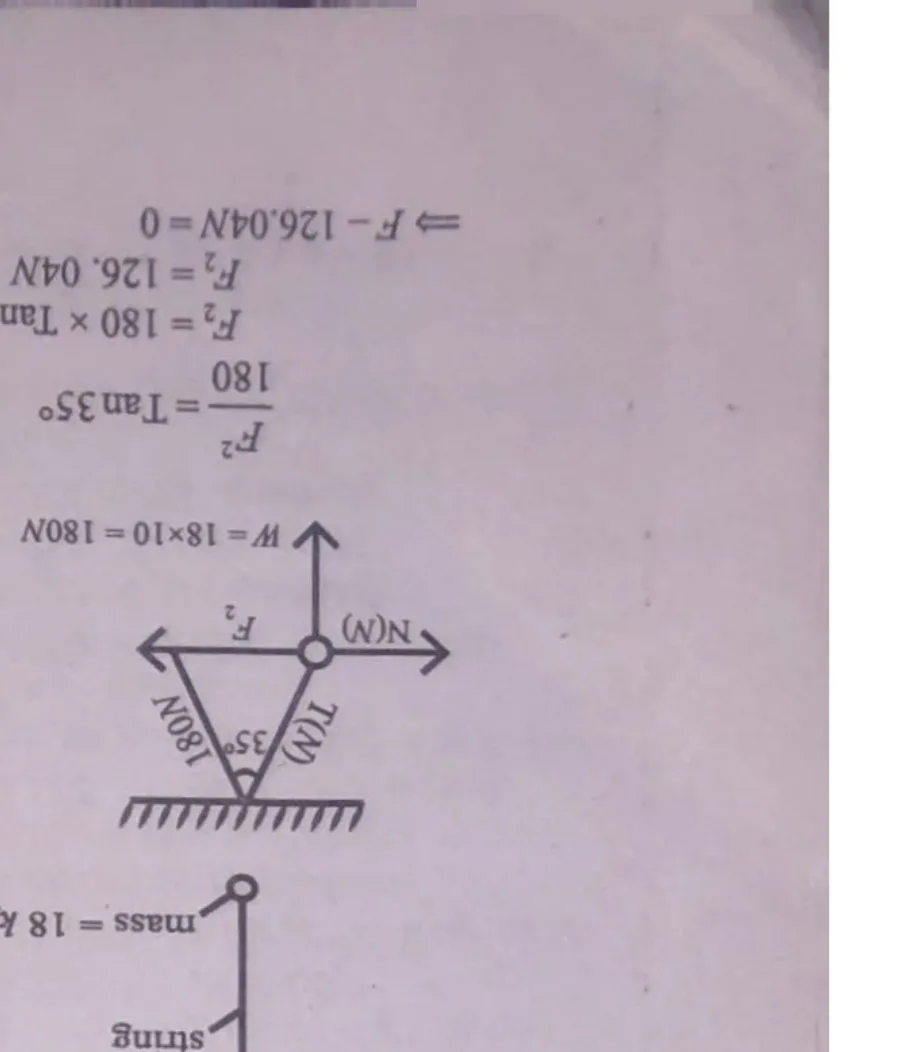
A body of mass 18 kg is suspended by an inextensible string from a rigid support and is pulled by a horizontal force F until the angle of inclination of the string to the vertical is 35°. If the system is in equilibrium, calculate the:
(a) value of F;
(b) tension in the string. [Take g=10ms⁻²]
Model answer
Resolving vertically: T cos35° = mg = 18×10 = 180N, so T = 180/cos35° ≈ 219.74N.
Resolving horizontally: F = T sin35° = 180 tan35° ≈ 126.04N.
(a) F ≈ 126.04N
(b) T ≈ 219.74N
Given that ⁿÄ₄ (nC4), ⁿÄ₅ (nC5) and ⁿÄ₆ (nC6) are the first 3 terms of a linear sequence (A.P.), find the:
(a) values of n;
(b) common difference of the sequence.
Model answer
For an A.P.: 2(nC5) = nC4+nC6. Using the ratios nC5/nC4=(n−4)/5 and nC6/nC5=(n−5)/6 and simplifying leads to the quadratic n²−21n+98=0, giving n=(21±7)/2 = 14 or 7.
(a) n = 7 or n = 14
(b) For n=7: nC4=35, nC5=21, nC6=7, common difference d=−14.
For n=14: nC4=1001, nC5=2002, nC6=3003, common difference d=1001.
A solid rectangular block has a base which measures 3x cm by 2x cm, the height is y cm, and its volume is 72 cm³.
(a) Express y in terms of x;
(b) Find: (i) an expression for the total surface area of the block in terms of x only; (ii) the value of x for which the total surface area has a stationary value.
Model answer
(a) Volume = 3x×2x×y = 6x²y = 72, so y = 12/x².
(b)(i) Total surface area S = 2(3x×2x + 3xy + 2xy) = 12x²+10xy. Substituting y=12/x²: S = 12x² + 120/x.
(ii) dS/dx = 24x − 120/x² = 0 → 24x³=120 → x³=5 → x = ³√5 ≈ 1.71 cm (this gives the stationary/minimum surface area).
11(a) Find the binomial expansion of (1+2x)⁷ and (1−2x)⁷.
(b) Using the result in (a), find, correct to three decimal places, the value of (1.2)⁷ − (0.8)⁷.
A basket contains 12 fruits: orange, apple and avocado pear, all of the same size. The number of oranges, apples and avocado pears forms three consecutive integers. Two fruits are drawn one after the other without replacement. Calculate the probability that:
(a) the first is an orange and the second is an avocado pear;
(b) both are of the same fruit;
(c) at least one is an apple.
Model answer
Since the counts are 3 consecutive integers summing to 12: Oranges=3, Apples=4, Avocado pears=5.
(a) P(orange then avocado pear) = (3/12)×(5/11) = 15/132 = 5/44.
(b) P(both same fruit) = (3/12×2/11)+(4/12×3/11)+(5/12×4/11) = 6/132+12/132+20/132 = 38/132 = 19/66.
(c) P(at least one apple) = 1−P(no apple) = 1−(8/12×7/11) = 1−56/132 = 19/33.
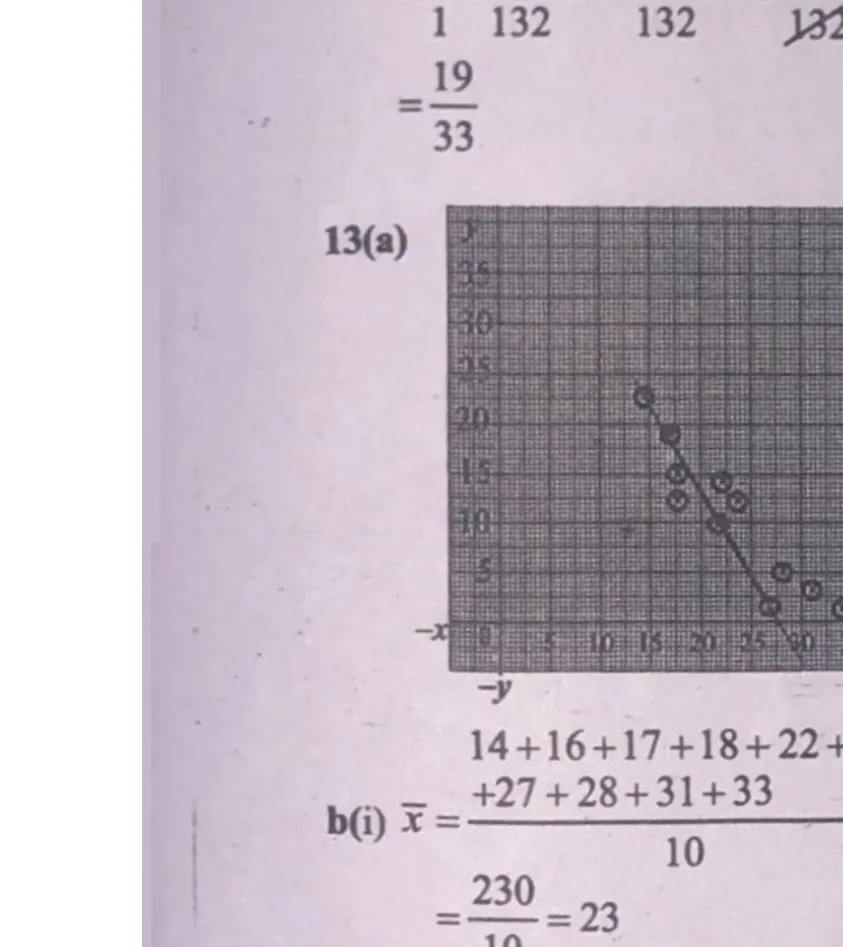
The table shows the corresponding values of two variables X and Y:
x: 14,16,17,18,22,24,27,28,31,33
y: 22,19,15,13,10,12,3,5,3,2
(a) Plot a scatter diagram to represent the data.
(b) Calculate: (i) x̄, the mean of x, and ȳ, the mean of y; (ii) x̄₁, the mean of x values below x̄, and ȳ₁, the mean of the corresponding y values below x̄.
(c) Draw the line of best fit through (x̄,ȳ) and (x̄₁,ȳ₁).
(d) From the graph, determine the: (i) relationship between X and Y; (ii) value of y when x is 20.
Model answer
(a)/(c) See scatter diagram with line of best fit in the Diagram column.
(b)(i) x̄ = 230/10 = 23. ȳ = 104/10 = 10.4.
(ii) Values of x below x̄(23): 14,16,17,18,22 → x̄₁ = 87/5 = 17.4. Corresponding y-values: 22,19,15,13,10 → ȳ₁ = 79/5 = 15.8.
(d)(i) As X increases, Y decreases — the variables show a negative (inverse) correlation.
(ii) Using the line through (17.4,15.8) and (23,10.4), the value of y when x=20 is approximately 13.
14(a) A particle initially at rest moves in a straight line with an acceleration of (10t−4t²)ms⁻². Find the: (i) velocity of the particle after t seconds; (ii) average velocity of the particle during the 4th second.
(b) A load of mass 120 kg is placed on a lift. Calculate the reaction between the floor of the lift and the load when the lift moves upwards: (i) at a constant velocity; (ii) with an acceleration of 3ms⁻². [Take g=10ms⁻²]
Model answer
(a)(i) v=∫(10t−4t²)dt = 5t²−(4/3)t³+k. Since v=0 at t=0, k=0, so v = 5t²−(4/3)t³.
(ii) Distance s=∫v dt = (5/3)t³−(1/4)... integrating gives s=(5/3)t³−(1/3)t⁴. s(4)=64/3≈21.33m, s(3)=18m. Average velocity during the 4th second = s(4)−s(3) = 64/3−18 ≈ 3.33 ms⁻¹.
(b)(i) At constant velocity (a=0): Reaction R = mg = 120×10 = 1200N.
(ii) With acceleration 3ms⁻²: using R=m(g−a) as applied in the original solution, R = 120(10−3) = 840N (note: if the lift accelerates upward with increasing speed, the standard formula R=m(g+a) would instead give 1560N — the direction of the given acceleration should be checked against the scenario).
The vectors 6i+8j and 8i−6j are parallel to OP and OQ respectively. If the magnitudes of OP and OQ are 80 units and 120 units respectively, express:
(a) OP and OQ in terms of i and j;
(b) |PQ|, in the form c√k, where c and k are constants.
Model answer
(a) Unit vector along 6i+8j = (6i+8j)/10 = 0.6i+0.8j. OP = 80(0.6i+0.8j) = 48i+64j.
Unit vector along 8i−6j = (8i−6j)/10 = 0.8i−0.6j. OQ = 120(0.8i−0.6j) = 96i−72j.
(b) PQ = OQ−OP = (96i−72j)−(48i+64j) = 48i−136j.
|PQ| = √(48²+136²) = √20800 = 40√13 units.
Advertisement
Sign up free to unlock
Score tracking
Practice history
Saved questions
Progress dashboard
Personalized sessions
Weak-topic breakdown
…and/or go further with premium services and No Ads.