WAEC Further Mathematics 2025 Theory Past Questions
All 16 questions from the West African Examinations Council (WAEC) Further Mathematics 2025 Theory paper, with the correct answer and a full explanation for each. Free, no signup needed.
A binary operation * is defined on the set of real numbers, R, by x*y = 2x+2y-xy/5. Find: (a) the inverse of x under *; (b) the truth set when m*7 = -2*m.
Model answer
(a) We need e such that x*e=x: 2x+2e-xe/5=x, so e(2-x/5)=-x, giving e=x/(x-10). This shows the identity element would depend on x, which is not allowed for a true identity element — so there is NO inverse element under this operation.
(b) m*7 = 2m+14-7m/5; -2*m = -4+2m-(-2m/5)=-4+2m+2m/5. Setting them equal and solving: 2m+14-7m/5 = -4+2m+2m/5 → 18 = 9m/5 → m = 10. Truth set = {10}.
Given that ⁸C₂ + ⁷C₃ - 4x = 0, where x is a positive integer, find the value of x.
Model answer
⁸C₂=28, ⁷C₃=35 (using the general expansion x(x-1)/2! and x(x-1)(x-2)/3! forms with n=8,7). Simplifying x(x-1)/2 + x(x-1)(x-2)/6 - 4x = 0, multiplying through by 6 and factorising gives x(x²-25)=0, so x=0, 5, or -5. Since x is a positive integer, x = 5.
Resolve (2x-7)/(25x-24-6x²) into partial fractions.
Model answer
Factorise the denominator: 25x-24-6x² = -(6x²-25x+24) = -(2x-3)(3x-8), so the fraction becomes (7-2x)/[(2x-3)(3x-8)]. Writing 7-2x = A(3x-8)+B(2x-3) and solving (using x=8/3 and x=3/2) gives A=-8/7 and B=5/7. So the partial fractions are: -8/[7(2x-3)] + 5/[7(3x-8)].
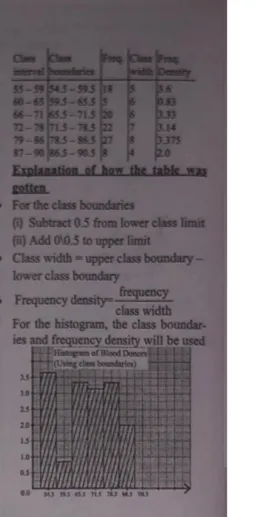
The table shows the distribution of the weights (Newtons) of 100 blood donors: 55-59 (18), 60-65 (5), 66-71 (20), 72-78 (22), 79-86 (27), 87-90 (8). Draw a histogram for the distribution.
Model answer
Using class boundaries (subtract 0.5 from lower limits, add 0.5 to upper limits) and computing class widths and frequency densities (frequency/width): 54.5-59.5 (width 5, density 3.6); 59.5-65.5 (width 6, density 0.83); 65.5-71.5 (width 6, density 3.33); 71.5-78.5 (width 7, density 3.14); 78.5-86.5 (width 8, density 3.375); 86.5-90.5 (width 4, density 2.0). A histogram is then drawn with class boundaries on the x-axis and frequency density on the y-axis, bars drawn to these heights with no gaps between bars.
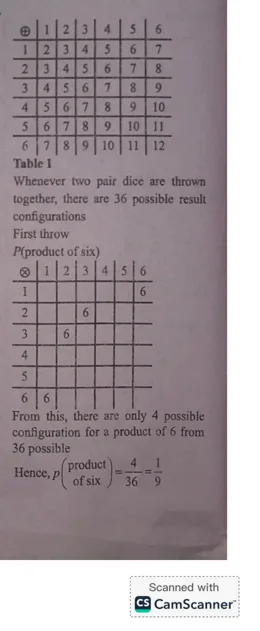
If two fair dice are thrown twice, find the probability of obtaining a product of six in the first throw and a sum of eight in the second throw.
Model answer
There are 36 equally likely outcomes per throw. P(product of 6 in first throw): pairs (1,6),(6,1),(2,3),(3,2) = 4/36 = 1/9. P(sum of 8 in second throw): pairs (2,6),(6,2),(3,5),(5,3),(4,4) = 5/36. Required probability = (1/9) × (5/36) = 5/324.
A light inextensible string passes over a smooth pulley and carries masses 4 kg and 3 kg at its ends. The masses are released from rest, calculate: (a) their acceleration; (b) their speed after 3 seconds. [Take g = 10 ms⁻²]
Model answer
Weights: 3kg → 30N, 4kg → 40N. Since the 4kg mass is heavier, it accelerates downward.
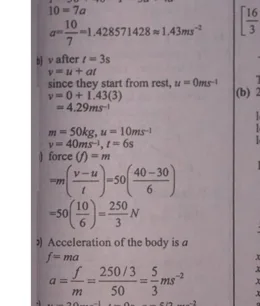
For the 3kg mass: T-30=3a. For the 4kg mass: 40-T=4a. Adding: 10=7a, so a = 10/7 ≈ 1.43 ms⁻².
(b) v = u+at = 0+1.43(3) = 4.29 ms⁻¹.
A force of F N acts on a body of mass 50 kg and changes its velocity from 30 ms⁻¹ to 40 ms⁻¹ in 6 seconds. Find: (a) the magnitude of the force; (b) the acceleration of the body; (c) the distance covered in 9 seconds when the initial velocity is 30 ms⁻¹. [Take g = 10 ms⁻²]
Model answer
(a)&(b) a = (v-u)/t = (40-30)/6 = 5/3 ms⁻². Force F = ma = 50 × 5/3 = 250/3 ≈ 83.3 N.
(c) With u=30 ms⁻¹, a=5/3 ms⁻², t=9s: s = ut + ½at² = 30(9) + ½(5/3)(81) = 270+67.5 = 337.5 m.
Given that ∫₁ₘ⁻(2x²-x-3)dx = -9/2 where m is an integer, find the value of m.
Model answer
Integrating: [2x³/3 - x²/2 - 3x] evaluated from -1 to m = -9/2. Substituting the limits and simplifying leads to the cubic equation 4m³-3m²-18m+16=0. Testing integer values, m=2 satisfies the equation (4(8)-3(4)-36+16=0). So m = 2.
Solve 2(log₃x - 1) = log₃x and y = √x+1 simultaneously.
Model answer
From 2(log₃x-1)=log₃x: 2log₃x-2=log₃x, so log₃x=2, meaning log₃(x²/9)=log₃x is consistent, giving x²-9x=0, so x=0 or x=9. Since x must be a positive integer, x=9 (x=0 is rejected as log is undefined there). For y=√x+1: when x=9, y=√9+1=4 (and the trivial case x=0 gives y=1). Solution: (x,y) = (9,4).
Given that ⁸Cₓ, ⁷Cₓ, and 7/6(⁶Cₓ) form the first three consecutive terms of an exponential sequence (G.P.), find: (a) the value of x; (b) the common ratio of the sequence; (c) the sum of the first ten terms of the sequence.
Model answer
(a) Setting up the G.P. condition (⁷Cₓ)² = ⁸Cₓ × (7/6)⁶Cₓ and simplifying the factorial ratios leads to x=4.
(b) With x=4: ⁸C₄=70, ⁷C₄=35, and 7/6(⁶C₄)=7/6(15)=35/2. So u1=70, u2=35, u3=35/2, giving common ratio r=1/2.
(c) Sum of first 10 terms: S₁₀ = a(1-r¹⁰)/(1-r) = 70(1-1/1024)/(1/2) = 70(1023/1024)×2 = 35805/256.
(a) Express [(4+√7)/(4-√7)]² - [(4-√7)/(4+√7)]² in the form p+q√7, where p and q are real numbers.
(b) Two functions f and g are defined on the set of real numbers by f:x→√[(16-x²)/(x²+4)] and g:x→(x²-4)/(8-x²), x≠±2√2. Find: (i) the domain of f; (ii) g∘f(x).
Model answer
(a) Using the difference of two squares and rationalising, the expression simplifies to 0 + (736/81)√7, i.e. p=0 and q=736/81.
(b)(i) For f(x) to be real, (16-x²)/(x²+4) ≥ 0. Since x²+4>0 always, we need 16-x²≥0, i.e. -4≤x≤4. Domain: {x : -4 ≤ x ≤ 4}.
(ii) g∘f(x) = g(f(x)) = [f(x)²-4]/[8-f(x)²]. Substituting f(x)²=(16-x²)/(x²+4) and simplifying gives g∘f(x) = -5x²/(9x²+16).
If the mean and standard deviation of the numbers x, 2.5, y and 7 are 4 and √(31/10) respectively, find the values of x and y where x < y.
Model answer
Mean = (x+2.5+y+7)/4 = 4, so x+y = 16-9.5 = 6.5, i.e. x+y=16-7-2.5 → x+y=6.5 (equation i).
Standard deviation: √[Σ(x-mean)²/n] = √(31/10). Squaring and substituting y=6.5-x from (i), then expanding, gives the quadratic 2x²-13x+21.1=0. Solving with the quadratic formula gives x≈3.36 or x≈3.14. Since x<y, taking x=3.14 gives y=6.5-3.14=3.36. So x=3.14 and y=3.36.
An association is made up of 10 journalists and 9 engineers. If a committee of 4 members is to be formed from the association, find the probability that it will consist of: (a) at least two engineers; (b) 75% journalists; (c) an odd number of engineers.
Model answer
Total ways to choose any 4 from 19 people = ¹⁹C₄ = 3876... (recomputed as 4845 using 19!/(4!15!)).
(a) At least 2 engineers = (2 eng,2 journ)+(3 eng,1 journ)+(4 eng,0 journ) = ⁹C₂¹⁰C₂+⁹C₃¹⁰C₁+⁹C₄¹⁰C₀ = 1620+840+126 = 2586. Probability = 2586/4845 ≈ 0.534.
(b) 75% journalists means 3 journalists and 1 engineer: ¹⁰C₃¹⁹C₁ = 120×9 = 1080. Probability = 1080/4845 = 72/323 ≈ 0.223.
(c) Odd number of engineers means 1 or 3 engineers: (1 eng,3 journ)+(3 eng,1 journ) = ⁹C₁¹⁰C₃+⁹C₃¹⁰C₁ = 1080+840 = 1920. Probability = 1920/4845 = 128/323 ≈ 0.396.
(a) Five forces acting on a particle are represented by (2i+3j), (4i-7j), (-5i+8j), (i+j) and (pi+qj), where p,q∈R. If the particle is in equilibrium, find the values of p and q.
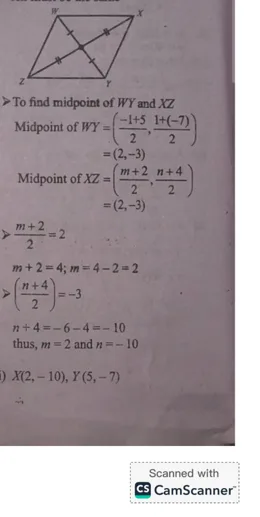
(b) WXYZ is a parallelogram whose vertices are W(-1,1), X(m,n), Y(5,-7) and Z(2,4). Find: (i) values of m and n; (ii) the unit vector in the direction of XY.
Model answer
(a) For equilibrium, the sum of all forces must be zero. Adding the i and j components: (2+4-5+1+p)=0 gives p=-2; (3-7+8+1+q)=0 gives q=-5.
(b)(i) In a parallelogram WXYZ, diagonals WY and XZ bisect each other, so their midpoints are equal. Midpoint of WY = (2,-3). Setting midpoint of XZ = (2,-3): (m+2)/2=2 gives m=2; (n+4)/2=-3 gives n=-10.
(ii) X=(2,-10), Y=(5,-7). XY = Y-X = (3,3), |XY|=√18=3√2. Unit vector = (1/3√2)(3,3) = (√2/2, √2/2), i.e. (√2/2)i + (√2/2)j.
An object is thrown vertically upwards from the top of a building 20 m high. If the object passes the point it was thrown from after 4 seconds, find: (a) the velocity at which the object was thrown; (b) the time taken when the object is 10 m above the level it was thrown; (c) the time taken when the object is 10 m below the level it was thrown; (d) the velocity with which the object hits the ground. [Take g = 10 ms⁻²]
Model answer
(a) Since it returns to the throwing point after 4s, time to reach maximum height = 2s. At max height v=0: 0=u-g(2) → u=20 ms⁻¹.
(b) Using s=ut-½gt² with s=10: 10=20t-5t² → 5t²-20t+10=0 → t²-4t+2=0. Solving: t = 2±√2, giving t≈3.414s or t≈0.586s.
(c) Using s=-10 (below throwing point): -10=20t-5t² → 5t²-20t-10=0 → t²-4t-2=0. Solving: t = 2±√6, giving t≈4.45s (taking the positive root).
(d) The ground is 20m below the throw point, so s=-20: v²=u²+2gs = 20²+2(10)(20) [taking downward as positive with magnitudes] = 400+400=800, so v=√800=20√2 ≈ 28.28 ms⁻¹ (downwards).
Advertisement
Sign up free to unlock
Score tracking
Practice history
Saved questions
Progress dashboard
Personalized sessions
Weak-topic breakdown
…and/or go further with premium services and No Ads.