Mathematics 2012 Objective — Question 1
Express 302.10495 correct to five significant figures.
- A. 302.10Correct
- B. 302.11
- C. 302.105
- D. 302.1049
Explanation
302.10495 correct to 5 significant figures = 302.10.
All 50 questions from the West African Examinations Council (WAEC) Mathematics 2012 Objective paper, with the correct answer and a full explanation for each. Free, no signup needed.
Advertisement
Express 302.10495 correct to five significant figures.
302.10495 correct to 5 significant figures = 302.10.
Simplify: (3√5×4√6)/(2√2×3√3)
(3√5×4√6)/(2√2×3√3) = 12√30/6√6 = 2√(30/6) = 2√5.
In 1995, the enrollments of two schools X and Y were 1,050 and 1,190 respectively. Find the ratio of the enrollments of X to Y.
Ratio 1050:1190; divide through by 70 = 15:17.
Convert 35(10) to a number in base 2.
35 in base 10 = 100011 in base 2.
The nth term of a sequence is Tn = 5 + (n−1)². Evaluate T4 − T6.
T4 = 5+(4−1)² = 5+9 = 14. T6 = 5+(6−1)² = 5+25 = 30. T4−T6 = 14−30 = −16.
Mr. Manu travelled from Accra to Pamfokrom, a distance of 720km in 8 hours. What will his speed be in m/s?
Distance in m = 720×1000 = 720,000m. Time in s = 8×3600 = 28,800s. Speed = distance/time = 720,000/28,800 = 25m/s.
If ₦2,500.00 amounted to ₦3,500.00 in 4 years at simple interest, find the rate at which the interest was charged.
I = PRT/100. I=1000, P=2500, T=4. 1000 = (2500×R×4)/100 = 100R. R = 10%.
Solve for x in the equation: 1/x + 2/3x = 1/3
1/x + 2/(3x) = 1/3. Combine: (3+2)/(3x) = 1/3, so 5/(3x)=1/3, 15=3x, x=5.
Simplify: (54k²−6)/(3k+1)
54k²−6 = 6(9k²−1) = 6(3k−1)(3k+1). Dividing by (3k+1): result = 6(3k−1).
Represent the inequality −7<4x+9≤13 on a number line.
−7−9<4x≤13−9 ⇒ −16<4x≤4 ⇒ −4<x≤1. This range (open at -4, closed at 1) is represented by option B.
Make p the subject of the relationship: q = 3p/r + s/2
q = 3p/r + s/2. Multiply through by 2r: 2qr = 6p + rs. So 6p = 2qr−rs, p = (2qr−rs)/6.
If x+y=2y−x+1=5, find the value of x.
From x+y=5 (i) and 2y−x+1=5 i.e. 2y−x=4 (ii). Multiply (i) by 2: 2x+2y=10 (iii). Subtract (ii) from (iii): 3x=6, x=2.
The sum of 12 and one third of n is 1 more than twice n. Express the statement in the form of an equation.
12 + n/3 = 2n+1. Multiply by 3: 36+n = 6n+3. 33 = 5n. So 5n−33=0.
Solve the inequality: −m/2 − 5/4 ≤ 5m/12 − 7/6
Multiplying through by 12 and collecting like terms: −11m≤1, so m≥−1/11 (inequality reverses when dividing by −11).
The curved surface area of a cylindrical tin is 704cm². If the radius of its base is 8cm, find the height. [Take π=22/7]
Curved surface area = 2πrh. 704 = 2×(22/7)×8×h. h = 14cm.
The lengths of the minor and major arcs of a circle are 54cm and 126cm respectively. Calculate the angle of the major sector.
Total arc corresponds to 360°. Angle of major sector = (126/(54+126))×360° = (126/180)×360° = 252°.
A sector of a circle which subtends 172° at the centre of the circle has a perimeter of 600cm. Find, correct to the nearest cm, the radius of the circle. [Take π=22/7]
Perimeter of sector = arc length + 2r. Arc length = (172/360)×2πr. 600 = (172/360)×2×(22/7)×r + 2r, solving gives r ≈ 107cm.
In the diagram above, |QR|=10m, |SR|=8m, ∠QPS=30°, ∠QRP=90° and |PS|=x. Find x.
tan30° = 10/(8+x). 8+x = 10/tan30° = 17.32. x = 17.32−8 = 9.32m.
In ΔXYZ, |XY|=8cm, |YZ|=10cm and |XZ|=6cm. Which of these relations is true?
Since 6²+8²=36+64=100=10², the triangle is right-angled at X, so |XZ|² = |YZ|²−|XY|² (Pythagoras: hypotenuse² = sum of squares of the other two, rearranged).
In the diagram above, O is the centre of the circle PQRS and ∠PSR=86°. If ∠POR=x°, find x°.
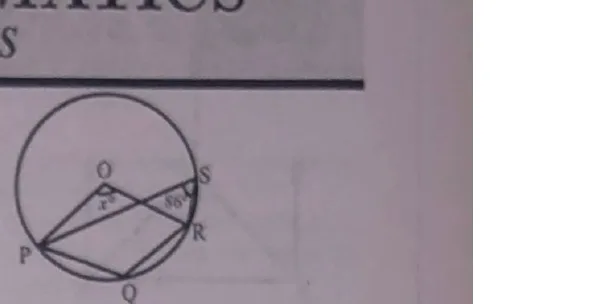
The angle at the centre is twice the angle at the circumference subtended by the same arc: x° = 2×86° = 172°.
The diagram above is a circle centre O. If ∠SPR=2m° and ∠SQR=n°, express m° in terms of n°.
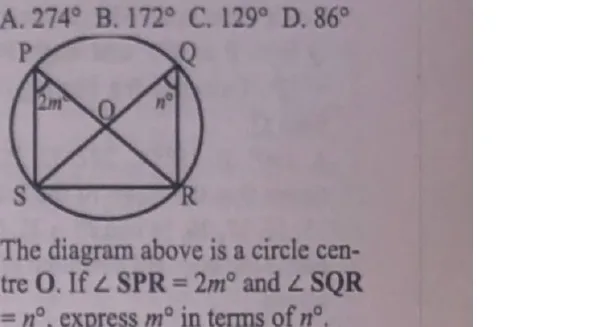
∠SPR and ∠SQR are angles subtended by the same arc SR at the circumference, so they are equal: 2m°=n°, giving m=n/2.
In the diagram above, MQ//RS, ∠TUV=70° and ∠RLV=30°. Find the value of x°.
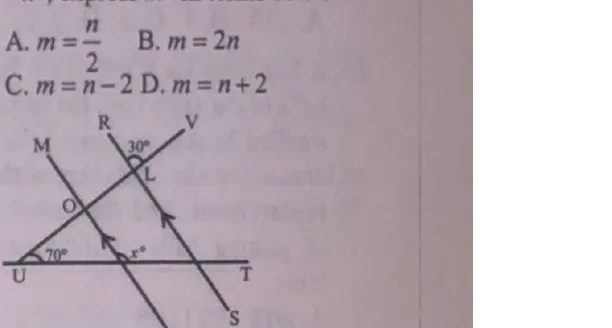
Using the properties of parallel lines and the given angles (alternate/corresponding angles and angles on a straight line), x° is found to be 150°.
In the diagram, MN, PQ and RS are three intersecting straight lines, which of the following statement(s) are true? I. t°=y° II. x°+y°+z°+m°=180° III. x°+m°+n°=180° IV. x°+n°=m°+z°
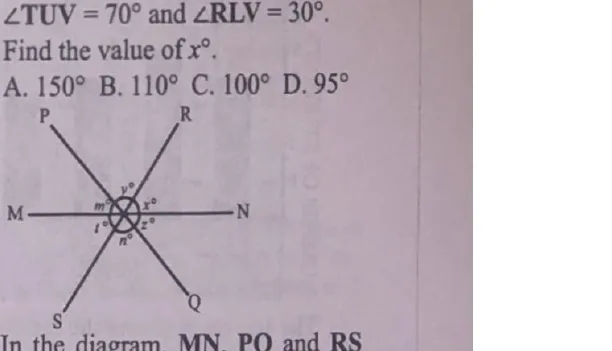
Using vertically opposite angles (giving t°=y°, statement I) and angle relationships around the point of intersection, statement IV also holds; the other statements do not hold generally. So I and IV only are true.
If cos(x+40)°=0.0872, what is the value of x?
cos⁻¹0.0872 = 85°. So x+40=85, x=45°.
A kite flies on a taut string of length 50m inclined at an angle of 54° to the horizontal ground. The height of the kite above the ground is
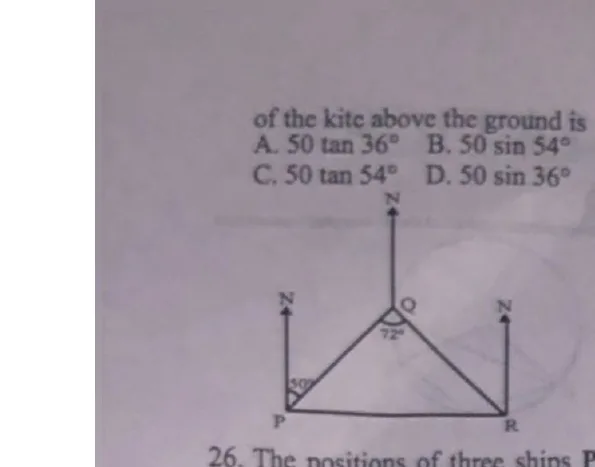
Height = string length × sin(angle of inclination) = 50 sin54°.
The positions of three ships P, Q and R at sea are illustrated in the diagram. The arrows indicate the North direction. The bearing of Q from P is 050° and angle PQR=72°. Calculate the bearing of R from Q.
Bearing of R from Q = 180°−22° = 158° (using the angle relationships formed by the bearing of Q from P and the given angle PQR).
Given that the mean of the scores 15, 21, 17, 26, 18 and 29 is 21. Calculate the standard deviation of the scores.
Standard deviation = √(Σ(x−x̄)²/n) = √[((15−21)²+(21−21)²+(17−21)²+(26−21)²+(18−21)²+(29−21)²)/6] = √[(36+0+16+25+9+64)/6] = √(150/6) = √25 = 5.
A bag contains 4 red and 6 black balls of the same size. The balls are shuffled briskly and two balls are drawn one after the other without replacement. Find the probability of picking balls of different colours.
P(different colours) = P(R then B) + P(B then R) = (4/10×6/9)+(6/10×4/9) = 24/90+24/90 = 48/90 = 8/15.
Use this bar chart, showing the frequency distribution of marks scored by students in a class test, to answer questions 29 to 31. How many students are in the class?
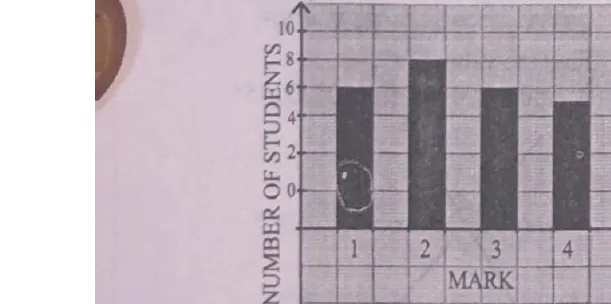
Total number of students = sum of frequencies from the bar chart = 25.
(Using the same bar chart as Q29) Calculate the mean of the distribution.
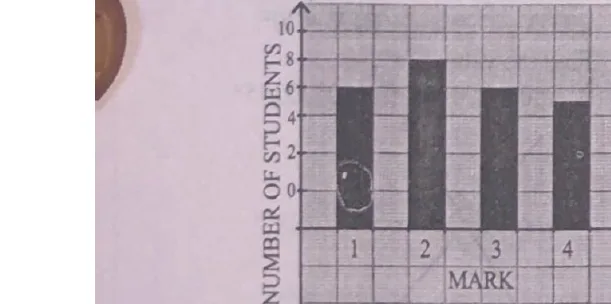
Mean = Σfx/Σf, computed from the bar chart's frequency distribution = 2.4.
(Using the same bar chart as Q29) What is the median of the distribution?
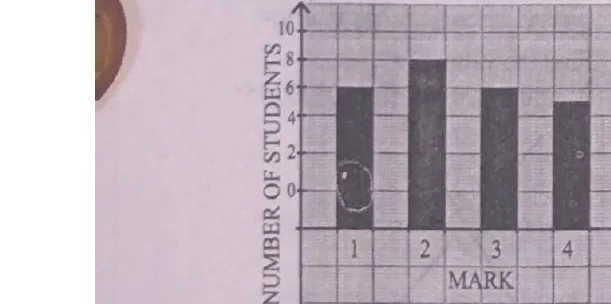
The median, found from the cumulative frequency position of the distribution shown in the bar chart, is 2.
Which of these statements about y=8√m is correct?
y=8√m = 2³×m^(1/2). Taking log of both sides: log y = log2³ + logm^(1/2) = 3log2 + ½logm.
If x+0.4y=3 and y=½x, find the value of (x+y).
Substituting y=½x into x+0.4y=3: x+0.4(½x)=3 ⇒ x+0.2x=3 ⇒ 1.2x=3 ⇒ x=2.5. Then y=½(2.5)=1.25. x+y = 2.5+1.25 = 3.75 = 3¾.
Express 3−[(x−y)/y] as a single fraction.
3−(x−y)/y = (3y−(x−y))/y = (3y−x+y)/y = (4y−x)/y.
Find the coefficient of m in the expansion of (m/2−1½)(m+⅔).
Expanding: (m/2)(m) + (m/2)(⅔) − 1½(m) − 1½(⅔). The coefficient of m comes from (m/2)(⅔) − 1½(m) = m/3 − 3m/2 = (2m−9m)/6 = −7m/6, giving coefficient −1⅙ (i.e. −7/6).
In the diagram above, MN//PO, ∠PMN=112°, ∠PNO=129°, ∠NOP=37° and ∠MPN=y°. Find the value of y°.
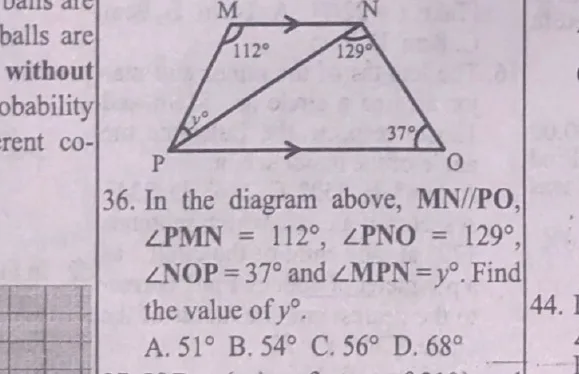
Using angle sum properties of the quadrilateral/parallel lines in the figure, y° = 54°.
If P={prime factors of 210} and Q={prime numbers less than 10}, find P∩Q.
210 = 2×3×5×7, so P={2,3,5,7}. Q={2,3,5,7} (primes less than 10). P∩Q = {2,3,5,7}.
Alfred spent 1/4 of his money on food, 1/3 on clothing and saved the rest. If he saved ₦72,000.00, how much did he spend on food?
Let total money = M. Savings = M − M/4 − M/3 = 5M/12 = 72,000. M = 72,000×12/5 = 172,800. Amount spent on food = M/4 = 172,800/4 = ₦43,200.
Solve (27/125)^(−1/3) × (4/9)^(1/2)
(27/125)^(−1/3) = (125/27)^(1/3) = 5/3. (4/9)^(1/2) = 2/3. Product = (5/3)×(2/3) = 10/9.
The sum of the interior angles of a regular polygon is 1800°. How many sides has the polygon?
Sum of interior angles = (n−2)×180° = 1800°. n−2 = 10. n = 12 sides.
The diagram is a circle with centre O. PRST are points on the circle. Find the value of ∠PRS.
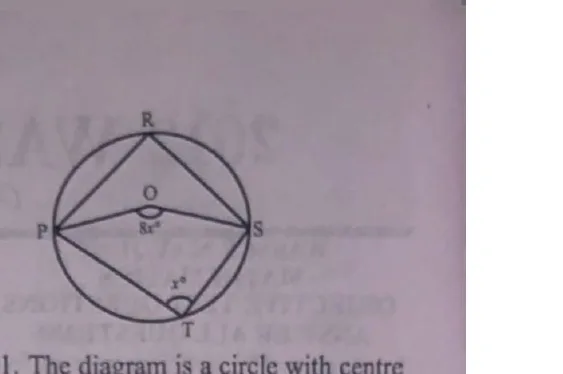
Using the reflex angle at the centre (2×72°=144°, or equivalent) and the circle theorem relating angle at centre to angle at circumference, ∠PRS = 144°.
The diagram above is a circle of radius |OQ|=4cm. Line /TR/ is a tangent to the circle at R. If ∠TPO=120°, find /PQ/.
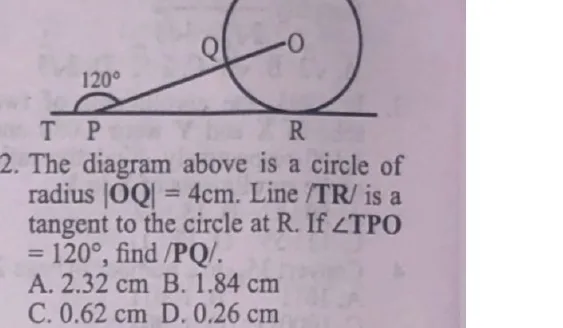
Using sin60° = 4/|PO| (from the tangent-radius right angle and the given angle), |PO| is found, and |PQ| = |PO|−|OQ| ≈ 0.62cm.
If x and y are variables and k is a constant, which of the following describes an inverse relationship between x and y?
An inverse relationship is one where y is proportional to 1/x, i.e. y=k/x.
In the diagram, /SR/=/QR/, ∠SRP=65° and ∠RPQ=48°. Find ∠PRQ.
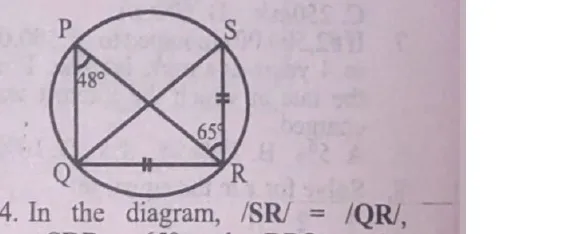
Since /SR/=/QR/, triangle SRQ (or the relevant sub-triangle) is isosceles; using the given angles 65° and 48° and angle sum properties, ∠PRQ = 19°.
The graph is that of y=2x²−5x−3. Use it to answer questions 45 and 46. For what values of x will y be negative?
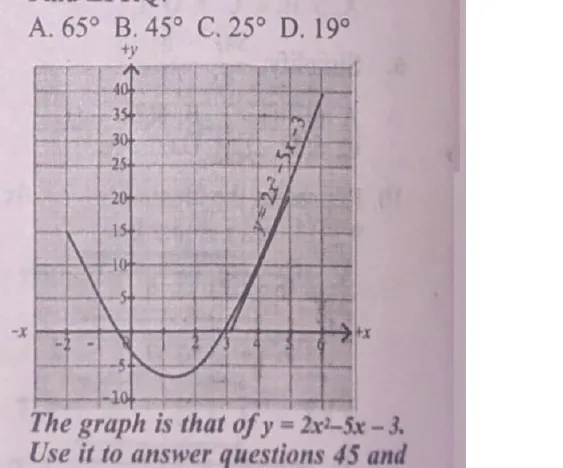
y<0 between the roots of 2x²−5x−3=0, which are x=−½ and x=3 (exclusive, since y=0 exactly at the roots), i.e. −½<x<3.
(Using the same graph as Q45) What is the gradient of y=2x²−5x−3 at the point x=4?
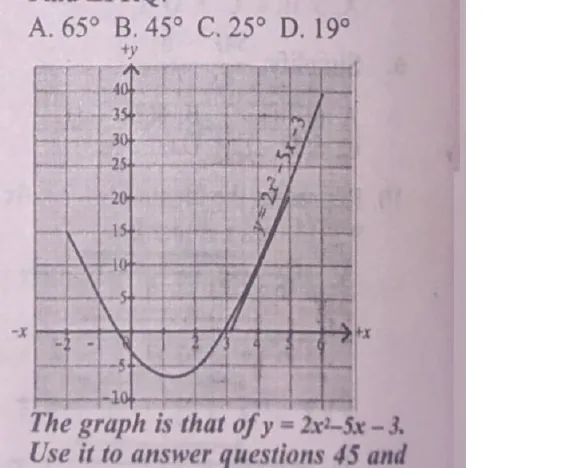
dy/dx = 4x−5. At x=4: dy/dx = 16−5 = 11.
The diagram above is a polygon. Find the largest of its interior angles.
Using the sum of exterior angles of a polygon (=360°) and the given angle expressions in the figure, the largest interior angle = 180°−30° = 150°.
The volume of a cuboid is 54cm³. If the length, width and height are in the ratio 2:1:1 respectively, find its total surface area.
Let L:B:H = 2:1:1, so L=2H, B=H. Volume = L×B×H = 2H×H×H = 2H³ = 54, H³=27, H=3. So L=6, B=3, H=3. Total surface area = 2LB+2LH+2BH = 2(6×3)+2(6×3)+2(3×3) = 36+36+18 = 90cm².
A side and a diagonal of a rhombus are 10cm and 12cm respectively. Find its area.
Half the given diagonal = 6cm. Using Pythagoras with side 10cm: the half of the other diagonal = √(10²−6²) = √64 = 8cm, so the other diagonal = 16cm. Area = ½×d1×d2 = ½×12×16 = 96cm².
Factorise completely: 32x²y−48x³y²
The highest common factor of 32x²y and 48x³y² is 16x²y. 32x²y−48x³y² = 16x²y(2−3xy).
Advertisement
…and/or go further with premium services and No Ads.