All 19 questions from the West African Examinations Council (WAEC) Mathematics 2025 Theory paper, with the correct answer and a full explanation for each. Free, no signup needed.
Given that μ = {x : 1 < x < 20, where x is an integer}, P = {x : x is a multiple of 3} and Q = {x : x is a prime number} where P and Q are subsets of μ, find:
(a) P ∩ Q′
(b) P′ ∪ Q
(c) (P ∪ Q)′
The product of the ages of Adu and Tanko is 9 less than Akorfa's age. If Tanko is 4 years older than Adu and Akorfa's age is six times Tanko's age, find Akorfa's age.
Model answer
Let Adu's age = x
Tanko = x + 4
Akorfa = 6(x + 4)
x(x+4) = 6(x+4) − 9
x² + 4x = 6x + 24 − 9
x² − 2x − 15 = 0
(x+3)(x−5) = 0 → x = 5
Akorfa = 6(5+4) = 54 years
A company installs solar panels to reduce electricity cost. Monthly savings S is modelled by S = 200 + 50x − 2x², where x is the number of months after installation.
(a) At what time will the savings on electricity stop increasing?
(b) Find the maximum savings.
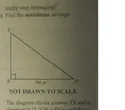
The diagram shows a tower TR and an observer at O. |OR| = 84 m and the angle of elevation of the top T from O is 57°.
(a) Calculate, correct to three significant figures, the height of the tower.
(b) The observer at O moved away from the tower in the same straight line until the angle of elevation of T is 49°. Find, correct to two decimal places, how far the observer moved backwards.
Model answer
(a) tan 57° = |TR|/84
|TR| = 84 × tan 57° = 84 × 1.5399 ≈ 129 m
(b) Let x = backward distance
tan 49° = 129.3516/(x + 84)
x + 84 = 129.3516/tan 49°
x + 84 = 112.444
x = 112.444 − 84 = 28.44 m
The data represent scores of 9 applicants in an interview arranged in ascending order:
(3x+2), 22, (4x−2), 23, 25, (5x−4), 29, 29 and (x²−7).
(a) Given that the range is 9, find:
(i) value of x
(ii) mean mark of the applicants.
(b) If four of the applicants who obtained the highest score were selected, determine the pass mark.
Model answer
(a)(i) Range = Highest − Lowest = 9
(x²−7) − (3x+2) = 9
x²−3x−9 = 9 → x²−3x−18 = 0
(x+3)(x−6) = 0 → x = 6
(a)(ii) Mean = (20+22+22+23+25+26+29+29+29)/9
Substituting x=6 → mean = 25
(b) Pass mark = 26 (4th highest score)
In a certain year, the consumption pattern of electricity charges in a town:
• Cost of first 30 units = $1.00/unit
• Cost of next 30 units = $7.00/unit
• Cost of each additional unit = $5.00
(a) If Amaka used 420 units in January, calculate the amount paid.
(b) If Amaka paid $2,740.00 in February, calculate the number of units consumed.
(c) Find, correct to two decimal places, the percentage change in units of electricity consumed by Amaka in January and February.
Model answer
(a) Cost = 30×$1 + 30×$7 + 360×$5
= $30 + $210 + $1,800 = $2,040.00
(b) Remaining after first 60 units cost:
$2,740 − $30 − $210 = $2,500
Units = 2500/5 = 500
Total = 500 + 30 + 30 = 560 units
(c) Change = 560 − 420 = 140 units
% change = (140/420) × 100 = 33.33%
Yaro drove from town Gaja to Banga. After 2 hours in the journey, he observed that he had covered 80 km and realized that if he continued at the same average speed, he would end up being late for 15 minutes. If he increased the average speed by 10 km/h, he would arrive at Banga 36 minutes earlier. Find the distance between Gaja and Banga.
Model answer
Initial speed = 80/2 = 40 km/h
Scheduled time = (x/40 − 15/60) hr
Remaining distance = (x − 80) km at 50 km/h
Scheduled time = 2 + (x−80)/50
With 36 min saved: x/40 − 15/60 = 2 + (x−80)/50 − 36/60
Solving: 5(x−10) = 4(x+50)
5x − 50 = 4x + 200
x = 250 km
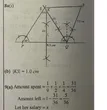
8(a). Using a ruler and a pair of compasses only, construct:
(i) A quadrilateral PQRS such that |PQ| = 8.5 cm, |QR| = 7.5 cm, ∠QPS = 60°, ∠PQR = 105° and S is a point on the locus L₁ which is equidistant from PQ and QR. Find PQ and QR.
(ii) Locus L₂ of points equidistant from P and Q.
(iii) Locate the point K, which is the point of intersection of L₁ and L₂.
(b) Measure |KS|.
Model answer
(a) Construction steps:
(i) Draw PQ = 8.5 cm. At P construct 60°; at Q construct 105°. Mark R at 7.5 cm from Q. Bisect angle PQR to find L₁.
(ii) Construct perpendicular bisector of PQ → L₂.
(iii) K = intersection of L₁ and L₂.
(b) |KS| = 1.0 cm
9(b). A sector of a circle of radius 6 cm subtends an angle of 105° at the centre. Calculate the:
(i) perimeter;
(ii) area of the sector. [Take π = 22/7]
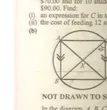
10(a). The cost C of feeding some students in a class is partly constant and partly varies as the number of students n. For 8 students the cost is $70.00 and for 10 students the cost is $90.00. Find:
(i) An expression for C in terms of n.
(ii) The cost of feeding 12 students.
Model answer
(i) C = K₁ + K₂n
K₁ + 8K₂ = 70 ...(1)
K₁ + 10K₂ = 90 ...(2)
2K₂ = 20 → K₂ = 10; K₁ = −10
∴ C = −10 + 10n
(ii) When n = 12:
C = −10 + 10(12) = $110.00
11(b). A bag contains 8 red balls and some white balls, all of the same size. If the probability of drawing at random a white ball from the bag is half the probability of drawing a red ball, find the number of white balls in the bag.
Model answer
Let white balls = n; total = n + 8
P(white) = n/(n+8)
P(red) = 8/(n+8)
n/(n+8) = ½ × 8/(n+8)
n = 4
Number of white balls = 4
12(a). The eighth term of an Arithmetic Progression (A.P.) is 46 and the sum of the first eight terms is 200. Find the:
(i) first term;
(ii) sum of the first 12 terms.
12(b). A bag contains 8 red balls and some white balls. Probability of drawing white is half the probability of drawing red. (See 11b above for solution).
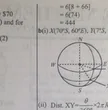
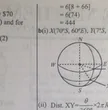
Alternatively: The points X(70°S, 60°E) and Y(7°S, 60°E) lie on the surface of the earth.
(i) Illustrate the information in a diagram.
(ii) Find the distance between X and Y along the meridian. [Take π = 22/7 and R = 6,400 km]
Model answer
(i) See diagram — both points lie on longitude 60°E, different latitudes.
(ii) θ = 70° − 7° = 63°
Dist. XY = (θ/360°) × 2πR
= (63/360) × 2 × (22/7) × 6400
= 7040 km
13. The following are the marks scored by 20 students in a test:
15 11 17 25 13 15 16 22 24 27
20 22 15 16 15 19 22 24 22 11
(a) Prepare a frequency table for the distribution using class intervals 10−12, 13−15, 16−18...
(b) Calculate the variance of the distribution.
(c) If the pass mark for the test was 16, find the probability that a student selected at random from the class failed.
12(b). A bag contains 8 red balls and some white balls. Probability of drawing white is half the probability of drawing red. (See 11b above for solution).
Alternatively: The points X(70°S, 60°E) and Y(7°S, 60°E) lie on the surface of the earth.
(i) Illustrate the information in a diagram.
(ii) Find the distance between X and Y along the meridian. [Take π = 22/7 and R = 6,400 km]
Model answer
(i) See diagram — both points lie on longitude 60°E, different latitudes.
(ii) θ = 70° − 7° = 63°
Dist. XY = (θ/360°) × 2πR
= (63/360) × 2 × (22/7) × 6400
= 7040 km
13. The following are the marks scored by 20 students in a test:
15 11 17 25 13 15 16 22 24 27
20 22 15 16 15 19 22 24 22 11
(a) Prepare a frequency table for the distribution using class intervals 10−12, 13−15, 16−18...
(b) Calculate the variance of the distribution.
(c) If the pass mark for the test was 16, find the probability that a student selected at random from the class failed.