Physics 2011 Theory — Question 1
PART I - 1(a) What is a vector quantity?
Model answer
A vector quantity is a physical quantity that has both magnitude and direction.
All 39 questions from the West African Examinations Council (WAEC) Physics 2011 Theory paper, with the correct answer and a full explanation for each. Free, no signup needed.
Advertisement
PART I - 1(a) What is a vector quantity?
Model answer
A vector quantity is a physical quantity that has both magnitude and direction.
1(b) Three vectors 3ms⁻¹ N45°W, 12ms⁻¹ W and 5ms⁻¹ S act at a point. (i) Sketch a vector diagram to illustrate the given information. (ii) Calculate the resultant of the vectors.
Model answer
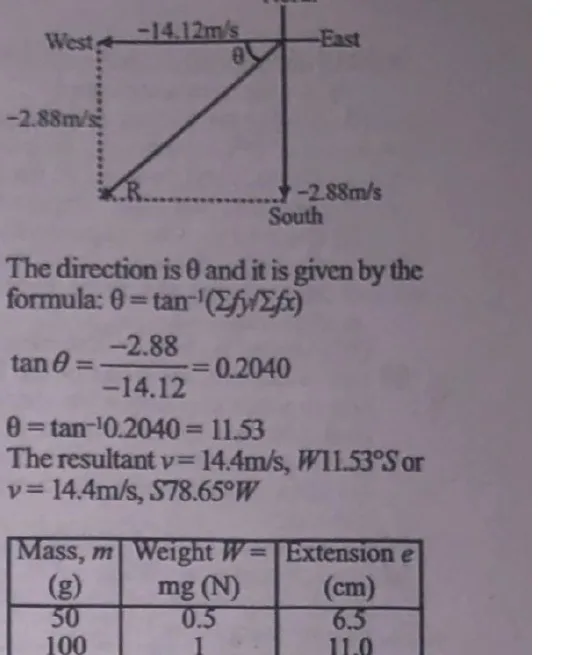
Resolving into horizontal and vertical components: V1(3ms⁻¹, N45°W): horizontal = -3sin45° = -2.12, vertical = 3cos45° = 2.12. V2(12ms⁻¹, W): horizontal = -12, vertical = 0. V3(5ms⁻¹, S): horizontal = 0, vertical = -5. Sum: Vx = -14.12, Vy = -2.88. Resultant V = sqrt(Vx² + Vy²) = sqrt(14.12² + 2.88²) = sqrt(199.37+8.29) = sqrt(207.66) = 14.4 m/s. Direction: tanθ = 2.88/14.12 = 0.204, θ = 11.53°. Resultant v = 14.4m/s, W11.53°S (or S78.65°W).
1(c) In a laboratory experiment to determine the force constant of a spiral spring, the mass on the spring was varied and the corresponding extensions were measured and recorded as shown in the table below. Mass(g): 50,100,150,200,250 | Weight W/N: (to calculate) | Extension e/cm: 6.5, 11.0, 15.0, 20.0, 25.0 (i) Copy and complete the table (Take g = 10 ms⁻²) (ii) Plot a graph of weight, W, on the vertical axis and extension, e, on the horizontal axis. (iii) Using the graph, determine the force constant of the spring. (iv) Determine the natural length of the spring if its length was 38.0 cm when loaded with 250 g mass.
Model answer
(i) Weight W(N) = mass(kg) x g: 0.5, 1.0, 1.5, 2.0, 2.5 N for masses 50g-250g respectively; extension e/m: 6.5x10⁻², 11.0x10⁻², 15.0x10⁻², 20.0x10⁻², 25.0x10⁻² m. (iii) Slope = ΔW/Δe = (W2-W1)/(e2-e1) = (2-0.65)/(20-6.5)x10⁻² = 1.35/13.5x10⁻² = 10 N/m. This slope is the force constant k = 10 N/m. (iv) Extension = final length - original length. When loaded with 250g, extension = 25cm and final length = 38.0cm. Natural (original) length = final length - extension = 38 - 25 = 13cm.
PART II - 2(a) Explain diffusion.
Model answer
Diffusion is the tendency of molecules to migrate to fill an empty space due to their random thermal or molecular motions. In diffusion, the molecules move from a region of high concentration to a region of low concentration.
2(b) Give one reason why the rate of diffusion is higher in gases than in liquids at the same temperature.
Model answer
The rate of diffusion is higher in gases than in liquids because in gases there is more space for the molecules to move, and molecular motion is faster in gases due to weaker intermolecular forces compared with liquids.
3(a) State the difference between plane polarized light and ordinary light.
Model answer
A plane polarized light vibrates in only one direction or plane (perpendicular to the direction of propagation), while an ordinary (unpolarized) light vibrates in different (all) directions.
3(b) State two uses of polaroids.
Model answer
Uses of polaroid: (i) In sunglasses, to reduce the amount of light intensity entering the eye by reducing glare from wet surfaces (blocking some reflected light). (ii) In stress analysis or photo-elasticity. (iii) In the measurement of concentration of sugar solution (saccharimetry) (any two).
4. State: (a) two applications of electrolysis in an industry (b) one application of electrolysis in a school laboratory.
Model answer
(a) Applications of electrolysis in industry: (i) electroplating, (ii) extraction of metals (electrometallurgy), (iii) purification of metals such as copper, silver, gold, aluminium etc, (iv) manufacturing of non-metals such as hydrogen (any two). (b) Application in school laboratory: determination of equivalent mass of elements; manufacturing of compounds such as NaOH; electrolysis of acidified water; calibration of an ammeter (any one).
5(a) The force causing a shrink in fig 1(b) is the upthrust of the water. Given: force constant k = 2.0x10^11 N/m, extension x = 2cm = 2x10⁻² m. Calculate the work done by the force in causing the shrink.
Model answer
Work done by force causing the shrink is given by W = ½kx² = ½ x 2.0x10^11 x (2x10⁻²)² = 4x10^7 J.
6. Explain why water in a narrow glass tube has a concave meniscus while mercury, in the same tube, has a convex meniscus.
Model answer
Water molecules are more strongly attracted to glass molecules than to other water molecules. Thus, adhesive forces are stronger than cohesive forces, resulting in the rise of water level at the edge of a glass container/narrow tube, forming a concave meniscus. In mercury, the cohesion forces are stronger than the adhesive forces, so mercury forms a convex meniscus.
7. State three methods of polarizing an unpolarized light.
Model answer
Methods of polarizing an unpolarized light: (i) using Polaroid, (ii) polarization by reflection, (iii) polarization by double refraction, (iv) polarization by scattering, (v) polarization by selective absorption (any three).
8. An electron of charge 1.60x10⁻¹⁹ C is accelerated under a potential difference of 1.0x10^5 V. Calculate the energy of the electron in joules.
Model answer
Energy of the electron, E = qV = 1.6x10⁻¹⁹ x 1x10^5 = 1.6x10⁻¹⁴ J.
9. State three properties of cathode rays which suggest the particle nature of matter.
Model answer
Properties of cathode rays suggesting particle nature: (i) possession of momentum, (ii) deflection in electric/magnetic fields (suggesting presence of charged tiny granules of matter), (iii) shadow formation (their path is blocked by objects in their path).
10. The uncertainty in determining the duration during which an electron remains in a particular energy level before returning to the ground state is 2x10⁻⁹s. Calculate the uncertainty in determining its energy at that level.
Model answer
The uncertainty principle is expressed by: Δx.Δp ≥ h or ΔE.Δt ≥ h, where h = h/2π = 1.054x10⁻³⁴ Js. Given Δt = 2x10⁻⁹s: ΔE ≥ h/Δt = 1.054x10⁻³⁴/(2x10⁻⁹) = 5.27x10⁻²⁶ J.
11(a) What is a vector quantity? [Please check 2014 obj Q7]
Model answer
A vector quantity is a physical quantity that has both magnitude and direction.
11(b)(i) Three vectors 3ms⁻¹ N45°W, 12ms⁻¹ W and 5ms⁻¹ S act at a point (see repeated question above).
Model answer
See solution to Q1(b) above: horizontal components sum to -14.12, vertical components sum to -2.88.
11(b)(ii) To calculate the resultant of the vectors, we must get the vector resultants for both the horizontal and vertical components.
Model answer
Resultant of the vectors V = sqrt(Vx²+Vy²) = sqrt((-14.12)²+(-2.88)²) = sqrt(199.37+8.29) = sqrt(207.66) = 14.4 m/s. Direction θ = tan⁻¹(2.88/14.12) = 11.53°, so v = 14.4m/s, W11.53°S or S78.65°W.
12(a)(i) Advantages of alcohol over mercury as a thermometer liquid.
Model answer
(I) Alcohol has a lower freezing point of -114°C (mercury freezes at -38.8°C) and thus can be used for measuring very low temperatures. (II) Expansivity: the expansivity of alcohol is about six times that of mercury for the same temperature rise. (III) Alcohol is cheaper than mercury.
12(a)(ii) When the bulb of a thermometer is placed in a beaker of hot water, the level of the mercury first falls and then rises gradually. Explain this observation.
Model answer
This is because the glass of the bulb first expands (since it is in contact with the hot water first) and hence the mercury level falls. But the expansion of the mercury increases more than that of the glass, so at a point the mercury level rises.
12(b) Mass of lead ML = 100 kg, initial temperature of lead = 40°C, melting point of lead = 32°C... [Please check 2012 obj Q25 for full lead heating problem]
Model answer
See worked solution in 12(c) below for the lead heating calculation.
12(c) A block of lead of mass 100 kg in a crucible at a temperature of 40°C was placed in an electric furnace rated 10 kW. If the melting point of lead is 320°C, calculate: (i) quantity of heat required to heat the lead to its melting point (ii) additional heat energy required to melt the lead (iii) time taken to supply this additional energy. (Specific heat capacity of lead = 120 Jkg⁻¹K⁻¹; specific latent heat of fusion of lead = 2.5x10⁴ JK⁻¹)
Model answer
(i) Quantity of heat required to heat the lead to its melting point Q = mLCLΔT = 100x120x(320-40) = 3.36x10^6 J. (ii) Additional heat required to melt the lead = mLlf where lf = latent heat of fusion of lead. Qf = 100x2.5x10^4 = 2.5x10^6 J. (iii) Time taken to supply the additional heat: T = additional heat energy introduced / electric power = 2.5x10^6/10x10^3 = 250s.
12(d) State two precautions necessary in an experiment to determine the specific latent heat of vaporization of water.
Model answer
Precautions: (i) the calorimeter should be well lagged, (ii) the calorimeter should be shielded from the heat source, (iii) the mixture should be gently and continually stirred, (iv) dry steam should be used (any two).
13(a)(i) What is an eclipse?
Model answer
An eclipse is the partial or total blockage/obstruction of a planetary luminous body by another. It occurs when the sun, moon and earth lie in a straight line.
13(a)(ii) List the three types of eclipse.
Model answer
Types of eclipse: solar eclipse, lunar eclipse, annular eclipse.
13(b)(i) A student in a lecture theatre can not read comfortably from a book at a normal distance without a pair of spectacles. What eye defect has this student?
Model answer
The eye defect the student has is long sightedness (hypermetropia). The lens is unable to adjust itself to become thick enough for looking at close objects, so rays are not bent inwards enough to reach the retina before meeting.
13(b)(ii) What type of lens is needed to correct the eye defect?
Model answer
To correct long sightedness, a convex (converging) lens is used. It bends rays inwards a little before it enters the eye.
13(b)(iii) The focal length of the lens used to correct this defect is 10cm. Calculate the power of the lens.
Model answer
Power of lens = 1/focal length. Where focal length = 10cm = 0.1m, Power of lens = 1/0.1 = 10D (dioptre).
13(c) A car B moves towards a stationary car A. If B produces an ultrasonic sound at a point and it takes 5.6x10⁻³s for a beep to be heard in B, calculate the distance between the two cars at that instant. (Speed of sound in air = 340 ms⁻¹)
Model answer
v = 2d/t, so d = vt/2. Given speed of sound v = 340 m/s, time t = 5.6x10⁻³s: d = (340 x 5.6x10⁻³)/2 = 0.952 m.
13(d) The image of an object is located 9cm behind a convex mirror. If the magnification produced is 0.6, calculate the focal length of the mirror.
Model answer
Image distance v = -9cm (behind the mirror), magnification m = v/u = 0.6, so u = v/m = -9/0.6 = -15cm. Using 1/f = 1/u + 1/v: 1/f = 1/(-15) + 1/(-9) = -1/15 - 1/9 = -3/45-5/45 = -8/45? (Using magnitudes as per official solution): 1/f = 1/u - 1/v = 1/15 - 1/9 = (3-5)/45 = -2/45, therefore f = -22.5 cm.
14(a) Explain mutual induction.
Model answer
Mutual induction is a phenomenon whereby a conducting path (or circuit) with changing magnetic flux induces an e.m.f in another conducting path or in a nearby conducting path.
14(b) State four uses of electromagnets.
Model answer
Electromagnets are used in: (i) producing intense magnetic fields such as those required in generators and electric meters, (ii) lifting and transporting heavy pieces of iron and steel, plates, ladders, scrap iron etc, (iii) separating iron from mixtures containing non-magnetic substances, (iv) the operation of electromagnetic devices such as electric bell, telephone earpiece, magnetic relay and circuit breakers.
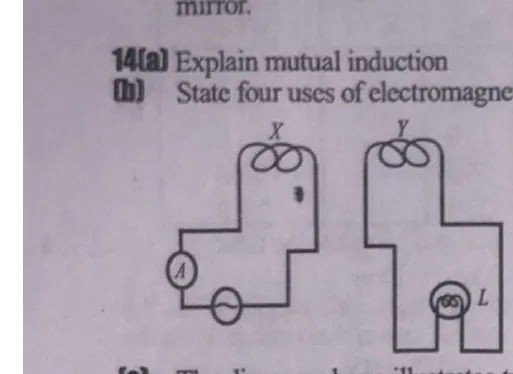
14(c) The diagram above illustrates two coils X and Y arranged so that their axes are collinear. X is connected to an a.c supply and has an ammeter in series with it while Y is connected to a lamp L. Explain the following observations: (i) the lamp is lit when the a.c supply is switched on; (ii) the brightness of the light from the lamp increases when the distance between X and Y is decreased; (iii) the filament of the lamp glows brighter when a bundle of insulated iron wires is placed along the common axis of the coils.
Model answer
(i) The lamp is lit when the a.c supply is switched on because the changing magnetic flux in X induces a corresponding changing magnetic flux in Y, which induces current that lights up the bulb. (ii) The brightness increases when the distance between X and Y decreases because as the distance decreases, the flux density linking coil Y increases, thus increasing the e.m.f/voltage induced in Y and consequently the brightness of the lamp. (iii) The filament of the lamp glows brighter when a bundle of insulated iron wires is placed along the common axis of the coils because the insulated soft iron wires concentrate/increase the magnetic flux through coil Y, thus increasing the e.m.f in Y, making the filament of the lamp glow brighter.
14(d) Two cells, one having an emf of 2.0V and an internal resistance of 0.4Ω and the other having an emf of 2.0V and an internal resistance of 0.1Ω, are connected in parallel. The combination is then connected in series with a 5Ω resistor. (i) Draw a circuit diagram of the arrangement. (ii) Calculate the current through the 5Ω resistor.
Model answer
(i) Circuit: two cells (V1=2.0V, r1=0.4Ω and V2=2.0V, r2=0.1Ω) connected in parallel, in series with a 5Ω resistor. (ii) Since both cells have the same emf (2V), the total voltage across the parallel combination = 2V. The total internal resistance of the parallel combination is given by 1/r = 1/r1 + 1/r2 = 1/0.4+1/0.1 = 2.5+10 = 12.5, so r = 1/12.5 = 0.08Ω. Using V = I(R+r): I = V/(R+r) = 2/(5+0.08) = 0.39 A.
15(a)(i) Explain the term transmutation as it relates to radioactivity.
Model answer
Transmutation is the conversion of one chemical element into another. It entails a change in the structure of atomic nuclei induced spontaneously by radioactive decay such as alpha decay and beta decay.
15(a)(ii) Explain the term stopping potential.
Model answer
The stopping potential is the potential difference of the anode of a photocell with respect to the cathode at which no electrons will reach the anode. In other words, it is the p.d across the plates that is required to stop the most energetic (fastest) photoelectron.
15(b)(i) In the nuclear equation 23/11 A + 2/1 B -> p/q C + proton, A and B, quickly decays to another nucleus E as indicated in the equations above. Determine the values of p, q, r and s.
Model answer
23/11 A + 2/1 B -> p/q C + 1/1 H (proton). Mass number conservation: 23+2 = p+1, so p = 25-1 = 24. Atomic number conservation: 11+1 = q+1, so q = 12-1 = 11. Therefore p/q C = 24/11 C. p/q C -> r/s E + beta particle (0/-1 B): Since p=24 and q=11, and beta emission increases atomic number by 1 while mass number stays the same: r = 24, s = 11+1 = 12. Therefore r/s E = 24/12 E.
15(c)(ii) E = W0 + K.E. A certain metal of work function 1.6eV is irradiated with ultra-violet light of wavelength 3.6x10⁻⁷m. Calculate the maximum kinetic energy of an ejected electron in joules.
Model answer
E = hf = hc/λ = W0 + K.E. Where h=6.6x10⁻³⁴Js, c=3.0x10^8m/s, λ=3.6x10⁻⁷m: hf = (6.6x10⁻³⁴x3.0x10^8)/3.6x10⁻⁷ = 5.5x10⁻¹⁹J. W0 = 1.6eV = 1.6x1.6x10⁻¹⁹ = 2.56x10⁻¹⁹J (approx 2.50x10⁻¹⁹J per official key). K.E. = hf - W0 = 5.5x10⁻¹⁹ - 2.50x10⁻¹⁹ = 2.9x10⁻¹⁹J.
15(c)(iii) Calculate the speed of an emitted electron. (mass of electron = 9.1x10⁻³¹kg)
Model answer
Using K.E. = ½mv², v² = 2xK.E./m = (2x2.9x10⁻¹⁹)/9.1x10⁻³¹ = 6.46x10¹¹, so v = 8.04x10^5 m/s.
15(d) If the source of the ultra-violet light in 15(c) above is moved away from the surface of the metal, state the effect on the maximum speed of the ejected electron.
Model answer
If the source of the ultra-violet light is moved away from the surface of the metal, the intensity of radiation reduces, and this will have no effect on the maximum speed of the ejected electron. The intensity of the incident radiation only affects the number of electrons emitted, not their maximum kinetic energy/speed.
Advertisement
…and/or go further with premium services and No Ads.