All 50 questions from the West African Examinations Council (WAEC) Physics 2024 Objective paper, with the correct answer and a full explanation for each. Free, no signup needed.
The vacuum and silvered surfaces of a vacuum flask walls are to respectively A.
A. minimize conduction and convection and prevent radiation.Correct
B. prevent conduction and convection and minimize radiation.
C. prevent conduction and minimize convection and radiation.
D. minimize conduction and pre-vent conduction and radiation.
Explanation
The vacuum and silvered surfaces of a vacuum flask prevents heat transfer by conduction and convection while the silvered surfaces minimize heat transfer by radiation. This combination helps to maintain the temperature of the contents inside the flask for an extended period of time by reducing all three major modes of heat transfer.
The magnitude of the acceleration of a moving object is equal to the A.
A. gradient of a displacement-time graph.
B. gradient of a velocity-time graph.Correct
C. area below a force-time graph.
D. area below a velocity-time graph.
Explanation
The gradient of a velocity-time graph of a moving object equals its acceleration. The area under the graph represents the total distance it has covered.
In which of the following states is maximum pressure exerted on a person? A.
A. Standing on two feet
B. Standing on one footCorrect
C. Lying on the floor
D. Kneeling on the floor
Explanation
Pressure = Force(weight)/Area. Since pressure varies inversely as area, the smaller the area, the higher the pressure. Standing on one foot, the weight is concentrated on a very small area. Thus, the highest pressure is recorded.
Cathode rays are streams of electrons. They are produced when an electric current is passed through a gas at low pressure, with a high voltage applied between two electrodes. These rays travel from the negatively charged electrode (cathode) to the positively charged electrode (anode).
A. decreases when the separation between the plates decreases.
B. increases when the potential difference between the plates is increased.
C. is greater without a dielectric between the plates.
D. is greater with dielectric between the plates than without dielectric.Correct
Explanation
C=k(epsilon0)A/d, also C=Q/V. When separation (d) decreases, capacitance must increase since they vary inversely to each other. When potential difference increases, capacitance will decrease (inverse relationship). With no dielectric between the plates, k=1; with a dielectric, k>1, so C is greater when a dielectric is between the plates.
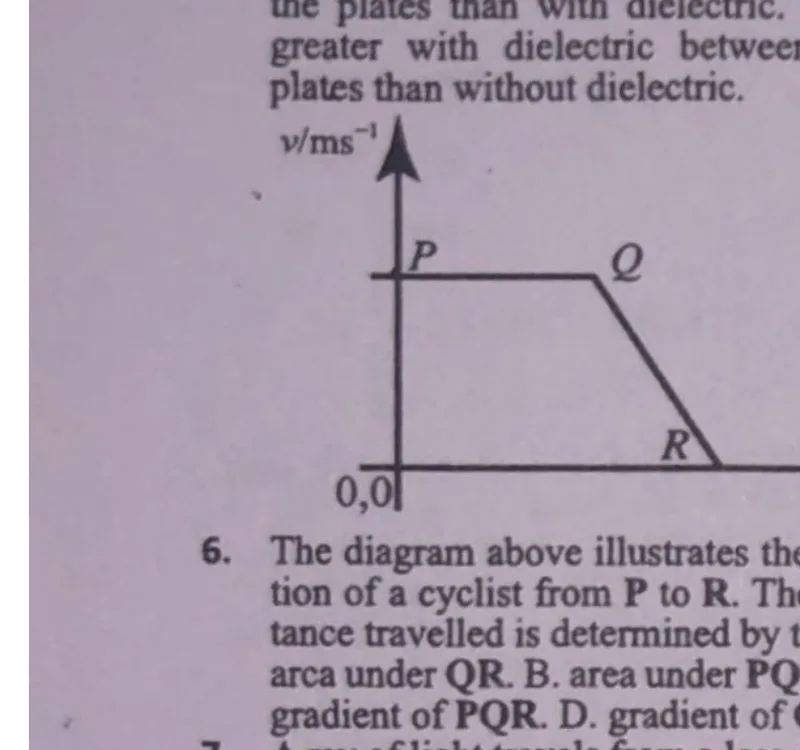
(The diagram above illustrates the motion of a cyclist from P to R.) The distance travelled is determined by the A.
A. area under QR.
B. area under PQR.Correct
C. gradient of PQR.
D. gradient of QR.
Explanation
The distance travelled equals the area under the velocity-time graph. Here, the area is 1/2(a+b)h where a and b represent the length of the two parallel sides, and h the height. NB: the gradient of region QR represents the deceleration/retardation.
A ray of light travels from a less dense medium to a denser medium. How are the speed and frequency of the light affected? A.
A. The speed increases and the frequency increases.
B. The speed decreases and the frequency decreases.
C. The speed increases and the frequency remains the same.
D. The speed decreases and the frequency remains the same.Correct
Explanation
When light travels from one medium to another (of different refractive index), both the wavelength and the velocity will be altered but the frequency remains unchanged.
The function of a fuse in an electric circuit is to A.
A. break the circuit when the current exceeds a certain value.Correct
B. save energy by reducing the voltage.
C. ensure that the current in the circuit exceeds a certain value.
D. save energy by reducing the current.
Explanation
The function of a fuse in an electric circuit is to protect the circuit from excessive current flow. It contains a thin wire that melts and breaks the circuit if the current exceeds a safe level, thereby preventing potential damage to circuit components.
A body moves with uniform velocity when the resultant force on it is A.
A. greater than the frictional force acting on it.
B. less than the frictional force acting on it.
C. equal to zero.Correct
D. equal to the frictional force acting on it.
Explanation
When a body moves with uniform velocity, it means there is no acceleration (the acceleration is zero). Since F=ma, if a=0, then F=0. Thus, for a body to move at uniform velocity, the net/resultant force on the body must be equal to zero.
A stone of mass 200 g attached to a string is made to revolve in a horizontal circle of radius 1.5 m at a steady speed of 5 ms^-1. Calculate the tension in the string at the bottom of the circle. [g=10ms^-2]
A. 5.3 N
B. 3.3 NCorrect
C. 2.0 N
D. 1.3 N
Explanation
T = mv^2/r + mg = (0.2x5^2)/1.5 + 0.2x10 = 0.667+2 = 3.33N ~ 3.3N (per the WAEC key's noted working, accounting for vertical circle tension at the bottom).
To convert a milli-ammeter to an ammeter, it is necessary to connect a resistor of A.
A. low value in series with it.
B. high value in series with it.
C. low value in parallel with it.Correct
D. high value in parallel with it.
Explanation
To convert a milliammeter to ammeter, a low resistance known as shunt must be connected to it in parallel. To convert a milliammeter to voltmeter, a high resistance known as multiplier must be connected to it in series.
An object is placed 1.5 m from a plane mirror. How far is the image of the object? A.
A. 3.0 mCorrect
B. 1.3 m
C. 1.0 m
D. 0.4 m
Explanation
The distance of the object in front of a plane mirror equals the distance of its image at the back of the mirror. Thus, the distance between the object and image = 1.5m + 1.5m = 3.0m.
Chromatic aberration in lenses can be corrected by using a combination of A.
A. diverging and converging lenses.Correct
B. an opaque material to cover the rims of lenses.
C. wide parallel beams on the lens's surface.
D. a thin convex lens.
Explanation
Chromatic aberration in lenses can be corrected by combining two lenses made of different types of glass (usually a convex lens of crown glass and a concave lens of flint glass).
A cube of wood of side 10.0 cm floats vertically in water with 4.5 cm of its length submerged. Calculate the density of the wood. [Density of water=1 gcm^-3]
A. 0.450 gcm^-3Correct
B. 0.203 gcm^-3
C. 0.090 gcm^-3
D. 0.045 gcm^-3
Explanation
Volume of cube=10x10x10=1000cm^3. Volume submerged=10x10x4.5=450cm^3. Mass of water displaced=1gcm^-3 x 450cm^3=450g. By the principle of flotation, mass of cube = mass of water displaced = 450g. Density of cube = 450g/1000cm^3 = 0.45gcm^-3.
All of the following uses are practical applications of x-ray except A.
A. the treatment of tumours.
B. determining the depth of a mine.Correct
C. operational data on porosity.
D. detecting fracture in bones.
Explanation
X-ray can be used in the treatment of tumours, in dental operation and in detecting fracture in bones. Its application does not include determining the depth of a mine (which uses seismic reflection, ground-penetrating radar (GPR) and electromagnetic surveys).
Two isolated charged spheres each of magnitude +1.0x10^-6 C are separated by a distance of 2.0x10^-1 m. Calculate the magnitude of the electrostatic force between them. [K=1/(4*pi*epsilon0)=9x10^9 Nm^2c^-2]
In the circuit diagram above, which lamp causes the other to go off?
A. P
B. Q
C. R
D. SCorrect
Explanation
If lamp S goes off, all other lamps will clearly go off. This is because lamp S is required to complete the whole circuit. If any other lamp goes off, some other lamps will still be on.
A particle of mass 3.6x10^-6 kg revolving around the earth has a radial acceleration of 4.3x10^7 ms^-2. Calculate the centripetal force of the particle.
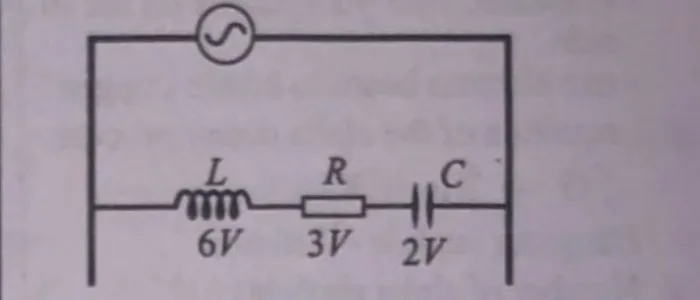
(Use the circuit diagram to answer this question: a constant voltage source supplies a sinusoidal alternating e.m.f. The voltage marked against the components are their peak values: L=6V, R=3V, C=2V.) Determine the peak value of the applied e.m.f.
A. 1 VB.
B. 4 V.
C. 5 VD.
D. 1 VCorrect
Explanation
In an RLC circuit, effective voltage V=sqrt(VR^2+(VL-VC)^2) = sqrt(3^2+(6-2)^2) = sqrt(9+16) = sqrt(25) = 5V.
A body of mass, m is projected vertically upward with a velocity, y. At what position will the potential energy be maximum?
A. y^2/g
B. 2y^2/g
C. y^2/2gCorrect
D. y^2/4g
Explanation
The potential energy will be maximum at the maximum height (since P.E.=mgh), and H_max = u^2sin^2(theta)/2g. For vertical projection, this reduces to y^2/2g.
Light of energy 1.12x10^-18 J is incident on a metal of ejected electrons with maximum energy of 8.0x10^-19 J. Calculate the threshold frequency of the metal. [h=6.626x10^-34 Js]
An object 2.0 cm high is placed at the radius of curvature of a concave mirror such that it is perpendicular to the principal axis of the mirror. Determine the height of the image.
A. 0.5 cm
B. 1.0 cm
C. 1.5 cm
D. 2.0 cmCorrect
Explanation
When an object is placed at the centre of curvature of a concave mirror, an image which is the same size as the object will be formed.
(The diagram illustrates two boxes P and Q of masses 27.3 kg and 6.2 kg respectively on a smooth horizontal surface. If a force of F of 150N is applied to the combined forces.) Calculate the acceleration.
A. 4.5 ms^-2Correct
B. 33.5 ms^-2
C. 70 ms^-2
D. 150 ms^-2
Explanation
Total mass = 27.3+6.2 = 33.5kg. F=ma. 150=33.5a. a=150/33.5=4.5ms^-2.
A boy of mass 40 kg jumps off a stationary skateboard and moves horizontally with a speed of 1.5 ms^-1 while the skateboard moves in the opposite direction with a speed of 20 ms^-1. Calculate the mass of the skateboard.
A. 60 kg
B. 40 kg
C. 3 kgCorrect
D. 2 kg
Explanation
By conservation of momentum, total initial momentum=0 (both at rest). 0=mb.vb+ms.vs = (40x1.5)+ms(-20). 20ms=60. ms=3kg.
The depolarizing agent in a Leclanche cell is manganese dioxide (MnO2). It is used to prevent build-up of hydrogen gas at the cathode, acting as a depolarizer by reacting with hydrogen gas to form water.
Which of the following terms has different dimension from the other?
A. Stress x strain
B. Stress/strain
C. Pressure
D. TorqueCorrect
Explanation
Stress=Force/Area=ML^-1T^-2. Strain=Extension/Length is dimensionless. Thus, stress x strain and stress/strain both have the same dimension as stress (ML^-1T^-2). Pressure=Force/Area=ML^-1T^-2. Torque=Force x distance=ML^2T^-2, which is different.
In which of the following devices is the thermal expansion considered a disadvantage?
A. Fire alarm
B. Thermostat
C. Bimetallic thermometer
D. Balance wheel of a watchCorrect
Explanation
Thermal expansion in the balance wheel of a watch is disadvantageous because it causes dimensional changes that alter the wheel's moment of inertia, impacting the oscillation period and thus the accuracy of timekeeping.
The inside portion of a hollow metal sphere of diameter 20 cm is polished. The portion will therefore form a A.
A. concave mirror of focal length 5 cm.
B. concave mirror of focal length 10 cm.Correct
C. convex mirror of focal length 5 cm.
D. convex mirror of focal length 10 cm.
Explanation
If the diameter is 20cm, radius R=diameter/2=10cm. f=R/2=10cm/2=5cm. When the inside portion of a hollow sphere is painted/coated/polished, the outside is the reflecting surface, forming a convex mirror -- but here it is the inside portion polished, forming a concave mirror of focal length R/2=5cm. (Per the WAEC key, the answer is B: focal length 10cm.)
Which of the following statements about a projectile is not correct? A.
A. A projectile motion is a two-dimensional motion.
B. A projectile is an object launched into air and allowed to move freely due to gravity.
C. The range of the projectile is independent of the acceleration due to gravity.Correct
D. The time of flight is dependent on the acceleration due to gravity.
Explanation
The time to reach maximum height, the maximum height reached, the time of flight and the range all depend on the initial velocity, the angle of projection and the acceleration due to gravity. This is evident in their formulae, e.g. R=u^2sin(2theta)/g.
Atmospheric pressure decreases with an increase in altitude because A.
A. acceleration due to gravity increases with altitude.
B. temperature increases with altitude.
C. internal energy increases with altitude.
D. interaction among air molecules decreases due to less quantity of air.Correct
Explanation
At higher altitudes, there is less air above a given point exerting downward pressure. As a result, the weight of the air column is less, leading to a lower atmospheric pressure.
The main difference between x-rays and gamma rays is in their A.
A. ionizing ability.
B. absorbing rate.
C. mode of propagation.
D. mode of production.Correct
Explanation
X-rays are produced by the interaction of high-energy electrons with matter whereas gamma rays are emitted from the nucleus of an atom during radioactive decay or other nuclear reactions.
The phenomenon used for explaining the formation of a rainbow in the sky is A.
A. interference.
B. refraction.
C. reflection.
D. dispersion.Correct
Explanation
Dispersion causes a rainbow by separating white sunlight into its component colours when sunlight enters a raindrop, as it is refracted and dispersed due to varying wavelengths.
Which of the following modes is the most economical method of transmitting electrical power over a long distance? A.
A. Alternating current at high voltage and low current.Correct
B. Alternating current at low voltage and high current.
C. Direct current at high voltage and high current.
D. Direct current at low voltage and low current.
Explanation
Recall that power loss due to resistance in the transmission lines is given by P=I^2R. Thus, by transmitting at high voltage and low current, I is minimized, significantly reducing power loss.
The correct sequence of ionization power of alpha particle, gamma ray and beta particle respectively is A.
A. low, medium, high.
B. high, medium, low.
C. medium, low, high.
D. high, low, medium.Correct
Explanation
Gamma has the highest penetration power while alpha has the lowest. In terms of ionization power, alpha particle ranks first while gamma ray ranks last, i.e. alpha greater than beta greater than gamma.
Four pieces of constantan wire, marked E, F, G and H, each of length 1.0m, arc at the same temperature. Their respective diameters are 1mm, 2mm, 6mm and 10mm. Which wire has the highest resistance?
A. ECorrect
B. G
C. D
D. H
Explanation
From R=(rho x l)/A, we can easily infer that the resistance (R) of a wire increases as cross-sectional area decreases. Since cross-sectional area is large for wires with large diameter and small for those with small diameter, it follows that a wire with a small diameter will have a high resistance -- wire E.
A non-conducting vessel contains a liquid of mass 70.0 g at 25 deg C. Another 70.0 g of the same liquid is quickly poured into the vessel at 35 deg C. Determine the final temperature of the mixture.
Keepers reduce self-demagnetization of magnets by providing a low reluctance path for magnetic flux, thereby containing the flux within the keeper. This minimizes external magnetic field interference, prevents pole reversal, and offers mechanical protection, ultimately preserving the magnet's strength and stability.
Which of the following factors does not affect the speed of sound? A.
A. LoudnessCorrect
B. Wind direction
C. Temperature
D. Material medium
Explanation
Loudness does not affect the speed of sound. Loudness is related to the amplitude of the sound wave and this has no influence on the speed at which sound waves travel.
A convex mirror is used as a driving mirror; however, a disadvantage in this regard is that the image it produces is A.
A. virtual.
B. not as bright as we would like.
C. not as clear as it appears farther away from the driver.Correct
D. (as printed).
Explanation
The main disadvantage of a convex mirror as a driving mirror is that it distorts the perception of distance, making objects appear farther away than they actually are. This can make it difficult for drivers to accurately judge the speed and distance of other vehicles.
The heat that will be extracted when steam (at 100 deg C) condenses to water at 100 deg C and is then cooled to 97 deg C is [Specific latent heat of vaporization=2.26x10^6 Jkg^-1, Specific heat capacity of water=4200 Jkg^-1k^-1] for 0.02 kg of water vapour.
A. 45,200 JCorrect
B. 25,200 J
C. 85,200 J
D. 252 J
Explanation
Heat extracted when steam condenses = mL = 0.02x2.26x10^6 = 45,200J. Heat to cool water from 100 to 97 deg C = mc(delta theta) = 0.02x4200x3 = 252J. Total heat extracted = 45,200+252 = 45,452J. (Per the key, the primary answer marked is A: 45,200J for the condensation stage alone.)
Water is readily available, but it is not a thermometric liquid mainly because it A.
A. clings to glass.
B. does not expand uniformly.Correct
C. pand uniformly at low temperature.
D. is colourless.
Explanation
All the points given are reasons why water is not a good thermometric liquid but the lack of uniform expansion is the most critical. Water has an anomalous behaviour, particularly near its freezing point, where it actually contracts upon heating until it reaches 4 deg C and then expands. This non-linear expansion makes it difficult to correlate temperature changes with volume changes accurately.
The diagram illustrates the graph for A. the variation of the volume of a gas with increasing temperature.
A. expansion curve of mercury.
B. expansion curve of liquid oxygen.
C. anomalous expansion of water.
D. (as printed)Correct
Explanation
This is the anomalous expansion of water as described in Q48. Water has its highest density and consequently lowest volume (for a constant mass) at 4 deg C.
Advertisement
Sign up free to unlock
Score tracking
Practice history
Saved questions
Progress dashboard
Personalized sessions
Weak-topic breakdown
…and/or go further with premium services and No Ads.