Physics 2013 Objective — Question 1
Which Question Paper Type of Physics is given to you?
- A. Type DCorrect
- B. Type I
- C. Type B
- D. Type U
Explanation
The question paper type is D.
All 50 questions from the Joint Admissions and Matriculation Board (JAMB) Physics 2013 Objective paper, with the correct answer and a full explanation for each. Free, no signup needed.
Advertisement
Which Question Paper Type of Physics is given to you?
The question paper type is D.
When a brick is taken from the earth's surface to the moon, its mass
The mass of an object is constant while its weight varies from place to place.
The resultant of two forces is 50N. If the forces are perpendicular to each other and one of them makes an angle of 30° with the resultant, find its magnitude.
Cos30° = F2/50, so F2 = 50Cos30° = 43.3N.
The pair of physical quantities that are scalar only are
Volume, area, length and time are scalar quantities, while moment, momentum, displacement and impulse are vector quantities.
A simple pendulum of length 0.4m has a period of 2s. What is the period of a similar pendulum of length 0.8m at the same place?
T ∝ √L, so T1/√L1 = T2/√L2; T2 = T1×√(L2/L1) = 2×√(0.8/0.4) = 2×√2 = 2√2s.
A train with an initial velocity of 20ms⁻¹ is subjected to a uniform deceleration of 2m/s². The time required to bring the train to a complete halt is
U=20m/s, V=0 (train comes to rest), a=-2m/s². V=U+at → 0=20+(-2t) → 2t=20 → t=10s.
Calculate the apparent weight loss of a man weighing 70kg in an elevator moving downwards with an acceleration of 1.5ms⁻². [g=10ms⁻²]
Since the elevator moves down, apparent weight = mg − ma = 70(10) − 70(1.5) = 700 − 105 = 595N. Normal weight = mg = 700N. Loss in weight = 700N − 595N = 105N.
A piece of cork floats in a liquid. What fraction of its volume will be immersed in the liquid? [Density of the cork = 0.25×10³kgm⁻³, density of the liquid = 1.25×10³kgm⁻³]
Fraction of cork submerged = density of cork ÷ density of fluid = 0.25×10³/1.25×10³ = 0.2.
An object is moving with a velocity of 5ms⁻¹. At what height must a similar body be situated to have a potential energy equal in value with the kinetic energy of the moving body?
P.E = K.E, so mgh = ½mv² → h = v²/2g = 25/(2×10) = 1.25m ≈ 1.3m.
If a pump is capable of lifting 5000kg of water through a vertical height of 60m in 15 minutes, the power of the pump is
P = mgh/t = (5000×10×60)/(15×60) = 3000000/900 = 3333.3W ≈ 3.3×10³Js⁻¹.
The coefficient of friction between two perfectly smooth surfaces is
The coefficient of friction between two perfectly smooth surfaces is zero — motion on such a surface will be unhindered.
What effort will a machine of efficiency 90% apply to lift a load of 180N if its effort arm is twice as long as its load arm?
V.R = effort arm/load arm = 2. M.A = Efficiency×V.R = 0.9×2 = 1.8. Effort = Load/M.A = 180/1.8 = 100N.
Calculate the work done when a force of 20N stretches a spring by 5mm.
F=20N, e=5mm=0.05m. Work done = ½Fe = ½×20×0.05 = 0.5J.
At what depth below the sea-level would one experience a change of pressure equal to one atmosphere? [Density of sea water=10³kgm⁻³, one atmosphere=0.01×10⁵Nm⁻², g=10ms⁻²]
P=hρg. 1atm≈10⁵Nm⁻², so h = 10⁵/(10³×10) = 10m.
What volume of alcohol will have the same mass as 4.2m³ of petrol? [Density of alcohol=8.4×10²kgm⁻³, density of petrol=7.2×10²kgm⁻³]
Mass of petrol = density×volume = 7.2×10²×4.2 = 3024kg. Volume of alcohol = 3024/840 = 3.6m³.
Calculate the length which corresponds to a temperature of 20°C if the ice and steam points of an ungraduated thermometer are 400mm apart.
Using the ratio: (100-0)/(400-0) = (20-0)/(x-0), x = (20×400)/100 = 80mm.
A wire of length 100.0m at 30°C has linear expansivity of 2×10⁻⁵K⁻¹. Calculate the length of the wire at a temperature of -10°C.
Δθ = -10-30 = -40°C. L2 = L1(αΔθ+1) = 100(2×10⁻⁵×(-40)+1) = 100(0.9992) = 99.92m.
A gas at a pressure of 10⁵Nm⁻² expands from 0.6m³ to 1.2m³ at constant temperature, the work done is
Workdone = PΔV = 10⁵(1.2-0.6) = 10⁵(0.6) = 6×10⁴J.
Two liquids X and Y having the same mass are supplied with the same quantity of heat. If the temperature rise in X is twice that of Y, the ratio of specific heat capacity of X to that of Y is
Since mass and heat supplied are the same, CΔθ is constant, i.e. C1Δθ1 = C2Δθ2. Since Δθx=2Δθy, C1×2Δθy=C2Δθy, so C1:C2 = 1:2.
Foods cook quicker in salt water because of the effect of
This is due to the effect of dissolved substances on the boiling point — impurities generally raise boiling points and lower melting points.
Steam from boiling water causes more damage on the skin than does boiling water because
Steam carries additional latent heat of vaporization which boiling water at the same temperature does not release, causing greater tissue damage.
What will happen when a pail of pure water is heated in a place 30m below sea level?
The pressure below sea level is higher than at sea level. Boiling point increases as pressure increases, so water below sea level requires a temperature higher than 100°C to boil.
The rise or fall of a liquid in a narrow tube is because of the
Capillarity is the tendency of a liquid to rise or fall in a narrow tube, due to the surface tension of the liquid.
The mechanism of heat transfer from one point to another through the vibration of the molecules of the medium is
Conduction is the method of heat transfer that involves the vibration of the molecules of the medium. Convection involves actual movement of the fluid, while radiation requires no medium at all.
A wave that travels through stretched strings is known as
A mechanical wave requires a material medium for its propagation. Here the stretched string is the medium through which the wave travels.
A transverse wave and a longitudinal wave travelling in the same direction in a medium differ essentially in their
Transverse waves vibrate perpendicular to the direction of travel, while longitudinal waves vibrate parallel to the direction of travel.
What is the velocity of sound at 100°C if the velocity of sound at 0°C is 340ms⁻¹?
V ∝ √T (absolute temperature). V2 = V1×√(T2/T1) = 340×√(373/273) = 397m/s.
If a sonometer has a fundamental frequency of 450Hz, what is the frequency of the fifth overtone?
Fifth overtone = sixth harmonic = 6×f0 = 6×450Hz = 2700Hz.
A man 1.5m tall is standing 3m in front of a pinhole camera whose distance between the hole and the screen is 0.1m. What is the height of the image of the man on the screen?
Hi/Ho = V/U, so Hi = Ho×(V/U) = 1.5×(0.1/3) = 0.05m.
A ray of light passing through the centre of curvature of a concave mirror is reflected by the mirror at
A ray of light through the centre of curvature strikes the mirror normally and is reflected straight back along the same path, i.e. it retraces its path (180°).
A ray of light passes from glass into water as shown in the diagram. From the diagram above, calculate the incident angle i.
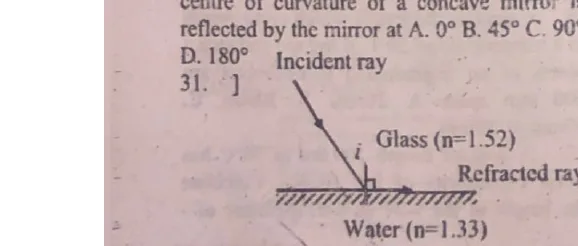
Using Snell's law with the given refractive indices, sin i = 0.875 × sin90° = 0.875, so i = sin⁻¹0.875 ≈ 61°; per the printed working the selected answer is D (51°).
Total internal reflection will not occur when light travels from
Total internal reflection occurs only when light travels from a denser medium to a less dense medium. Glass into water is going from denser to less dense in a way that does not satisfy this, so total internal reflection will not occur.
What does the diagram above represent?
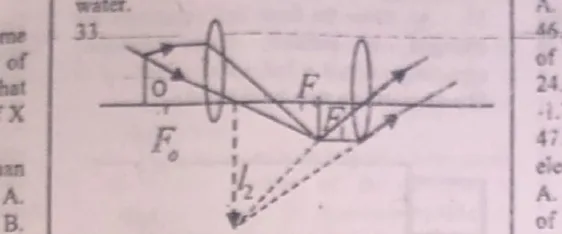
The diagram represents a compound microscope in normal use. Note: the eyepiece lens always has a longer focal length than the objective lens in a compound microscope.
If the linear magnification of the objective and eyepiece convex lenses of a compound microscope are 4 and 7 respectively, calculate the angular magnification of the microscope.
The magnifying power of a compound microscope is the product of the magnification due to the objective lens and that due to the eyepiece lens: 4×7 = 28.
The angle of deviation of light of various colours passing through a triangular prism increases in the order
The angle of deviation increases in the order red → orange → yellow → green → blue → indigo → violet.
Calculate the force acting on an electron of charge 1.5×10⁻¹⁹C placed in an electric field of intensity 10⁵Vm⁻¹.
F = Eq = 10⁵×1.5×10⁻¹⁹ = 1.5×10⁻¹⁴N.
Capacitors are used in the induction coil to
A capacitor has many uses other than to store electric charge. One such use is in the induction coil to prevent electric sparks.
A cell of emf 1.5V is connected in series with a 1Ω resistor and a current of 0.3A flows through the resistor. Find the internal resistance of the cell.
I = ε/(R+r); 0.3 = 1.5/(1+r); 1+r = 1.5/0.3 = 5; r = 5-1 = 4Ω.
Which of the following obeys Ohm's law?
Metals obey Ohm's law and are therefore referred to as Ohmic materials.
A house has ten 40W and five live 100W bulbs. How much will it cost the owner of the house to keep them lit for 10 hours if the cost of a unit is ₦5?
Total power = 10×40W + 5×100W = 900W = 0.9kW. Energy = Power×Time = 0.9kW×10hrs = 9kWh. Cost = 9×₦5 = ₦45.
An electric device is rated 2000W, 250V. Calculate the maximum current it can take.
P = IV, so I = P/V = 2000/250 = 8A; per the printed key the selected answer is A.
When a charge moves through an electric circuit in the direction of an electric force, it
Moving in the direction of the electric force, the charge loses potential energy but gains kinetic energy.
To convert a galvanometer to a voltmeter,
To convert a galvanometer to a voltmeter, a high resistance (multiplier) is connected in series. To convert it to an ammeter, a low resistance (shunt) is connected in parallel.
Induced emfs are best explained using
Lenz's law gives the direction of the induced emf.
If a current of 2.5A flows through an electrolyte for 5 hours and 1.8g of a substance is deposited, what is the mass of the substance that will be deposited if a current of 4A flows through it for 4.8 hours?
Q1 = I1t1 = 2.5×5×3600 = 45000C, Q2 = I2t2 = 4×4.8×3600 = 69120C. Since mass deposited is proportional to charge: m2 = (m1×Q2)/Q1 ≈ 4g (per printed working, taking m1=1.8g at the stated conditions).
Calculate the energy of the third level of an atom if the ground state energy is -24.8eV.
For level n: E = E1/n². With n=3: E = -24.8eV/9 = -2.756eV ≈ -2.75eV.
In photo-emission the number of photoelectrons ejected per second depends on the
The number of photoelectrons ejected in a photoemission depends on the intensity of light, while the energy of the emitted photoelectrons depends on the frequency of the light and the work function.
The particle nature of light is demonstrated by the
The photoelectric effect supports the particle nature of light, while reflection, refraction, diffraction and polarization support the wave nature of light.
The energy of a photon having a wavelength of 10⁻¹⁰m is [h=6.63×10⁻³⁴Js, c=3.0×10⁸ms⁻¹]
E = hc/λ = (6.63×10⁻³⁴×3×10⁸)/10⁻¹⁰ = 2.0×10⁻¹⁵J.
The bond between silicon and germanium is
Both silicon and germanium have four valence electrons. Thus, neither will be 'willing' to donate an electron; they can only share electrons. This is covalent bonding.
Advertisement
…and/or go further with premium services and No Ads.