All 24 questions from the West African Examinations Council (WAEC) Chemistry 2018 Theory paper, with the correct answer and a full explanation for each. Free, no signup needed.
1.(a)(i) Define the term fermentation.
(ii) Name the catalyst that can be used for this process.
Model answer
(i) Fermentation is the breakdown of sugar into alcohol and carbon (IV) oxide, usually with the aid of micro-organisms such as yeast: C₆H₁₂O₆ → 2C₂H₅OH + 2CO₂.
(ii) The catalyst (enzyme) is zymase.
1.(c) Consider the reaction: Fe + H₂SO₄ → FeSO₄ + H₂. Calculate the mass of unreacted iron when 5.0g of iron reacts with 10cm³ of 1.0moldm⁻³ H₂SO₄ [Fe=56.0]
Model answer
n(H₂SO₄) = 1moldm⁻³ × (10/1000)dm³ = 0.01mol. Since the mole ratio Fe:H₂SO₄ is 1:1, mol Fe reacted = 0.01mol. Mass Fe reacted = 0.01×56 = 0.56g. Mass of unreacted Fe = 5.0 − 0.56 = 4.44g.
1.(e) Explain briefly how a catalyst increases the rate of a chemical reaction.
Model answer
A catalyst increases the rate of a chemical reaction by lowering the activation energy of the reaction; it achieves this by providing an alternative reaction pathway that requires less energy.
1.(f)(i) Write the chemical formula for the product formed when ethanoic acid reacts with ammonia.
(ii) Give the name of the product formed in 1(f)(i).
Model answer
(i) CH₃COOH + NH₃ → CH₃COONH₄.
(ii) The product is ammonium ethanoate.
2.(a)(i) State the collision theory of reaction rates.
(ii) Using the collision theory, explain briefly how temperature affects the rate of a chemical reaction.
Model answer
(i) The collision theory states that there must be an effective collision between reacting particles for a reaction to occur.
(ii) As temperature increases, particles gain more kinetic energy and collide more frequently and more effectively; this increase in collision rate/frequency increases the reaction rate.
2.(b)(i) Sketch a graphical representation of Charles' Law.
(ii) Calculate the volume of oxygen that would be required for the complete combustion of 2.5moles of ethanol at s.t.p. [molar volume at s.t.p = 22.4dm³]
Model answer
(i) A graph of Volume (V) against Temperature (T in Kelvin) is a straight line passing through the origin (or through −273°C on a Celsius axis).
(ii) C₂H₅OH + 3O₂ → 2CO₂ + 3H₂O. 1 mole ethanol requires 3 moles O₂, so 2.5 moles requires 7.5 moles O₂. Volume = 7.5 × 22.4 = 168dm³.
2.(c)(i) Define esterification.
(ii) Give two uses of alkanoates.
(iii) Give the products of the alkaline hydrolysis of ethyl ethanoate.
Model answer
(i) Esterification is the reaction between an alkanoic acid and an alkanol to produce an alkanoate (ester), in the presence of a mineral acid catalyst.
(ii) Alkanoates are used as solvents for paints and nail varnishes, and are used as food flavourings due to their characteristic fragrance.
(iii) With KOH: CH₃COOC₂H₅ + KOH → CH₃COOK + C₂H₅OH (potassium ethanoate and ethanol). With NaOH: CH₃COOC₂H₅ + NaOH → CH₃COONa + C₂H₅OH (sodium ethanoate and ethanol).
2.(d) A tin coated plate and a galvanized plate were exposed for the same length of time.
(i) Which of the two plates corrodes faster?
(ii) Explain briefly your answer in 2(d)(i).
Model answer
(i) The tin-coated plate corrodes faster.
(ii) Tin is lower than zinc in the electrochemical series. A galvanized plate is simply coated with zinc; since zinc is highly reactive (higher up the electrochemical series), it corrodes preferentially, protecting the iron underneath. For a tin-coated plate, once the coating is scratched, corrosion of the iron underneath is inevitable and even faster, since tin is less reactive than iron and so does not sacrificially protect it.
3.(a)(i) Draw the structure of the sixth member of the alkene series.
(ii) Calculate the relative molecular mass of the sixth member of the alkene series. [H=1, C=12]
(iii) State one difference between cracking and reforming in the petroleum industry.
Model answer
(i) The sixth member of the alkene series is heptene, C₇H₁₄ (structure: a 7-carbon chain with one C=C double bond).
(ii) Molecular mass = (12×7)+(1×14) = 98.
(iii) Cracking involves breaking large hydrocarbon molecules into smaller ones, while reforming involves the re-arrangement of atoms within molecules without necessarily changing their size.
3.(b)(i) Define the term enthalpy of neutralization.
(ii) Describe briefly how the enthalpy of the reaction of dilute hydrochloric acid and aqueous potassium hydroxide could be determined.
Model answer
(i) Enthalpy of neutralization is the heat released when one mole of H⁺ ions from an acid reacts with one mole of OH⁻ ions from a base to form one mole of water.
(ii) Measure known volumes and concentrations of KOH and HCl separately and note their average initial temperature. Mix them in a calorimeter and record the maximum temperature reached. Using the temperature change, the mass (density ≈ 1gcm⁻³) and the specific heat capacity of water, the heat evolved (and hence the enthalpy of neutralization) can be calculated.
3.(c) An electrochemical cell is constructed with copper and silver electrodes.
(i) State which of the electrodes will be the: (I) anode; (II) cathode.
(ii) Give the reason for your answer in 3(c)(i).
(iii) State the type of reaction occurring at each electrode.
(iv) Write a balanced equation for the overall cell reaction.
Model answer
(i) Copper is the anode; silver is the cathode.
(ii) This is because copper is higher than silver in the electrochemical series (more reactive/more readily oxidised).
(iii) Oxidation always occurs at the anode; reduction always occurs at the cathode.
(iv) Cu(s) + 2Ag⁺(aq) → Cu²⁺(aq) + 2Ag(s).
3.(d) Name the compound formed when iron is exposed to moist air for a long time.
(i) Write a balanced chemical equation for this reaction.
(ii) Name one ore of iron.
Model answer
The compound formed is hydrated iron (III) oxide (rust).
(i) 4Fe + 3O₂ + 2xH₂O → 2Fe₂O₃.xH₂O.
(ii) Common ores of iron include: Magnetite, Haematite, Iron pyrite, Siderite, and Limonite (any one).
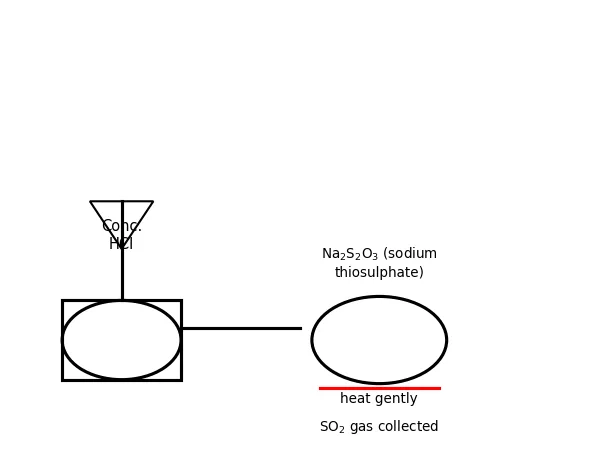
4.(a)(i) Draw and label a diagram for the laboratory preparation of a dry sample of Sulphur (IV) oxide.
(ii) Write a balanced chemical equation for the reaction in 4(a)(i).
(iii) State the precaution that must be taken in the preparation of the gas stated in 4(a)(i).
(iv) Give a reason why the precaution stated in 4(a)(ii) must be taken.
Model answer
(i) The apparatus consists of a dropping funnel of concentrated hydrochloric acid added to sodium thiosulphate in a flask, gently heated, with the gas dried and collected as shown in the diagram.
(ii) 2HCl + Na₂S₂O₃ → 2NaCl + H₂O + SO₂.
(iii) The gas (SO₂) must be prepared in a fume cupboard.
(iv) This precaution is necessary because the gas is poisonous.
4.(b)(i) State Dalton's law of partial pressures.
(ii) The volume of a sample of methane collected over water at a temperature of 12°C was 30cm³ when the pressure of the dry gas at s.t.p was measured with saturated vapour pressure of water at 12°C being 10mmHg and real pressure 700mmHg. Calculate the volume of the dry gas at s.t.p.
Model answer
(i) Dalton's law of partial pressures states that in a mixture of gases which do not react chemically, the total pressure exerted by the mixture is the sum of the partial pressures exerted by the individual gases.
(ii) Real pressure of gas at 12°C = 700−10 = 690mmHg. Using P₁V₁/T₁ = P₂V₂/T₂ with T₁=285K, T₂=273K, P₂=760mmHg, V₁=30cm³: V₂ = (690×30×273)/(760×285) ≈ 26.09cm³.
4.(c)(i) Write an equation for the reaction between chlorine and water.
(ii) Why does litmus paper turn red when put in the resulting solution in 4(c)(i)?
Model answer
(i) Cl₂(g) + H₂O(l) ⇌ HOCl(aq) + HCl(aq).
(ii) Because the resulting solution is acidic — both HCl (hydrochloric acid) and HOCl (chloric(I)/hypochlorous acid) formed are acids, turning litmus red.
4.(d)(i) State the trend in the boiling points of chlorine, bromine and iodine.
(ii) Explain briefly why water has a higher boiling point than ammonia.
Model answer
(i) Boiling points increase down the group: Chlorine < Bromine < Iodine.
(ii) Both NH₃ and H₂O have appreciably high boiling points due to hydrogen bonding, but the hydrogen bonding in water is stronger than in ammonia because oxygen is more electronegative than nitrogen, so water has the higher boiling point.
5.(a)(i) State one industrial use of hydrogen gas.
(ii) Consider the equation: Mg(HCO₃)₂(aq) → MgCO₃(s) + H₂O(l) + CO₂(g). State the type of hardness of water being removed as shown above.
(iii) Give two disadvantages of hardness of water.
Model answer
(i) Hydrogen is used in the manufacture of ammonia (Haber process); it is also used in filling balloons and in the production of methanol.
(ii) Since the water contains HCO₃⁻ (bicarbonate) ions, the hardness being removed is temporary hardness.
(iii) Disadvantages of hard water: it causes furring of kettles/pipes, and it wastes soap by forming scum before lathering.
5.(b)(i) In the extraction of aluminium by electrolysis, graphite electrodes are used. State the disadvantage of using this type of electrode.
(ii) Calcium oxide reacts with water to form slaked lime. Write a balanced equation for this reaction, and state one use of slaked lime.
Model answer
(i) The oxygen gas produced at the anode combines, at the high operating temperature, with the graphite electrode to form CO₂; this leads to the graphite anode being gradually worn away (depleted) and needing frequent replacement.
(ii) CaO(s) + H₂O(l) → Ca(OH)₂(s). Slaked lime is used to treat acidic soil (and in the manufacture of bleaching powder / mortar).
Advertisement
Sign up free to unlock
Score tracking
Practice history
Saved questions
Progress dashboard
Personalized sessions
Weak-topic breakdown
…and/or go further with premium services and No Ads.