Free account: track your progress — Sign up free

WAEC Physics 2015 Objective Past Questions

All 50 questions from the West African Examinations Council (WAEC) Physics 2015 Objective paper, with the correct answer and a full explanation for each. Free, no signup needed.

Advertisement

Physics 2015 Objective — Question 1

Which of the following statements about mass and weight are correct? I. Weight is the force of gravity on a body II. The mass of a body is the quantity of matter in the body III. The weight of a body is greatest at the equator IV. The mass of a body is greatest at the poles.

  • A. I and II onlyCorrect
  • B. I and III only
  • C. II and IV only
  • D. III and IV only

Explanation

Weight is the force of gravity on a body (I is correct) and mass is the quantity of matter in a body (II is correct). Weight is actually greatest at the poles (not the equator) and mass does not depend on location, so III and IV are false.

Physics 2015 Objective — Question 2

Materials that can be stretched and still return to their original forms when the stresses are removed are said to be

  • A. elasticCorrect
  • B. elastomer
  • C. plastic
  • D. thermoplastic

Explanation

Elastic materials return to their original size and shape once the deforming (stretching) force is removed.

Physics 2015 Objective — Question 3

Which of the following units is derived?

  • A. kg
  • B. m
  • C. K
  • D. NCorrect

Explanation

Kilogram, metre and Kelvin are all fundamental (base) SI units, while the Newton (force) is a derived unit, obtained from mass, length and time.

Physics 2015 Objective — Question 4

The barometric reading at a place is 73.5 cm Hg. Calculate the pressure at a point 30 m below the surface of water contained in a reservoir at the place. [g = 10 ms⁻², density of mercury 13.6×10⁴ kg m⁻³, density of water = 1.0×10³ kg m⁻³]

  • A. 4.0×10⁵Nm⁻²Correct
  • B. 3.0×10⁵Nm⁻²
  • C. 2.0×10⁵Nm⁻²
  • D. 1.0×10⁵Nm⁻²

Explanation

Converting the barometer reading to Pascals gives about 1.0×10⁵ N/m². Adding the pressure due to the 30 m water column (ρgh = 1000×10×30 = 3×10⁵ N/m²) gives a total pressure of about 4.0×10⁵ N/m².

Physics 2015 Objective — Question 5

An object floats in a fluid when it displaces its

  • A. volume of fluid in which it floats
  • B. mass of fluid in which it floats
  • C. weight of fluid in which it floatsCorrect
  • D. density of fluid in which it floats

Explanation

By the principle of flotation, a floating object displaces a weight of fluid equal to its own weight.

Physics 2015 Objective — Question 6

The resultant force in a couple is

  • A. zeroCorrect
  • B. infinite
  • C. the sum of the forces
  • D. the product of the forces

Explanation

A couple consists of two equal, opposite, parallel forces; their resultant force is zero, though they produce a turning effect (moment).

Physics 2015 Objective — Question 7

The slope of a straight-line velocity-time graph represents

  • A. uniform accelerationCorrect
  • B. uniform speed
  • C. total distance travelled
  • D. work done

Explanation

On a velocity-time graph, the gradient (slope) gives the acceleration of the body.

Physics 2015 Objective — Question 8

A body is projected with an initial velocity u at an angle θ to the horizontal. The time taken by it to reach its maximum height is given by the expression

  • A. 2u sinθ/g
  • B. u² sin²θ/2g
  • C. u sinθ/gCorrect
  • D. u sinθ/2g

Explanation

At maximum height the vertical velocity is zero. Using v = u sinθ − gt with v = 0 gives t = u sinθ/g.

Physics 2015 Objective — Question 9

Which of the following statements describes a body in a stable equilibrium correctly?

  • A. a person walking on a tight-rope
  • B. a ball on a smooth horizontal table
  • C. a ball resting on an inverted hemispherical bowl
  • D. a ball in the middle of a hemispherical bowlCorrect

Explanation

A body is in stable equilibrium if, when slightly displaced, it returns to its original position; a ball resting in the middle of a hemispherical bowl (low centre of gravity, wide base of support) is a classic example.

Physics 2015 Objective — Question 10

In a school compound, a girl walks 40 m due east from the laboratory to the staff room to submit her report. Then she turns and walks 30 m due north to her classroom. Determine the magnitude of her displacement from the laboratory.

  • A. 10 m
  • B. 35 m
  • C. 50 mCorrect
  • D. 70 m

Explanation

By Pythagoras' theorem, displacement = √(40² + 30²) = √2500 = 50 m.

Physics 2015 Objective — Question 11

Two strings each inclined at an angle of 30° to the horizontal are used to hold a bucket of water weighing 20 N. Calculate the tension in each string.

  • A. 20√3 N
  • B. 20 NCorrect
  • C. 10√3 N
  • D. 10 N

Explanation

By symmetry, the two equal tensions each make 60° with the horizontal (30° with the vertical each side), and applying the sine rule/resolving forces gives T₁ = T₂ = 20 N.

Physics 2015 Objective — Question 12

A bullet fired vertically upwards reaches a height of 500 m. Neglecting air resistance, calculate the magnitude of the initial velocity of the bullet. [g = 10 ms⁻²]

  • A. 500.0 ms⁻¹
  • B. 100.0 ms⁻¹Correct
  • C. 70.0 ms⁻¹
  • D. 50.0ms⁻¹

Explanation

At maximum height v = 0, so from v² = u² − 2gh: 0 = u² − 2(10)(500), giving u² = 10000 and u = 100.0 ms⁻¹.

Physics 2015 Objective — Question 13

A uniform bar AB is balanced on a knife-edge which is 60 cm from B by a mass of 22 g which hangs at C, 10 cm from B. Calculate the mass of the bar.

  • A. 133.2 g
  • B. 66.0 gCorrect
  • C. 60.0 g
  • D. 22.0 g

Explanation

Taking moments about the pivot: M × (50−40) = 22 × (40−10) → M×10 = 22×30 → M = 66 g.

Physics 2015 Objective — Question 14

A body of mass 1000 kg is released from a height of 10 m above the ground. Determine its kinetic energy just before it strikes the ground. [g = 10 ms⁻²]

  • A. 10 J
  • B. 10³ J
  • C. 10⁴ J
  • D. 10⁵ JCorrect

Explanation

By conservation of energy, KE just before impact = initial PE = mgh = 1000×10×10 = 100,000 J = 10⁵ J.

Physics 2015 Objective — Question 15

The diagrams below illustrate four test-tubes containing the same volume of a liquid at different pressures. In which of the test-tubes does the liquid boil last if they are supplied with the same quantity of heat?

Diagram for question 15
  • A. the tube at 2 atmospheresCorrect
  • B. the tube at 1½ atmosphere
  • C. the tube at 1 atmosphere
  • D. the tube at less than 1 atmosphere

Explanation

An increase in pressure raises the boiling point of a liquid, so the test-tube under the highest pressure (2 atmospheres) requires the highest temperature and therefore boils last.

Physics 2015 Objective — Question 16

The crackling noise produced by aluminium roofing sheets on a house during a hot sunny day is as a result of

  • A. thermal equilibrium of the sheets
  • B. conduction of heat by the sheets
  • C. contraction of the sheets
  • D. expansion of the sheetsCorrect

Explanation

The heat from the sun causes the aluminium sheets to expand, and this expansion produces the crackling noise.

Physics 2015 Objective — Question 17

Water is unsuitable for use as a thermometric liquid because it

  • A. expands unevenly between 0°C and 4°CCorrect
  • B. has a narrow temperature range
  • C. has a concave meniscus
  • D. maintains a fixed density

Explanation

Water contracts (rather than expands) between 0°C and 4°C, an anomalous, uneven expansion which makes it unsuitable as a thermometric liquid.

Physics 2015 Objective — Question 18

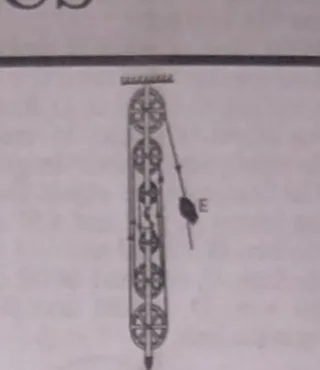
The diagram above illustrates a block and tackle pulley system in which an effort E supports a load of 100.0 N. If the efficiency of the machine is 75%, calculate the value of E.

Diagram for question 18
  • A. 22.2 NCorrect
  • B. 38.0 N
  • C. 67.0 N
  • D. 75.0 N

Explanation

With a velocity ratio of 6 (six pulleys), MA = Load/Effort and Efficiency = (MA/VR)×100%. So Effort = Load/(Efficiency×VR) = 100/(0.75×6) = 22.2 N.

Physics 2015 Objective — Question 19

A quantity of hot water at 100°C is added to 400 g of water at 10°C until the temperature of the mixture is 60°C. Calculate the mass of the hot water added. [Specific heat capacity of water = 4200 J kg⁻¹K⁻¹]

  • A. 200 g
  • B. 320 g
  • C. 400 g
  • D. 500 gCorrect

Explanation

Heat lost by hot water = heat gained by cold water: M(4200)(100−60) = 0.4(4200)(60−10), giving M = (0.4×50)/40 = 0.5 kg = 500 g.

Physics 2015 Objective — Question 20

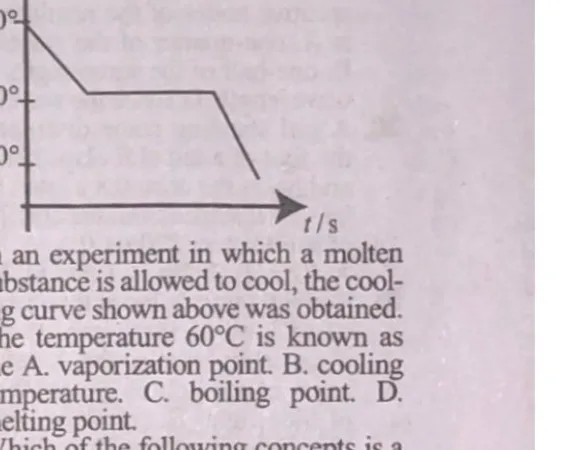
In an experiment in which a molten substance is allowed to cool, the cooling curve shown above was obtained. The temperature 60°C is known as the

Diagram for question 20
  • A. vaporization point
  • B. cooling temperature
  • C. boiling point
  • D. melting pointCorrect

Explanation

The flat (plateau) section of a cooling curve marks the temperature at which the substance changes from liquid to solid at a constant temperature - the melting (freezing) point.

Physics 2015 Objective — Question 21

Which of the following concepts is a method of heat transfer that does not require a material medium?

  • A. Conduction
  • B. RadiationCorrect
  • C. Diffusion
  • D. Convention

Explanation

Radiation is the transfer of heat via electromagnetic waves and does not require a material medium, unlike conduction and convection.

Physics 2015 Objective — Question 22

Which of the following units is the S.I. unit of heat capacity?

  • A. Jkg⁻¹
  • B. Jkg⁻¹K⁻¹
  • C. Jk⁻¹Correct
  • D. Jg⁻¹k⁻¹

Explanation

Heat capacity C = Q/ΔT is measured in Joules per Kelvin (Jk⁻¹); specific heat capacity (Jkg⁻¹K⁻¹) additionally accounts for mass.

Physics 2015 Objective — Question 23

The pressure applied to an enclosed fluid at one end is transmitted equally throughout the fluid and to the container walls. This statement is

  • A. Archimede's principle
  • B. Bernoulli's principle
  • C. Pascal's principleCorrect
  • D. Heisenberg's uncertainty principle

Explanation

This is a statement of Pascal's principle.

Physics 2015 Objective — Question 24

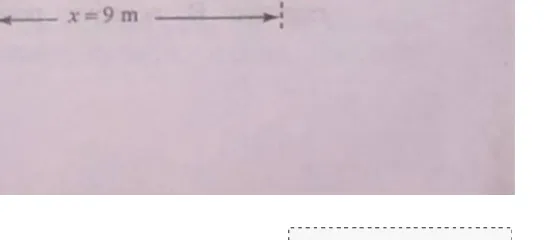
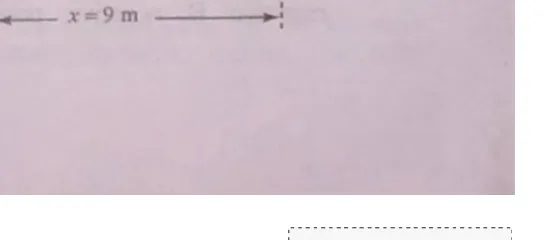
In the diagram above (displacement-time graph, t = 0.6 s, x = 9 m), determine the speed of the wave.

Diagram for question 24
  • A. 5.4 ms⁻¹
  • B. 8.4 ms⁻¹
  • C. 9.6 ms⁻¹
  • D. 10.0 ms⁻¹Correct

Explanation

The period T = 0.6/2 = 0.3 s (0.6 s spans two cycles) and the wavelength λ = 9/3 = 3 m (3 complete waves shown). Speed v = λ/T = 3/0.3 = 10.0 ms⁻¹.

Physics 2015 Objective — Question 25

What type of wave is emitted by a loud speaker?

  • A. Transverse
  • B. LongitudinalCorrect
  • C. Gamma
  • D. Radio

Explanation

Sound waves, including those from a loud speaker, are longitudinal waves.

Physics 2015 Objective — Question 26

An object is placed 15 cm from a diverging lens of focal length 12 cm. The image of the object formed by the lens is

  • A. real and 6.67 cm from the lens
  • B. virtual and 6.67 cm from the lensCorrect
  • C. real and 60.00 cm from the lens
  • D. virtual and 60.00 cm from the lens

Explanation

Using 1/v = 1/u − 1/f with f = −12 cm (diverging) and u = 15 cm gives v ≈ −6.67 cm; the negative sign shows the image is virtual, located 6.67 cm from the lens.

Physics 2015 Objective — Question 27

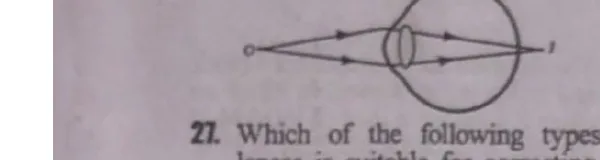
Which of the following types of lenses is suitable for correcting the eye defect illustrated by the ray diagram above (converging rays that focus behind the retina)?

Diagram for question 27
  • A. Bi-convergingCorrect
  • B. Bi-diverging
  • C. Piano diverging
  • D. Diverging meniscus

Explanation

The ray diagram illustrates hypermetropia (long-sightedness), where the image forms behind the retina; it is corrected using a converging (convex) lens.

Physics 2015 Objective — Question 28

A swimming pool is 2.1 m deep. If it contains water of refractive index 1.3, calculate the apparent depth of the pool.

  • A. 3.4 m
  • B. 2.7 m
  • C. 1.6 mCorrect
  • D. 0.8 m

Explanation

Apparent depth = real depth / refractive index = 2.1/1.3 ≈ 1.6 m.

Physics 2015 Objective — Question 29

When an air column is set into vibrations, the distance between two consecutive nodes of the resultant wave is

  • A. one-quarter of the wavelength
  • B. one-half of the wavelengthCorrect
  • C. the wave length
  • D. twice the wavelength

Explanation

Adjacent nodes in a standing wave are separated by half a wavelength (λ/2).

Physics 2015 Objective — Question 30

A girl standing some distance from the foot of a tall cliff claps her hands and hears the echo 0.8 s later. Calculate her distance from the cliff. [Speed of sound in air = 320 ms⁻¹]

  • A. 82 m
  • B. 102 m
  • C. 128 mCorrect
  • D. 140 m

Explanation

Distance = (speed × time)/2 = (320×0.8)/2 = 128 m.

Physics 2015 Objective — Question 31

Red light travels faster than blue light when both of them pass through a glass prism because the

  • A. refractive index of red light is greater than that of blue light
  • B. refractive index of blue light is greater than that of red lightCorrect
  • C. red light is more intense than the blue light
  • D. blue light is more intense than the red light

Explanation

Blue light is refracted (bent) more and travels slower in glass, meaning it has a higher refractive index than red light, which travels faster with a lower refractive index.

Physics 2015 Objective — Question 32

An object is placed 20 cm from a concave mirror of focal length 15 cm. Calculate the linear magnification of the image formed.

  • A. 0.5
  • B. 1.5
  • C. 2.0
  • D. 3.0Correct

Explanation

Using 1/v = 1/f − 1/u = 1/15 − 1/20 = 1/60, so v = 60 cm. Magnification = v/u = 60/20 = 3.0.

Physics 2015 Objective — Question 33

All electromagnetic waves in a vacuum have the same

  • A. wavelength
  • B. frequency
  • C. speedCorrect
  • D. amplitude

Explanation

All electromagnetic waves travel at the same speed in a vacuum (the speed of light, c), though their wavelengths, frequencies and amplitudes may differ.

Physics 2015 Objective — Question 34

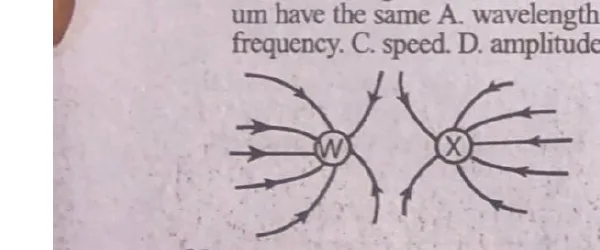
The diagram above illustrates two particles W and X. The charges on W and X are respectively

Diagram for question 34
  • A. negative; negative
  • B. negative; positive
  • C. positive; negativeCorrect
  • D. positive; positive

Explanation

Field lines point away from W (outward), showing it is positively charged, and point into X (inward), showing it is negatively charged.

Physics 2015 Objective — Question 35

An alternating current supply is connected to an electric lamp which lights with the same brightness as it does with a direct current source of e.m.f. 6 V. The peak potential difference of the a.c. supply is

  • A. 4.6 V
  • B. 6.0 V
  • C. 8.5 VCorrect
  • D. 12.0 V

Explanation

Peak voltage = rms voltage × √2 = 6×1.414 ≈ 8.5 V.

Physics 2015 Objective — Question 36

An electric generator rated 12 kW, 2 kV distributes power through a cable of resistance 20Ω. Calculate the power loss in the cable.

  • A. 120 W
  • B. 360 W
  • C. 720 WCorrect
  • D. 2400 W

Explanation

Current I = P/V = 12000/2000 = 6 A. Power loss = I²R = 6²×20 = 720 W.

Physics 2015 Objective — Question 37

Which of the following statements is correct? When capacitors of different values are connected in series

  • A. the same charge flows through themCorrect
  • B. the same voltage appears across each capacitor
  • C. different quantities of charges flow through them with different voltages across them
  • D. different quantities of charges flow through them with the same voltage across them

Explanation

In a series arrangement of capacitors, the same charge flows through (and is stored on) each capacitor, though the voltage across each may differ.

Physics 2015 Objective — Question 38

Which of the following statement(s) about a three-pin plug is/are correct? I. The brown wire is the live wire II. The fuse is connected to the live wire III. The earth wire is coloured blue

  • A. I only
  • B. II only
  • C. I and II onlyCorrect
  • D. I, II and III

Explanation

The brown wire is live and the fuse is connected to the live wire (I and II correct); the earth wire is green/yellow, not blue (III is false - blue is the neutral wire).

Physics 2015 Objective — Question 39

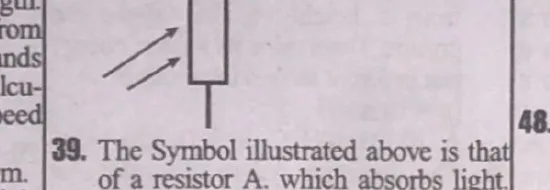
The symbol illustrated above is that of a resistor

Diagram for question 39
  • A. which absorbs light
  • B. which emits light
  • C. which absorbs heat to function properly
  • D. whose resistance is light dependentCorrect

Explanation

The symbol represents a light dependent resistor (LDR), a photoconductive device whose resistance changes (decreases) with incident light intensity.

Physics 2015 Objective — Question 40

A wire of cross-sectional area 0.60 mm² has a resistivity of 7.2×10⁻⁷ Ωm. Calculate the length of wire that will have a resistance of 3Ω.

  • A. 0.25 m
  • B. 2.50 mCorrect
  • C. 3.60 m
  • D. 36.00 m

Explanation

R = ρL/A ⇒ L = RA/ρ = (3×0.6×10⁻⁶)/(7.2×10⁻⁷) = 2.5 m.

Physics 2015 Objective — Question 41

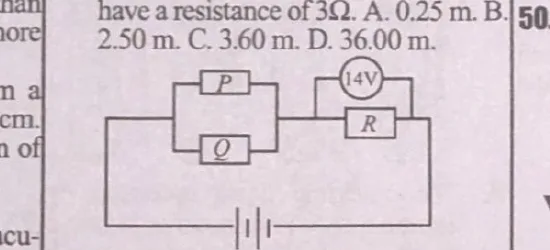
A battery of e.m.f. 24 V is connected to three resistors P, Q and R as illustrated in the diagram above. Determine the voltage across the resistor Q.

Diagram for question 41
  • A. 5 V
  • B. 10 VCorrect
  • C. 14 V
  • D. 24 V

Explanation

P and Q are in parallel, so they share the same voltage. Since 14 V is dropped across R, the remaining voltage across P (and Q) is 24 − 14 = 10 V.

Physics 2015 Objective — Question 42

The mass of the earth is 6.0×10²⁴ kg and that of the moon is 7.0×10²² kg. If the distance between them is 4.0×10⁸ m, calculate the force of attraction between them. [G = 6.7×10⁻¹¹ Nm²kg⁻²]

  • A. 1.8×10¹² N
  • B. 1.8×10¹⁵ N
  • C. 1.8×10¹⁸ N
  • D. 1.8×10²⁰ NCorrect

Explanation

F = GMm/r² = (6.7×10⁻¹¹×6×10²⁴×7×10²²)/(4×10⁸)² ≈ 1.8×10²⁰ N.

Physics 2015 Objective — Question 43

The angle which the direction of the earth's magnetic field makes with the horizontal at a place is known as

  • A. angle of contact
  • B. angle of dipCorrect
  • C. angle of declination
  • D. magnetic meridian

Explanation

This angle is called the angle of dip.

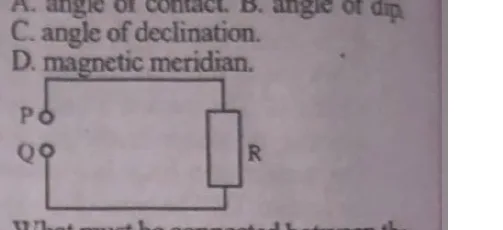
Physics 2015 Objective — Question 44

What must be connected between the points P and Q to establish a steady current through the incomplete circuit diagram illustrated above?

Diagram for question 44
  • A. Fuse
  • B. Ammeter
  • C. CellCorrect
  • D. Voltmeter

Explanation

A cell (source of e.m.f.) must be connected between P and Q to drive a steady current through the circuit.

Physics 2015 Objective — Question 45

When current flows through a moving-coil galvanometer, the force exerted on the pointer depends on the: I. strength of the current; II. magnetic field strength; III. length of the coil. Which of the statement(s) above is/are correct?

  • A. I only
  • B. II only
  • C. I and III only
  • D. I, II and IIICorrect

Explanation

The deflecting force/torque on the coil depends on the current strength, the magnetic field strength, and the length (and other dimensions) of the coil, so all three (I, II and III) are correct.

Physics 2015 Objective — Question 46

In a nuclear fission process, the mass defect was 1.2×10⁻⁵ kg. Calculate the energy released. [Speed of light in vacuum = 3.0×10⁸ ms⁻¹]

  • A. 1.08×10¹¹ J
  • B. 5.20×10¹¹ J
  • C. 1.08×10¹² JCorrect
  • D. 2.50×10¹³ J

Explanation

E = Δmc² = 1.2×10⁻⁵ × (3×10⁸)² = 1.08×10¹² J.

Physics 2015 Objective — Question 47

Which of the following statements about a diode is correct?

  • A. Reverse bias diodes have low resistance
  • B. Forward bias diodes have high resistance
  • C. Forward bias diodes produce high currentCorrect
  • D. Forward bias diodes function as a result of heat

Explanation

In forward bias, a diode's depletion layer narrows, giving low resistance and allowing a high current to flow.

Physics 2015 Objective — Question 48

Which of the following phenomena best supports the wave nature of matter?

  • A. Electron diffractionCorrect
  • B. Photoelectric effect
  • C. Electron momentum
  • D. Black body radiation

Explanation

Electron diffraction demonstrates the wave-like behaviour of matter (particles), supporting wave-particle duality.

Physics 2015 Objective — Question 49

Which of the following radiations constitutes a stream of electrons?

  • A. Gamma rays
  • B. X-rays
  • C. Cathode raysCorrect
  • D. Radio waves

Explanation

Cathode rays are streams of electrons.

Physics 2015 Objective — Question 50

²²⁶Ra emits two alpha particles to produce Polonium (Po) nuclide. The correct formula for the nuclide is

  • A. ²²⁴₈₆Po
  • B. ²²²₈₆Po
  • C. ²²²₈₄Po
  • D. ²¹⁸₈₄PoCorrect

Explanation

Each alpha particle reduces the mass number by 4 and the atomic number by 2. Two alpha particles: mass number 226−8=218, atomic number 88−4=84, giving ²¹⁸₈₄Po.

Advertisement

Sign up free to unlock

  • Score tracking
  • Practice history
  • Saved questions
  • Progress dashboard
  • Personalized sessions
  • Weak-topic breakdown

…and/or go further with premium services and No Ads.