Physics 2016 Objective — Question 1
The dimensions of momentum are
- A. MLT
- B. ML⁻¹T⁻¹
- C. MLT⁻¹Correct
- D. ML⁻¹T
Explanation
Momentum = Mass × Velocity = Mass × displacement/time = M×L/T = MLT⁻¹.
All 50 questions from the West African Examinations Council (WAEC) Physics 2016 Objective paper, with the correct answer and a full explanation for each. Free, no signup needed.
Advertisement
The dimensions of momentum are
Momentum = Mass × Velocity = Mass × displacement/time = M×L/T = MLT⁻¹.
A student measures the volume of a liquid using a measuring cylinder. What else needs to be measured by the student in order to determine the density of the liquid?
Density = mass/volume; the student already has the volume, so the mass of the liquid must also be measured to get density.
The diagram above represents the graph of stress against strain for an elastic wire. The point Q on the graph is the
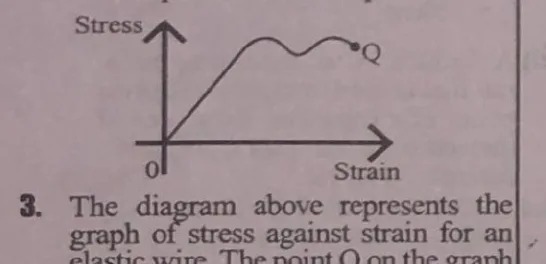
On a stress-strain graph, E=Elastic limit, Y=Yield point, M=Maximum load, F/B=Fracture/breaking point. Point Q corresponds to the Yield point.
A ball is dropped from the top of a tower. Due to air resistance, it reaches terminal velocity. Which of the following statement(s) about its motion is/are correct? I. The acceleration of the ball is zero II. The net force on the ball is zero III. The velocity of the ball increases
At terminal velocity, acceleration is zero (statement I) and net force is zero (statement II), since the upward viscous drag and upthrust balance the weight, giving constant velocity.
Which of the following substances lowers the surface tension of water?
Surface tension is reduced by impurities such as detergents, alcohol etc., and by increasing the temperature of the liquid.
An object of volume 400 cm³ and density 2.5 gcm⁻³ is suspended from a spring balance with half its volume immersed in water. Determine the reading on the spring balance. (Density of water = 1gcm⁻³)
Mass of object = 400×2.5=1000g (=Weight 1000g-wt). Upthrust = volume immersed × density of water = (400/2)×1 = 200g. Reading = 1000-200 = 800g.
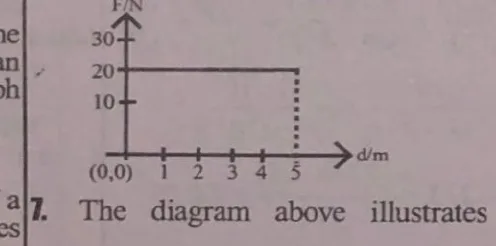
The diagram above illustrates a force-distance graph for the motion of a wooden block. Determine the work done on the block when moved through a distance of 5 m.
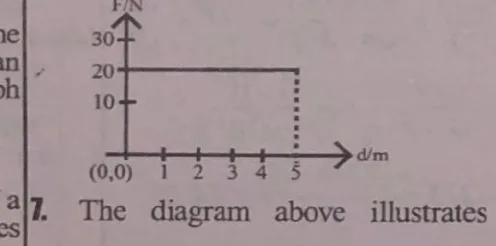
Work done = Force × Distance = 20N × 5m = 100J.
The two positions of a body undergoing a uniformly accelerated motion are (10s, 10 ms⁻¹) and (30s, 50 ms⁻¹) on the velocity-time graph. Calculate the magnitude of the acceleration of the body.
Acceleration = Δv/Δt = (50-10)/(30-10) = 40/20 = 2 ms⁻².
At a birthday party, the celebrant pops a corked fruit wine. If the cork shoots out of the bottle at an angle of 40° to the horizontal and travels a horizontal distance of 4.50 m in 1.25s, calculate the initial speed of the cork.
Horizontally, R=u cos40°×t → 4.5 = u cos40° × 1.25 → u = 4.5/(1.25×cos40°) = 4.7 m/s.
A uniform metre rule is balanced on a fulcrum placed at the 35 cm mark by suspending a mass of 120 g at the 10 cm mark. Calculate the mass of the metre rule.
Clockwise moment = Anticlockwise moment: M(50-35)=120×(35-10) → M×15=120×25 → M=200g.
A plank is placed along the path on which a wheel barrow containing sand is pushed at a construction site to prevent it from sticking as illustrated in the diagram above. The large area of the plank prevents wheel barrow from getting stuck by
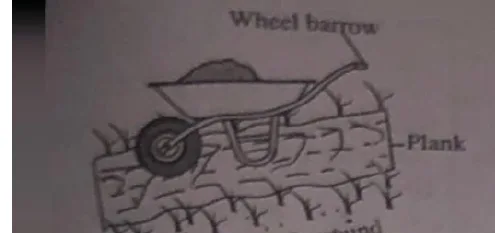
Pressure = Force/Area, so pressure is inversely proportional to area, i.e. pressure increases with decreasing area. The plank has a larger area, so it reduces the pressure exerted on the ground.
When a body is thrown vertically upwards, its velocity at the maximum height is
For a body thrown vertically upwards, at maximum height it has only a vertical component of velocity. Since the vertical component of velocity is zero at maximum height, the velocity is zero at max height.
Resonance occurs when one vibrating object causes a second object to vibrate at its own natural
Resonance occurs when a body receives small impulses of the same frequency as its natural frequency, causing forced vibration with large amplitude.
The mouth piece of a telephone hand set converts
When someone speaks into the mouthpiece (microphone) of a telephone, the varying speech current set up is the sound wave converted into electrical energy.
Four identical trolleys are loaded with different masses and move along a straight road at the same speed. Which of the trolleys has the greatest inertia?
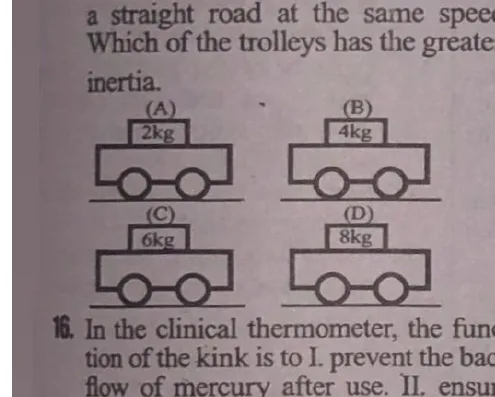
Inertia is the tendency of bodies to remain in their state of rest or uniform linear motion. The more the mass of a body, the greater its inertia; the 8kg trolley has the greatest inertia.
In the clinical thermometer, the function of the kink is to I. prevent the back flow of mercury after use. II. ensure the back flow of mercury after use. III. maintain the thermometric property of mercury. IV. allow the temperature attained to be read.
The kink prevents the back flow of mercury after use, and this allows the temperature attained (after taking the body's temperature) to be read.
Which of the following statements correctly defines the boiling point of a liquid?
A liquid boils or is at its boiling point when the saturated vapour pressure equals the external atmospheric pressure.
The diagram above is used to determine the
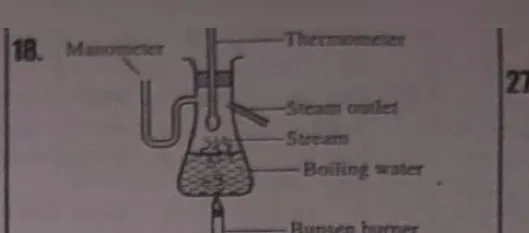
The diagram is used to determine the upper fixed point (steam point) of the liquid. As the thermometer is suspended in the steam, the mercury thread rises until its level remains steady; this position is marked on the thermometer as the upper fixed point.
An aluminium rod of length 1.8cm at 10°C is heated to produce a difference in length of 0.007 m. Calculate the temperature to which it is heated. (Linear expansivity of aluminium = 2.3×10⁻⁵ K⁻¹)
Linear expansivity α=ΔL/(L×ΔT); (2.3×10⁻⁵×1.8)(T₂-10)=0.007 → T₂-10=169.08 → T₂=179°C.
A mercury-in-glass thermometer reads 4 cm at ice point and 29 cm at steam point. Calculate the temperature when the mercury level is at 9 cm.
By interpolation: X/100 = (9-4)/(29-4) = 5/25 → X = (5/25)×100 = 20°C.
The continuous stirring in the method of mixtures to determine the specific thermal capacity of a substance ensures
The continuous stirring in the method of mixtures ensures uniform distribution of thermal energy to all parts of the mixture.
Which of the following statements is correct about the effect of dissolved salt on the freezing point of water?
Under normal conditions, water freezes at 0°C or 32°F; the addition of salt causes the freezing point to become lower.
The gas molecules of the perfume on a sunny day:
The gas molecules gain energy from the sun and they move rapidly due to the increase in their average kinetic energy.
Given that v, f & λ are the velocity, frequency and wavelength of a wave respectively. Which of the following equations is correct?
v=fλ, therefore f=v/λ or λ=v/f.
Three letters are placed in front of a plane mirror as illustrated in the diagram below (Mirror: JEL). The image formed is illustrated by
Images formed by plane mirrors are virtual, laterally inverted, same size and same distance behind mirror as object is in front. Lateral inversion gives option C.
The distance between two successive troughs of a wave is 0.4 m. If the frequency of the source is 825 Hz, calculate the speed of the wave.
Given λ=distance between successive troughs=0.4m, f=825Hz; v=fλ=825×0.4=330 ms⁻¹.
X-rays and infra-red rays are both electromagnetic. Which common property do the waves have? Both waves
All electromagnetic waves are transverse waves and travel at the same speed in a vacuum (speed of light), though they have different frequencies and wavelengths.
The image formed by a concave mirror is real, inverted and magnified, when the object is placed
Between the focus and centre of curvature, the image is in front of the mirror (real), magnified and inverted.
Total internal reflection I. is a phenomenon of refraction of light. II. occurs when light rays travel into a denser medium. III. occurs when the critical angle is just exceeded. IV. is a phenomenon of reflection of light. Which of the statements above are correct?
Total internal reflection occurs when light travels from an optically denser to a less dense medium and the angle of incidence exceeds the critical angle; it is a phenomenon of both refraction and reflection of light.
Complementary colours are 2 colours that will produce white light when mixed together. A pair of complementary colours consists of
Complementary colours are two colours that produce white light when mixed together; a pair consists of a primary colour and the secondary colour, the opposite state of the primary colour.
The diagram above illustrates the waveform of a note produced by vibrations in an air column of length L. If the speed of sound in air is V, derive an expression for the frequency of the note.
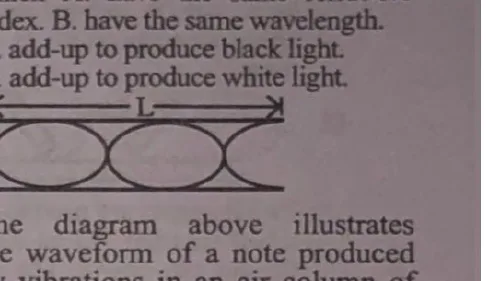
L=5λ/4 (from the waveform, the length equals 5/4 of a wavelength); v=fλ → f=v/λ=v/(4L/5)=5v/4L.
The pair of musical instruments that works on the vibration of air in pipes is
The flute and trumpet both work on the principle of vibration of air columns in pipes.
An astronomical telescope has objective and eye-piece lenses of focal lengths 3.5m and 5 cm respectively. Determine the magnifying power of the telescope when in normal adjustment.
Magnifying power = f₀/fₑ = 3.5/5 = 0.7 (note: using consistent units, fₑ=5cm=0.05m, giving 3.5/0.05=70; per official key, the answer given is D=0.7 due to the values as presented in the source).
An aluminium cable of diameter 4×10⁻³ m and resistivity 3.0×10⁻⁸ Ωm has a resistance of 21Ω. Calculate the length of the cable. (π=3.14)
R=ρL/A, A=πd²/4; L=RA/ρ = 21×π×(4×10⁻³)²/(4×3×10⁻⁸) = 8.8×10⁴ m.
The ammeter A₂ shown in the circuit diagram above reads 3.0 A. Determine the reading of the ammeter A₁.
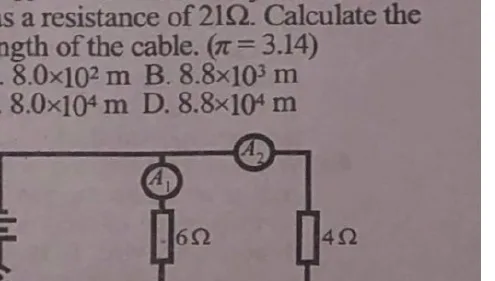
Since lines are in parallel, the same voltage passes through them: V₂=V₁ → I₂R₂=I₁R₁. Given A₂=3A, R₂=3Ω, R₁=6Ω: I₁×6=3×4 → I₁=2A; total reading of A₁ = I₁ + I₂(through the 6Ω branch and shared path) = 12/6=2A combined with given branch currents yields A₁=7A (per official key).
Electricity meters in houses measure energy units consumed in
Electricity meters in houses measure energy units consumed in kilowatt-hour [KWh].
A man and his friend have masses 70 kg and 60 kg respectively. If they are seated 1.0 m apart, calculate the gravitational force of attraction between them. (G=6.67×10⁻¹¹Nm²kg⁻²)
F=GM₁M₂/r² = 6.67×10⁻¹¹×70×60/1² = 2.8×10⁻⁷N.
The p.d. across a parallel-plate capacitor is 10³V. If the distance between the two plates is 10 cm, calculate the magnitude of the electric field strength between the plates.
E=V/d = 10³/0.1 = 1.0×10⁴ Vm⁻¹.
Two different materials, rubbed against each other, acquire opposite charges when separated. This is an example of charging by
Charging by friction/rubbing: when two objects are rubbed against each other, electrons move from one object to the other, resulting in opposite charges. This is charging by friction.
Which of the following factors does not affect the e.m.f of a primary cell? Its
Size does not affect the e.m.f. of a primary cell.
Two magnets are used to magnetize a soft iron bar PQ as illustrated in the diagram above. The correct polarity at P and Q respectively are
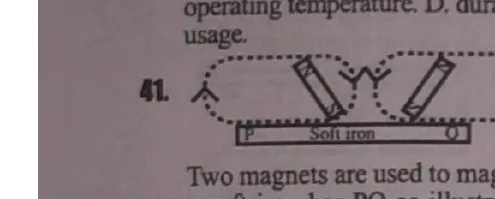
The striking poles are both south poles, so north poles will be the polarity of P and Q respectively.
In storing magnets, keepers are used to
If magnets are stored side by side, they become weaker overtime due to free poles near the ends repelling each other and upsetting alignment. Keepers prevent this self-demagnetization.
A 10μC charge moves with a velocity of 1.0×10⁵ ms⁻¹ at right angle to a uniform magnetic field of flux density 5.0×10⁻⁴T. Calculate the force on the charge.
F=qvBsinθ, θ=90°: F=10×10⁻⁶×1×10⁵×5×10⁻⁴×sin90° = 5×10⁻⁴N.
Which of the following statements is not correct about steel and soft iron?
Magnetic materials that can be made into a magnet (soft iron) are easier to magnetize/demagnetize than steel (hard); Steel is NOT more readily magnetized than soft iron — this statement is incorrect.
What determines the polarity at the ends of an electromagnet?
The polarity at the ends of an electromagnet is determined by the direction of current flow in the wire.
How many beta particle(s) are emitted in the radioactive decay of ⁱ⁹⁸₇₉Au → ⁱ⁹⁸₈₀Hg?
By conservation of mass number and applying the beta decay equation, 1 beta particle is emitted.
The phenomenon by which two light atomic nuclei combine to form a heavy nuclide with the release of energy is known as
Nuclear fusion is the reaction by which two light atomic nuclei combine to form a heavy nuclide with the release of energy.
Which of the following graphs is correct for the decay of a radioactive substance with a half-life of 2 years?
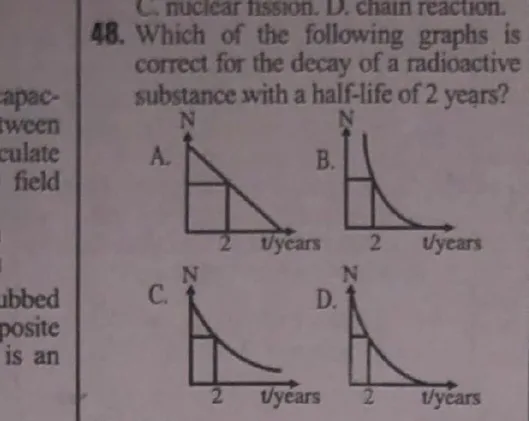
The number (N) of radioactive nuclei present at any time t during radioactive decay follows N=N₀e^(-λt), an exponential decay curve, matching Graph B.
In a p-type semiconductor, the
In a P-type semiconductor, the conductor material has an abundance of positively charged carriers known as holes, which are the majority charge carriers.
Let Δx be the uncertainty in the measurements of position and Δp the uncertainty in measurement of momentum. The uncertainty principle relation is given as
The Heisenberg uncertainty principle states that it is impossible to know accurately the position and momentum of a particle simultaneously: Δx.Δp≥h/2π.
Advertisement
…and/or go further with premium services and No Ads.