Chemistry 2012 Objective — Question 1
Which Question Paper Type of Chemistry as indicated above is given to you?
- A. Type Green
- B. Type Purple
- C. Type Red
- D. Type YellowCorrect
Explanation
This is a type Yellow Chemistry Question Paper.
All 50 questions from the Joint Admissions and Matriculation Board (JAMB) Chemistry 2012 Objective paper, with the correct answer and a full explanation for each. Free, no signup needed.
Advertisement
Which Question Paper Type of Chemistry as indicated above is given to you?
This is a type Yellow Chemistry Question Paper.
Which of the following methods can be used to obtain pure water from a mixture of sand, water and methanoic acid?
The sand can be removed using filtration. The water can be separated from the methanoic acid by distillation. Since methanoic acid is of a lower boiling point than water, it distils over first.
How many atoms are present in 6.0g of magnesium? [Mg=24, Na=6.02×10²³ mol⁻¹]
Mass of magnesium = 6.0g. Molar mass of magnesium = 24g/mol. Mole = Mass/Molar mass = 6/24 = 0.25mol. Number of Mg atoms = Mole of Mg × Avogadro's number = 0.25×6.02×10²³ = 1.505×10²³.
50 cm³ of a gas was collected over water at 10°C and 765 mm Hg. Calculate the volume of the gas at s.t.p. if the saturated vapour pressure of water at 10°C is 5mm Hg.
P1=765−5=760mmHg, V1=50cm³, T1=283K (10°C+273); P2=760mmHg, T2=273K, V2=?. Using the general gas law: P1V1/T1=P2V2/T2, giving V2 ≈ 49.19cm³ (per printed key, option A).
An increase in the pressure exerted on a gas at a constant temperature results in a
An increase in the pressure exerted on a gas at a constant temperature results in a decrease in volume, consistent with Boyle's law.
2H2(g) + O2(g) → 2H2O(g). In the reaction above, what volume of hydrogen would be left over when 300cm³ of oxygen and 1000cm³ of hydrogen are exploded in a sealed tube?
From the equation, mole ratio of H2:O2 = 2:1. 300cm³ of oxygen will react with 600cm³ of hydrogen. Excess hydrogen = (1000−600)cm³ = 400cm³.
I. Evaporation II. Sublimation III. Diffusion IV. Brownian motion. Which of the above can correctly be listed as evidences for the particulate nature of matter?
Evaporation, sublimation, diffusion, and Brownian motion are all evidences that particles making up matter are in constant motion — supporting the particulate nature of matter.
If the elements X and Y have atomic numbers 11 and 17 respectively, what type of bond can they form?
X (atomic number 11) is sodium, with electron configuration 2,8,1 — it readily loses one electron. Y (atomic number 17) is chlorine, with configuration 2,8,7 — it readily gains one electron. This electron transfer forms an ionic bond.
A hydrogen atom which has lost an electron contains
A hydrogen atom has one proton and one electron (no neutron in the common isotope). If it loses its electron, it is left with one proton only.
The electronic configuration of Mg²⁺ is
Magnesium (Mg) has electron configuration 1s²2s²2p⁶3s². Losing two electrons to form Mg²⁺ gives 1s²2s²2p⁶.
Group VII elements are
Group VII elements (halogens) are good oxidizing agents, being highly electronegative and readily accepting electrons.
Two elements, X and Y are in the same group on the periodic table because they both have the same
Elements in the same group have the same number of valence (outermost) electrons.
Air has a varied composition from one place to another; its constituents can be separated by physical means; it contains unreactive noble gases. Which of the above shows that air is a mixture?
Air's varied composition, physical separability, and its unreactive noble gas content are all evidence supporting that air is a mixture.
The chemicals used to soften hard water involves the addition of
Softening hard water involves the addition of soluble sodium compounds which form insoluble precipitates of calcium and magnesium ions, thereby removing them from solution.
Chlorination of water for town supply is carried out to
Chlorination of water for town supply is carried out to remove germs from the water.
Which of the following pollutants is associated with brain damage?
Carbon (II) oxide (carbon monoxide) is associated with brain damage, as it binds to haemoglobin and starves the brain of oxygen.
Which of the following will produce a solution with pH less than 7 at equivalent point?
HCl+Mg(OH)2 is a reaction between a strong acid and a weak base; at the equivalence point the resulting salt solution hydrolyses to give a pH less than 7 (acidic).
Which of the following is a polysaccharide?
Glucose is a monosaccharide, sucrose and maltose are disaccharides. Starch, cellulose, etc. are polysaccharides.
Write the structure of the amino acid, CH3CH(NH2)COOH in acidic medium and alkaline medium.
In acidic medium, the amino acid exists predominantly as CH3CH(NH3⁺)COOH. In alkaline medium, it exists predominantly as CH3CH(NH2)COO⁻.
The number of hydroxonium ions produced by one molecule of an acid in aqueous solution is its
The basicity of an acid is defined as the number of hydroxonium (H3O⁺) ions that can be produced by one molecule of the acid in aqueous solution. HCl, H2SO4 and H3PO4 have basicity of 1, 2, and 3 respectively.
During a titration experiment, 0.05 moles of carbon(IV) oxide is liberated. What is the volume of gas liberated? [Molar volume of a gas at s.t.p.=22.4dm³]
Volume = Mole × GMV = 0.05×22.4 = 1.12dm³.
A major factor considered in selecting a suitable method for preparing a simple salt is its
Solubility in water is a major factor to be considered when selecting a suitable method for preparing a salt. For instance, a water-insoluble salt like AgCl can be obtained by double decomposition: AgNO3(aq)+NaCl(aq)→AgCl(s)+NaNO3(aq).
The oxidation number of boron in NaBH4 is
NaBH4 is sodium tetrahydridoborate (III). Na=+1, H=−1 (each of 4 hydrogens). +1+B+(−1×4)=0 ⇒ 1+B−4=0 ⇒ B=+3.
2Na2O2(s) + 2H2O(l) →4NaOH(s) + O2(g). The substance that is oxidized in the reaction above is
In this reaction, the oxidation number of oxygen in Na2O2 (peroxide, −1) increases to 0 in O2, meaning Na2O2 is oxidized.
What number of moles of Cu²⁺ will be deposited by 360 coulombs of electricity? [F=96,500C]
1 mole of Cu²⁺ requires 2F (96,500C×2). Thus, 360C will only produce (1/(2×96,500))×360 mole = 1.87×10⁻³ mole.
A metal M displaces zinc from ZnCl2 solution. This shows that M is
For a metal to displace another metal from its solution, the former must be more electropositive than the latter.
CO(g) +H2O(g)→ CO2(g)+H2(g). Calculate the standard heat change of the reaction above, if the standard enthalpies of formation of CO2(g), H2O and CO(g) in kJ mol⁻¹ are -394, -242 and -110 respectively.
ΔH = ΣH(products) − ΣH(reactants) = −394 − (−352) = −42kJ mol⁻¹, where ΣH(reactants) = −110+(−242) = −352.
An increase in entropy can best be illustrated by
Entropy is the degree of disorderliness or randomness of a system. When gases are mixed, there is great disorder, so entropy increases substantially.
The highest rate of production of carbon (IV) oxide can be achieved using
Higher concentration and powdered form (greater surface area) both increase reaction rate; the option with both 0.10 mol dm⁻³ HCl and powdered CaCO3 gives the fastest reaction.
2HCl(aq) + CaCO3(s) → CaCl2 + CO2(g) + H2O(l). From the reaction above, which of the curves represents the production of CO2 gas as dilute HCl is added to the apparatus shown (with an empty flask, sodium, and water)?
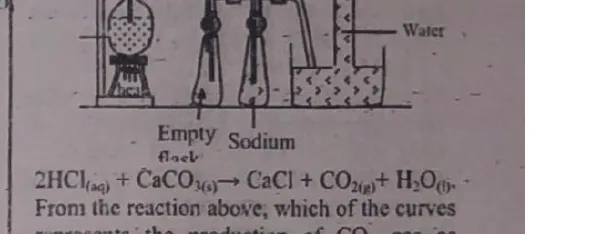
Curve M represents the production of CO2 gas over time as dilute HCl is gradually added to the calcium carbonate, based on the shape of gas evolution shown in the source diagram.
2CO(g)+ O2(g)⇌2CO2(g). In the reaction above, high pressure will favour the forward reaction because
High pressure will favour the forward reaction because the process occurs with a decrease in volume (fewer moles of gas on the product side).
A piece of filter paper moistened with lead(II) ethanoate solution turns black when the paper is dropped into a gas jar containing an unknown gas. The gas is likely to be
Lead(II) ethanoate paper turning black indicates the presence of hydrogen sulphide gas, which reacts to form black lead(II) sulphide.
A spot of oil paint on a shirt can best be removed using
A spot of oil paint on a shirt can be removed effectively using kerosene, a good solvent for oil.
Commercial bleaching can be carried out using
Commercial bleaching can be carried out using chlorine and sulphur(IV) oxide.
Mineral acids are usually added to commercial hydrogen peroxide to
Mineral acids are added to commercial hydrogen peroxide to minimize its decomposition, stabilizing the solution.
Which of the following compounds will burn with a brick-red colour in a non-luminous Bunsen flame?
Calcium chloride (CaCl2) burns with a brick-red flame colour, characteristic of calcium ions.
The purest form of iron which contains only about 0.1% carbon is
Wrought iron is the purest form of iron, containing only about 0.1% carbon.
A common characteristic between zinc and the other transition elements is the
Like other transition elements, zinc also forms complex ions. Zinc has a fixed +2 oxidation state (i.e. it does not have variable oxidation states) and, having a completely filled d-orbital, does not give coloured ions.
Which of the following metals is the least reactive?
Gold is the least reactive of the metals, according to the electrochemical series (K, Na, Ca, Mg, Al, Zn, Fe, Sn, Pb, H, Cu, Hg, Ag, Au — decreasing reactivity).
Geometric isomerism can exist in
Geometric (cis-trans) isomerism requires restricted rotation around a double bond with two different groups on each carbon of the double bond. Hex-3-ene satisfies this condition; the others do not.
Alkanals can be distinguished from alkanones by the reaction with
Alkanals (aldehydes) give a positive test with Fehling's solution (forming a brick-red precipitate), while alkanones (ketones) do not.
The isomers of C3H8O are
The isomers of C3H8O are 1-propanol and 2-propanol.
Carbohydrates are large molecules with the molecular formula Cx(H2O)y. In which of the following pairs is x not equal to y?
Glucose C6H12O6=C6(H2O)6 (x=y=6). Fructose is also C6H12O6 (x=y=6). Sucrose C12H22O11=C12(H2O)11 (x=12,y=11, x≠y). Thus for the sucrose/fructose pair, x is not equal to y for sucrose (unlike fructose, where x=y).
A compound contains 40.0% C, 6.7% H and 53.3% O. If the molecular mass of the compound is 180, its molecular formula is [C=12, H=1, O=16]
Empirical formula from percentages (40.0/12 : 6.7/1 : 53.3/16 ≈ 1:2:1) gives CH2O (empirical mass 30). Since molecular mass is 180, n=180/30=6, so molecular formula = C6H12O6.
The alkyne that will give a white precipitate with silver trioxonitrate(V) is
A terminal alkyne is one that has the triple bond at the end of the chain, e.g. CH3CH2CH2C≡CH. Only terminal alkynes give a white precipitate with silver trioxonitrate(V).
The saponification of an alkanoate to produce soap and alkanol involves
Saponification is a typical hydrolytic reaction involving oil (alkanoate) and alkali to form soap and alkanol (glycerol).
2-methylpropan-2-ol is an example of a
2-methylpropan-2-ol is a tertiary alkanol. A tertiary alkanol has three alkyl groups attached to the carbon atom that carries the OH functional group.
The final oxidation product of alkanol, alkanal and alkanones is
The final oxidation product of alkanol, alkanal and alkanones is alkanoic acid.
Ethanol reacts with concentrated tetraoxosulphate(VI) at a temperature above 170°C to form
Ethanol reacts with concentrated H2SO4 at about 180°C to produce ethene upon total dehydration.
An example of oxidation-reduction enzyme is
Dehydrogenase is the degree of an oxidation-reduction enzyme.
Advertisement
…and/or go further with premium services and No Ads.