All 22 questions from the West African Examinations Council (WAEC) Physics 2014 Theory paper, with the correct answer and a full explanation for each. Free, no signup needed.
PART 1 — Answer any five questions from this part.
1. A particle is projected horizontally at 10ms⁻¹ from the top of a tower 20m high. Calculate the horizontal distance travelled by the particle when it hits the level ground. [g=10ms⁻²]
Model answer
Time to fall: h=½gt² ⟹ 20=½(10)t² ⟹ t²=4 ⟹ t=2s
Horizontal distance = horizontal velocity × time = 10×2 = 20m
An electron moves with a speed of 2.00×10⁷ ms⁻¹ in an orbit in a uniform magnetic field of 1.20×10⁻³T. Calculate the radius of the orbit. [Mass of an electron=9.11×10⁻³¹kg; charge on an electron=1.61×10⁻¹⁹C]
Model answer
For circular motion in a magnetic field, the magnetic force provides the centripetal force:
qvB = mv²/r ⟹ r = mv/(qB)
r = (9.11×10⁻³¹ × 2.00×10⁷)/(1.61×10⁻¹⁹ × 1.20×10⁻³)
r = (1.822×10⁻²³)/(1.932×10⁻²²)
r ≈ 0.0943m (9.43×10⁻²m)
A metallic bar 50cm long has a uniform cross-sectional area of 4.0cm². If a tensile force of 35kN produces an extension of 0.25mm, calculate the value of Young's modulus.
Model answer
Young's modulus, E = (F/A)/(e/L) = FL/(Ae)
F=35,000N, A=4.0×10⁻⁴m², L=0.5m, e=0.25×10⁻³m
E = (35,000×0.5)/(4.0×10⁻⁴×0.25×10⁻³)
E = 17,500/(1.0×10⁻⁷)
E = 1.75×10¹¹ Pa (N/m²)
5(a). Explain how a gas can be made to conduct electricity.
Model answer
A gas can be made to conduct electricity by ionizing it — through exposure to a strong electric field, heat, or radiation (e.g. X-rays, UV light), or by passing it through a flame. This ionization creates free electrons and ions in the gas that can carry electric current when a potential difference is applied.
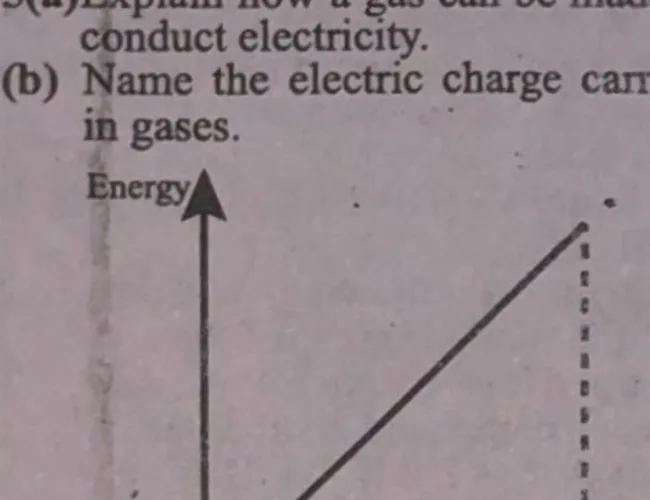
6. The diagram represents the graph of electron energy against the frequency of the radiation incident on a metal surface (photoelectric effect). Interpret the: (a) slope of the graph; (b) intercept, OC; (c) intercept, OK.
Model answer
(a) The slope of the graph represents Planck's constant, h.
(b) The intercept OC (on the negative energy axis) represents the work function of the metal (as a negative energy intercept, −W₀).
(c) The intercept OK (on the frequency axis) represents the threshold frequency — the minimum frequency of radiation needed to cause photoelectric emission from the metal surface.
7(a). State two conditions under which photo-electrons can be emitted from the surface of a metal.
Model answer
1. The frequency of the incident radiation must be equal to or greater than the threshold frequency of the metal.
2. The radiation must fall directly on the metal surface, supplying enough energy per photon (hf) to overcome the metal's work function.
PART 2 — Answer any three questions from this part.
8(a). Give two examples each of: (i) rotational motion; (ii) linear motion. (2 marks)
Model answer
(i) Rotational motion: the spinning of a wheel; the rotation of the Earth on its axis.
(ii) Linear motion: a car moving along a straight road; a ball falling vertically under gravity.
8(b). Describe a laboratory experiment to determine the density of an irregularly shaped solid. (3 marks)
Model answer
Using the displacement (measuring cylinder) method:
1. Find the mass (m) of the solid using a beam balance.
2. Partly fill a measuring cylinder with water and record the initial volume reading (V₁).
3. Gently lower the solid into the water (tied with a thread if necessary) and record the new volume reading (V₂).
4. Volume of the solid = V₂ − V₁.
5. Density = mass/volume = m/(V₂−V₁).
8(c). State Newton's second law of motion. (2 marks)
Model answer
Newton's second law states that the rate of change of momentum of a body is directly proportional to the applied (net) force, and takes place in the direction in which the force acts.
Inertia is the natural tendency of a body to resist any change in its state of rest or of uniform motion in a straight line, unless it is acted upon by an external (net) force.
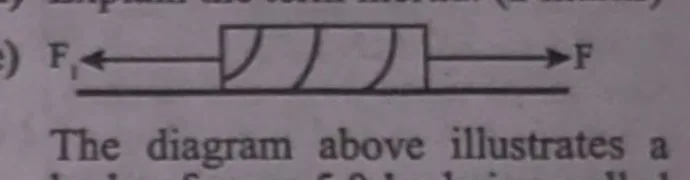
8(e). The diagram illustrates a body of mass 5.0kg being pulled by a horizontal force F. If the body accelerates at 2.0ms⁻² and experiences a frictional force of 5N, calculate the: (i) net force on it; (ii) magnitude of F; (iii) coefficient of kinetic friction. [g=10ms⁻²] (6 marks)
Model answer
(i) Net force = ma = 5.0×2.0 = 10N
(ii) F − friction = net force ⟹ F − 5 = 10 ⟹ F = 15N
(iii) Normal force = mg = 5.0×10 = 50N
Coefficient of kinetic friction, μ = friction/Normal force = 5/50 = 0.1
Heat capacity is the quantity of heat required to raise the temperature of a body (or substance) by 1 Kelvin (1°C). Its SI unit is Joules per Kelvin (JK⁻¹).
9(c). Explain how a tightly fitted glass stopper could be removed from a reagent bottle.
Model answer
The neck of the bottle (around the stopper) is gently heated, e.g. by running hot water over it. The glass neck expands due to the heat faster than the stopper inside it, loosening the grip and allowing the stopper to be removed.
9(d). A quantity of pepper soup of mass 800g poured into a plastic container with a tight fitting lid has a temperature of 30°C. The container is placed in a microwave oven, rated 1200W, and operated for 3 minutes. (i) Calculate the final temperature attained by the soup (assuming no heat losses); (ii) Explain why containers with tight-fitting lids are not suitable for use in microwave cooking; (iii) When the soup is brought out and allowed to cool, a dent is observed on the container. Explain. [specific heat capacity of soup=4000 J kg⁻¹K⁻¹]
Model answer
(i) Heat supplied = Power × time = 1200×(3×60) = 1200×180 = 216,000J
Heat = mcΔT ⟹ 216,000 = 0.8×4000×ΔT ⟹ ΔT = 216,000/3200 = 67.5°C
Final temperature = 30+67.5 = 97.5°C
(ii) The heat generated causes the liquid and trapped air/vapour to expand, building up pressure inside the sealed container. Since the tight lid does not allow this pressure to escape, it can cause the container to burst.
(iii) As the soup and trapped vapour inside the container cool, they contract, lowering the internal pressure below the surrounding atmospheric pressure. The greater external atmospheric pressure then pushes inward on the container walls, causing the observed dent.
10(a). State the three characteristics of sound and the factor on which each of them depends.
Model answer
1. Pitch — depends on the frequency of the sound wave.
2. Loudness — depends on the amplitude of the sound wave.
3. Quality (timbre) — depends on the overtones/waveform present.
Resonance is the phenomenon in which a vibrating body causes another body to vibrate, with the amplitude of vibration becoming very large, when the frequency of the forcing vibration matches the natural frequency of the second body.
10(c). What role does echo play in the construction of a concert hall?
Model answer
Echoes (reflected sound) must be controlled/minimized in the design of a concert hall, since excessive reverberation from repeated reflections would blur or distort the original sound, reducing clarity for the audience. Sound-absorbing materials are used in the hall's construction to reduce unwanted echoes.
10(d). The surface of an ear drum (assumed circular) has a radius 2.1mm. It resonates with an amplitude of 0.8×10⁻⁷m as a result of impulses received from an external body vibrating at 2,400Hz. If the resulting pressure change on the ear drum is 3.6×10⁻³Nm⁻², calculate the: (i) period of oscillation; (ii) velocity.
Model answer
(i) Period, T = 1/f = 1/2400 ≈ 4.17×10⁻⁴s
(ii) Velocity (maximum particle velocity) = amplitude × angular frequency = a×2πf
= 0.8×10⁻⁷ × 2π×2400
≈ 0.8×10⁻⁷ × 15,080
≈ 1.21×10⁻³ m/s
Advertisement
Sign up free to unlock
Score tracking
Practice history
Saved questions
Progress dashboard
Personalized sessions
Weak-topic breakdown
…and/or go further with premium services and No Ads.