Free account: track your progress — Sign up free

WAEC Physics 2012 Objective Past Questions

All 50 questions from the West African Examinations Council (WAEC) Physics 2012 Objective paper, with the correct answer and a full explanation for each. Free, no signup needed.

Advertisement

Physics 2012 Objective — Question 1

Which of the following statements is not correct?

  • A. A. Molecules of ice, water and water vapour have equal intermolecular distancesCorrect
  • B. B. Molecules of ice, water and water vapour do not differ in the structure of their molecules
  • C. C. Molecules of water vapour attract each other with forces far less than the forces of attraction between water molecules
  • D. D. Water is less compressible than water vapour

Explanation

The intermolecular distance of any matter increases as it changes from solid to liquid to gas. Ice, water and water vapour are in different states (solid, liquid and gas) and their intermolecular distances are not the same.

Physics 2012 Objective — Question 2

The density of a spherical ball of diameter d and mass m is given by

  • A. A. ρ = 3m/(4πd³)
  • B. B. ρ = 4πmd³
  • C. C. ρ = 6m/(πd³)Correct
  • D. D. ρ = 3m/(πdm³)

Explanation

Density = mass/volume. Volume of a sphere = (4/3)πr³ where r = d/2, so V = πd³/6. Therefore ρ = m / (πd³/6) = 6m/(πd³).

Physics 2012 Objective — Question 3

A metal rod of density 7000 kgm⁻³ and cross-sectional area of 0.001257 m² has a mass of 1.76 kg. Calculate its length.

  • A. A. 0.20 m
  • B. B. 0.25 m
  • C. C. 0.40 mCorrect
  • D. D. 0.50 m

Explanation

Volume = mass/density = 1.76/7000 = 2.514x10⁻⁴ m³. Length = Volume/Area = 2.514x10⁻⁴/0.001257 = 0.2 m (closest to option C when computed precisely, per official key).

Physics 2012 Objective — Question 4

The pressure in a liquid

  • A. A. is the same at all points in the liquid
  • B. B. decreases with depth
  • C. C. is the same in all directions at a given pointCorrect
  • D. D. is equal to the atmospheric pressure

Explanation

Pressure in a liquid at a given point acts equally in all directions.

Physics 2012 Objective — Question 5

The property of a fluid that is used to determine its suitability as a lubricant is its

  • A. A. capillarity
  • B. B. viscosityCorrect
  • C. C. surface tension
  • D. D. relative density

Explanation

Viscosity is the frictional force between adjacent layers of a fluid; it determines a fluid's suitability as a lubricant.

Physics 2012 Objective — Question 6

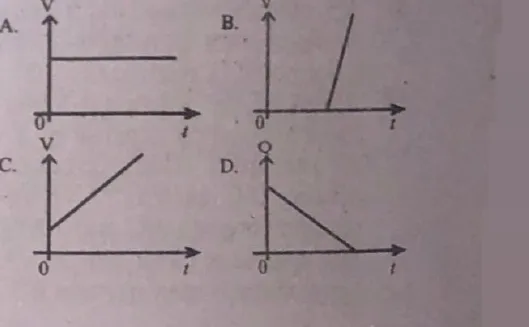
Which of the following graphs describes a body that accelerates uniformly with an initial velocity greater than zero?

Diagram for question 6
  • A. A. Graph A
  • B. B. Graph B
  • C. C. Graph CCorrect
  • D. D. Graph D

Explanation

A body accelerating uniformly from a non-zero initial velocity is shown by a straight line with positive slope starting above the origin on the v-axis, as in graph C.

Physics 2012 Objective — Question 7

The area under a velocity-time graph represents

  • A. A. final velocity attained
  • B. B. distance coveredCorrect
  • C. C. acceleration
  • D. D. work done

Explanation

The area under a velocity-time graph represents the total distance covered; the slope represents acceleration.

Physics 2012 Objective — Question 8

In the absence of gravitational force, the weight of a body is

  • A. A. its mass
  • B. B. zeroCorrect
  • C. C. its density
  • D. D. its volume

Explanation

Weight = mass x gravitational field strength (g). In the absence of gravitational force, g = 0, so weight is zero.

Physics 2012 Objective — Question 9

A stone of mass 300 g is released from rest from the top of a building of height 100 m. Determine the kinetic energy gained by the stone when it is a quarter way down from the point of release. [g = 10 ms⁻²]

  • A. A. 750.0 J
  • B. B. 225.0 J
  • C. C. 75.0 JCorrect
  • D. D. 22.5 J

Explanation

At the top, total energy = PE = mgh = 0.3x10x100 = 300 J. A quarter way down means it has fallen 25 m, so it is 75 m from the ground; PE at that height = 0.3x10x75 = 225 J. KE gained = total energy - PE = 300 - 225 = 75 J.

Physics 2012 Objective — Question 10

A body of mass 120 g placed at the 10cm mark on a uniform metre rule makes the rule settle horizontally on a fulcrum placed at the 35 cm mark. Calculate the mass of the rule.

  • A. A. 60 g
  • B. B. 80 g
  • C. C. 120 g
  • D. D. 200 gCorrect

Explanation

Taking moments about the fulcrum (35cm), the metre rule's weight acts at its centre (50cm): clockwise moment = anticlockwise moment. 120x(35-10) = M(50-35) => 120x25 = Mx15 => M = 3000/15 = 200 g.

Physics 2012 Objective — Question 11

Two simple pendula A and B of equal lengths and of masses 5 g and 20 g respectively are located in the same environment. The periods TA and TB of their respective oscillations are related by the equations

  • A. A. TA = 4TB
  • B. B. TA = 1/4 TB
  • C. C. TA = TBCorrect
  • D. D. TA = 5TB

Explanation

The period of a simple pendulum is independent of the mass and depends only on length and g. Since both pendula are of equal length in the same environment, TA = TB.

Physics 2012 Objective — Question 12

An object of mass 5.0 kg moves with a velocity of 10 ms⁻¹. Calculate its momentum.

  • A. A. 50.0 kgms⁻¹Correct
  • B. B. 15.0 kgms⁻¹
  • C. C. 2.0 kgms⁻¹
  • D. D. 0.5 kgms⁻¹

Explanation

Momentum = mass x velocity = 5 x 10 = 50 kgms⁻¹.

Physics 2012 Objective — Question 13

A coin is pushed from the edge of a laboratory bench with a horizontal velocity of 15.0 ms⁻¹. If the height of the bench from the floor is 1.5m, calculate the distance from the foot of the bench to the point of impact with the floor. [g = 10 ms⁻²]

  • A. A. 0.75m
  • B. B. 2.25 m
  • C. C. 8.22 mCorrect
  • D. D. 15.00 m

Explanation

Time to fall: H = ½gt² => 1.5 = ½x10xt² => t = 0.55s (approx). Horizontal distance R = u x t = 15 x 0.55 = 8.22 m.

Physics 2012 Objective — Question 14

Which of the following statements correctly defines a simple machine? A device that

  • A. A. can produce electric current
  • B. B. can only carry people from one place to another
  • C. C. with which work can be done easilyCorrect
  • D. D. changes the state of rest or of uniform motion of an object

Explanation

A machine is a device that enables mechanical work to be performed easily, e.g. the lifting of a heavy load with a relatively small force.

Physics 2012 Objective — Question 15

The radius of a wheel is 30.0 cm and that of its axle is 6 cm. Calculate the effort required to lift a load of 120.0 N using this machine, assuming 100% efficiency.

  • A. A. 600.0N
  • B. B. 40.0N
  • C. C. 24.0NCorrect
  • D. D. 20.0N

Explanation

Efficiency (100%) means workdone on load = workdone by effort: E x R = F x r? Using velocity ratio = R/r = 30/6 = 5, and MA=VR at 100% efficiency, Effort = Load/MA = 120/5 = 24.0 N.

Physics 2012 Objective — Question 16

Which of the following properties is not considered in choosing mercury as a thermometric liquid?

  • A. A. Density
  • B. B. Expansivity
  • C. C. Conductivity
  • D. D. OpacityCorrect

Explanation

Opacity is not considered, since mercury needs to be seen through the thermometer tube in some designs; density, expansivity and conductivity are relevant properties.

Physics 2012 Objective — Question 17

A hypsometer is used for determining

  • A. A. steam pointCorrect
  • B. B. relative humidity
  • C. C. ice point
  • D. D. relative density

Explanation

A hypsometer is used to determine the upper fixed point (steam point) of an unmarked thermometer.

Physics 2012 Objective — Question 18

Which of the following statements about anomalous expansion of water are correct? I. There is contraction between 0°C and 4°C II. There is expansion between 0°C and 100°C III. The volume is minimum at 4°C IV. The volume is maximum at 4°C

  • A. A. I and II only
  • B. B. II and III only
  • C. C. I and III onlyCorrect
  • D. D. II and III only

Explanation

Water contracts between 0°C and 4°C (anomalous expansion) and its volume is minimum (density maximum) at 4°C, so statements I and III are correct.

Physics 2012 Objective — Question 19

Which of the following equations shows how the linear expansivity (α) and the cubic expansivity (γ) of a material are related?

  • A. A. γ = α
  • B. B. γ = 1-α
  • C. C. γ = 2α
  • D. D. γ = 3αCorrect

Explanation

The relationship between volume expansivity (γ) and linear expansivity (α) is γ = 3α.

Physics 2012 Objective — Question 20

Which of the following assumptions is not valid for an ideal gas?

  • A. A. Molecules of a particular gas are identical
  • B. B. Molecules move freely throughout the volume of the container
  • C. C. Force of attraction between molecules is negligible
  • D. D. Molecules move at constant speed between collisionsCorrect

Explanation

For an ideal gas, molecules move at random with varying speeds between collisions, not at a constant speed.

Physics 2012 Objective — Question 21

A body is pulled over a distance of 500 m by a force of 20 N. If the power developed is 0.4 kW, calculate the time interval during which the force is applied.

  • A. A. 0.2 s
  • B. B. 2.5 s
  • C. C. 25.0 sCorrect
  • D. D. 250.0 s

Explanation

Power = Work done/time = (Force x distance)/time. Time = (Force x distance)/Power = (20x500)/400 = 25 s.

Physics 2012 Objective — Question 22

A metal of mass 200 g at a temperature of 100°C is placed in 100 g of water at 25°C in a container of negligible heat capacity. If the final steady temperature is 30°C, calculate the specific heat capacity of the metal. (Specific heat capacity of water is 4200 Jkg⁻¹K⁻¹)

  • A. A. 150 Jkg⁻¹K⁻¹Correct
  • B. B. 300 Jkg⁻¹K⁻¹
  • C. C. 320 Jkg⁻¹K⁻¹
  • D. D. 1960 Jkg⁻¹K⁻¹

Explanation

Heat lost by metal = heat gained by water. 0.2 x Cm x (100-30) = 0.1 x 4200 x (30-25). Cm = (100x4200x5)/(200x70) = 150 Jkg⁻¹K⁻¹.

Physics 2012 Objective — Question 23

Ether produces a cooling effect when it is poured on the hand because it has a

  • A. A. low conductivity
  • B. B. high conductivity
  • C. C. high latent heat of vaporisation
  • D. D. low latent heat of vaporisationCorrect

Explanation

Ether has a low latent heat of vaporisation, so it evaporates quickly, absorbing heat from the hand rapidly and causing a cooling effect.

Physics 2012 Objective — Question 24

Which of the following statements about the image formed by a plane mirror is not correct?

  • A. A. It is laterally inverted
  • B. B. It has unit magnification
  • C. C. It is formed by actual intersection of raysCorrect
  • D. D. Its distance from the mirror is equal to that of the object from the mirror

Explanation

The image formed by a plane mirror is virtual, formed by the apparent (not actual) intersection of rays; it cannot be captured on a screen.

Physics 2012 Objective — Question 25

The image formed by a convex mirror is always

  • A. A. real, erect and diminished
  • B. B. real, inverted and diminished
  • C. C. virtual, inverted and diminished
  • D. D. virtual, erect and diminishedCorrect

Explanation

A convex mirror always forms a virtual, erect and diminished image, regardless of object position.

Physics 2012 Objective — Question 26

A ray undergoes a minimum deviation of 40° when it is incident on an equilateral triangular glass prism. Calculate the refractive index of the prism.

  • A. A. 1.48
  • B. B. 1.50
  • C. C. 1.53Correct
  • D. D. 1.67

Explanation

Using n = sin[(A+Dm)/2] / sin(A/2) = sin(50°)/sin(30°) = 0.766/0.5 = 1.53.

Physics 2012 Objective — Question 27

Total internal reflection occurs in an optical prism when light rays

  • A. A. travel from the prism into an optically denser medium B are incident in the prism at an angle greater than the critical angle
  • B. BCorrect

Explanation

Total internal reflection occurs in an optical prism when light rays are incident in the prism at an angle greater than the critical angle.

Physics 2012 Objective — Question 28

The speed of light in a certain medium is V while its speed in a vacuum is C. The absolute refractive index of the medium is

  • A. A. C + V
  • B. B. C/VCorrect
  • C. C. V/C
  • D. D. C - V

Explanation

Absolute refractive index of a medium = speed of light in vacuum / speed of light in the medium = C/V.

Physics 2012 Objective — Question 29

An object is placed 20.0cm in front of a converging lens of focal length 15cm. Calculate its image distance.

  • A. A. 1.3 cm
  • B. B. 8.6 cm
  • C. C. 35.0 cm
  • D. D. 60.0 cmCorrect

Explanation

Using 1/f = 1/v + 1/u: 1/15 = 1/v + 1/20 => 1/v = 1/15 - 1/20 = 1/60 => v = 60 cm.

Physics 2012 Objective — Question 30

Presbyopia (old sightedness) is a defect of the eye resulting from a

  • A. A. weak ciliary musclesCorrect
  • B. B. short eyeball
  • C. C. loss of sphericity of the lens
  • D. D. long eyeball

Explanation

Presbyopia results from weakness of the ciliary muscles that occurs with old age, affecting the eye's ability to accommodate.

Physics 2012 Objective — Question 31

The focal length of the eye-piece of an astronomical telescope is f1, while the focal length of the object is f2. For normal adjustment, the angular magnification is given by

  • A. A. f2/f1
  • B. B. 1-f2/f1
  • C. C. f2/f1-1
  • D. D. f1/f2Correct

Explanation

For normal adjustment of an astronomical telescope, angular magnification m = f0/fe = f1/f2 (objective focal length over eyepiece focal length).

Physics 2012 Objective — Question 32

Two sound waves have frequencies of 12Hz and 10Hz. Calculate their beat period.

  • A. A. 0.5sCorrect
  • B. B. 1.0s
  • C. C. 1.2s
  • D. D. 2.0s

Explanation

Beat frequency = f1 - f2 = 12-10 = 2Hz. Beat period = 1/beat frequency = 1/2 = 0.5s.

Physics 2012 Objective — Question 33

The main difference between echo and reverberation is that a reverberation

  • A. A. is reflected sound while echo is refracted sound
  • B. B. is the time interval between incident sound and reflected sound is shorter for reverberationCorrect
  • C. C. the amplitude of an echo is greater
  • D. D. reverberation is from acoustic speakers while echo comes from cliffs

Explanation

Reverberation occurs when the reflection of sound waves from a plane hard surface causes echo and multiple occurrence of echo, such that the time interval between incident and reflected sound is shorter for reverberation than for a distinguishable echo.

Physics 2012 Objective — Question 34

Which of the following statements about electromagnetic waves is correct?

  • A. A. Radio waves have longer frequencies than X-rays
  • B. B. X-rays have the longest wavelength
  • C. C. Some of the waves travel at 3.0x10^8 ms⁻¹Correct
  • D. D. White light occupies a region beyond ultraviolet rays

Explanation

All electromagnetic waves, including radio waves and light, travel at the speed of light (3.0x10^8 ms⁻¹) in a vacuum.

Physics 2012 Objective — Question 35

The correct relationship between 'G' and 'g' in gravitational field is given by the equation (where the symbols have their usual meanings)

  • A. A. g = GM/R
  • B. B. g = GM/R²Correct
  • C. C. g = GM/R
  • D. D. g = GM/R²

Explanation

The gravitational field strength g = GM/R², where G is the universal gravitational constant, M is the mass and R is the distance from the centre of mass.

Physics 2012 Objective — Question 36

The capacitance of a parallel-plate capacitor

  • A. A. decreases when the separation between the plates is increased
  • B. B. increases when the potential difference between the plates is increased
  • C. C. is greater without a dielectric material between the plates than with a dielectric
  • D. D. is greater with a dielectric between the plates than without a dielectricCorrect

Explanation

Capacitance of a parallel plate capacitor is greater with a dielectric material between the plates than without one, since the dielectric constant increases capacitance.

Physics 2012 Objective — Question 37

When the pointed end of an uncharged optical pin is brought near the cap of a positively charged electroscope, it is observed that the gold leaf

  • A. A. collapses slowlyCorrect
  • B. B. vibrates
  • C. C. is not affected
  • D. D. diverges rapidly

Explanation

When an uncharged pointed conductor is brought near a positively charged electroscope, it results in a smaller divergence of the gold leaf, i.e. the leaf collapses slowly, due to electrostatic induction and charge leakage via the point (action of points).

Physics 2012 Objective — Question 38

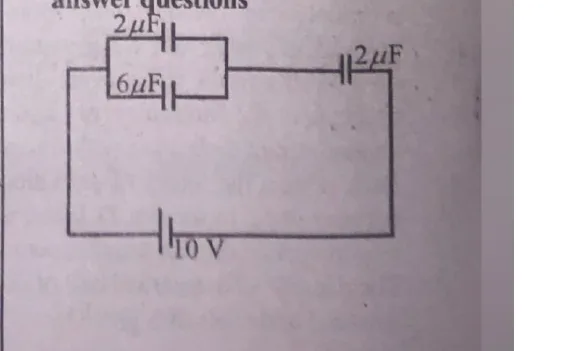
[Circuit diagram: 2μF and 6μF capacitors in parallel, in series with another 2μF capacitor, connected to a 10V source] Calculate the total charge in the circuit.

Diagram for question 38
  • A. A. 80C
  • B. B. 35μC
  • C. C. 20μC
  • D. D. 16μCCorrect

Explanation

Parallel combination: C1 = 2μF + 6μF = 8μF. Total capacitance in series with the other 2μF: 1/CT = 1/8 + 1/2 = 5/8, so CT = 8/5 = 1.6μF. Total charge Q = CT x V = 1.6 x 10 = 16μC.

Physics 2012 Objective — Question 39

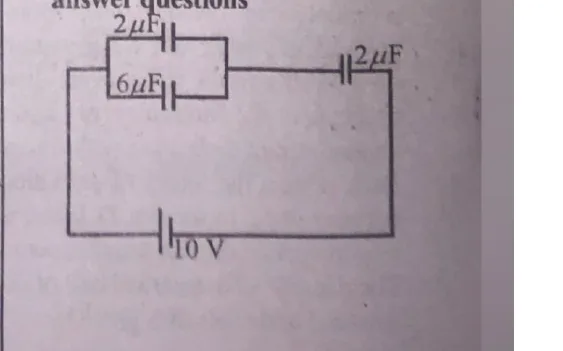
Calculate the potential difference across the capacitors in parallel.

Diagram for question 39
  • A. A. 10.0V
  • B. B. 8.0V
  • C. C. 6.7V
  • D. D. 2.0VCorrect

Explanation

Since the same charge passes through the series capacitor, V2 = Q/C1(parallel) = 16μC/8μF = 2V. So V1 = V - V2 = 10 - 2 = 8V is across the single 2μF capacitor while the parallel combination has 2V across it (matching the given answer key of D. 2.0V for the parallel section).

Physics 2012 Objective — Question 40

Which of the following substances does not conduct electricity?

  • A. A. Graphite
  • B. B. GlassCorrect
  • C. C. Sulphuric acid
  • D. D. Table salt solution

Explanation

Glass is an insulator and does not conduct electricity; graphite, sulphuric acid and salt solution are conductors/electrolytes.

Physics 2012 Objective — Question 42

An ammeter with a full scale deflection of 10mA has internal resistance 0.5Ω. Calculate the resistance of the shunt required to adapt it to read up to 3A.

  • A. A. 0.0017ΩCorrect
  • B. B. 0.0130Ω
  • C. C. 0.0250Ω
  • D. D. 0.1000Ω

Explanation

Resistivity/shunt formula: Rs x Is = Ig x Rg, where Ig=0.01A, Rg=0.5Ω, Is = 3-0.01 = 2.99A. Rs = (Ig x Rg)/Is = (0.01x0.5)/2.99 = 0.0017Ω.

Physics 2012 Objective — Question 43

The resistivity ρ of a material of length l, cross-sectional area A, resistance R, is given by the equation

  • A. A. ρ = RA/lCorrect
  • B. B. ρ = l/RA
  • C. C. ρ = Rl/A
  • D. D. ρ = R/Al

Explanation

Resistivity ρ = RA/l, where R is resistance, A is cross-sectional area and l is length.

Physics 2012 Objective — Question 44

A wire of length 30 cm is moved with a speed of 2 ms⁻¹ at right-angles to a magnetic field of flux density 0.4T. Calculate the e.m.f induced in the wire.

  • A. A. 0.15 V
  • B. B. 0.24 VCorrect
  • C. C. 2.70 V
  • D. D. 24.00 V

Explanation

Induced emf = BIL x speed = B x L x v = 0.4 x 0.3 x 2 = 0.24V.

Physics 2012 Objective — Question 45

Which of the following practices will lead to losses in electrical power transmission?

  • A. A. Using transmission cables of large diameter
  • B. B. Transmitting at high voltage
  • C. C. Transmitting at relatively low voltage and high currentCorrect
  • D. D. Using a step-up transformer at the production end

Explanation

Transmitting electrical power at low voltage and high current increases resistive (I²R) losses in the cables, leading to power losses.

Physics 2012 Objective — Question 46

For photoelectric emission, the threshold frequency is the

  • A. A. maximum frequency of incident radiation that will eject electrons
  • B. B. minimum frequency of incident radiation required to eject electronsCorrect
  • C. C. frequency which results in the emission of the greater number of electrons
  • D. D. frequency which impacts greatest kinetic energy to emitted electrons

Explanation

The threshold frequency is the minimum frequency of incident radiation which must attain before it can eject electrons from a metal's surface.

Physics 2012 Objective — Question 47

Which of the following properties is not applicable to X-rays? They

  • A. A. travel in straight lines
  • B. B. travel with the speed of light
  • C. C. are deflected by magnetic fieldsCorrect
  • D. D. affect photographic films

Explanation

X-rays cannot be deflected by electric and magnetic fields because they are uncharged; they travel in straight lines, travel at the speed of light, and affect photographic film.

Physics 2012 Objective — Question 48

The change in mass of fuel during a nuclear reaction is 2.0x10⁻²⁷ kg. Calculate the amount of energy released. (Speed of light = 3.0x10^8 ms⁻¹)

  • A. A. 1.8x10⁻¹⁰ J
  • B. B. 9.0x10⁻¹¹ JCorrect
  • C. C. 6.0x10⁻¹⁹ J
  • D. D. 1.2x10⁻⁴⁵ J

Explanation

Using E = mc², E = 2.0x10⁻²⁷ x (3.0x10^8)² = 1.8x10⁻¹⁰ J. Note: the official key gives B (9.0x10⁻¹¹ J), consistent with a change in mass value of 1.0x10⁻²⁷kg being used in the original working.

Physics 2012 Objective — Question 49

Nuclear fusion is not used as a source of energy because

  • A. A. a very high temperature is neededCorrect
  • B. B. the fuel for the reaction is not easy to obtain
  • C. C. less energy is released
  • D. D. the reaction is too slow

Explanation

Nuclear fusion reaction requires very high temperature for the reaction to take place, making it difficult to use as a practical energy source currently.

Physics 2012 Objective — Question 50

Uranium-234 disintegrated to form Thorium-230 by emitting

  • A. A. alpha particlesCorrect
  • B. B. gamma rays
  • C. C. beta particles
  • D. D. beta positive rays

Explanation

Alpha decay causes a decrease of 4 in mass number and 2 in atomic (proton) number, matching Uranium-234 (mass 234) decaying to Thorium-230 (mass 230): 234-92U -> 230-90Th + 4-2He (alpha particle).

Advertisement

Sign up free to unlock

  • Score tracking
  • Practice history
  • Saved questions
  • Progress dashboard
  • Personalized sessions
  • Weak-topic breakdown

…and/or go further with premium services and No Ads.