All 50 questions from the West African Examinations Council (WAEC) Physics 2020 Objective paper, with the correct answer and a full explanation for each. Free, no signup needed.
In a collision between two objects, kinetic energy is conserved only if
A. one of the objects was initially at rest
B. potential energy is converted to work
C. the collision is inelastic
D. the collision is elasticCorrect
Explanation
An elastic collision is one in which the total kinetic energy of the colliding systems does not change after collision, i.e. there is no net conversion of energy into other forms. Both momentum and kinetic energy are conserved. An inelastic collision is one in which there is a loss of kinetic energy while momentum of the colliding systems is conserved.
The volume of a fixed mass of a gas varies inversely as the pressure on it, provided the temperature is constant. This statement is
A. Pressure law
B. Charles' law
C. Boyle's lawCorrect
D. General gas law
Explanation
Boyle's law states that the volume of a fixed mass of a gas varies inversely as the pressure on it, at constant temperature, i.e. P is proportional to 1/V, so PV=constant, P1V1=P2V2=P3V3=...
An image formed on a screen can either be magnified, diminished or the same size as the object, and it is always inverted. Virtual images are always upright.
How would the capacitance of a parallel plate capacitor be affected if the distance of separation of its plates is decreased? It will
A. increase in valueCorrect
B. decrease slightly
C. remain unchanged
D. drop to zero
Explanation
For a parallel plate capacitor, the capacitance depends on the geometry of the plates: C = (epsilon)A/d, where A=area of plates, d=distance between plates. Decreasing d increases the capacitance since capacitance is inversely proportional to plate separation.
Which of the following machines does not apply the lever principle?
A. Claw hammer
B. Wheel barrow
C. Single pulleyCorrect
D. Sugar tong
Explanation
A single pulley is a device consisting of a wheel on an axle or shaft over which a cord is looped in order to change the direction of force or load at the other end; it does not apply the lever principle. Claw hammer is a first class lever, wheel barrow is a second class lever, and sugar tongs use the third class lever principle.
The average distance moved by a molecule between collisions is called
A. molecular distance
B. intermolecular distance
C. mean distance
D. mean free pathCorrect
Explanation
Mean free path is the average distance moved by a molecule between collisions. Intermolecular distance is the average distance between two chemically combined atoms in a molecule.
Which of the following waves requires a material medium for its propagation?
A. Radio waves
B. Light waves
C. Sound wavesCorrect
D. X-rays
Explanation
Radio waves, light waves, X-rays are all electromagnetic waves which do not require a material medium for propagation. However, sound wave as a mechanical wave requires a material medium for its propagation.
The Leclanche cell is the most common dry cell containing ammonium chloride as the electrolyte, negative terminal (anode) zinc plate, positive terminal (cathode) carbon rod, and manganese dioxide (MnO2) as the depolarizer.
The material used to slow down the neutrons in a nuclear reactor is
A. boron
B. copper
C. graphiteCorrect
D. uranium
Explanation
For a nuclear reactor: the graphite/graphite moderator controls neutron speed; boron rod - control neutron population; uranium - serves as fuel; coolant - reduces excessive heat produced; heat exchanger - converts the heat energy produced to other forms.
Which of the following statements explains why hot soapy water is more effective in cleaning oil-stained dishes? A. The oil on the dishes repels the soap. B. Soap and heat decrease the surface tension of water. C. Hot water increases the surface tension of oil. D. Soap increases the surface tension of oil and water.
A. The oil on the dishes repels the soap
B. Soap and heat decrease the surface tension of waterCorrect
C. Hot water increases the surface tension of oil
D. Soap increases the surface tension of oil and water
Explanation
Hot soapy water lowers the net force of attraction among molecules and hence decreases surface tension, allowing it to more effectively clean oil-stained dishes.
A. Amplitude of vibration, force constant of string and length of string
B. Amplitude of vibration, force constant of string and tension in string
C. Mass per unit length of string, tension in string and length of stringCorrect
D. Force constant of string, tension and length of string
Explanation
The velocity v of a wave in a stretched string depends on the tension T in the string and the mass per unit length (mu) of the string, obtained using the method of dimensions.
A beam of parallel rays from a distant object O, incident on one side of a total reflecting prism. Which diagram does not represent the correct path of the beam when it emerges from the prism?
A. W
B. X
C. Y
D. ZCorrect
Explanation
In a totally reflecting prism, the beam should undergo total internal reflection and emerge deflected by 90 deg (or as appropriate for the prism's setup) without loss of intensity; diagram Z does not represent the correct path for the beam as it emerges from the prism.
The earpiece of a telephone handset converts energy from A. electrical to sound. B. sound to electrical. C. radio wave to sound. D. sound to radio wave.
A. electrical to soundCorrect
B. sound to electrical
C. radio wave to sound
D. sound to radio wave
Explanation
The telephone works by converting sound energy into electrical energy (mouth piece, direct current electrical power, uses ring/commutators for one direction current flow). The earpiece is an A.C. generator, which converts electrical energy into sound energy; it does not have slip-rings but uses commutators.
Two identical cups containing the same volume of water at 45C and 5C, are left in a room at 25C. Which of the following graphs correctly illustrates the variation of temperature with time?
A. Graph ACorrect
B. Graph B
C. Graph C
D. Graph D
Explanation
While water A cools to the room temperature, water B heats up to the room temperature 25C; both approach 25C from opposite directions over time, matching the trend shown in graph A.
A ray of light travelling from glass into ethyl alcohol is incident at the boundary at an angle of incidence 30 deg. Calculate the angle of refraction. [Refractive index of glass = 1.5; refractive index of ethyl alcohol = 1.36]
A. 27.00 deg
B. 33.50 degCorrect
C. 51.70 deg
D. 72.80 deg
Explanation
Using Snell's law: n = sin i / sin r, where n = n1 sin(theta1) = n2 sin(theta2), i.e. 1.5 sin30 = 1.36 sin r. So sin r = 1.5x0.5/1.36 = 0.75/1.36 = 0.55147, giving r = sin^-1(0.55147) = 33.46, approximately 33.50 deg.
A 60 kg man stands on a weighing balance in an elevator. If the elevator accelerates upwards at 5 ms^-2, determine the reading of the scale. [g=10ms^-2]
A. 300 N
B. 600 N
C. 800 N
D. 900 NCorrect
Explanation
Free body diagram: since the acceleration is upward, T-mg=ma, thus T=m(a+g)=60(5+10)=60x15=900N. The scale reading is greater than the weight (600N) of the man since the elevator accelerates upward.
The length of an iron bar is 100 cm at 20C. At what temperature will its length increase by 0.01%? [Linear expansivity of iron=1.2x10^-5 C^-1]
A. 48.0 C
B. 38.0 C
C. 28.3 CCorrect
D. 23.0 C
Explanation
Given original length l0=100cm, theta1=20C. Since length increases by 0.01%, delta_l=0.01cm. alpha=delta_l/(l0 x delta_theta), so delta_theta=delta_l/(l0 x alpha)=0.01/(100x1.2x10^-5)=8.3. theta2=theta1+delta_theta=20+8.3=28.3C.
A moving-coil galvanometer which gives a full-scale deflection with 0.005 A is converted to a voltmeter, reading up to 5 V using an external resistance of 975 ohm. What is the resistance of the metre?
A. 0.25 ohm
B. 2.50 ohm
C. 25.00 ohmCorrect
D. 250.00 ohm
Explanation
This involves converting an ammeter to a voltmeter using a multiplier (a high resistance resistor in series with the galvanometer). Resistance of the multiplier Rm = V/I - Rg = 5/0.005 - 975 = 1000-975 = 25 ohm.
A beam consisting of alpha-particles, beta-particles and gamma-rays pass through a magnetic field at right angles to the direction of the field. Which of the following observations would be made about the alpha-particles, beta-particles and gamma-rays respectively?
A. Deflected, deflected, deflected
B. Deflected, deflected, not deflectedCorrect
C. Deflected, not deflected, deflected
D. Not deflected, deflected, deflected
Explanation
Since alpha particles (positively charged) and beta particles (negatively charged) are charged, they are deflected both by magnetic and electric fields. Gamma radiation is however not deflected by both fields since it has no charge.
A parallel plate capacitor is charged and the charging battery subsequently disconnected. If the plates of the capacitor are moved farther apart by means of insulating handles, the
A. capacitance would increase
B. capacitance would decreaseCorrect
C. charge on the capacitor would increase
D. charge on the capacitor would decrease
Explanation
As C = q.A/d, C is proportional to 1/d. Since the battery is disconnected (charge q remains constant), moving the plates farther apart (increasing d) decreases the capacitance.
The velocity of sound in air at 15 C is 340 ms^-1. Calculate the velocity at 47 C.
A. 790 ms^-1
B. 602 ms^-1
C. 358 ms^-1Correct
D. 322 ms^-1
Explanation
Given V1=340m/s, T1=15C=288K, T2=47C+273=320K. Since V is proportional to sqrt(T) (absolute temperature), V2=V1 x sqrt(T2/T1)=340 x sqrt(320/288)=340 x sqrt(1.11)=340x1.0536=358.21 m/s.
Which of the current-voltage characteristics shown below is that exhibited by an ohmic conductor?
A. Graph A
B. Graph BCorrect
C. Graph C
D. Graph D
Explanation
A device is ohmic if it obeys Ohm's law, i.e. V is proportional to I with a constant slope (a straight line through the origin), as shown by the graph labelled B for an ohmic conductor. A non-ohmic conductor does not obey Ohm's law; its resistance changes based on the current moving through it.
A 500 N box rests on a horizontal floor. A constant horizontal force is exerted on the box so that it moves through 8 m. If the coefficient of kinetic friction between the floor and the box is 0.22, calculate the work done on the box.
A. 880 JCorrect
B. 440 J
C. 400 J
D. 110 J
Explanation
Given W=500N (50kg), distance d=8m, coefficient of kinetic friction (uk)=0.22. Work done = force x distance, where force = friction force = uk x mg = 0.22 x 500 x 8 = 880 J.
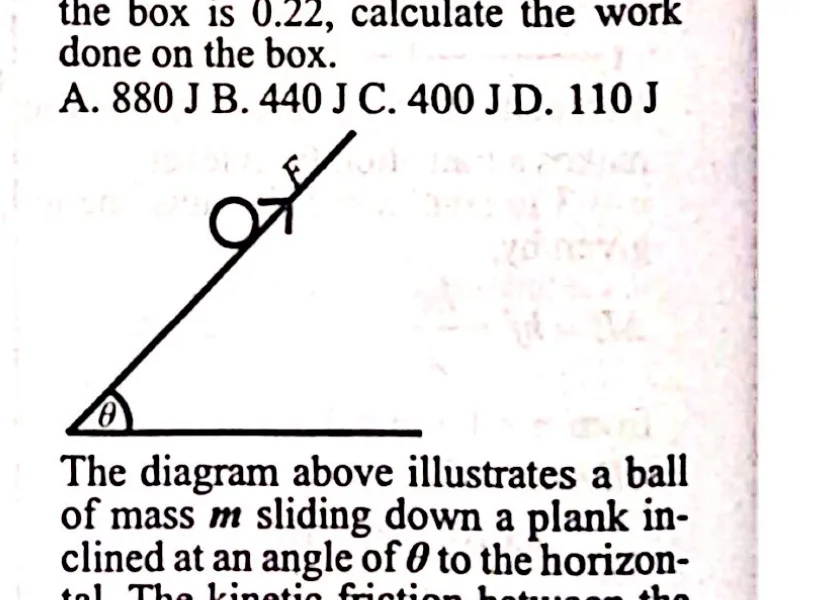
Since the ball slides down the plank (motion is downward, and a=0 initially before considering net motion), mg sin(theta) acts down the plank while friction F opposes it; from Newton's second law, the net force along the plank is mg sin(theta) - F.
What factors determine the frequency of vibration of a sonometer wire/string?
A. Amplitude of vibration, force constant of string and length of string
B. Amplitude of vibration, force constant of string and tension of string
C. Mass per unit length of string, tension in string and length of stringCorrect
D. Force constant of string, tension and length of string
Explanation
The frequency of a note emitted by a vibrating string is given by f = (1/2l) x sqrt(T/mu), where T = tension in string, mu = mass per unit length, l = length of string. Thus f is proportional to 1/l, f is proportional to sqrt(T), and f is proportional to 1/sqrt(mu).
An electron of mass m and charge e moves in a circular path in a magnetic field of flux density B. How long does it take to complete one orbit?
A. 2me/B(pi)
B. 2B/me(pi)
C. 2(pi)m/BeCorrect
D. B e/2(pi)m
Explanation
The magnetic force on the charge provides the centripetal force for the circular path: F=evB=mv^2/r, so r=mv/(eB). The angular speed omega=v/r=eB/m. The time period T=2(pi)/omega=2(pi)m/(Be).
Which of the following statements about photoelectrons is correct?
A. A faint green light produces photoelectrons with less kinetic energy than a bright red light
B. A red light releases a smaller number of electrons than a green light
C. A faint green light produces photoelectrons with greater kinetic energy than a bright red lightCorrect
D. A red light produces more photoelectrons than a green light
Explanation
A faint green light has a lower wavelength and hence higher photon energy than a bright red light; thus it produces photoelectrons with greater kinetic energy than a bright red light, though fewer in number since it's fainter (lower intensity).
The temperature of an object is raised by 120 C. The resulting increase in its absolute temperature is
A. 50 K
B. 120 KCorrect
C. 200 K
D. 393 K
Explanation
Given delta(theta)=120 deg C. Since delta(T in Kelvin)=delta(T in Celsius), the resulting increase in absolute temperature is 120 K. It is however important to note that temperature in Kelvin is not the same as temperature in degree Celsius; it is the changes in both that are the same. T(K)=273+T(C).
Which of the following statements about the motion of a simple pendulum is true?
A. It is a simple harmonic motion when the angle of displacement is large
B. It passes the equilibrium position with minimum speed
C. It possesses maximum kinetic energy at the extreme positions
D. It swings faster at the poles than at the equatorCorrect
Explanation
Characteristics of Simple Harmonic Motion (SHM): It is SHM when the angle of displacement is small. It passes the equilibrium position with maximum speed and minimum speed at the extreme positions of oscillation. It possesses maximum kinetic energy and minimum P.E. at the centre, and maximum P.E. and minimum K.E. at the extreme positions. It swings faster at the poles than at the equator (equilibrium position).
An electron of mass m and charge e moves in a circular path in a magnetic field of flux density B. The magnetic force on the charge is given by
A. F=evB sin90 = qvBCorrect
B. F=evB cos90
C. F=ev/B
D. F=eB/v
Explanation
The magnetic force on the charge is given by F=evB sin90=qvB, the centripetal force (mv^2/r) needed for the circular path is provided by the magnetic force. Thus evB/r=mv/r and r=mv/(qB).
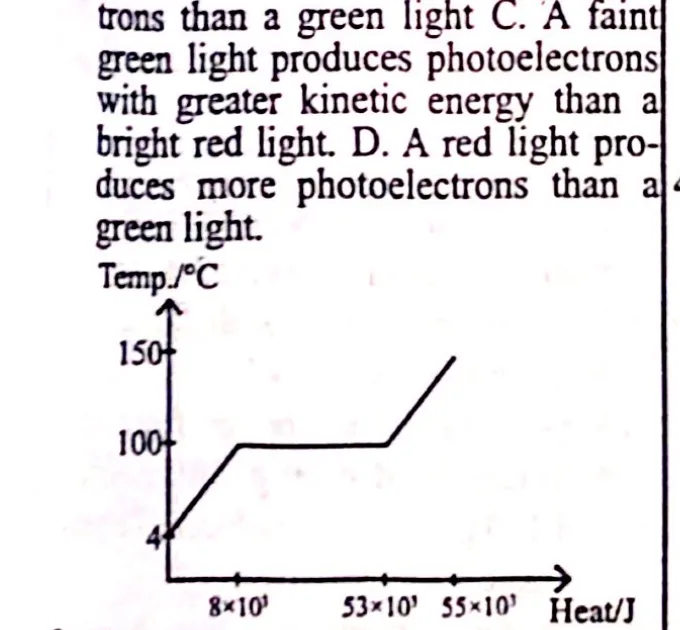
The sketched graph above illustrates the heating curve of a 0.02 kg of water. Estimate the specific latent heat of vapourization of water.
A. 2.25x10^6 J/kgCorrect
B. 4.17x10^3 J/kg
C. 2.00x10^3 J/kg
D. 1.00x10^3 J/kg
Explanation
From the given graph, the temperature remained constant from 8x10^3 J till 53x10^3 J, indicating the latent heat. Thus, q=(53x10^3)-(8x10^3)=45x10^3 J. Using q=ml, where l=latent heat of vapourization: l=(45x10^3)/0.02=2.25x10^6 J/kg.
In the hydraulic press, the force F applied is related to the diameter d of the cylinder by
A. F is proportional to d^2Correct
B. F is proportional to d
C. F is proportional to d^-1
D. F is proportional to d^-2
Explanation
In a hydraulic press, pressure transmission is constant: P=F/A=constant, so F=KA. F is proportional to A, and F is proportional to d^2 since A=(pi)d^2/4.
In an electric circuit, an inductor of inductance 0.5 H and resistance 50 ohm is connected to an alternating current source of frequency 60 Hz. Calculate the impedance of the circuit.
A. 50.0 ohm
B. 150.5 ohm
C. 195.0 ohmCorrect
D. 1950.1 ohm
Explanation
Given L=0.5H, R=50 ohm, f=60Hz, required Z=? Z=sqrt(R^2+XL^2), where XL=2(pi)fL=2(pi)x60x0.5=188.52 ohm. Z=sqrt(50^2+188.52^2)=sqrt(2500+35,539.6)=sqrt(38039.79)=195.04 ohm.
Which of the following statements correctly explains why a total solar eclipse would be seen by people on only a small portion of the earth surface?
A. The moon is larger in diameter than the earth
B. earth is larger in diameter than the sun
C. earth revolves around the sun
D. earth is larger in diameter than the moonCorrect
Explanation
This is because the earth is larger in diameter than the moon, so the moon's shadow only covers a small portion of the earth's surface during a total solar eclipse.
Water waves have a wavelength of 3.6 cm and speed of 18 cm/s in deep water. If the waves enter a shallow water with wavelength of 2.0 cm, calculate the speed of the waves in the shallow water.
A. 0.4 cm/s
B. 2.5 cm/s
C. 10.0 cm/sCorrect
D. 10.8 cm/s
Explanation
Given v1=18cm/s, lambda1=3.6cm, lambda2=2.0cm, v2=? Using n=v1/lambda1=v2/lambda2, v2=v1x(lambda2/lambda1)=18x(2.0/3.6)=10 cm/s.
An a.c. generator can be converted to a d.c. electric motor by replacing the
A. slip rings with a split ring and connecting a batteryCorrect
B. split ring with slip rings and connecting a battery
C. a.c. with d.c. source and connecting slip rings
D. a.c. source and connecting split rings
Explanation
An a.c. generator can be converted to a d.c. electric motor by replacing the slip rings in a.c. generators with a split ring (commutator) and connecting a battery.
A ray of light travels obliquely from a less dense medium to a denser medium. Which of the following statements is true about the light?
A. The wavelength of the light increases in the second medium
B. The speed of the light increases in the second medium
C. The light refracts towards the normalCorrect
D. There is a change in the frequency of the light
Explanation
When light travels from a less dense medium to a denser medium: the light refracts toward the normal; the wavelength of the light decreases in the second medium; the speed also decreases in the second medium; frequency remains unchanged.
An electron of mass 9.1x10^-31 kg is travelling at a speed of 2.0x10^6 m/s. Calculate the associated wavelength of the electron. [h=6.6x10^-34 J s]
A. 3.63x10^-10 mCorrect
B. 3.63x10^-8 m
C. 3.63x10^-7 m
D. 6.89x10^-4 m
Explanation
Given me=9.1x10^-31kg, v=2.0x10^6m/s, h=6.6x10^-34Js. Using the De-Broglie wavelength lambda=h/p, where p=momentum=mv: lambda=h/(mv)=6.6x10^-34/(9.1x10^-31 x 2x10^6)=3.63x10^-10 m.
Which of the following statements about the process of melting of a solid are true? I. The temperature of the solid will remain steady until melting starts. II. keep rising until melting starts. III. Remain steady as melting proceeds. IV. Keep rising as melting proceeds.
A. II and III onlyCorrect
B. III and IV only
C. I, II and III only
D. II, III and IV only
Explanation
During melting of a pure solid, the temperature keeps rising until melting starts (II), then remains steady (constant) as melting proceeds (III), matching the melting curve of a pure solid.
A diver steps off a diving platform 10 m above the water. If there is no air resistance during the fall, there will be a decrease in the diver's
A. gravitational potential energyCorrect
B. total mechanical energy
C. kinetic energy
D. momentum
Explanation
At the top of the diving platform, the total energy = gravitational potential energy = mgh (since the diver is at height h above the water). As the diver falls, the gravitational potential energy decreases as the height of fall decreases, being converted to kinetic energy; total mechanical energy remains conserved (no air resistance).
A luminous object is one that A. gives off dim blue-green light only in the dark. B. gives out light of its own. C. shines by reflected light only. D. glows only in the presence of light.
A. gives off dim blue-green light only in the dark
B. gives out light of its ownCorrect
C. shines by reflected light only
D. glows only in the presence of light
Explanation
A luminous object gives out light of its own. Non-luminous objects shine by reflected light.
Joule is not a fundamental unit; it is a derived unit. There are only seven (7) known fundamental units: mass (kg), length (m), time (s), temperature (K), current (A), amount of substance (mol) and luminous intensity (cd).
The vacuum between the double walls of a thermos flask reduces heat loss through
A. conduction and radiation
B. convection and conductionCorrect
C. radiation only
D. conduction only
Explanation
Heat loss by conduction is reduced by the vacuum, stopper, glass, cork and air spaces. Heat loss by convection is reduced by the vacuum, stopper and the trapped air spaces. Heat loss by radiation is reduced by the silvered glass walls. The vacuum specifically reduces heat loss through both conduction and convection.
In photoelectric effect, the number of electrons emitted per second from a metallic surface is proportional to the
A. intensity of the incident radiationCorrect
B. frequency of the incident radiation
C. energy of the incident radiation
D. work function of the metal
Explanation
In photoelectric effect, the number of electrons emitted per second from a metallic surface is proportional to the intensity of the incident radiation. Thus, a bright red light produces more photoelectrons per second than a faint red light.
When two cells of negligible internal resistances and equal e.m.f. denoted by E1 and E2 are connected in parallel, the combined e.m.f. E is given by
A. E = E1 + E2
B. 1/E = 1/E1 + 1/E2
C. E = E1 = E2Correct
D. E = E1/E2
Explanation
When two cells of negligible internal resistance and equal e.m.f. are connected in parallel, the combined e.m.f. E remains equal to the e.m.f. of each individual cell, i.e. E = E1 = E2.
Advertisement
Sign up free to unlock
Score tracking
Practice history
Saved questions
Progress dashboard
Personalized sessions
Weak-topic breakdown
…and/or go further with premium services and No Ads.